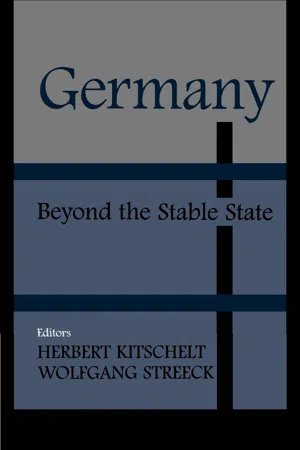
- 256 pages
- English
- ePUB (mobile friendly)
- Available on iOS & Android
eBook - ePub
About this book
From the 1960s to the 1980s, observers gave the name "Model Germany" to the Federal Republic. They saw in Germany a political-economic "model" that was able to weather many economic challenges. "Model Germany" permitted political competition, while coordinating public policy among interest associations and private businesses so that changes would only take place only in a balanced and positive way.
Since the early 1990s this "German Model" has faced serious troubles. Authors in this book describe its disintegration in the past decade and probe into the causes of this. Articles argue that it is Germany's national and European integration that has triggered the model's unravelling.
These processes are paralleled by tendencies in public opinion, social life styles, and political mobilization in parties, interest groups, and social movements. The strains of "model Germany" show up in the transformation of industrial relations, corporate governance structures, and social and immigration policies in Germany.
Information
PART I: NATIONAL UNIFICATION AND EUROPEAN INTEGRATION
German Unification and ‘Model Germany’: An Adventure in Institutional Conservatism
HELMUT WIESENTHAL
At first glance, Germany appears to have benefited extraordinarily from the collapse of East European communism. With the accession of the German Democratic Republic (GDR) to the Federal Republic of Germany (FRG) on 3 October 1990, Germany was able to overcome one painful result of its defeat in World War II: its split into two opposing parts along the front line of the Cold War. Moreover, reunification seemed to promise that West Germany would reinforce its already strong position among the world’s leading economies.
But a few years after unification it became apparent that the event hurt German economic performance more than it helped. From 1992 to 2002, Germany experienced growth rates below its annual increases in productivity, resulting in rising unemployment and the weakest economic performance overall among the European Union countries. While economic reform issues took centre-stage in the 1998 and 2002 German federal election campaigns, the Red-Green government achieved little tangible change. This was in large part due to the fact that the unification process had contributed both to the worsening of Germany’s economic performance and to political stalemate over economic reform. Failure to adapt to new challenges does not protect the status quo. Rather, it is likely to make the situation more painful.
In the process of unification, the transfer of Western political-economic institutions to post-socialist Eastern Germany took place just at a time when ‘model Germany’ was beginning to lose its capacity to deliver favourable economic outcomes, even in the Western heartland. To make matters worse, West German institutions were imposed on a social and economic fabric that lacked the organisational prerequisites to benefit from them. As a consequence, the transfer of institutions to Eastern Germany accelerated the crisis of the German model in the unified country.
This article addresses two questions. First, how and why did the process of unification negatively affect the nation’s ability to sustain the German model? Second, why have the problems and detrimental consequences of institutional transfer nevertheless made it harder rather than easier to reform key pillars of the model? This study will focus first on the macroeconomic dynamics of East Germany’s incorporation into the West. The fact that these dynamics made it harder for Eastern Germany to create microeconomic institutions and mechanisms like those in West Germany that would be able to sustain economic growth is discussed in the second section. Finally, Eastern German public opinion is opposed to any macro-and microeconomic reforms that might get Germany out of its predicament. The conclusion speculates that this leaves few options open for serious reform.
THE MACROECONOMICS OF GERMAN UNIFICATION
West Germany never relied on a counter-cyclical Keynesian fiscal policy, and especially not on demand-side deficit spending during periods of economic recession. The terms of unification, however, forced German economic policy-making into precisely that pattern.
Four general conditions shaped—if not over-determined—a post-socialist pathway of political-economic reform in the territory of the former German Democratic Republic that was unlike any chosen by neighbouring post-socialist countries. First, in terms of international security and power relations, Western elites perceived a fleeting window of opportunity to seize upon Gorbachev’s willingness to trade the GDR in for a new era of co-operation with the West. Asserting a ‘primacy of polities’ over mundane economic details, the Bonn government hurriedly closed a deal with the four World War II allied powers to make rapid unification possible. International security considerations caused the Kohl government to ignore the warnings by leading economists and opposition leaders that the costs of rapid unification would be very high. The speed of unification, in turn, left little room for social experiments and required that existing institutions be transferred to the new German Länder which had previously constituted the German Democratic Republic.
Second, initial uncertainties about East German support for the rapid absorption of the GDR into West Germany shaped the pathway of unification. In the autumn of 1989, neither the East German civil rights associations nor the small group of reformers within the Communist Party that would later refashion itself as the Party of Democratic Socialism (PDS) welcomed a ‘capitalist’ system. Instead, they preferred a modernised democratic socialist East Germany in an economic and political confederation with West Germany. West German politicians were able to overcome popular East German reservations by embedding unification into the process of deepening European integration. They also offered economic benefits to East Germans that would allow them to rapidly approach the standard of living enjoyed by West Germans. In this process, the memory of West Germany’s ‘miracle economy’ of the 1950s and 1960s served as a helpful myth, even though the preconditions—such as an undervalued currency or a rapidly expanding post-war world economy—were manifestly missing in the early 1990s. The Eastern elites’ principled aversion to unification was rendered ineffectual after the unequivocal popular pro-unity vote in the last GDR legislative election on 18 March 1990.
Third, the rapid speed and external West German control of the unification process came about as a result of the weakness of East German civil society and of nascent post-communist politics after 40 years of intense repression—which, since the 1960s, had not allowed dissidents to organise themselves in ways comparable to Hungary, Poland or Slovenia. Although some 20 East German civil action groups and organisations had been founded in the autumn of 1989, they played only a minor role in identifying and representing the citizens’ interests. As a consequence, the Bonn government was able to drive forward the process of unification as a transfer of West German institutions with virtually no serious opposition—especially after the March elections had awarded the East German affiliates of the major West German parties an overwhelming majority in both the legislative and executive branches of the GDR government. All aspects of reform—whether in the form of direct institutional adoption, as a consequence of extensive bargaining, or as market-driven change1—thus boiled down to the external governance of unification by the West German political and economic elite. However, this could only be made palatable to the East Germans by granting them comprehensive economic benefits and protection from the costs of economic and institutional transformation.
Fourth, Western electoral and political-economic interests drove the speed of the unification process. Only a high pace of unification would guarantee the governing Christian Democratic-Liberal coalition government the opportunity to time the all-German elections sufficiently early to take advantage of the initial popular enthusiasm and optimism before its costs and frictions could surface and lead to disenchantment.
Against the backdrop of these conditions, the implementation of pluralist democracy and a market economy in East Germany and the legal unification of the country occurred within the span of less than one year. Economic, monetary and social union (EMSU) took effect in July 1990. This secured the transfer of West Germany’s entire array of legal, social and economic institutions and became the framework for all subsequent regulations—in particular, the Unification Treaty, which resulted in the GDR’s formal accession to the Federal Republic of Germany.
Thus, from the very start, Eastern Germany benefited from a proven and complete institutional system that included a legal framework, a judicial system, administrative agencies and representational bodies. Neither the political institutions of the market economy, the demarcation of sub-national administrative jurisdictions and local self-government nor the political-economic frameworks of social insurance, industrial relations and economic interest representation had to be invented from scratch. In addition to the transfer of institutions, the new Länder had the extraordinary advantage of being able to draw on economic resources from the formerly West German and now all-German public budgets and social security funds.
In macroeconomic terms, the rapid integration of East Germany, with comprehensive economic protection, compensation and improvement of the population’s living standards, combined an extreme economic shock therapy with far-reaching insulation of the population from its consequences—in other words, with an anti-shock policy. Currency reform and privatisation were the shock element in the package. With the EMSU, the East German Mark was made equivalent to the western Deutsche Mark on a parity basis. Wages and transfer incomes were also fixed in a one-to-one relationship. This amounted to an overnight appreciation of the local currency by about 400 per cent, rendering almost all East German economic activity instantly uncompetitive with western products and services. Productivity levels in the east were estimated at only about 30 per cent of western levels, and thus far too low to meet the new labour costs faced by East German production units.
Although the purchasing power of the East Germans had quadrupled as a consequence of currency reform, there was popular pressure for further improvements. With the December 1990 all-German election approaching, the federal government succumbed to the temptation to promise interregional wage equalisation within five years, thus promoting unrealistic popular aspirations. The federal government generated expectations that later yielded an endemic problem of widespread popular dissatisfaction with the material results of subsequent economic developments.
The costs of shock therapy combined with anti-shock guarantees began to surface in the rapid tailspin of the East German economy that occurred throughout the 1990s. Growing imports, financed by huge income transfers from the west, caused the collapse of production in the east as well as a dramatic rise in unemployment.2 Meanwhile, the newly installed privatisation agency operated by West German restructuring experts—the Treuhandanstalt—rapidly dismantled the state-owned industrial conglomerates, gave them a legal corporate governance framework, and weaned them off soft credits in order to prepare them for privatisation. Many of these firms were forced to shrink dramatically or had to go out of business before or after privatisation. Even then, about half of the survivors had to be granted state subsidies for restructuring and new investments, at least in the early years. Overall, the gainfully employed labour force in Eastern Germany shrank from close to ten million in 1989 to barely six million within a couple of years. Employment in manufacturing nose-dived from close to 50 per cent of the total to under 20 per cent, thus undoing 50 years of industrialisation in less than three years.
The painful restructuring and shrinkage of the East German economy were followed by a giddy surge, with growth rates of up to eight per cent (from a low floor) in the 1992–95 period—mostly fuelled by a giant building boom aided by western public investments in infrastructure and residential renovation. But then, in the period between 1995 and 2000, the structural weakness of the new Länder economy asserted itself again, with sluggish growth rates of only about half of the already modest western levels. In 2001, the eastern economy shrank by 0.5 per cent. Even generous investment incentives had been unable to compensate for the comparative disadvantage inflicted on the eastern economy by EMSU. Because currency union had removed devaluation as an option to restore eastern competitiveness, East German firms could not cover the huge increase in wages and social contributions—which far exceeded productivity—through price increases or reductions in the cost of factor inputs.3 At the macroeconomic level, this produced extraordinarily high unemployment and a need for ever-higher fiscal transfers from West Germany, resulting in very large budget deficits. At the microeconomic level, federal and state governments were compelled to engage in industrial policy. The macro and microeconomic policies adopted in response to the eastern crisis were inconsistent with the practices that had traditionally been pursued under the auspices of the German model.
Soon after unification, unemployment in the east grew to a level twice as high as that of West Germany—not taking into account the substantial share of the former East German labour force that was sent into early retirement, had withdrawn from the labour market, or took part in public retraining programmes. At almost 20 per cent from 1996 on (23 per cent including hidden unemployment), East German rates exceeded those of all Central European countries. This extreme unemployment—resulting both from the wave of de-industrialisation and from higher labour market participation among East German women—constitutes Eastern Germany’s basic political-economic problem. On the one hand, the only proper way of improving the macroeconomic situation (technically speaking) is through lower wages, lower tax rates and more flexibility in the labour market and in state regulation. On the other hand, politicians in both the east and the west are experiencing strong pressure to call for the final closure of the remaining east-west income gap of 15 per cent. While Eastern German voters are demanding the full equalisation of all living conditions, economically sound policies lack sufficient public support. The much lamented consequences are the ongoing migration of skilled younger people4 and more than one million unoccupied apartments in the east.
In order to compensate for the extensive layoffs in industry and agriculture, huge transfer payments were directed to the east. Popular pressure demands that they continue until the GDP per capita approaches the western level. Meanwhile, labour productivity has risen to 78 per cent of the West German level but, due to high unemployment, eastern domestic production per capita remains at only two-thirds of the western level. Transfers and new debts of between 75 and 100 billion euros per annum finance East Germany’s high consumption. The ‘borrowed’ share of East Germany’s prosperity thus amounts to one-third of the total of investment and consumption. Cumulative total net financial transfers from the west between 1990 and 2002 reached 800 billion euros.5 Much of this was invested in subsidised employment—above all, in the still over-staffed public sector.
One striking indicator of over-staffing is the proportion of wage income to regional GDP. This amounts to 112 per cent of its western equivalent, even though the average eastern individual wage is only 77 per cent of the West German level.6 The most conspicuous consequence of East Germany’s sponsored prosperity is thus the escalation of public debt. As a percentage of total GDP, Germany’s state debt rose from 41.5 per cent in 1991 to 61.5 per cent in 1997. Correspondingly, interest payments increased from 11.4 per cent of the budget in 1991 to 18.9 per cent in 1999.7 In 2002 and 2003, the federal government was unable to confine the budget shortfall to the three per cent ceiling fixed in the EU Stability Pact. Since unification, German macroeconomic policy has developed a propensity towards persistent counter-cyclical deficit financing.
Is there no way out of this economic malaise? Now an integral part of Germany, the new Länder lack autonomous macroeconomic control. Because all the important variables are externally controlled, only regional wage levels remain available for intervention. Early on in the unification process, the suggestion that lower eastern wages would trigger migration to the west helped legitimise the high-wage policy of (western-controlled) trade unions and employers’ associations, although the underlying presumption lacked empirical evidence.8 Since then, because of electoral imperatives, parties and state governments have found it increasingly difficult to resist the pressure for inter-regional wage equalisation. Proposals to make wages match the low level of labour productivity definitely seem unfeasible.9 In 2002, the re-elected Red-Green coalition government promised a step-by-step equalisation of wages in the public sector until 2007—of c...
Table of contents
- Cover Page
- Books of Related Interest
- Title Page
- Copyright Page
- From Stability to Stagnation: Germany at the Beginning of the Twenty-First Century
- Part I: National Unification and European Integration
- Part II: Labour Markets, Life Styles and Political Preferences
- Part III: Reorganisation of State and Political Economy
- Abstracts
- Notes on Contributors
Trusted by 375,005 students
Access to over 1.5 million titles for a fair monthly price.
Study more efficiently using our study tools.
Frequently asked questions
Yes, you can cancel anytime from the Subscription tab in your account settings on the Perlego website. Your subscription will stay active until the end of your current billing period. Learn how to cancel your subscription
No, books cannot be downloaded as external files, such as PDFs, for use outside of Perlego. However, you can download books within the Perlego app for offline reading on mobile or tablet. Learn how to download books offline
Perlego offers two plans: Essential and Complete
- Essential is ideal for learners and professionals who enjoy exploring a wide range of subjects. Access the Essential Library with 800,000+ trusted titles and best-sellers across business, personal growth, and the humanities. Includes unlimited reading time and Standard Read Aloud voice.
- Complete: Perfect for advanced learners and researchers needing full, unrestricted access. Unlock 1.5M+ books across hundreds of subjects, including academic and specialized titles. The Complete Plan also includes advanced features like Premium Read Aloud and Research Assistant.
We are an online textbook subscription service, where you can get access to an entire online library for less than the price of a single book per month. With over 1.5 million books across 990+ topics, we’ve got you covered! Learn about our mission
Look out for the read-aloud symbol on your next book to see if you can listen to it. The read-aloud tool reads text aloud for you, highlighting the text as it is being read. You can pause it, speed it up and slow it down. Learn more about Read Aloud
Yes! You can use the Perlego app on both iOS and Android devices to read anytime, anywhere — even offline. Perfect for commutes or when you’re on the go.
Please note we cannot support devices running on iOS 13 and Android 7 or earlier. Learn more about using the app
Please note we cannot support devices running on iOS 13 and Android 7 or earlier. Learn more about using the app
Yes, you can access Germany by Herbert Kitschelt,Wolfgang Streeck in PDF and/or ePUB format, as well as other popular books in Politics & International Relations & International Relations. We have over 1.5 million books available in our catalogue for you to explore.