The Letter of Aristeas tells the story of how Ptolemy Philadelphus of Egypt commissioned seventy scholars to translate the Hebrew Bible into Greek.
Long accepted as a straightforward historical account of a cultural enterprise in Ptolemaic Alexandria, the Letter nevertheless poses serious interpretative problems. Sylvie Honigman argues that the Letter should not be regarded as history, but as a charter myth for diaspora Judaism. She expounds its generic affinities with other works on Jewish history from Ptolemaic Alexandria, and argues that the process of translation was simultaneously a process of establishing an authoritative text, comparable to the work on the text of Homer being carried out by contemporary Greek scholars.
The Letter of Aristeas is among the most intriguing literary productions of Ptolemaic Alexandria, and this is the first book-length study to be devoted to it.
eBook - ePub
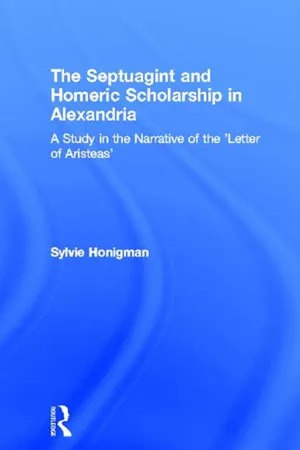
The Septuagint and Homeric Scholarship in Alexandria
A Study in the Narrative of the 'Letter of Aristeas'
- 224 pages
- English
- ePUB (mobile friendly)
- Available on iOS & Android
eBook - ePub
The Septuagint and Homeric Scholarship in Alexandria
A Study in the Narrative of the 'Letter of Aristeas'
About this book
Trusted by 375,005 students
Access to over 1.5 million titles for a fair monthly price.
Study more efficiently using our study tools.
Information
Subtopic
Ancient HistoryIndex
History1
INTRODUCTION
The work traditionally known as the Letter of Aristeas is not a letter at all. Its identification as a letter can be traced back to a fourteenth-century manuscript and no earlier.1 The mediaeval monk who was responsible for this denomination was no doubt led astray by the fact that the story is told in the first person. To make confusion even greater, the work opens with a personal address: the narrator is addressing a certain Philocrates, whom he calls his ‘brother’. However, the custom of dedicating a literary work to a nominal addressee was common in Graeco-Roman literature.2 This practice has nothing to do with epistolary formulae and, in fact, the work that concerns us here has none of the usual salutation formulae conventional in letters, both in their introduction and conclusion. Its length is also unusual for a letter – one of the few parallels that could be proposed of similar length, Alexander’s Letter to Aristotle about India is, in fact, a historical diegesis written in epistolary form.3
None of the ancient sources which mention our book refers to it as a letter. The author himself introduces his text as a diegesis (ch. 1), a term that simply indicates a prose account. Flavius Josephus4 calls it the Book of Aristaios. Epiphanius speaks of a syntagma, or ‘composition’, a term as vague as a diegesis. Eusebius refers to the book as On the Interpretation of the Law of the Jews.5
If our text is not a letter, then the traditional name by which it has been known in modern times is unsuitable. Of the ancient titles which are known to us, Josephus’ and Epiphanius’ are the most neutral. Josephus’ title will be the one adopted in the present study, with the proviso that the name of the (author)/narrator will conform to the spelling given by the document itself in its extant form. Werner Schmidt has argued on the basis of the extant testimonia that the original name was ‘Aristaios’, not ‘Aristeas’. The latter distortion was due to the influence of the name ‘Andreas’ which appears together with it in chs 19, 40 and 43.6 This conclusion would be plausible if our author were unknown. However, Oswyn Murray’s hypothesis that our author is identical with the Aristeas who was author of a work ‘On the Jews’, referred to by Alexander Polyhistor, is no less seductive.7 Thus, keeping to the now traditional name, ‘Aristeas’ will be a way of not choosing between the two spelling possibilities, ‘Aristeas’ and ‘Aristaios’. We shall speak of the Book of Aristeas and use the abbreviation B.Ar. throughout the forthcoming pages.
A further problem concerns the name by which we should refer to the author of B.Ar. The label ‘Pseudo-Aristeas’ often used to refer to him is inappropriate, especially if we accept the opinion shared by most scholars that our author is otherwise unknown.8 If this is indeed the case, there is no Aristeas (or Aristaios) to whom to refer a Pseudo-Aristeas (or Aristaios). But even if we do accept the link with the historical Aristeas, Oswyn Murray has noted that the author ‘was inventing himself, not impersonating another.’9 The pseudo form is therefore not suitable in this case either. There is no reason, either, to confuse the author with the narrator by calling him ‘Aristeas’/‘Aristaios’. It will be best to resort to admittedly clumsy but at least neutral denominations such as ‘the author of B.Ar.’.
Three things only are certain about our author, all derived from internal analysis of the text. To begin with, the content makes it clear that the author was Jewish. The verbal reminiscences of the Septuagint found in B.Ar. are unthinkable for a non-Jewish author in Ptolemaic times.10 Second, there can be no doubt that the author lived after the period of Ptolemy II, the time in which his story is set. How long after, however, is still debated. The only two safe landmarks we have are, on the one hand, clues in the text that the author was not an eyewitness, but wrote at least one or two generations later. In chs 28 and 182, the narrator speaks of ‘these kings’ (tois basileusi toutois). This locates our author under Ptolemy III (246–222) or IV (222/1–205) at the earliest, but does not preclude a later date. At the other end of the spectrum, a terminus ante quem is provided by Josephus’ paraphrase of B.Ar. in AJ 12.12–118, a work written about 90 CE. All possible solutions in between have been argued for in modern studies. Third, the place of composition must be Alexandria. The text is pervaded with royal Ptolemaic ideology related to the Alexandrian library, as will be made clear below (especially in Chapters 3 and 6). Furthermore, as will be argued in more detail in Chapter 4, the author makes fairly accurate use of technical vocabulary relating to institutions peculiar to Ptolemaic Egypt, while the description of Jerusalem is idealized and broadly fictional. Our author was clearly more familiar with Alexandria than with Jerusalem.
The narrator in B.Ar., as distinct from the author, is a court official of Ptolemy II Philadelphus (285/2–246 BCE). In his account he tells of his embassy to the High Priest Eleazar in Judaea. He was allegedly sent there by Ptolemy, together with another ambassador, Andreas, in order to bring back an authoritative scroll of the Law of the Jews from Jerusalem to Alexandria. The King wished to have a translation into Greek based on a reliable version. B.Ar. is thus one of the oldest – in fact probably the oldest – source that tells us about the origins of the LXX.
Understandably, the work was very popular in Antiquity, first among Hellenized Jews (Philo probably and Josephus certainly knew it and made use of it in their own writings) and later among the Fathers of the Church. We have no means of reconstructing the early oral tradition about the translation of the LXX that must have circulated among Alexandrian Jews from shortly after its completion, and therefore cannot know to what extent B.Ar. followed or modified it. At any rate, the story of the translation is told in B.Ar. in a manner which is both relatively sober and strictly rationalized. Only in subsequent versions does the story appear embellished with miraculous elements designed to confirm the divine character of the translation, and hence the divine nature of the LXX. This process is already discernible in Philo. In its literary form at least, the story thus seems to have taken on an increasingly legendary guise, and it may already have been like this at an early stage in the version that was circulated orally. Even though B.Ar. itself no longer met the need for the marvellous felt in popular circles, the importance of this text did not diminish with time. Although it was not included in the Christian canon, it was inserted into the Byzantine Bible, and in 1471 into the first printed Latin Bible, as an introduction recording the history of the sacred text.
In more modern times B.Ar. underwent a dramatic reversal of fortune. Luis Vives in 1522 and Humphrey Hody in 1684 demonstrated that the author of B.Ar. was not the non-Jewish Greek eyewitness he purported to be, but must have been a Jew who, moreover, must have lived after the events he related.11 Once the ‘forger’ had been ‘unmasked’, B.Ar. was regarded with general suspicion and its value as historical evidence for the origins of the Septuagint was severely undermined. The intellectual context of the time certainly played against B.Ar. The Bible itself was by then coming under sharp re-examination. Doubts were being raised as to whether Moses really was the author of the whole Pentateuch. As is well known, the questions raised in this period of intellectual inquiry were the beginning of modern critical study of the Bible, with devastating consequences in the realm of religious belief in Western Europe. Being caught out as a ‘liar’, as B.Ar.’s author was now called, was no small matter in sixteenth- and seventeenth-century Western Europe, especially since B.Ar. had close connections with the Greek Bible.12 The credit enjoyed by B.Ar. was now, therefore, at its lowest ebb.
The fate of B.Ar. in the nineteenth and twentieth centuries shows a curious blend of interest and suspicion. This work continued to be at the centre of scholarly interest, especially but not exclusively among LXX exegetes and theologians. The bibliography on it is very large – even if we discount the one or two much vexed issues that elicited huge discussions, such as the date of composition. At the same time, the low esteem in which the work had been held ever since Vives and Hody persisted. Unavoidably, suspicions of B.Ar. had practical consequences for the way scholars reconstructed the early history of the LXX. No longer bound by the version given in B.Ar., they felt free to take as their sole guide ‘common sense’ and personal credo. This was all the easier since virtually no other sources were available on the matter besides B.Ar. A new consensus crystallized on the origins of the LXX, stating that the translation ‘must’ have been initiated by the Jews themselves, not by a Ptolemaic king, ‘since’ ‘only’ Jews would be concerned to have their Law translated into the vernacular. The involvement of the king in B.Ar.’s version was deemed an unhistorical detail inserted in the story for apologetic reasons.13 B.Ar. was accordingly classified as apologetic literature – an opinion consistent with the definition of its author as a ‘liar’, or at best as non-serious.14
However, at the same time as the question of the historical reliability of B.Ar. was considered as settled – in the negative – as far as the origins of the LXX were concerned, the debate over the historical reliability of the text still raged around the realia that appear in it, either in the context of Ptolemaic Egypt or of Palestine.15 To this day, B.Ar. is regularly quoted in academic studies as evidence for the arrival of Jews in Egypt as slaves, on the basis of chs 12–14, and as evidence for Jerusalem in archaeological studies (chs 83–106). These are only the sections most often quoted in modern scholarship – there are many others.16 This dichotomy in the treatment of B.Ar. – dismissal of the central narrative on the one hand, and the use of specific details arbitrarily fished out of their context as raw material for historical reconstruction on the other – stems from a confusion between the notions of plausibility – modern plausibility – and historical reliability. In the case of the description of Jerusalem, reference to B.Ar. as a reliable source is clearly based on a confusion between eyewitness experience and reliable report. Not so long ago, scholars still debated as to whether the author of B.Ar. had made a journey or pilgrimage to Jerusalem, as if this could solve the issue of the value of his account from an archaeological point of view.17 It is, however, doubtful whether this dichotomy of treatment is justifiable. The use of specific sections of B.Ar. as historical evidence ignores the intention of the author in presenting the facts as he does. In other words, it ignores the literary dimension of the text.
In recent years there has been a shift in approach. More scholars are ready to accept the version of B.Ar. regarding the origins of the LXX, with a few adjustments. This new attitude is, of course, consistent with the wider trend towards thorough reappraisal of previous readings of ancient texts which is currently affecting the field of Classical studies as a whole. The prevailing trend is to accept that the initiative for the translation came from the Ptolemaic court, as it says in B.Ar., and not from the Jewish community itself. That is, the first part of B.Ar.’s version is being rehabilitated.18 However, scholars, especially LXX students, are still reluctant to accept the second part, namely, that the translation was ordered for the royal library of Alexandria. They still infer that B.Ar. was written to benefit the Jews, undeterred by the fact that the text is absolutely silent on this motive. All it says is that Ptolemy wished to show favour to the Jews by ordering a translation of their Law (ch. 38), but this is presented as a side-effect of the main purpose, which is to provide his Library with the book.19 For a work usually deemed apologetic, this omission of the motive would be rather puzzling. However, scholars generally do not appear to feel the need to address this problem. Thus Dominique Barthélemy spoke of a ‘twofold result’:20 the King got a book for his library and a Law for the Jews. Only very recently have scholars begun to accept B.Ar.’s version in its entirety. Thus, after Dorival’s hesitant discussion, Wolfgang Orth and Tessa Rajak have argued assertively that the LXX made its way into the library.21 Orth typically argues with previous opinions on the basis of long-familiar sources only, making it clear that the interpretation of the sources is subjective and influenced by the status quaestionis of broader issues. These last studies thus take the psychological leap that most LXX exegetes, brought up on the view that the translation of the Bible into Greek was an exceptional event, are still reluctant to take: they ‘normalize’ the event by inscribing it in the broader context of Ptolemaic society.
Unfortunately, the general reappraisal of B.Ar. that is currently under way is not always based on a reading of the sources which is as critical as one would like. Dorival, for instance, sketched a historical reconstruction of the circumstances of the translation based on an acceptance not only of B.Ar.’s version, but also on later patristic sources which ascribe the initiative to Ptolemy I, not II. Thus, according to Dorival, Ptolemy I initiated the translation at Demetrius’ instigation, and Ptolemy II integrated it in his judicial reform as a law for the Jews.22 This attempt to reconcile ancient Jewish and Christian viewpoints may be praiseworthy on other grounds, but it overlooks the basic principles of source criticism. Orth’s argument basically reflects a change in attitude.
The various methodological flaws just emphasized are largely the outcome of the fact that studies dealing with B.Ar. address one question at a time, neglecting other aspects liable to affect the conclusions reached. The only way to tackle the issue of the historical reliability of B.Ar. for any given topic, whether it be the early history of the LXX or th...
Table of contents
- Front Cover
- Half Title
- Title Page
- Copyright
- Dedication
- Contents
- Preface and acknowledgements
- List of abbreviations
- 1 Introduction
- 2 Genre and composition in the Book of Aristeas
- 3 The central narrative: the transfiguration of history into charter myth
- 4 Enforcing the narrative veracity: the rhetoric of historiography in the Book of Aristeas
- 5 The origins and early history of the LXX: guidelines for a reconstruction of the past
- 6 The Homeric paradigm: a hypothesis on the genesis of the LXX and the Book of Aristeas
- 7 Conclusion: the Book of Aristeas between two worlds
- Appendix: outline of the composition of the Book of Aristeas
- Notes
- Selected bibliography
- Index of sources
- General index
Frequently asked questions
Yes, you can cancel anytime from the Subscription tab in your account settings on the Perlego website. Your subscription will stay active until the end of your current billing period. Learn how to cancel your subscription
No, books cannot be downloaded as external files, such as PDFs, for use outside of Perlego. However, you can download books within the Perlego app for offline reading on mobile or tablet. Learn how to download books offline
Perlego offers two plans: Essential and Complete
- Essential is ideal for learners and professionals who enjoy exploring a wide range of subjects. Access the Essential Library with 800,000+ trusted titles and best-sellers across business, personal growth, and the humanities. Includes unlimited reading time and Standard Read Aloud voice.
- Complete: Perfect for advanced learners and researchers needing full, unrestricted access. Unlock 1.5M+ books across hundreds of subjects, including academic and specialized titles. The Complete Plan also includes advanced features like Premium Read Aloud and Research Assistant.
We are an online textbook subscription service, where you can get access to an entire online library for less than the price of a single book per month. With over 1.5 million books across 990+ topics, we’ve got you covered! Learn about our mission
Look out for the read-aloud symbol on your next book to see if you can listen to it. The read-aloud tool reads text aloud for you, highlighting the text as it is being read. You can pause it, speed it up and slow it down. Learn more about Read Aloud
Yes! You can use the Perlego app on both iOS and Android devices to read anytime, anywhere — even offline. Perfect for commutes or when you’re on the go.
Please note we cannot support devices running on iOS 13 and Android 7 or earlier. Learn more about using the app
Please note we cannot support devices running on iOS 13 and Android 7 or earlier. Learn more about using the app
Yes, you can access The Septuagint and Homeric Scholarship in Alexandria by Sylvie Honigman in PDF and/or ePUB format, as well as other popular books in History & Ancient History. We have over 1.5 million books available in our catalogue for you to explore.