eBook - ePub
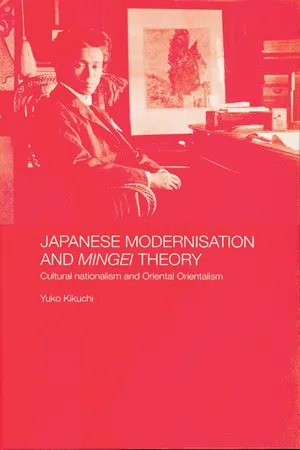
Japanese Modernisation and Mingei Theory
Cultural Nationalism and Oriental Orientalism
- 328 pages
- English
- ePUB (mobile friendly)
- Available on iOS & Android
eBook - ePub
About this book
Conceptualised in 1920s Japan by Yanagi Sôetsu, the Mingei movement has spread world wide since the 1950s, creating phenomena as diverse as Mingei museums, Mingei connoisseurs and collectors, Mingei shops and Mingei restaurants. The theory, at its core and its adaptation by Bernard Leach, has long been an influential 'Oriental' aesthetic for studio craft artists in the West. But why did Mingei become so particularly influential to a western audience? And could the 'Orientalness' perceived in Mingei theory be nothing more than a myth? This richly illustrated work offers controversial new evidence through its cross-cultural examination of a wide range of materials in Japanese, English, Korean and Chinese, bringing about startling new conclusions concerning Japanese modernization and cultural authenticity. This new interpretation of the Mingei movement will appeal to scholars of Japanese art history as well as those with interests in cultural identity in non-Western cultures.
Information
1 Orientalism
The foundation of Mingei theory
Yanagi’s claims to originality
One of the significant problems which has existed in the academic study of Mingei theory is the lack of comparative studies and historical contextualisation. Mingei theory has escaped critical assessment, which has been largely due to Yanagi’s claim to the originality of Mingei theory and his description of its formation. Neither the question of the originality nor the formation of Mingei theory have been adequately examined or subjected to critical assessment.
Yanagi Sōetsu, a great self-publicist, strongly emphasised the originality of his Mingei theory in his many writings. He repeatedly claimed the value of his chance discoveries, his originality and the independence of his theory from any precedents, including the practices of the Japanese tea masters, the English Arts and Crafts ideas pioneered by John Ruskin and William Morris, and European Modernists’ ideas which include ideas in common with Mingei theory.
In Kōgei no Michi (The Way of Crafts): ‘Kōgei Biron no Senkusha ni tsuite’ (About the Predecessors of Crafts Aesthetics) published in 1927, for example, Yanagi acknowledged Ōkuma’s book, published in the same year, as having given him information about Ruskin and Morris, but claimed that his ideas were original and owed nothing at all to Ruskin and Morris:
I am extremely isolated in my ideas on the beauty of crafts. Fortunately or unfortunately I owe hardly anything to those who came before me. The incredible crafts themselves taught me … Looking back over the history of aesthetics on the beauty of crafts, I reached the conclusion that there were two types of predecessors,1 though I had never directly connected myself with any of those people when I constructed my own theory … Until very recently I knew very little about Ruskin and Morris. I would like to express my appreciation to Mr Ōkuma Nobuyuki for the recent publication of his book titled Shakai Shisōka toshiteno Rasukin to Morisu (Ruskin and Morris as Social Theorists), which increased my knowledge of Ruskin and Morris.2
In the preface to a later text, Kōgei Bunka (Craft Culture) in 1942, Yanagi repeated his claim that Japanese ideas on the Mingei movement were original and independent of Western ideas.
Our activities in the field of craft have been known as the ‘Mingei movement’ and what we are most proud of is the fact that it was conceived in Japan, not initiated by foreign ideas. We took note of existing attitudes in the West toward crafts, but we did not find anything useful. So, our ideas are totally original and contain no trace of imitation. It is very significant that we create our own original path, even if it is premature, given that at present the fields of current thoughts and crafts are slavishly following after the West. We Japanese have to bear the torchlight now to lead, one step ahead of them.3
In another article titled ‘Mingei Undō wa Nani o Kiyoshitaka’ (What the Mingei Movement Contributed) published in 1946, he emphasised the casual nature of Ruskin’s and Morris’s approach and the lack of sophistication of their findings:
Currently our activities are considered as a movement, but in the beginning we did not have any clear intention of bringing the matter up in this way. We established neither an ‘ism’ nor did we criticise beauty using an ‘ism’. Instead we started incredibly simply. In fact, we did not have any theory at first. We just looked directly at the crafts themselves, and were dazzled by them. That was the start. With hindsight, I feel this start, whereby we looked at the thing itself, was fortunate for us.4
It is generally understood, from Yanagi’s writings, that his interest in mingei dated from his first trip to Korea in 1916 with a sudden interest in Korean crafts, which extended to mokujikibutsu (wooden statues of Buddha carved by Mokujiki Shōnin).5 This trip led not only to the establishment of the Korean Folk-arts Gallery in 1924 but interest in Korean crafts led to the coining of the term mingei by Yanagi, Kawai and Hamada in 1925 when they were travelling to see mokujikibutsu.6 By 1927, Yanagi’s interest in and his aesthetic theory relating to getemono (common household handicrafts) had gradually developed and eventually contributed to the Mingei movement:
When I travelled to Korea in 1916 in order to visit my sister there, I met Asakawa Yoshitaka and Takumi who helped to build my interest in and empathy for Korean artefacts. From then on, I was attracted by artefacts of the Yi period and visited Korea several times to purchase various things from my limited budget …7 In New Year 1924, I went to Kōfu with Asakawa Takumi to visit Mr Komiyama Seizō, just to see artefacts of the Yi period. There I unexpectedly came across mokujikibutsu which was a form of art I had never thought of.… Because of this incident, I started to study Mokujiki Shōnin and travelled all over Japan, tracing the route Mokujiki Shōnin travelled.… Then while I was travelling, I became aware of the local handicrafts of this period.8 This trip gave me a chance to see the situation of the handicrafts of Japan.9
Statements of this kind have underpinned the belief that in the formation of Yanagi’s Mingei theory the first impetus was Korea, and that he had neither interactions with the social and historical climate of the period nor inspirations from the ideas of Ruskin and Morris.
Critics such as Mizuo Hiroshi, Tonomura Kichinosuke, Jugaku Bunshō and Yamamoto Shōzō took Yanagi’s statement at face value and strongly supported his claim that Mingei theory was an original Japanese aesthetic theory. Their views are well represented by the two articles ‘Yanagi Sōetsu to Wiriamu Morisu’ (Yanagi Sōetsu and William Morris) by Tonomura10 and ‘Futatsu no Kōgeiron: Morisu to Yanagi Sōetsu’ (Two Craft Theories: Morris and Yanagi) by Jugaku.11 Tonomura defended Yanagi by writing that although there appeared to be similarities in Yanagi’s and Morris’s work, this was not the case and he pointed out the superiority of Yanagi’s spiritual quality compared with Morris’s superficiality. Jugaku took Yanagi’s originality for granted, not questioning Yanagi’s own words. He admired what he saw as Yanagi’s more profound, correct and acute ideas and considered them superior to those of Morris whom he considered to be an ‘unfortunate craftsman’, ‘aesthetic romanticist’ and ‘dreamer of dreams’. These strongly nationalistic opinions encouraged many more uncritical admirers to promote the idea in Japan and elsewhere that Yanagi was a pioneer of this kind of crafts movement. The problem here is that these critics did not contextualise Mingei theory.
Up to now, this uncritical appraisal by the so-called Mingei-ha (Mingei School Faction) has been in the mainstream and Yanagi’s claims have not been seriously questioned. However after 1976 when Tsurumi Shunsuke’s biography of Yanagi Sōetsu was published,12 probably the first critical study by an ‘outsider’, some critical research began to appear. This includes Okamura Kichiemon’s studies13 on the early Mingei movement, Idekawa Naoki’s analysis of Mingei theory,14 Takasaki Sōji’s cross-cultural examination regarding Yanagi’s involvement in Korea,15 Brian Moeran’s anthropological studies on a pottery village and comparative studies with English Arts and Crafts ideas,16 Ajioka Chiaki’s PhD thesis17 contextualising Mingei theory in the modern Japanese design movements, and Lisbeth Brandt’s PhD thesis on the Mingei movement in relation to Japanese modern culture and national identity.18
To develop further the critical assessment of Yanagi’s achievements these few critical studies have pioneered a deeper examination of Mingei theory in the context of Japanese history and culture. An examination of a crosscultural milieu of modern ideas and visual objects is required in order to avoid any hint of making dogmatic assertions outside of context. I shall therefore begin by examining Yanagi’s biographical and educational background to trace his early interests during the period 1907 to 1910, when he was at high school.
The Oriental-Occidental hybrid of philosophy and religion
Yanagi’s interest in pseudo-science and new Buddhism
Yanagi went to the high school, Gakushūin Kōtōka, Peers’ school, where he met his lifelong friends of the Shirakaba (White Birch) group.19 They were liberal idealistic young intellectuals who opposed militarism and aristocratic feudalism, taking Tolstoyan idealism and individualism as their guiding principle. Because of this, they did not get along with Gakushūin authorities, particularly General Nogi who was both the principal of Gakushūin at that time and a general in the Japanese Army. However at this school Yanagi encountered three teachers who influenced him greatly. Hattori Tanosuke, who was ‘personally the most influential teacher’,20 was one of them. Hattori was a Christian and a botanist, specialising in insectivorous plants. He not only taught him the English language but also religion and ethics through such authors as Beecher Stowe, John Milton, John Bunyan, Ralph Waldo Emerson and Henry David Thoreau. Shiga and Yanagi were frequent visitors to Hattori’s house and most of these authors were read there. They also walked often together to Mount Akagi to experience the virgin wilderness. Thoreau’s Walden, which, next to the Bible was Hattori’s favourite book, deeply influenced them on these occasions. Yanagi’s interest in the laws and philosophy of nature was also inspired by Maurice Maeterlinck, a Belgian poet and playwright to whose work he was also introduced by Hattori.
Hattori satisfied Yanagi’s intellectual curiosity regarding questions about body and soul, life and death, and psychic phenomena such as supernaturalism. No satisfactory answers were provided for these questions by the official education in Gakushūin, which emphasised ‘dry’21 science and social science. Yanagi’s youthful intellectual quest resulted in his first book titled Kagaku to Jinsei (Science and Life) published in 1911 at the age of twentytwo. This book is an account of four ‘scientific’ books which impressed him. It consists of two parts; Part One, titled Atarashiki Kagaku (The New Science) which had already been published in 1910 in Shirakaba and Part Two, titled Mechinikofu no Kagakuteki Jinseikan (The Scientific Life of Metchnikoff). Part One mainly introduces two books, After Death–What? by Cesare Lombroso and The Survival of Man by Sir Oliver Lodge, who were both members of the British Society for Psychical Research. Yanagi wrote about the supernatural phenomena which had been recorded and subjected to scientific experiments in the Occident, and which included such things as the transposition of the senses, telepathy, clairvoyance, premonition and automatic writing in trance. Yanagi’s intentions were both to emphasise that human spirituality was as significant as physicality, and to introduce a ‘new science’ which took a scientific and optimistic approach to the psyche of human beings. It seems clear that Yanagi was searching for a spiritual alternative to ‘dry’ science and it was this ‘new science’ which paved the way to Yanagi’s solution to the relationship between body and soul.
What Yanagi called ‘new science’ at that time appears to be what is now called occultism. Occultism saw a phenomenal boom in Europe from the late nineteenth century. Reflecting the cul-de-sac situation of the historical ideology of ‘rationalism’, various pseudo-scientific occult movements were led by such people as E. P. Blavatsky who founded Theosophy and Rudolf Steiner who founded Anthroposophy.22 Interestingly, Roger Fry whose Modernist aesthetic became an influence on Yanagi later, was also an enthusiast of psychic phenomena. Virginia Woolf wrote about Fry’s attendance at the Psychical Research Society and his letter to his mother reported the heated discussions on Mrs Piper’s revelations as well as his own experiments in haunted houses to search for the ‘spirits’ in ‘luminiferous aether’.23 In Japan, too, Yanagi was not alone in this interest in occultism. Tsurumi examined the sudden frenzied popular belief in occultism and supernaturalism which reflected the frustration and uncertainty of the people on whom reparations had been imposed even after the victory of the Russo-Japanese War.24 In 1910, the same year as Yanagi’s publication of Kagaku to Jinsei, the newspapers were also enthusiastically featuring people with supposed supernatural powers, like Mifune Chizuko who claimed to have senrigan (clairvoyance). It has sometimes been postulated that Yanagi div...
Table of contents
- Cover
- Halftitle
- Title
- Copyright
- Contents
- List of figures
- Acknowledgements
- Author’s note
- Introduction
- 1 Orientalism: the foundation of Mingei theory
- 2 Appropriation of Orientalism
- 3 ‘Oriental Orientalism’
- 4 Reverse Orientalism: the development of Mingei theory into national and international Modernism
- Conclusion
- Notes
- Bibliography
- Index
Trusted by 375,005 students
Access to over 1.5 million titles for a fair monthly price.
Study more efficiently using our study tools.
Frequently asked questions
Yes, you can cancel anytime from the Subscription tab in your account settings on the Perlego website. Your subscription will stay active until the end of your current billing period. Learn how to cancel your subscription
No, books cannot be downloaded as external files, such as PDFs, for use outside of Perlego. However, you can download books within the Perlego app for offline reading on mobile or tablet. Learn how to download books offline
Perlego offers two plans: Essential and Complete
- Essential is ideal for learners and professionals who enjoy exploring a wide range of subjects. Access the Essential Library with 800,000+ trusted titles and best-sellers across business, personal growth, and the humanities. Includes unlimited reading time and Standard Read Aloud voice.
- Complete: Perfect for advanced learners and researchers needing full, unrestricted access. Unlock 1.5M+ books across hundreds of subjects, including academic and specialized titles. The Complete Plan also includes advanced features like Premium Read Aloud and Research Assistant.
We are an online textbook subscription service, where you can get access to an entire online library for less than the price of a single book per month. With over 1.5 million books across 990+ topics, we’ve got you covered! Learn about our mission
Look out for the read-aloud symbol on your next book to see if you can listen to it. The read-aloud tool reads text aloud for you, highlighting the text as it is being read. You can pause it, speed it up and slow it down. Learn more about Read Aloud
Yes! You can use the Perlego app on both iOS and Android devices to read anytime, anywhere — even offline. Perfect for commutes or when you’re on the go.
Please note we cannot support devices running on iOS 13 and Android 7 or earlier. Learn more about using the app
Please note we cannot support devices running on iOS 13 and Android 7 or earlier. Learn more about using the app
Yes, you can access Japanese Modernisation and Mingei Theory by Yuko Kikuchi in PDF and/or ePUB format, as well as other popular books in Social Sciences & Cultural & Social Anthropology. We have over 1.5 million books available in our catalogue for you to explore.