From the traditional stereotyped viewpoint, femininity and technology clash. This negative association between women and technology is one of the features of the sex-typing of jobs. Men are seen as technically competent and creative; women are seen as incompetent, suited only to work with machines that have been made and maintained by men. Men identify themselves with technology, and technology is identified with masculinity. The relationship between technology, technological change and women's work is, however, very complex.; Through studies examining technological change and the sexual division of labour, this book traces the origins of the segregation between women's work and men's work and sheds light on the complicated relationship between work and technology. Drawing on research from a number of European countries England, Sweden, Denmark and the Netherlands, international contributors present detailed studies on women's work spanning two centuries. The chapters deal with a variety of work environments - office work, textiles and pottery, food production, civil service and cotton and wool industries.; This work rejects the idea that women were mainly employed as unskilled labour in the industrial revolutions, asserting that skill was required from the women, but that both the historical record about women's work and the social construction of the concept of "skill" have denied this.
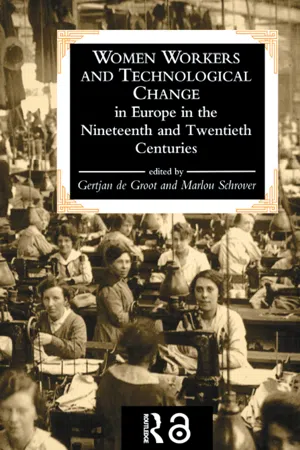
eBook - ePub
Women Workers And Technological Change In Europe In The Nineteenth And twentieth century
- 214 pages
- English
- ePUB (mobile friendly)
- Available on iOS & Android
eBook - ePub
Women Workers And Technological Change In Europe In The Nineteenth And twentieth century
About this book
Chapter 1 General Introduction
DOI: 10.4324/9780203991084-1
From the traditional stereotyped viewpoint, femininity and technology clash. Men are traditionally seen as technically competent and creative. Women are seen as incompetent – suited only to work with machines that have been made and are maintained by men. Women use machines, in the home or at work, but are depicted as depending on men as soon as the machinery falters. This negative association between women and technology is one of the features of the sex-typing of jobs. Technological insight has partly replaced strength as a segregative concept, since the advent of the machine era. Men identify themselves with technology, and technology is identified with masculinity. 1 The masculine image of technology is reserved for certain types of technology. Sewing and knitting, requiring knowledge, training and sometimes the use of machines, do not have a technological ‘ring’. Moreover, technical competence is part of the male gender identity, but not part of each man’s identity. Furthermore, it is class-related. In the lower classes men are expected to be knowledgeable about car mechanics. The higher classes take their cars to the garage.
Technological change is commonly seen as leading to deskilling, opening up possibilities for the replacement of men by women. 2 The relationship between technology, technological change and women’s work is complicated. If the concepts ‘skill’ and ‘technology’ are regarded critically, this relationship becomes even more complicated. These concepts have been widely used to describe, explain and justify the segregation of work. Studies in this book show that, on the micro level, the interaction between women’s work and technological change is much more complex than has hitherto been recognized. The impact of technological change on women’s work cannot be generalized. It needs to be examined at the level of individual industries and individual innovations. 3
This book sheds light on the complicated relationship between work and technology through studies at micro level, examining technological change and its consequences in their social settings. Focusing on specific developments helps to trace the origins of gendering. Technology as such does not determine anything, but its introduction, and the social setting in which it is introduced, do. Technological change can lead to the regendering of existing work, to the disappearance of work, or to the creation of new work. We argue that technological change facilitates the regendering of work. It does not necessarily cause it, but without it regendering seldom occurs. Specific historical and social settings may lead to the gendering of certain techniques, and thus to the creation or abolition of women’s work, which may find its repercussions in completely different historical and social settings. Developments in England, with its early industrialization, are contrasted with those in Sweden, Denmark and the Netherlands, where industrialization took off much later.
The textile industry is the traditional field for studying the gendering of work. The idea that the segregation into men’s work and women’s work was passed on from the cottage system to the factory stems from this field. In this book, Harriet Bradley describes the work of women in the British textile industry; Marianne Rostgård does so for Denmark, and Gertjan de Groot for the Netherlands. Office work is a field now strongly dominated by women. Typing was, however, not women’s work from the start. Meta Zimmeck shows that it was first allocated to men and boys, then to boys only and finally to women and girls. In pottery, ‘skill’ is not the only concept used for segregating work between the genders: ‘strength’ and ‘health risk’ may also be used to justify it. Jacqueline Sarsby writes on the pottery industry in England, and Ulla Wikander on that in Sweden. During the First World War, there were rapid changes in the nature of women’s employment. Deborah Thom shows that, in England, this did not lead to a permanent modification of ideas about segregation, although it did prove that changes were possible if enforced. Women played an important role in the production of food, both for the family and for the market. The nineteenth century saw radical changes in this field, with the industrialization of food production and the rise of new industries. Women ought to have had a head start as far as ‘skills’ were concerned. In an attempt to explain women’s place in these industries, Lena Sommestad looks at Sweden, and Marlou Schrover at the Netherlands.
Although skill and technology are important concepts in the explanation of the segregation between men’s work and women’s work, there are many other factors to which the segregation can be attributed. 4 Waged work is sharply differentiated along gender lines. Men’s work in one region can be women’s work in another, but in virtually all cases there is a clear distinction between ‘men’s work’ and ‘women’s work’. 5 According to Phillips and Taylor, sexual demarcations were rigidly maintained, even when men and women worked in the same industry. 6 Although this is true, demarcation lines were not inflexible over time, and differences were often minute, as the studies in this book show. Bradley, for instance, describes how in hosiery women worked the smaller specialized machines, and men the larger ones. Rostgard shows that in the Danish textile industry there was hardly any difference between male tacklers and female twisters, except for the name.
Cheap Labour
An important reason for employers to hire women was that they were cheaper than men. Low wages were, however, never the only reason for employing women. Most occupations were gender-segregated, at least for a single time and place. There was little possibility of substituting female for male workers as wage differences changed, unless there were other contiguous changes. 7 When discussing wages, age differences between the male and female workforce have to be taken into account. The average wage of men was higher than the average wage of women, but so was the average age of male employees. In general, however, the low women’s wages explain the crowding of women in labour-intensive sectors of production. It is not that women were paid less than men for exactly the same job. Women hardly ever did exactly the same job as men, although differences may have been small. If an employer succeeded in qualifying a certain task as feminine, he could employ women, who were generally paid less. The fact that women were paid less than men is a historical constant, going back before the onset of the industrial era. Even the ratio between women’s wages and men’s wages hardly varies: women’s wages are half to two-thirds of those of men. 8 The explanation for the difference varies. The reason employers gave for paying women lower wages was that women were inferior workers: their production was lower, and they lacked a sense of responsibility. This argument is generally hard to counter, because men and women seldom did exactly the same work. Even when both men and women did do the same work, as Bradley describes for weavers and knitters, women got to work fewer or older machines, thus reducing their output.
The physical strength needed for a job was often used as a justification for higher wages and a preference for men. Women were not considered to be suitable for all jobs, because they allegedly lacked strength, and strength is an ability to be valued, whereas nimbleness is not. The justification is based on two assumptions: that all men are strong and that all men’s work requires strength. Most work does not require more strength than women have, and work that requires a lot of strength cannot be done by all men, but only by the stronger ones. Furthermore, the strength required for certain tasks depends on choices that are made. Why should cement or cocoa beans be packed in sacks of fifty kilos? Sarsby shows that in pottery the physical strength argument was only used after men took over tasks requiring strength.
The so-called family wage has been an important factor in sustaining the segregation between men’s work and women’s work. Employers have assumed that working women lived in families, with working men providing them with support. 9 Both employers and trade union representatives have defended the fact that women were paid less with the argument that women were not the main breadwinners. 10 Women themselves also tended to see their wages in this way, as described by Sarsby, even if they were the main breadwinners during long periods of time while their husbands were unemployed. Pay was related to the social position of the earner, and not to performance.

Tilly has argued that women were excluded from certain jobs, and from career progression through jobs, because of the expectations that they would marry, have children, and take responsibility for raising them. Employers, according to Tilly, were segregative and inflexible about their designation of the appropriate gender for jobs, because their utilization of fixed capital and organization of work were closely linked to the process of sex-typing of jobs. With a higher concentration of capital, large-scale industrial production, wage labour, and radical spatial separation of home and work, formal or informal gender qualifications for employment affected more and more individuals. 11 Kessler-Harris argues that the sexual division of labour is widely assumed to rest on social conceptions of appropriate male and female work which legitimate the prevailing economic system. Men and women are considered to have different needs of, and requirements in, the workforce. This makes the sources of these conceptions oppositional, and thus self-reinforcing. The economic inefficiency that defined the sexual division of labour was sustained by an ideological conviction that the separate spheres were naturally ordained. 12
The approaches of Tilly and Kessler-Harris, with their stress on opportunistic choices of both workers and employers, are similar to what Thompson has called the rationalization of wage differences through the concept of the breadwinner in the neo-classical economic theory. 13 Neo-classical economic theory rests on the assumption that economic behaviour is governed by the free choices of individuals attempting to maximize their utility. People marry to increase their utility, and the resulting division of labour between breadwinner and home-maker is based on an assessment of the likely returns from the work of each partner on the market. This circular reasoning is supplemented by the human capital theory. From this perspective, sexual inequalities are not the result of structural discrimination, but of the voluntary smaller investments in their own capital by women, which results from their ‘choice’ to spend more time in the family. Employers, according to Thompson’s summary of this theory, take note of this and place men in the best jobs. It was not only the cheapness that made female labour attractive to employers. A factor of importance was also their high turnover. Women were expected to be ready to accept jobs with little or no career prospects, since marriage, accompanied by withdrawal from paid work, was assumed to be their universal destiny. 14
We now turn to a key concept in the segregation between women’s work and men’s work: ‘skill’. It is almost impossible to discuss work without referring to this concept.
Skill as a Social Construct
Skill is the ability to perform a certain task. Training, time, and transfer of knowledge can all make somebody better at a certain job. However, whether a job is called ‘skilled’ or ‘unskilled’ is mainly determined by the social negotiations that surround the definitions of jobs and skills. Social negotiations are more important than any measurable ability. Women workers have generally been denied access to formal training in traditionally masculine areas of work. Comparing the skill required in women’s and men’s work is therefore not simply a technical matter. Work is designated as skilled as a result of the workers’ collective efforts to protect and secure their conditions of employment, often by excluding outsiders. These efforts have predominantly been made by, and on behalf of, the male working class.
There are hardly any jobs that require no training at all. However, it is not the number of weeks, months or years of training that distinguish a skilled worker from an unskilled one. Jobs that require a training period of a few weeks are sometimes regarded as more skilled than others that require a few months’ training. Women’s work tends to fall into the unskilled or semi-skilled categories of official classifications. 15 Cooking, for example, which involves complex competencies, is not conventionally defined as skilled unless performed by chefs. 16 The concept ‘skill’ is saturated with sexual bias, as Phillips and Taylor have shown. Not all unskilled work was women’s work, but most work that was considered typically feminine was also considered unskilled. Sommestad shows that there were of course exceptions, such as the dairymaids who were machine operators and not machine assistants. In general, however, most women’s work was considered unskilled. Far from being an objective economic fact, Phillips and Taylor claim that skill is an ideological category imposed on certain types of work by virtue of the sex and power of the workers who perform it. Few categories of women’s work are designated as skilled, because of the pervasive belief that women’s work is by definition unskilled. The male cotton spinners in Lancashire successfully retained their skilled status, and the high earnings which differentiated them from unskilled groups, and they assumed the position of an elite in the cotton industry. Women spinners in the Glasgow cotton industry had no such status, and were generally regarded as socially and morally inferior. 17
Female skills are considered complementary to male skills. If women lack a certain skill, men are supposed to possess it, and vice versa. 18 All jobs done by men, simply by virtue of that fact, are seen as more skilled than those done by women. Women’s skills, such as cooking, caring and sewing, are seen as ‘natural’. 19 This also applies to complicated tasks in which the ‘natural’ aspect is difficult to detect. In hosiery, closing the toes of stockings was the task of women. This was a demanding job, that required expertise and experience if it was to be done effectively and with sufficient speed. The ability to do this work, however, was seen as ‘natural’. The ‘skill’ was seen as hereditary, passed on from mother to daughter, as it seemed impossible to acquire it in the training period that was customary for this work. 20 In the hosiery industry, women’s jobs required skills comparable to or even superior than those of men. Although women’s qualifications were recognized, they were referred to in different terms from those used with regard to men. Male qualifications were referred to using terms such as...
Table of contents
- Cover Page
- Half-Title Page
- Title Page
- Copyright Page
- Table of Contents
- Acknowledgments
- List of Tables
- List of Figures
- Chapter 1 General Introduction
- Chapter 2 Frames of Reference: Skill, Gender and New Technology in the Hosiery Industry
- Chapter 3 The Creation of a Gendered Division of Labour in the Danish Textile Industry
- Chapter 4 Foreign Technology and the Gender Division of Labour in a Dutch Cotton Spinning Mill
- Chapter 5 ‘The Mysteries of the Typewriter': Technology and Gender in the British Civil Service, 1870–1914
- Chapter 6 ‘A Revolution in the Workplace'? Women’s Work in Munitions Factories and Technological Change 1914–1918
- Chapter 7 Gender and Technological Change in the North Staffordshire Pottery Industry
- Chapter 8 Periodization and the Engendering of Technology: The Pottery of Gustavsberg, Sweden, 1880–1980
- Chapter 9 Creating Gender: Technology and Femininity in the Swedish Dairy Industry
- Chapter 10 Cooking up Women's Work: Women Workers in the Dutch Food Industries 1889–1960
- Notes on Contributors
- Index
Trusted by 375,005 students
Access to over 1.5 million titles for a fair monthly price.
Study more efficiently using our study tools.
Frequently asked questions
Yes, you can cancel anytime from the Subscription tab in your account settings on the Perlego website. Your subscription will stay active until the end of your current billing period. Learn how to cancel your subscription
No, books cannot be downloaded as external files, such as PDFs, for use outside of Perlego. However, you can download books within the Perlego app for offline reading on mobile or tablet. Learn how to download books offline
Perlego offers two plans: Essential and Complete
- Essential is ideal for learners and professionals who enjoy exploring a wide range of subjects. Access the Essential Library with 800,000+ trusted titles and best-sellers across business, personal growth, and the humanities. Includes unlimited reading time and Standard Read Aloud voice.
- Complete: Perfect for advanced learners and researchers needing full, unrestricted access. Unlock 1.5M+ books across hundreds of subjects, including academic and specialized titles. The Complete Plan also includes advanced features like Premium Read Aloud and Research Assistant.
We are an online textbook subscription service, where you can get access to an entire online library for less than the price of a single book per month. With over 1.5 million books across 990+ topics, we’ve got you covered! Learn about our mission
Look out for the read-aloud symbol on your next book to see if you can listen to it. The read-aloud tool reads text aloud for you, highlighting the text as it is being read. You can pause it, speed it up and slow it down. Learn more about Read Aloud
Yes! You can use the Perlego app on both iOS and Android devices to read anytime, anywhere — even offline. Perfect for commutes or when you’re on the go.
Please note we cannot support devices running on iOS 13 and Android 7 or earlier. Learn more about using the app
Please note we cannot support devices running on iOS 13 and Android 7 or earlier. Learn more about using the app
Yes, you can access Women Workers And Technological Change In Europe In The Nineteenth And twentieth century by Gertjan De Groot, Marlou Schrover, Gertjan De Groot,Marlou Schrover in PDF and/or ePUB format, as well as other popular books in Business & Business General. We have over 1.5 million books available in our catalogue for you to explore.