- 198 pages
- English
- ePUB (mobile friendly)
- Available on iOS & Android
eBook - ePub
About this book
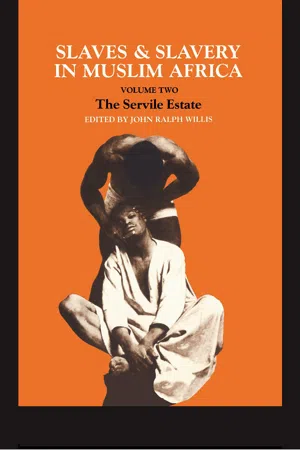
First Published in 1986. Slavery in Islamic Africa has been a fascinating subject to which many scholars have referred, but of which no detailed monograph has emerged. The better part of the essays in these volumes has its ancestry in a conference held at Princeton University during the Summer of 1977 under the title: "Islamic Africa: Slavery and Related Institutions". At that international gathering, four principal themes dominated discussion: the servile estate, its genesis and composition; the master-slave connection and the post-servile condition; patterns and perspectives of slave trading; the legacy of Islamic slavery in Africa to contemporary societies.
IV
Ahmad Rasim Pasha and the suppression of the Fazzan slave trade, 1881–1896
B.G.Martin
I
In a portrait, doubtless painted toward the end of his life, Ahmad Rasim Pasha looks out from behind a full white beard and long moustaches. Portly, and dressed in the long frockcoat of nineteenth century Turkish officialdom, Ahmad Rasim also wears a red fez. A multicolored ribbon crosses his chest, setting off several orders and decorations of large dimensions. Smiling slightly, the Pasha wears an expression of assured benevolence, that of a man satisfied by a long career in the Ottoman civil service. Indeed, Ahmad Rasim had good reason to be proud of his achievements; even now, he is gratefully remembered by some of the older inhabitants of the Libyan capital. Here he served as Veli (governor), his last post before his retirement to Istanbul in 1896. He died the following year at the age of 72, and is buried in the Kayalar Cemetery on the European side of the Bosporus, across the harbor from the centre of Istanbul.1
Born in the Turkish capital in 1825, Ahmad Rasim had his earliest education in Athens, where he studied Greek, Italian, and French. In 1844, his first government post took him to the Translation Bureau (Tercüme Odasi) at the Sublime Porte. He then transferred to the Foreign Ministry, where he was entrusted with the “solution of political problems” at Salonica, Monastir, and the Island of Samos. In 1863, he was appointed Extraordinary Müteserrif for Tulja, then for Vidin, in Bulgaria. In 1867, he became Veli of Yanina in Albania. In 1872, he was sent with the same rank to Trabzon on the Black Sea. In 1873, he returned to Albania, this time to Uskudar (Scutari), then back to Diyarbekir in Anatolia. After a few years there, he returned to Istanbul, becoming Director of the Sanitary Commission at the Ministry of Public Health and Prefect (‘Amid) of the capital. In the autumn of 1881, Ahmad Rasim was appointed Veli of Tripoli, where he arrived on the fourth of Muherrem 1299, or 27 November 1881. 2
Soon after his arrival, an official Ottoman annual noted that the new Veli had not only made every effort to implement the policies of his master, Sultan ‘Abd al-Hamid II, but that
Since his Lofty Presence [came here], he has restricted the glance of his concern to the betterment of all that he sees less in need of reform, whether fundamental or particular, in all branches of provincial affairs. He has put in order thing after thing, by moves suited to the time and place. He has drawn the attention of his Exalted Government to important measures designed to advance the prosperity of the state and the increase of its wealth. Up to now, he has succeeded in many matters and in many glorious respects, both material and spiritual…3
These conventional phrases concealed many real achievements. Ahmad Rasim had not only coped successfully with a huge influx of Arab refugees from Tunis into the Ottoman vilayet, after the French takeover there in 1881, but had also improved communications there by making strategic extensions to the telegraph network. Within a year after his arrival, Tripoli was newly linked to such important towns as Tarhuna and Misurata, Fassatu and Nalut, and by cable to Istanbul. Ahmad Rasim had likewise improved the provincial postal services, built modern hospitals and schools (including one for girls). He pro vided Tripoli with its first modern water supply, and tried to revive the cultivation of disused lands in the vicinity of the capital. The Veli also despatched one of Tripoli’s municipal physicians to the Institut Pasteur in Paris to study the latest cure for quinsy (suppurating tonsillitis), an illness which much afflicted local children.4
With his competence in matters of public health, it would not be long before the energetic, humanitarian, and reform-minded Veli came to grips with the worst abuse of his time. This was the slave trade from the far side of the Sahara. For years, Tripoli had been known to Turks and North African Arabs as Suq al-Bashar—“the slave market”.5 Since 1863, the Ottoman Government had made more than one effort to stop this obnoxious traffic. But until the 15-year tenure of Ahmad Rasim, the Turks had had variable success with this perennial problem.
One of Ahmad Rasim’s first measures, and one which he could enforce locally with vigor, was the manumission of all slaves within the town of Tripoli. Before giving an account of the Pasha’s other moves against the trade, it seems worthwhile to note some of the landmarks in the history of the Fazzan slave traffic, whose beginnings went far back into the past. In this paper, it has seemed necessary to treat the slave trade together with the history of the Fazzan, since the two themes are very much intertwined. The economic situation of the Fazzan and its relative richness made it politically attractive as a conquest, or as an area for trade and settlement, particularly in the Islamic period. When the Fazzan trade, especially the slave trade declined, it became of less political importance. Thus the Fazzan became the home region of the Garamantes, with their capital at German or Jarma. Towards the end of the Garamantian era, as the country came into closer contact with Byzantium and accepted Christianity, the slave trade began to grow. In the early seventh century, when the Muslims conquered the Fazzao, it was already known as a source of captives, since the first Arab raiders in the Fazzan wanted tribute from the declining Garamantes in the form of slaves.
Later, under the Banu Khattab bin Izliten, who established themselves at Zuwayla, a slave trade based on trans-Saharan wars and raiding developed to supply slaves to an accelerating Muslim economy which needed them for domestic and industrial purposes. After about three hundred years of profitable dealing from Zuwayla, the Banu Khattab were wiped out by a renegade Ayyubid Mamluk who was drawn to Zuwayla by its reputed wealth. Very soon after, the Empire of Kanem took over the task of slave-dealing, establishing a corridor by the thirteenth century from Lake Chad to the Mediterranean to protect its slave exports, and imports from the north. The fourteenth and fifteenth centuries are obscure in the Fazzan, but after an era of instability and Berber raids a minor dynasty, the Banu Khurman established itself in the Wadi al-Ajal north of Murzuq. It was shortly replaced by the Awlad Muhammad (the founder of which was a migrant from Mauritania), about 1550.
At nearly the same time, strategic considerations, and a lengthy Mediterranean war between Ottoman Turkey and Hapsburg Spain brought the Turks into Tripoli. They were unable to resist expansion southward and made continued efforts to control the Awlad Muhammad, whom they brought into tributary status. At the least sign of Ottoman weakness, the Murzuq dynasty refused the tribute, which led to a cycle of Ottoman incursion and devastation. Throughout its long life, to 1812, the Awlad Muhammad were supported by the slave trade. The Qaramanli dynasty at Tripoli attempted to control the Awlad Muhammad by the same method as the Ottomans, making them pay tribute. After an interval under ‘Abd al-Jalil and the Awlad Sulayman Arabs, the Ottoman Turks took over the Fazzan again in 1842. Trade at Murzuq declined again by the end of the 1860s, in favor of Ghat, Ghadamis and other towns. As trade declined, the Fazzan declined farther as the slave trade was slowly throttled under Ahmad Rasim Pasha after 1881. Eventually it came under Italian colonial control in the 1930s, and it is now one of three major regions in an independent Libya.
II
Like the Greek and Roman civilizations of antiquity, and like their Byzantine successor, the medieval Islamic world obtained much of its labor from slaves. These workers by coercion, the “property” of their owners, fell into three categories. They performed agricultural labor in larger or smaller groups, or worked in gold mines or on sugar plantations, or extracted salt from salt pans. These were invariably male slaves. Women and eunuchs were also used, in the harims or as house servants, or as musicians or singers or guardians (such as the kizlar agas of Ottoman times).6 Another category, exclusively of male slaves, served as soldiers or mercenaries, usually called mamluks if they were whites, or ‘abd, raqiq, or ‘abid if not.
Once the early Islamic state had reached its full spatial dimensions— say by the end of the Umayyad period (750 AD)—a style of Islamic plural society had been established, in which Jews and Christians and Zoroastrians had their accepted places, and likewise their accepted social functions as traders, physicians, or even bureaucrats. As “protected persons” (dhimmis), they could no longer be enslaved. This principle was already enshrined in Islamic law. Those who required slave labor, in whatever form, were forced to look beyond the frontiers of the Islamic world for enslavable persons.7
Three areas and peoples existed which could supply slaves for export: the Blacks, the Slavs of Eastern Europe and Russia, and the central Asian Turks. The Slavs and Turks had a long history in Islam as eunuchs, servants, or soldiers. Africa remained the last major slaving area. It is accurate to say that Africa provided more slaves, and furnished them over a longer period than any other region—well into the twentieth century. The other two regions had been closed off to Muslim slave purchases or raiding (particularly the eastern Black Sea districts and the Caucasus) when they came under Russian control.8
Within Africa, there were many sources of slaves. The East African coast including Somalia and Ethiopia were several such sources. From eastern Tanzania (the Mrima coast), south Kenya, and southern Ethiopia, large numbers of slaves passed into the medieval Islamic world. Many of the boys were forcibly made into eunuchs at intermediate points on the routes towards Muslim territories. Among the survivors of these crude gelding operations, a much smaller fraction reached the places where they were to be used, passing via Socotra Island, or Aden or Zabid in the Yaman en route to the Persian Gulf, or passing through Aswan on their way into Egypt.9
In the “far West” of Africa, a great number of routes brought slaves from Takrur or the lands of the Niger bend, across the western Sahara into North Africa. From there sizable contingents passed at times into the hands of the Christian Catalonians and Sicilians.10
Between the westernmost parts of North Africa and Egypt to the east, there was also a constant flow of captives over a central route, from the Hausa country and the Lake Chad region into Libya, via the Fazzan and its trading towns: Zuwayla, Sabha, Murzuq, Ghat, and Ghadamis. Since the slave trade and the history of the Fazzan are closely intermingled, and because neither is fully comprehensible without an explanation of the other, it seems essential to give an account of both of these themes simultaneously. In this long series of historical problems, it is useful to go back to classical times, to examine certain facts about the early history of the Fazzan and a people called the Garamantes.11
The word “Garamantes” was apparently derived from the name of thei...
Table of contents
- Cover Page
- Title Page
- Copyright Page
- Preface
- Acknowledgements
- Notes On Contributors to Vols I and II
- I. The ‘Ulama’ of Fas, M.Isma‘il and the Issue of the Haratin of Fas
- II. Notes On Slavery In the Songhay Empire
- III. Comparative West African Farm-Slavery Systems (South of the Sahel) With Special Reference to Muslim Kano Emirate (N.Nigeria)
- IV. Ahmad Rasim Pasha and the Suppression of the Fazzan Slave Trade, 1881–1896
- V. Slavery and Society In Dar Fur
- VI. Al-Zubayr Pasha and the Zariba Based Slave Trade In the Bahr Al-Ghazal 1855– 1879
- VII. The Ethiopian Slave Trade and Its Relation to the Islamic World
- VIII. Black Slavery In Egypt During the Nineteenth Century As Reflected In the Mahkama Archives of Cairo
- IX. The Slave Mode of Production Along the East African Coast, 1810–1873
- Glossary
Trusted by 375,005 students
Access to over 1.5 million titles for a fair monthly price.
Study more efficiently using our study tools.
Frequently asked questions
Yes, you can cancel anytime from the Subscription tab in your account settings on the Perlego website. Your subscription will stay active until the end of your current billing period. Learn how to cancel your subscription
No, books cannot be downloaded as external files, such as PDFs, for use outside of Perlego. However, you can download books within the Perlego app for offline reading on mobile or tablet. Learn how to download books offline
Perlego offers two plans: Essential and Complete
- Essential is ideal for learners and professionals who enjoy exploring a wide range of subjects. Access the Essential Library with 800,000+ trusted titles and best-sellers across business, personal growth, and the humanities. Includes unlimited reading time and Standard Read Aloud voice.
- Complete: Perfect for advanced learners and researchers needing full, unrestricted access. Unlock 1.5M+ books across hundreds of subjects, including academic and specialized titles. The Complete Plan also includes advanced features like Premium Read Aloud and Research Assistant.
We are an online textbook subscription service, where you can get access to an entire online library for less than the price of a single book per month. With over 1.5 million books across 990+ topics, we’ve got you covered! Learn about our mission
Look out for the read-aloud symbol on your next book to see if you can listen to it. The read-aloud tool reads text aloud for you, highlighting the text as it is being read. You can pause it, speed it up and slow it down. Learn more about Read Aloud
Yes! You can use the Perlego app on both iOS and Android devices to read anytime, anywhere — even offline. Perfect for commutes or when you’re on the go.
Please note we cannot support devices running on iOS 13 and Android 7 or earlier. Learn more about using the app
Please note we cannot support devices running on iOS 13 and Android 7 or earlier. Learn more about using the app
Yes, you can access Slaves and Slavery in Africa by John Ralph Willis in PDF and/or ePUB format, as well as other popular books in History & World History. We have over 1.5 million books available in our catalogue for you to explore.