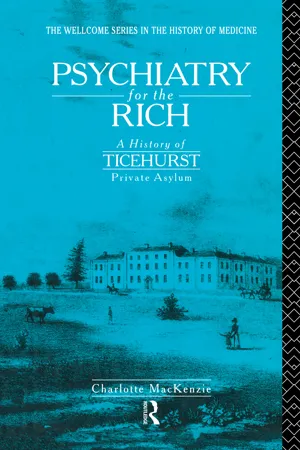
The madhouse often figures prominently in popular conceptions of the nineteenth century, yet little is known about the realities of private institutions. In Psychiatry for the Rich, Charlotte MacKenzie examines the history of the asylum at Ticehurst in Sussex to explore the social history of madness and the impact of politics and popular opinion. She details the backgrounds of the patients, their own descriptions of the asylum as well as changes in the institution through the lunacy reforms and developments in medical theory.
Challenging many of the accepted views of the Victorian asylum, Money, Medicine and Madness is the most revealing account of the trade in lunacy in the nineteenth century.
eBook - ePub
Psychiatry for the Rich
A History of Ticehurst Private Asylum 1792-1917
- 248 pages
- English
- ePUB (mobile friendly)
- Available on iOS & Android
eBook - ePub
About this book
1
The commercialization of care
The making of the asylum
For nearly thirty years, historians and sociologists have been debating the reasons why institutions for the insane developed on an unprecedented scale in eighteenth- and nineteenth-century Europe. Earlier Whiggish evaluations in terms of medical and humanitarian progress – the realization that insanity is an illness, the rise of the welfare state – gave way in the 1960s–70s to more sceptical appraisals linking the birth of the asylum to a repudiation of the irrational in the age of reason (Foucault), or a quest for social control in newly industrialized societies (Doerner).1 Both Foucault and Doerner included England in their broader European analyses, but it remained for Scull to provide a more detailed study of the genesis of English asylums in terms of social control. Scull linked the rise of the asylum to the demands which an industrial-capitalist labour market placed on family resources, arguing that segregation of the dependent insane freed other family members to participate in the market, as well as endorsing the social order by removing the disruptive or deviant. He also emphasized the self-promotion of the medical profession as experts in insanity as the motor of continuous growth of the asylum system throughout the nineteenth century.2
As Scull acknowledged, however, with the exception of Bethlem, the first asylums to develop in England were private madhouses; and it is not so easy to fit these into an explanatory framework based on social control.3 Since 1714, magistrates had been empowered to confine those who were ‘furiously Mad, and dangerous to be permitted to go Abroad’ (12 Anne, c.23); but those who were detained under this legislation were most likely to be confined in bridewells and workhouses, rather than specialized institutions for the insane, despite the fact that from 1744 parishes carried a statutory responsibility for ‘curing such Person during such Restraint’ (17 Geo. II, c.5).4 In other words, although some of the vagrant and violent insane were initially detained under public order legislation, this did not in itself lead to the development of asylums. Private madhouses accommodated some pauper patients whose fees were paid by the parish, but their inmates were otherwise private fee-paying patients – unlikely targets of a bourgeois offensive against the idleness of the insane poor. In addition, as MacDonald has argued, the development of these asylums antedated industrialization.5 Although Scull noted that asylums did not necessarily develop first in urban and industrial areas, and was careful therefore to link the growth of the asylum system more broadly to ‘the advent of a mature capitalist market economy’, he clearly envisaged this economic change as a consequence of industrialization, making it difficult to explain earlier eighteenth- century developments.6
In contrast, MacDonald's evaluation of social and cultural attitudes to madness in seventeenth- and eighteenth-century England hints at one possible explanation for the development of private madhouses. He argues that the Anglican ruling classes of eighteenth-century England embraced medical approaches to insanity before the labouring classes because they were eager to repudiate religious enthusiasm and thaumaturgic explanations of recovery from mental disorders. From this perspective, a predisposition amongst the ruling classes to lodge the mentally disordered with medical practitioners would seem self-explanatory, whether or not Georgian mad-doctors were as self-aggrandizing as their nineteenth-century counterparts. Nevertheless, as MacDonald is aware, the link between Anglican advocacy of medical therapy and the eighteenth-century asylum movement is not self-evident.7 Private madhouses were opened by lay proprietors of varied religious beliefs, as well as by medical men; by medically qualified Dissenters, as well as by Anglican doctors; and wealthy insane were as likely to be lodged with Anglican clergy as with Anglican medical men. For example, the Baptist Joseph Mason (d. 1779), who started an asylum at Fishponds near Bristol, was not medically qualified; but the Quaker Edward Long Fox (1761–1835), who ran Cleeve Hill near Bristol 1794–1806, and subsequently purpose-built the prestigious Brislington House, had an MD from Edinburgh. The Anglican Revd Francis Willis (1718–1807), MD (Oxon.), ran an asylum at Greatford in Lincolnshire from 1776, and is best known as the physician who treated George Ill's insanity; while Revd John Lord was not medically qualified, but opened a small madhouse at Drayton Parslow in Buckinghamshire, which primarily catered for insane Oxford undergraduates.8 In other words, it seems unlikely that the growth of private asylums can be explained by a shift towards a medical model for mental disorders, whether this is perceived in terms of scientific progress or ideological retrenchment amongst the Anglican elite.
Most recently, Porter has argued that there may be a simpler explanation for the proliferation of madhouses in eighteenth-century England. He suggests that the expansion of the Georgian trade in lunacy can best be understood as part of the growth of service industries capitalizing on the boom in spending which accompanied the Industrial Revolution but was not confined to consumption of manufactured goods.9 In Porter's model, the emphasis is not on the buoyancy of demand for the asylum – from scientific rationalists eager to assert their hegemony over crazed and troubled minds, or a new bourgeoisie anxious to discipline a maverick labour force – but on the entrepreneurial creation of new markets by ‘captains of confinement’, the private-madhouse proprietors.
Madhouses and mad-doctors arose from the same soil which generated demand for general practitioners, dancing masters, man midwives, face painters, drawing tutors, estate managers, landscape gardeners, architects, journalists and that host of other white-collar, service, and quasi-professional occupations which a society with increased economic surplus and pretensions to civilization first found it could afford, and soon found it could not do without.10
In providing an economic rationale for the growth of asylums which depends on an increase in disposable income, rather than fully fledged industrialism, this argument appears to avoid many of the difficulties of timing implicit in Scull's analysis. Equally, it delineates a shared entrepreneurial agenda amongst asylum keepers, who were not necessarily united in their religious and medical beliefs.
Nevertheless, Porter's interpretation poses new questions about the madhouse business. For example, it has been argued that the consumer boom reached ‘revolutionary proportions’ in the third quarter of the eighteenth century, but is this when the biggest expansion in the trade in lunacy took place? To what extent did madhouse keepers see themselves, first and foremost, as entrepreneurs? Who were the consumers of private asylum services, and was this an area of spending in which upper-class or middle-class spenders led the way? One aspect of the recent emphasis on consumption, particularly domestic consumption, has been a sharpened interest amongst economic historians in the influence of the family on consumer choices.11 Who took decisions about spending on health care within the family, and what made them interested in the services offered by madhouse proprietors? If the growth of private asylums reflected an increasing upper- and/or middle-class acceptance of, perhaps even a demand for, non-familial, commercialized care for their insane dependants, how does this relate to the contemporaneous restructuring of family relationships?12 Finally, to what extent did health-care consumers, as well as madhouse entrepreneurs, help to shape the character of the treatment and care provided in private asylums?13 (Perhaps even encouraging that ugly word ‘madhouse’ to be dropped in favour of ‘asylum’.)
The madhouse business
It is in fact difficult to estimate the scale of the eighteenth-century trade in lunacy prior to the introduction of licensing legislation in 1774 (14 Geo. Ill, c.9). There are occasional documentary references to individual madhouses from the seventeenth century, as well as earlier literary evidence that the insane were sometimes lodged with keepers in exchange for money.14 From the early eighteenth century, increasing evidence of the trade survives, such as handbills and advertisements in newspapers for private asylums, books touting the skills of particular madhouse keepers, protest literature alleging wrongful confinement and references to sequestration of the insane in diaries and letters. In addition, the case of Rex v. Turlington (1761), in which a successful habeas corpus plea led to the release of Mrs Deborah D'Vebre from Turlington's madhouse in Chelsea, was widely publicized, and helped mount pressure for government regulation of private asylums. However, subsequent investigations into the madhouse business by a Commons select committee in 1763 were perfunctory, and it was a further eleven years before legislation was passed requiring private asylums to be licensed, and introducing annual inspections by two magistrates and a physician in the provinces, and five Commissioners from the Royal College of Physicians in the metropolitan area.15
Increasing documentary evidence relating to madhouses, and mounting public concern about malpractices, both suggest impressionistically that the trade in lunacy may have been becoming more noticeable because it was expanding. Nevertheless, prior to registration, the evidence is necessarily only impressionistic, and could be misleading. For example, Daniel Defoe estimated that there were fifteen private madhouses in the metropolitan area in 1724; and in 1774, sixteen metropolitan houses were licensed under the new legislation. By 1807, this number had risen to only seventeen; nor are there strong grounds for believing that non-registration would have been common in the metropolitan district.16
The 1774 Act imposed a penalty of £500 for keeping more than one lunatic without a licence; but laid down no circumstances in which a licence could be refused or revoked, except for denial of access to the metropolitan Commissioners or provincial magistrates when they called to inspect. Although concern to maintain discretion on behalf of lunatics' families is often cited as the main reason for opposition to regulation, it was in fact the removal, in response to lobbying by the legal profession, of clauses giving powers to the Commissioners to revoke licences in other circumstances which ultimately enabled the bill to pass the Lords as well as the Commons.17 Victims of malpractice were required to prove a misdemeanour under common law ‘in the same Manner as ...
Table of contents
- Cover
- Half Title
- THE WELLCOME INSTITUTE SERIES IN THE HISTORY OF MEDICINE
- Full Title
- Copyright
- Dedication
- Contents
- List of plates, figures and tables
- Acknowledgements
- Introduction
- 1. The commercialization of care
- 2. Starting a family business
- 3. The asylum and moral reform
- 4. Madness and the Victorian family
- 5. Mid-Victorian prosperity
- 6. The fourth generation
- 7. The protection of private care
- Conclusion
- Bibliography
- Index
Trusted by 375,005 students
Access to over 1.5 million titles for a fair monthly price.
Study more efficiently using our study tools.
Frequently asked questions
Yes, you can cancel anytime from the Subscription tab in your account settings on the Perlego website. Your subscription will stay active until the end of your current billing period. Learn how to cancel your subscription
No, books cannot be downloaded as external files, such as PDFs, for use outside of Perlego. However, you can download books within the Perlego app for offline reading on mobile or tablet. Learn how to download books offline
Perlego offers two plans: Essential and Complete
- Essential is ideal for learners and professionals who enjoy exploring a wide range of subjects. Access the Essential Library with 800,000+ trusted titles and best-sellers across business, personal growth, and the humanities. Includes unlimited reading time and Standard Read Aloud voice.
- Complete: Perfect for advanced learners and researchers needing full, unrestricted access. Unlock 1.5M+ books across hundreds of subjects, including academic and specialized titles. The Complete Plan also includes advanced features like Premium Read Aloud and Research Assistant.
We are an online textbook subscription service, where you can get access to an entire online library for less than the price of a single book per month. With over 1.5 million books across 990+ topics, we’ve got you covered! Learn about our mission
Look out for the read-aloud symbol on your next book to see if you can listen to it. The read-aloud tool reads text aloud for you, highlighting the text as it is being read. You can pause it, speed it up and slow it down. Learn more about Read Aloud
Yes! You can use the Perlego app on both iOS and Android devices to read anytime, anywhere — even offline. Perfect for commutes or when you’re on the go.
Please note we cannot support devices running on iOS 13 and Android 7 or earlier. Learn more about using the app
Please note we cannot support devices running on iOS 13 and Android 7 or earlier. Learn more about using the app
Yes, you can access Psychiatry for the Rich by Charlotte MacKenzie in PDF and/or ePUB format, as well as other popular books in History & World History. We have over 1.5 million books available in our catalogue for you to explore.