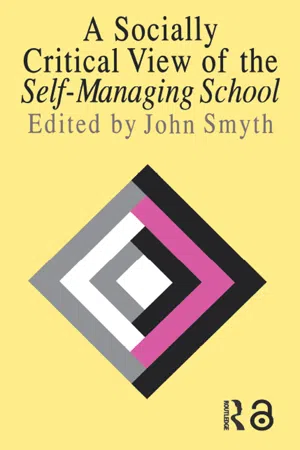
The shift from the model of central government educational control to school- based management has been widely adopted and acclaimed and has created the general impression of increased democracy and participation.; The international contributors to this book tackle this important policy issue and look behind the scenes of the moves towards school self- management. They investigate the phenomenon of the self-managing school, Why It Is Happening Now, What Is The Truth Behind This Notion And The problems which lie behind devolution and self-management.; The self- managing school, it is claimed is not about "grassroots democracy" or "parent participation" but absolutely the reverse and this contradiction is best understood in terms of the ideology of the New Right. Enlightened and informed perspectives of the reality behind school self-management suggest that the devolution of power is only superficial. Hierarchies continue to exist as unequally funded schools which perpetuate class, gender and ethnic divisions. The mechanism involved promotes the Survivial Of The Fittest Through Notions Of Choice.; For Those Involved in school management and education generally, this book should provide a useful insight into the struggle surrounding the control of schooling.
- 268 pages
- English
- ePUB (mobile friendly)
- Available on iOS & Android
eBook - ePub
A Socially Critical View Of The Self-Managing School
About this book
Information
Topic
EducationSubtopic
Education General1: Democratic Participation or Efficient Site Management: The Social and Political Location of the Self-Managing School
Lawrence Angus
Current discourses on the self-management of schools incorporate particular understandings of notions such as democracy, participation, choice, community and society. The problem is that the meaning in context of these notions is quite variable and is influenced by the importance, and perception, of other powerful organizing concepts including those of efficiency, accountability, responsibility and authority. In a period in which educational debates have become characterized by neo-conservative and New Right thinking, and by the marginalization of socially democratic themes which had become partially institutionalized in the work and thinking of many education workers during the 1970s and 1980s (Angus, 1992; Apple, 1991), we have seen the incorporation of all the terms mentioned into a rather simplistic slogan system of market efficiency and quality control of schools.
Such incorporation is not challenged by many of the currently popular texts which purport to offer assistance to participants in local school management. Indeed, one of the most popular of these manuals, The Self-Managing School, by Brian Caldwell and Jim Spinks (1988), celebrates the utility and effectiveness of its proposed model of school management which, the authors claim, can be adapted for virtually any occasion or any type of political context. Far from challenging New Right themes, The Self-Managing School, perhaps unintentionally, provides a spurious legitimacy to the New Right educational project.
In this chapter, before addressing particular limitations in the approach to school management offered by authors like Caldwell and Spinks, I shall sketch briefly the broad policy context against which models of school-based administration should be understood. This context is extremely complex, not least because of the appropriation into neo-conservative rhetoric of notions like participation that previously have been associated with the increased democratization of education rather than its privatization and incorporation into New Right social and economic policy. It is important to recognize, therefore, that particular forms of school level participation may well serve as conservative managerial devices rather than as genuine democratic reforms (Angus, 1989; Davies, 1990). Versions of participation offered to members of the school community within current policy frameworks, I shall argue, tend to take educational management in educationally, socially and administratively conservative directions.
Advocates of school-based management have long argued that, in education systems which have been characterized by highly centralized bureaucracies, schools should be granted a significant level of autonomy in making decisions about such matters as curriculum, finances and resources, staffing and school policy. A measure of authority should be appropriately devolved from central administration to the school level. The bureaucracy, according to the argument, would then become more responsive to the needs of schools and their communities, and would facilitate the realization of schooldetermined priorities rather than impose centrally mandated ones. Moreover, in order to develop general commitment to priorities which are decided at the school level, local decisions should be made collaboratively by principal, teachers, parents and, in some cases, students.
This much seems unexceptionable. The problem is that, although there is widespread endorsement in current education debates of terms like ‘participation’, ‘devolution’ and ‘responsive bureaucracy’, the apparent simplicity of these notions is deceptive. Their meanings must be understood in context—in relation to the broader educational policy agenda, which is itself sensible only in relation to broad social and economic policy directions. Perhaps a good starting point is to consider the ostensible relationship between schools and reformed, responsive educational bureaucracy in versions of school-based management.
Responsive Bureaucracy and Participative Democracy
Bureaucracy can be reformed in a number of ways (Rizvi and Angus, 1990). Different approaches in the discourse of educational governance to such reform in the past decade or so provide a key for understanding important differences in approaches to local school management. For instance, in Australia in the early 1980s the state of Victoria witnessed perhaps the most serious attempt anywhere to introduce democratic principles into educational governance. The Ministerial Papers published in 1983 and 1984 (see collected version, Victoria, Minister of Education, 1986) provide an outline of what a devolved educational structure in Victoria under a then newly elected Labor government was to look like. Participation was presented as an essential corollary to the devolution of authority from the central office to regions and schools. At the school level the importance of school councils, which were representative of local communities and would have a major say in school decisions, was emphasized.
The most important point about the restructure was that the notion of devolution of authority, so prominent throughout the Ministerial Papers, implied that the patterns of educational governance were to alter. Instead of offering obedience to a central authority, those involved in education at the school level—administrators, teachers, parents and students—were invited to participate in the decision-making process in such a way that shared and informed consent to school level decisions would ensure both commitment to such decisions and collective responsibility for their implementation.
Participative, school level goverance was to be facilitated by a ‘responsive bureaucracy’. Just how the bureaucracy was to be reformed to make it more responsive,however, was not fully spelled out (Rizvi and Angus, 1990). This lack of detail was not necessarily a weakness in the policy. Indeed, it could be argued that it was a potential strength in that, while a clear policy principle of participation was enunciated, its success or otherwise would depend upon the way in which responsiveness was demanded and asserted by participants at various points within the educational process. The government did have a responsibility, however, to facilitate responsiveness not only in rhetoric but with adequate resources. Importantly, the policy linked the notion of participation with notions of equity and redress of disadvantage, as well as responsiveness to the needs of local communities. The rhetoric of democratic governance and community participation in the Victorian policy gave hope to advocates of democratic education, including parents, that a genuine shift of power was likely to occur which would significantly change the system in democratic ways.
In the event, as I have argued in more detail elsewhere (Angus and Rizvi, 1989; Rizvi and Angus, 1990), despite significant gains at the level of particular school communities where participation was strongly asserted from below, and within now-marginalized sections of the education bureaucracy, participative democratic practices have not, in the main, been institutionalized within the Victorian administrative system. This does not mean that we should be pessimistic about the ultimate possibilities of more democratic and participative modes of educational governance. The advocates of reform took on an extremely difficult task in attempting to shift the system—a massive, centralized state bureaucracy—in democratic ways, and may well have underestimated the extent to which managerial expectations and institutionalized power relationships are entrenched in hierarchical management structures (Angus and Rizvi, 1989). Despite the pervasive rhetoric, the extent to which principles of participation and equity actually were shared throughout the system (as opposed to being asserted in particular sites) is also questionable. Moreover, the reassertion of corporate managerial practices and the winding back of reforms in Victoria from the mid-1980s can be seen partly as a response in times of increasing financial restriction to a perceived need for economy and efficiency. It was also a response to an ultimate failure at the system level, despite the system-changing intentions of the policy, seriously to challenge the entrenched acceptance of bureaucratic managerial relationships as being appropriate for educational administration.
Decentralization as Efficient Site Management
The noble but flawed Victorian attempt to reform educational bureaucracy and promote school level participation in the early 1980s can be contrasted with recent reforms in the neighbouring state of New South Wales. There, a major report on education (Scott, 1989) set out to recommend ways of improving the operations of the state’s education bureaucracy. The starting assumption seemed to be that the performance of the Education Department could be improved by a more tightly defined structure of roles and responsibilities, a better coordinated, hierarchical accountability system and a clearer definition of goals. In the ensuing report, Schools Renewal: A Strategy to Revitalise Schools within the New South Wales State Education System (Scott, 1989), little attention is devoted to the examination of educational goals because these are seen as being independent of the real issues of organizational efficiency and effectiveness. In this sense, the reforms are not directed at changing the system so much as tightening up the system.
The general approach and underlying assumptions of Schools Renewal capture much of the essence of recent reforms in the United Kingdom and New Zealand as well as New South Wales. These emphasize the importance of local school management, but, in this version, the notion of school level participation in educational decision-making is accommodated comfortably within the principles of corporate management (Angus, 1989; Bessant, 1988). An important new element in all of these cases is a strong rhetoric of the need to reduce unwieldy and self-serving bureaucracy (the so-called ‘educational establishment’) and release schools from bureaucratic restrictions. In other words, rather than reforming bureaucracy in ways that would render it more responsive, the emphasis is on, as far as possible, eliminating bureaucracy. Dramatically symbolic of such a shift was the selling of the historic Bridge Street ‘headquarters’ of the New South Wales Education Department. To many it seemed then that the Department literally had no ‘centre’.
Despite such rhetoric and symbolism, it would be incorrect to describe trends of educational governance exclusively in terms of a shift towards decentralization. Rather, the general pattern of educational organization which seems to be emerging is much more complicated. For instance, the guiding principles which informed notions of decentralization in the state of Victoria in the early 1980s were participation and collaboration in a spirit of democratization and community involvement in local schools. In the neighbouring state of New South Wales, in the 1990s, the emphasis seems to be upon notions of effective and efficient institutionally-based educational management which is argued to result from the reduction of bureaucratic control and interference at the school level. In the New South Wales case, where policies and language that largely echo the British Education Reform Act are employed, the reduction of central control is linked with the deregulation of school zones. This has enabled schools to be placed in relation to each other as competitors in an educational market. Within such a relationship, individual schools will have to compete with other schools for pupils (or market share) in such a way that, according to the advocates of this style of institutional management, the more efficiently managed and entrepreneurial schools are likely to be successful. At the time of writing the people of the state of Victoria are facing an election that almost certainly will be won by the conservative coalition of Liberal and National parties. Part of their electoral appeal is their promise to ‘fix’ the education ‘problem’ by putting schools on a market footing. The Shadow Treasurer indicated an extension of New Right themes of accountability and an educational market as he spelled out the thinking behind the Coalition’s education policy in a recent speech:
Resources and authority will be devolved to the school council to run the school, as is already the case in the non-government sector. We will give the school council power to hire and fire the principal, and the principal and the school council the power to hire and fire teachers. They will operate within a core curriculum that will demand excellence but we will impose accountability on them in a host of ways, and I shall now instance two of those ways.
Firstly, we will ensure that funding follows the student. If a school ceases to attract students, if its enrolments start to decline because it is not delivering what the community wants, that will be reflected in lower funding…. Secondly, we will impose accountability, particularly at year 12, through a higher proportion of external assessments so that there is a standardisation of measurements across schools, and the community will be able to see which schools are delivering educational excellence and which are not.
It seems that there is a simultaneous shift in the direction of decentralization for some kinds of decisions and centralization for others. In particular, central governments are assuming, or in some cases returning to, a powerful role in setting broad educational goals, mandating curricula and establishing common methods of accountability so that school level decisions are made within a broad framework of centrally determined priorities and, most importantly, within the constraints of a devolved budget. The imposition of centralized curriculum and evaluation also provides a means of gauging the ‘performance’ of particular schools. The emphasis on testing, therefore, has less to do with providing educational feedback, or even determining standards, than with providing a basis on which schools can be compared by education consumers and administrators.
A Climate of Conservative Educational Reform
Perhaps the most important point about the context of educational policy and planning is that it is linked directly with national social and economic goals. This linkage has profound implications for the ways in which the purposes of education are regarded. It is significant that in countries like Australia, the United Kingdom and New Zealand the voice of public educators has been largely marginalized in the educational policy arena (Angus, 1992). This is largely because, in Thatcherite terminology, education is believed to suffer from ‘provider capture’—self-interested educators and education officials are claimed to have been running the system to suit themselves rather than the needs of children or the nation. This is one of a number of assumptions that seem to be shared by the main political groups. The voices of politicians and their advisers, business and industry representatives, conservative academics and social commentators seem to have displaced those of various education workers, including administrators, teachers and their unions, teacher educators and members of parent organizations. Schools and the education system are seen as key strategic sites in which pupils can be trained to contribute, individually and collectively, to the nation’s economic and industrial development and competitiveness. Within this general approach, the essential role for education is seen as one of contributing to the efficient development of a nation’s human resources, or human capital, as a major part of the effort to achieve the nation’s social and economic priorities.
The dismissal of educational arguments in discussion of education policy seems in part to have resulted from a false perception that schooling has failed to serve the needs of the economy. The obvious problem with this perception is that schools are being blamed for contributing to social and economic uncertainty that is, in fact, a product of the failure of capital, social and cultural change, and shifting economic relativities. In the face of such uncertainty, we tend to fall back too easily upon a general faith in managerialism that has been socially constructed in industrial societies through the institutionalization of practices of bureaucracy and scientific management. These practices, now represented in educational administration in terms of competences and corporate management, need to be recognized as more than neutral managerial devices and as significant contributors to patterns of social relationships. The institutionalization of these as standard and proper ways of managing has led to the taken-for-granted acceptance of the necessity of efficiency and effectiveness, conceived of in a particular managerial fashion.
The pervasiveness of such socially constructed ‘common sense’ may well explain the widespread acceptance of the belief that education’s ills may be remedied by the dismantling of bureaucracy and the imposition of the discipline of the market (Pusey, 1991). It is in relation to this belief that the full implications of local school management become apparent. An educational market, according to proponents, would facilitate increased parental choice among educational institutions, and the resulting competition and consumer pressure, it is argued, would lead directly to higher educational standards and an education that was more relevant to the needs of the closely integrated labour market. Such an approach, the argument continues, will ensure greater efficiency in education because the twin themes of competition and relevance to the labour market will lead to reduced wastage of human capital and a consequent increase in educational quality and productivity.
Within this approach the notion of ‘choice’ is emphasized and associated with the dezoning of schools so that parents can take their pick from the full market range. The effect of this emphasis in the United Kingdom, as Whitehead and Aggleton (1986) point out, is that the conservative potential of parent and community participation is now in the ascendancy and the notion of democracy seems to have been reduced to a simplistic concept of parental ‘choice’. Parents are encouraged ‘under the guise of involvement and partnership…to become agents in the implementation of central government policies’ (Whitehead and Aggleton, 1986, p. 444). The emphasis is on accountability and control rather than personal empowerment. For instance, the right of self-managing schools to opt out of local education authorities (LEAs) is consistent with removal of the ‘educational establishment’ from interference in educational management. Schools are to operate within market conditions, education is regarded as a commodity and schools are valued to the extent to which they can attract customers.
Within the versions of local school management that are on offer in New South Wales, the United Kingdom, New Zealand, and now Victoria, and in conservative education policy generally, it would appear that what is actually devolved to schools is responsibility for a range of management tasks and control of their budgets. Local decisions about the best and most appropriate form of educational delivery and policy, or about the nature and purpose of schooling, are secondary to, and need to be subordinated to, budget considerations. In other words, while the rhetoric celebrates autonomy and control at the school level, the financial limits within which schools must work are obscured (Ball, 1990). Within a climate of expenditure cuts in education and the public sector generally, local management begins to sound like a euphemism for devolving to schools the blame for cutbacks.
Under New Right versions of local management, each school receives a devolved budget the size of which depends on pupil numbers. This comes very close to a full voucher system for public schools in that each pupil whom the school can attract through th...
Table of contents
- Cover Page
- Title Page
- Copyright page
- Introduction
- 1: Democratic Participation or Efficient Site Management: The Social and Political Location of the Self-Managing School
- 2: The New Right and the Self-Managing School
- 3: Paradigm Shifts and Site-based Management in the United States Toward a Paradigm of Social Empowerment
- 4: Culture, Cost and Control; Self-Management and Entrepreneurial Schooling in England and Wales*
- 5: Reinventing Square Wheels: Planning for Schools to Ignore Realities
- 6: The Evaluative State and Self-Management in Education: Cause for Reflection?
- 7: The Politics of Devolution, Self-Management and Post-Fordism in Schools
- 8: Pushing Crisis and Stress down the Line: The Self-Managing School
- 9: Managerial ism, Market Liberalism and the Move to Self-Managing Schools in New Zealand
- 10: Teaching Cultures and School-based Management: Towards a Collaborative Reconstruction
- 11: ‘And Your Corporate Manager Will Set You Free…’: Devolution in South Australian Education
- 12: Managerialism and Market Forces in Vocational Education: ‘Balkanizing’ Education in the ‘Banana Republic’
- 13: Self-Managing Schools, Choice and Equity
- Notes on Contributors
Trusted by 375,005 students
Access to over 1.5 million titles for a fair monthly price.
Study more efficiently using our study tools.
Frequently asked questions
Yes, you can cancel anytime from the Subscription tab in your account settings on the Perlego website. Your subscription will stay active until the end of your current billing period. Learn how to cancel your subscription
No, books cannot be downloaded as external files, such as PDFs, for use outside of Perlego. However, you can download books within the Perlego app for offline reading on mobile or tablet. Learn how to download books offline
Perlego offers two plans: Essential and Complete
- Essential is ideal for learners and professionals who enjoy exploring a wide range of subjects. Access the Essential Library with 800,000+ trusted titles and best-sellers across business, personal growth, and the humanities. Includes unlimited reading time and Standard Read Aloud voice.
- Complete: Perfect for advanced learners and researchers needing full, unrestricted access. Unlock 1.5M+ books across hundreds of subjects, including academic and specialized titles. The Complete Plan also includes advanced features like Premium Read Aloud and Research Assistant.
We are an online textbook subscription service, where you can get access to an entire online library for less than the price of a single book per month. With over 1.5 million books across 990+ topics, we’ve got you covered! Learn about our mission
Look out for the read-aloud symbol on your next book to see if you can listen to it. The read-aloud tool reads text aloud for you, highlighting the text as it is being read. You can pause it, speed it up and slow it down. Learn more about Read Aloud
Yes! You can use the Perlego app on both iOS and Android devices to read anytime, anywhere — even offline. Perfect for commutes or when you’re on the go.
Please note we cannot support devices running on iOS 13 and Android 7 or earlier. Learn more about using the app
Please note we cannot support devices running on iOS 13 and Android 7 or earlier. Learn more about using the app
Yes, you can access A Socially Critical View Of The Self-Managing School by John Smyth in PDF and/or ePUB format, as well as other popular books in Education & Education General. We have over 1.5 million books available in our catalogue for you to explore.