Pressure is increasing on all those involved in education, from teachers to policy-makers, to transform schools as organisations, while continuing to implement effective new approaches to teaching and learning. The demand is not only to reach attained targets, but also to be accountable for teaching methods.
Developing Teachers and Teaching Practice brings together a selection of papers given at the ninth conference of the International Study Association of Teachers and Teaching (ISATT). The collection takes as a central theme the issue of education as a key concern within the international rhetoric of globalisation. The book offers insights in to the nature of teaching and learning, including the key new research area of emotions. It then goes on to explore the nature of teacher learning before looking at the impact of major policy initiatives on the work of teachers internationally.
Developing Teachers and Teaching Practice contains contributions from some of the best-known academics in the field, and will be of great interest to teacher educators and educational researchers around the world.
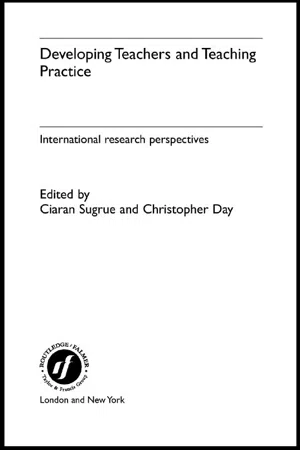
eBook - ePub
Developing Teachers and Teaching Practice
International Research Perspectives
- 288 pages
- English
- ePUB (mobile friendly)
- Available on iOS & Android
eBook - ePub
Developing Teachers and Teaching Practice
International Research Perspectives
About this book
Information
Section 1: Changing understandings
Chapter 1: Teaching in a box: Emotional geographies of teaching1
Andy Hargreaves
Introduction
If you want to improve learning, improve teaching! The injunction contained within this deceptively simple equation has driven numerous research and reform efforts over the years to define and improve the quality of teaching. Training teachers in the skills and strategies of ‘effective’ pedagogy, setting and applying professional standards of what teachers should know and be able to do, even testing teachers periodically on their basic, subject-matter knowledge – these are the sorts of methods that reformers have employed to try and raise standards in teaching. These prevalent reform strategies and the research agendas that feed them – on teacher thinking, teacher planning, teacher behaviour and professional knowledge – address some of what is important in teaching. Setting standards of what teachers should know and be able to do can certainly help insure the profession against truly awful teaching, against ignorance and incompetence in our classrooms. Moreover, professional standards can spur teachers and their systems on towards learning and acquiring more sophisticated and effective skills and strategies over time. But somehow, measures such as this miss a lot of what matters most in developing really good teaching. They do not quite get to the heart of it.
When people recall the truly great or dreadful teachers they have encountered in their lifetime, it is not usually this knowledge, skill, thinking or planning (or their absence) that stand out most to them. We remember our best teachers not just or even mainly for being knowledgeable, well organized or even for acting like consummate ‘reflective practitioners.’ Our best teachers, rather, stand out because they were inspiring, enthusiastic, caring, forgiving, supportive, indeed ‘thoughtful’ in the widest sense of the word (Clark, 1995).
My best teacher, Miss Hindle, was the only teacher in elementary school who let us stay in at recess, who allowed and encouraged us to produce a student newspaper in class-time throughout the year, who admonished us but quickly forgave us for our indiscretions, and who exuded a constant, irrepressible enthusiasm about teaching and learning. When I visited her ten years later, just before I became a teacher, and she was in late career, the emotional infection of her enthusiasm still suffused her classroom. Just two years ago, I discovered that she was still alive and I sent her one of my books, explaining how her example as a teacher had influenced my own writing (and perhaps, therefore, the views of some of those who read it). That she wrote back appreciatively, and movingly was pleasing but not especially surprising. More surprising and also satisfying was that at the age of 85, she still spontaneously recalled my passion as a student for and my adeptness at Spanish dancing (in revealing this, I am trusting that my colleagues will not insist on any encore performances).
Our worst teachers stand out as much as, sometimes more than, our best ones. They still haunt us not because of their ignorance or incompetence but because of the cruelty, sarcasm, thoughtlessness or sheer stultifying boredom they inflicted on our classroom existence. When I was 12 years old and attending an academic English grammar school, my father died suddenly. No teacher at my school ever discussed this with me. Academic learning was paramount. I never knew whether they knew about my dad’s death. About that time, and for several years afterwards, I had a French teacher, who seemed to rule his classrooms with a reign of terror. He would, for example, shake misbehaving students, and drag ones he found talking at the back of the class to the front, scattering desks across the room in his wake. As is usual in emotional memory work (Crawford et al., 1992), my recollections of this man came back to me in deeply embodied ways – in images of his stunted, Napoleonic stature; his yellow, nicotine-stained teeth; the spit he sprayed through the gaps in them; the foul odour of his breath as he thrust his face at you if you dared to disobey him or give him the wrong answer. One of his most common teaching strategies was to ask questions in French of individual students, in strict rotation around the class. ‘What is your sister called?’, ‘Where did you go on vacation this year?’, ‘What is your father’s job?’. For three years, I approached every French lesson in fear that he would ask me this last question, and I would be unable to answer it. Time and again, I rehearsed my defiant retort of ‘Mon pére est mort, Monsieur.’ He never did ask me the question. But my daily fear that he might created within me a block in second language learning, that persists to this day.
Strong or weak, good or bad, emotion is integral to all teaching, not just the best and worst of it. As I have argued elsewhere, policy strategies designed to improve or raise standards in teaching and learning rarely acknowledge this vital emotional dimension. Often, emotions are excluded from professional standards’ frameworks, teacher evaluation schemes, student learning targets and even from the basic idea of ‘reflective practice’ in teaching. Where emotions are officially acknowledged as being relevant to teaching and learning issues, this recognition is usually conditional or restricted. For example, emotions are recognized in the school effectiveness literature as providing a context for learning – in terms of there needing to be a safe and orderly climate in which learning takes place (Mortimore et al., 1988). Similarly, the guidance and counselling literature points to the necessity for systems of care and support to deal with students’ emotional or ‘personal’ problems that might otherwise interfere with their learning (Hargreaves, forthcoming). Alternatively, emotions are sometimes viewed as a form of learning – in terms of developing self-esteem or acquiring emotional competence (see, for example, Goleman, 1995). Rarely, though, do policymakers acknowledge that emotions are integral to and foundational for all teaching and learning.
A baseline proposition underpinning this paper is that teaching and learning are always emotional practices. This does not mean that teaching and learning are solely emotional practices. In reality, emotion and cognition, feeling and thinking, combine together in all social practices in highly complex ways (Damasio, 1994; Oatley, 1991). But teaching and learning are irretrievably emotional practices. There is always an emotional dimension to them. In his classic text, On Understanding Emotion, Norman Denzin (1984: 89) argues that an emotional practice is
An embedded practice that produces for the person, an expected or unexpected emotional alteration in the inner and outer streams of experience.… Emotional practices make people problematic objects to themselves. The emotional practice radiates through the person’s body and streams of experience, giving emotional culmination to thoughts, feelings and actions.
As an emotional practice, teaching activates, colours and expresses teachers’ own feelings and actions as well as the feelings and actions of others with whom teachers interact. Teachers are engaged in an emotional practice when they enthuse their students or bore them, when they are approachable to parents or stand-offish with them, when they trust their colleagues or are suspicious of them. All teaching is therefore inextricably emotional either by design, or default.
In recent years, an expanding body of literature has sought to remedy the neglect of emotion in the fields of teaching and teacher development, by providing theoretical and empirical grounds that honour the place of emotion in teaching. We are, for example, seeing increasing number of papers and books that expound and expand upon the virtues of caring teachers (Noddings, 1992; Acker, 1992; Elbaz, 1993), passionate teaching (Fried, 1995), thoughtful teaching (Clark, 1995), and tactful teaching (van Manen, 1995). The literature also points to the importance of cultivating greater hope (Fullan, 1997), attentiveness (Elbaz, 1993) and emotional intelligence (Goleman, 1995; Fullan, 1999; Day, 1998) among teachers, and to the significance of emotionality in particular areas of the curriculum such as arts education (e.g. Eisner, 1986).
This important literature provides a counter discourse to the more technical and cognitive conceptions of teaching and teacher development that dominate the language of educational policy and administration. At the same time, writers in these traditions tend to advance a view of teachers’ emotions and emotionality that is broadly personal and psychological – indeed, sometimes Pollyanna-like. Becoming a tactful, caring or passionate teacher is treated as largely a matter of personal disposition, moral commitment or private virtue. What is missing or underemphasized in this literature is how the emotions and emotionality of learning, teaching and teacher development take particular forms according to how the work of teaching is configured and organized in particular times and contexts.
In this respect, it is also important to understand some of the more unsettling and even darker emotions of teaching such as guilt, shame, anger, jealousy, envy and fear. The literature of teaching and teacher development would benefit from understanding and explaining these profane emotional realities of people’s worklives, as well as celebrating the more ‘sacred’ ones of care, tact, affection and so on (e.g. Fineman, 1993). A small collection of studies does already suggest how the emotional lives of teachers are being adversely affected and sometimes seriously damaged by high-stakes inspection processes (Jeffrey and Woods, 1996), stress-inducing reform strategies (Woods et al., 1997; Nias, 1999), the risks of collaborative teacher research (Dadds, 1993), authoritarian leadership styles among principals (Blase and Anderson, 1995) and the general speeding-up, intensification and extensification (spreading out) of teachers’ work (Hargreaves, 1994). But, across the range of what teachers do, we do not yet have a systematic or interconnected understanding of how emotions are embedded in and shaped by the changing conditions of teachers’ work; nor of how these emotions manifest themselves in and affect teachers’ interactions with students, parents, administrators and each other. This chapter takes the first steps in developing such an understanding by setting out a preliminary conceptual framework of teachers’ emotions as they are embedded in the conditions and interactions of their work. I characterize this framework in terms of what I call emotional geographies of teaching.
The emotions of teaching and educational change
The data on which the chapter is based are drawn from a study of the emotions of teaching and educational change which comprised interviews with 53 teachers in a range of elementary and secondary schools in the province of Ontario in Canada. The sample was distributed across fifteen varied schools of different levels, sizes and serving different kinds of communities (i.e. urban, rural, suburban). In each school, we asked principals to identify a sample of up to four teachers that included the oldest and youngest teachers in the school, was gender mixed, contained teachers with different orientations to change, represented a range of subject specializations (within secondary schools), and (where possible) included at least one teacher from an ethnocultural minority.
The interviews lasted for 1–1½ hours and concentrated on eliciting teachers’ reports of their emotional relationships to their work, their professional development and educational change. A substantial part of the interview drew on methodological procedures used by Hochschild (1983) in her key text on the sociology of emotion, The Managed Heart: The Commercialization of Human Feeling. It asked teachers to describe particular episodes of positive and negative emotion with students, colleagues, administrators and parents. This chapter is mainly based on teachers’ reports about episodes involving their emotional relationships with parents and students. While one-time interviews have limitations as ways of getting others to access and disclose their emotions (and we are therefore now complementing our methodology with long-term discussion groups), they bring to the surface new topics and themes in previously unexplored areas, and they enable us to identify patterns and variations in teachers’ emotions across different school contexts, and different kinds of teachers. Also, the particular nature of our database (that of critical episodes) highlights what is emotionally significant and compelling to teachers, not how frequently or infrequently the episodes that teachers describe occur in general.
The interviews were analysed inductively with the assistance of the computer program Folio Views. Data were extracted electronically, then marked, coded and grouped into increasingly larger themes, ensuring that all identified pieces of data were accounted for and included in the framework.
Conceptual framework
The approach taken by The emotions of teaching and educational change project is broadly social constructionist. Our immediate interest is not in the brain circuitry and psychology that stimulates and organizes emotion. Nor is it in Darwinian understandings of the biological dynamics of basic emotions such as fear that we share in common with other animals. Neither, is the project concerned with long-standing philosophical debates about whether the passions disturb rational thought or enhance it, and about whether thought organizes feeling, or feeling organizes thought (e.g. James, 1917). In taking a social constructionist view, rather, the project is concerned with how teachers’ emotions are experienced and represented in various contexts and in patterns of interaction with others who are part of teachers’ working lives.
The theoretical framework for this social constructionist understanding of teachers’ emotions is grounded in two basic concepts: emotional understanding and emotional geographies. According to Denzin, emotional understanding
is an intersubjective process requiring that one person enter into the field of experience of another and experience for herself the same or similar experiences experienced by another. The subjective interpretation of another’s emotional experience from one’s own standpoint is central to emotional understanding. Shared and shareable emotionality lie at the core of what it means to understand and meaningfully enter into the emotional experiences of another.
(Denzin 1984, p. 137)
Teaching, learning and leading all involve emotional understanding as people reach into the past store of their own emotional experience to interpret and unravel, instantaneously, at-a-glance, the emotional experiences and responses of others. Emotional understanding can be established through a number of means. Denzin describes emotional ‘infection’ (spreading our own optimistic or pessimistic moods to others), and vicarious emotional understanding (where we empathize with characters’ lives or predicaments through theatre or literature, for example), as two such means. One of the key ways in which emotional understanding develops, however, is through long-standing, close relationships with others. Without such relationships, teachers (indeed anyone) will experience emotional misunderstanding where they ‘mistake their feelings for the feelings of the other’ (Denzin, 1984: 134). In schools where such close relationships do not exist, where teachers do not know students well (Sizer, 1992), they will frequently misconstrue student exuberance for hostility, or parent respect for agreement, for example. Emotional misunderstanding strikes at the foundations of teaching and learning – lowering standards and depressing quality. If we misunderstand how students are responding, we misunderstand how they learn. Successful teaching and learning therefore depend on strong emotional understanding, on establishing close bonds with students (and to a lesser extent, with colleagues and parents as well) and on creating the conditions in teaching that make this understanding possible.
Emotional understanding is achieved not just by acts of personal will, sensitivity or virtue...
Table of contents
- Cover Page
- Title Page
- Copyright Page
- Tables and figures
- Contributors
- Acknowledgements
- Introduction
- Section 1: Changing understandings
- Section 2: Sites and sources
- Section 3: Reform and renewal
Trusted by 375,005 students
Access to over 1.5 million titles for a fair monthly price.
Study more efficiently using our study tools.
Frequently asked questions
Yes, you can cancel anytime from the Subscription tab in your account settings on the Perlego website. Your subscription will stay active until the end of your current billing period. Learn how to cancel your subscription
No, books cannot be downloaded as external files, such as PDFs, for use outside of Perlego. However, you can download books within the Perlego app for offline reading on mobile or tablet. Learn how to download books offline
Perlego offers two plans: Essential and Complete
- Essential is ideal for learners and professionals who enjoy exploring a wide range of subjects. Access the Essential Library with 800,000+ trusted titles and best-sellers across business, personal growth, and the humanities. Includes unlimited reading time and Standard Read Aloud voice.
- Complete: Perfect for advanced learners and researchers needing full, unrestricted access. Unlock 1.5M+ books across hundreds of subjects, including academic and specialized titles. The Complete Plan also includes advanced features like Premium Read Aloud and Research Assistant.
We are an online textbook subscription service, where you can get access to an entire online library for less than the price of a single book per month. With over 1.5 million books across 990+ topics, we’ve got you covered! Learn about our mission
Look out for the read-aloud symbol on your next book to see if you can listen to it. The read-aloud tool reads text aloud for you, highlighting the text as it is being read. You can pause it, speed it up and slow it down. Learn more about Read Aloud
Yes! You can use the Perlego app on both iOS and Android devices to read anytime, anywhere — even offline. Perfect for commutes or when you’re on the go.
Please note we cannot support devices running on iOS 13 and Android 7 or earlier. Learn more about using the app
Please note we cannot support devices running on iOS 13 and Android 7 or earlier. Learn more about using the app
Yes, you can access Developing Teachers and Teaching Practice by Christopher Day,Ciaran Sugrue in PDF and/or ePUB format, as well as other popular books in Education & Education General. We have over 1.5 million books available in our catalogue for you to explore.