First published in 1927. John Macdonald (1741-96) was born, and died, a Scottish Highlander. First published at the time of the French Revolution, these memoirs of his days in service provide a rich panorama of life in the company of blind fiddlers, maid-servants, the Scottish aristocracy, soldiers, historians, Oriental Princes, servants of the East India Company and men of great wealth, including James Coutts the banker. In 1768 - as the result of an errand - it fell to Macdonald to witness the death of Laurence Sterne.
'Simply packed with interest' Sunday Times
'..a model of genuine writing' Evening Standard
'Deserves a high place among autobiographies.' Nation
eBook - ePub
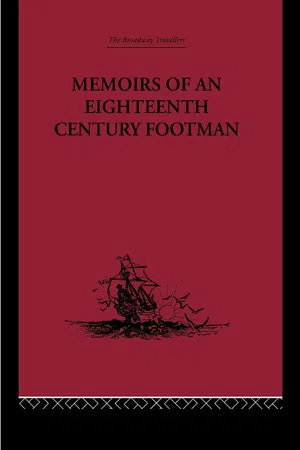
Memoirs of an Eighteenth Century Footman
John Macdonald Travels (1745-1779)
- 304 pages
- English
- ePUB (mobile friendly)
- Available on iOS & Android
eBook - ePub
About this book
Information
The Life and Travels of John Macdonald
IT was formerly customary for the younger sons of gentlemen’s families, in Scotland, that did not go into the navy or army to become graziers. My father, who had no estate of his own, rented near a thousand acres of the Laird of Grant. He reared cattle, and drove them to the South of Scotland, and into England, where he sold them. He married, at the age of twenty, a daughter of some family of the name of Mackay; but I never knew anything of her family. My mother bore a daughter to him, and four sons; but he, being a rover in disposition and always hankering after the army, addicted himself to the use of the broadsword, in which he excelled; and, being very hot and quarrelsome, challenged and fought many gentlemen with the sword and target, which affronted many families in the neighbourhood, and broke my mother’s heart.
I was born in the beginning of the year 1741; and, about two years after, my mother had another son, of whom she died in child-bed. On this my father was almost distracted, swore he would never marry another woman, and said often to the children: “Thy mother I shall never forget.” Then he turned extravagant, did not stay at home so much as he should have done, but neglected his business; and when the Rebellion began, in 1745, he raised a number of men of his own name, whom he employed as his drovers, and marched them up to Prince Charles, whose first camp was about twenty miles off my father’s house. The Prince received him very kindly, and made him a captain of the Macdonald’s clan. He then left his business to the grieve, or foreman, and very seldom came home. He was in all the battles that ensued in Scotland, till he fell at Culloden. Having thus given an account of my parentage, I shall go on with perfect impartiality; and, without taking my own part, to relate every thing that I did, or suffered, whether good or bad.
The Laird of Grant, thinking things would go wrong with Prince Charles, took possession of what cattle was left, and put a person in the house in his name, which indeed saved it afterwards from the flames, when the rebels’ horses were burnt in their stables. The man that had the charge of my father’s affairs went with the cattle, and had a place at the Laird of Grant’s. His name was Boyd. He took my eldest brother, as he had a great regard for the boy and the boy for him, and then we four were left with the maid, who took no care of the house or any little things that were left, as she never expected any wages; but soon went off with a lover. We were now left alone; but my sister being by the providence of God bold, of a heroic disposition, and strong withal, was prepared to go through the following hardships.—Boyd, having read a letter dated from my father, Captain Macdonald, at Goolen’s Inn and Livery Stables, Head of the Canongate, Edinburgh, an answer was returned; but I believe all the letters to Prince Charles’s camp were intercepted, for we never saw or heard from our f father more.
After the letter came from our father, my sister was never easy, but going from one town to another, on foot, sometimes to Inverness, then to see my brother, out and in, to and fro. This made the people take notice and say she had something extraordinary to go through. Now we had no person with us in the house; but the neighbours came to see us now and then. My sister had it in her head to go to Edinburgh, to see my father. She got all the money she could get together, which was fourteen pounds Scots, or twenty-three shillings and four-pence English. With this, the letter from my father in her bosom, and her three brothers in her hand, out she sets for Edinburgh, from the parish of Urquhart, about the middle of September, 1745. Now our ages were as follows: Kitty, fourteen; Duncan, that was left with Boyd, between ten and eleven; Daniel, seven; I, four and a half; and my brother, Alexander, two years and a half. She chose for her departure a moonlight night, that the people should not stop her; and so she got into Inverness about breakfast, having travelled nine miles. My sister carried the child on her back, Daniel carried the bundle, and I ran along side of both. In this manner we travelled from Inverness to Edinburgh, which is one hundred and fifty measured miles, in the space of two months.
Now you shall see the providence of God towards helpless orphans that are left to his care alone. As we travelled, we were the surprise of every one, as we were so young. Our money being expended, we were obliged to beg our bread. We were kindly used by some and harshly by others that were against the Prince. One kind woman equipped us with a little bag for oatmeal, for people that would not take us in would give us a handful of meal. She gave us a round wooden dish also, which my sister put our pottage in when she met with good people that would let her bake it or bake cakes of oatmeal on their gridiron. The chief of our food was pottage and milk, or cakes and milk; and sometimes, if we met with good friends at a farmhouse, we got a bit of meat. If it rained, we waited at a farmhouse sometimes for two or three days. On the journey we had two things to recommend us, although begging from house to house: the things we had on were all plaid, and of the finest kind, for an extravagant father cares not what he buys. Our apparel looked like that of a gentleman’s children, and we had a great share of beauty. Oftentimes where we came folks would say: “Poor dears! they certainly are some gentleman’s children.” Others, “What if they are a gentleman’s bastards?” so, as God knows all things that are to happen, if he takes one thing he gives another; and he has promised to take care of fatherless and motherless children: for nothing can happen without God’s knowledge. We never marched when it rained, if it had been two or three days; and, on a fine sun-shining day, we played on the road till near night, when we continued to shuffle forward. If we could not reach a house, my sister would cover us with our plaids, and cut the tops of brooms with her knife to lay on and cover our plaids. In this manner we lay at nights for weeks, and always set off in the morning. When we had any brook to cross, or small river, my sister would carry over my young brother, then come for me, and afterwards come back to take my brother’s hand.
PLATE II

One time, as she was wading a river with Alexander, when she came near the other side, the water overpowered her and carried her and my brother into a whirlpool, where they floated, till a man who was digging potatoes at a little distance saw her distress, and ran to her relief. He took her and the boy out of the pool, and carried my brother and me over also. He then took us to a farmhouse, where we had victuals and drink, and our clothes dried; and at night we were put into a barn amongst the straw. If at any time we happened to be benighted, and could not get quarters, we sometimes lay in an old house without a roof or any house near it; another time, if the weather was fine, near the roadside, amongst some fine broom. One day, in the morning, before we got up, a lunatic who was coming along heard us speak; he drew aside, and stood over us for some time; he never spoke but seemed amazed. He then ran away as if he had been afraid, and we were very glad. My sister next night was told that he was out of his mind for love. A gentleman in the country gave him every year a suit of clothes; he went where he liked; he would work sometimes well, and, when the work was over, they would take some method to affront him that he might set off in a pet without asking for any wages. This they did not consider as any act of injustice; for, if he got any money he would hide it under a stone, and forget where he laid it; so that the money was lost to the public. One time he worked with a farmer for the whole time of hay and harvest; when the season of his labours was over, the butcher came one night with his cord, his knife, and steel, felt his neck and loins, told the farmer he was fat enough, and that he might be killed in the morning; but before morning he was gone many miles. He often told afterwards how he had deceived the butcher. Many things of this kind we met with, too tedious to be mentioned. When we came near to Dundee, not far from the town, on the side of a river, there was an old castle where there was a blacksmith’s shop. The blacksmith’s wife was as good a woman as ever lived; she put hay in one of the corners of the castle where the rain did not come in, and there at night we lay. In the day we went a-begging to Dundee, and at night we came home. She let my sister dress our pottage and bake cakes; so we staid here three weeks, after which we set out again on our journey. When it was fine weather and we came to a rivulet, my sister washed our second shirt and stockings, for we either had no more at first, or else she did not chuse to bring any more with her. When we came to a river where was a ferry-boat, we begged our passage over. Then we came to Perth, where we stayed a week or two. The letter from my father was now so worn, with fretting and chaffing, that it was scarce legible; but a gentleman made shift to copy it for us afresh. From Perth we travelled to Kinghorn, where we staid a few days till we could get our passage to Leith. A gentleman who was a passenger in the same boat with us, paid our fare. Before we left the boat the same gentleman made a collection for us. He raised half-a-crown. As we passed through Leith we went into an eating-house, and had plenty of bread, meat and broth, for five-pence. In those days a working-man could dine well for two-pence. After dinner, we set out for Edinburgh on a fine walk, a mile and a half in length.
Now, my readers, let me tell you, that for what I have wrote hitherto I have been obliged to my sister; for I was too young to remember it. As we were passing onward to Edinburgh by Leith Walk, a country-woman of ours spoke to us, and asked my sister where we were going and from whence we came. My sister told her. She answered that Prince Charles was gone from Edinburgh, and all his army with him. On hearing this, we sat down and cried; and the woman cried out of pity. Then she took us to Goolen’s Inn. Mr Goolen and every one in the house was surprised and sorry to see us in such a situation. Mr Goolen gave us some victuals, and told my sister he would get us into the workhouse; for he was a very good man and beloved by everyone that knew him. My sister would not hear of the workhouse, nor of any confinement, but took us away immediately. We strayed down towards the bottom of the Canongate, staring at the signs, coaches, and fine horses. At the house below the Duke of Queens-berry’s, in the Canongate, a woman who stood at the door, seeing us strangers, and in the Highland dress, took us in, and asked us several questions concerning our situation; which we answered. She was a widow, and let lodgings; her husband, before he died was a master-chairman, of the name of Macdonald, born near the place where we were born. The woman let us sleep in a lumber garret on an old mattress, and gave us an old blanket or two. We had a shilling left from the collection made for us in the boat, with which we bought provisions. Next morning we set out again, and returned at night; and in this manner continued to live for some time. When we were tired of the town, then we went and begged our way in the country. Sometimes we lay in a barn, and at other times in a barn-yard. In such situations my sister would not let us cough, left we should be heard; and we set off early in the morning for fear of being seen. In this manner we travelled round the country to Berwick, and to Morpeth in England. We now began to get a little money and old clothes, with other things left off by both boys and girls.
PLATE III

In the month of April, 1746, we returned to Edinburgh, by the Cheviot Hills and Coldstream. We went to Mrs Macdonald’s, as before, and she let us lie in the lumber-chamber as usual. Brother Daniel and I, when we got up one day in the morning, went out to play with the boys, and would not be kept under command by my sister, who had the young child to take care of; so that, in the day-time, we were seldom together. We went on in this manner for some time, till an unlucky accident happened, which separated us all. One day, as the Countess of Murray, who reisded in the Canongate, was returning from an airing with her coach-and-six, my sister and the child on her back, crossing the street, were both run over by the carriage. My sister and brother screaming for fear, and the people calling “Stop, stop!”, made the Countess faint away. Kitty and Alexander were taken from under the horses, and, as God would have it, no bones were broken. They were both taken into the lady’s house, and duly taken care of. When they recovered, the boy was put to nurse by Lady Murray; and one Mr Vernon, an Englishman who had been butler to Lord Murray and by him placed in a good office in the Excise, took my sister for a servant, and clothed her. Thus my sister and Alexander were done for. As to Daniel and me, we both of us begged, and played our time away; strolling round the country, and stopping sometimes in the barnyards, and at other times in a barn. In town we lay in the stairs; for about Edinburgh, as in Paris and Madrid, many large families live upon one staircase. They shut their own door, but the street-door is always open. There was an opinion at that time very prevalent amongst us poor children, of whom, after the Rebellion there were a great many, that the doctors came at night to find poor children asleep, and put sticking-plasters to their mouth, that they might not call out, and then to take them away to be dissected; and indeed I believe it very true, for what everyone says must be true; and the poor Highlanders were more despised at that time by the Scots in general, of the other party, than the devils in hell. So when we passed the night in a stair or at a door, one slept and the other kept watch. In our rounds we went to see our brother, sometimes, at nurse; and one time to see my sister, but she wept so much, that Daniel, having more sense than me, said, after we came away, he would not go again because our being poor and helpless hurt her so much. Another day we went a-begging to Mr Campbell’s, a master-carpenter’s; and who should come to the door but one of my father’s servants? The man, on seeing us, was greatly affected, and a scene ensued, which took the attention of many. But nothing touched our hearts; we had no sorrow, nor the least uneasiness. One morning we strolled within the gates of the city of
Edinburgh, to see the fine high houses, and were taken up by the soldiers of the City Guard; for none may beg within the walls of the city, and the soldiers have an allowance for every one they take up. Our names were given to the Captain of the Guard, and entered in a book. Young people that could not find protection were sent abroad in merchant-ships, in a situation little better than that of convicts, though not under the same disgrace. Those who were kept in the guard-house lived well, by the side of a good fire, with three rolls and three pints of beer a day. In this comfortable state we remained for three nights and two days, till the Council Chamber met. But when the guard soldiers found who we were, they were very sorry at what they had done; for they were mostly all Highlanders, and from our shire of Inverness. They asked us if we knew any person in town. My brother mentioned Mr Goolen, at the Livery-stables, at the head of the Canongate. This worthy man appeared for us at the Council Chamber before the Lord Provost, and gave him such information concerning us as induced him to set us at liberty. We went with Mr Goolen; and, as there was one of his houses, next door to his dwelling-house, empty, he let us lie at night in a closet on hay. When we had a mind to go to rest, we got both of us together into a cornsack. We went out in the daytime, as before, a-begging; but at night we had a whole house to ourselves like gentlemen. Now Daniel, being the oldest and about the size of Mr Goolen’s son, his only child, he got his old clothes, and played with the boy, and went on errands, and there remained.
I was still left to my shifts, and went out, as usual, to beg and play, for about one year. Sometimes I was desired to get in the ride, and at other times to ride a horse to a brook, about a mile out of town; in which employment I very much delighted. At night, when I came home, I lay down at the door of a warehouse, till my brother came to bed. He always brought me something to eat, and some halfpence for the next day. One morning, as we were getting up, a woman came into our empty house, where she saw a plaid that Mr Goolen had given to cover us. She asked if we took that out with us. We said: “No— never.” She went away, and as usual we left the door on the latch. But she afterwards came and stole our plaid, which contained six yards. Soon after this the house was let. We then slept in the stable in the hay-stall.
About this time, one Mr Frazer, a master shoemaker, took me to rock the cradle. I did not like the confinement of this. I pinched the child in the cradle and made it cry. I was turned off accordingly, which was the thing that I wanted. I was now taken into a gentleman’s house to turn the spit. They gave me stinking veal for dinner—I put it behind the chest and set off.
I went next to lead a blind fiddler, with whom I lived four months. He taught me to play on the bass. He carried the one instrument, and I the other on my back. One time we went to a wedding in the country, near Roslin Castle. Thither he rode on his ass: I walked in the middle of the road, and the ass followed. We lived well all that day, and my master took thirty shillings. At night we both lay in the barn amongst some hay; but we forgot the ass in the field. When the fiddler recollected this circumstance, he sent me for him; and when I had brought the creature home, I tied him with his halter to the strong beer-cock. In the night the ass drew out the cock, and the beer was spilt. At daylight I saw the place all wet, and told my master what had happened. The fiddler beat me well with the strap of the fiddle-case; so, as I had got two shillings at the wedding in my pocket, I left my master, the ass, and the fiddles, and ran as fast as I could into Edinburgh. I went next to a farmer’s, near Corstorphin, about five miles from Edinburgh. I would not stay in the farmer’s two days: like Lot’s wife I looked back to the city, whither I returned. I now began to live off Goolen’s Lane, or Close, and found out Gibbs’ Lane, a little below, about thirty yards distance. Mr Gibbs kept hackney-coaches and chaises and twenty horses. I got some victuals and drink from the coachmen and postilions for doing what they desired me, and I slept in the large tub in which they mixed the oats and corn for the horses. In this situation I continued for some time. When I left my brother, he was taken to sleep in Mr Goolen’s house. I saw him every day. About this time one of the coachmen’s sons died, and, as I was all tatters, he gave me his clothes, which fitted me to an hair. When a coachman went into the country with a family, to their country-house, I went in the boot and came home with them again. And, when I told them, on their asking, who I was, they often gave me six-pence or a shilling, which I spent immediately with the coachman and postilion. I liked this life with all my heart. In October, 1746, my brother Duncan, in the Highlands, hearing that we were about Edinburgh, that our father was killed in the battle of Culloden, which is within twenty miles of the place where he lived with Boyd; that everything belonging to the rebels was destroyed and their houses set on fire by the Duke of Cumberland, came to Edinburgh, dressed very genteelly, with two guineas in his pocket—one of which he had received from the Laird of Grant and the other from Mr. Boyd—for he never tasted of poverty as we did. When he saw us, he was amazed, and grieved to the heart, and thought bad worse. He stopped at Mr Goolen’s with his brother, and paid what he called for. Mr Goolen asked him if he would be a mason. He said: “Yes.” So in a week he sent him to Falkirk to his brother, a stonemason in great business and credit, with whom he was bound apprentice for seven years.
Between this time and the year fifty, I became a postilion to Mr Gibbs, who set his carpenter to make a bed-frame for me over the hay-stall, in one of the stables, and gave me blankets, bedding, and sheets every month. Mr Gibbs was a man of great possessions. He had a whole lane of houses, the largest coachyard in Great Britain, a garden and a gardener. He put me in livery, and looked upon me as his apprentice. I was fitted out with a green jacket with a red cape, a red waistcoat, and a leather cap with the forepart lined with red morocco. Mr Gibbs was a gentleman, the son of a gentleman, and dressed as a gentleman, every day in his ruffles, which is uncommon for men over horses and carriages, and never drove a coach in his life. The coat-of-arms he had on his carriage was a hand in hand, within a double treasure of flowers: his motto, the Gibbs’ Contract. He married a gentleman’s daughter. Her father was the Laird of Craig-Leith. When he was courting his mistress, I always drove him in the chaise to see the young lady, and then I lived well. In those days genteel families took a coach-and-six horses, as there was no chaise to be hired, but single chairs with two wheels, and the second horse was often fixed to the left side to draw it along: so, in returning to town, the coachman would make the postilion drive the set of horses; and I was postilion while the coachman was inside. By this means I learned to drive, and soon became the road-postilion myself; in which station I enjoyed a very pleasant life. When we went into the country with gentlemen’s families, to their seats, we had good living on the road; and, when we arrived at our journey’s end, most commonly noblemen and gentlemen made us stay a day or two to rest our horses. My master pitched on me to go into the country because I was light. When I was put on the horse I had a strap about my waist, and fastened to the crupper of the saddle; so that if the horse stumbled I could not pitch over his head. The roads, in those days, were very bad. Travelling, of course, was not so easy as it is now. It was therefore thought to be a matter of consequence to have drivers of light weight, and I was the littlest postilion in Scotland or any other country. When I went the Falkirk way, I used to see my brother Duncan, the mason. He was very happy to see me. He came sometimes to see us in Edinburgh. My master, after a short courtship, married Craig-Leith’s daughter; he had fifteen hundred pounds with her. Soon after their marriage, she gave a feast in my master’s own house to the blacksmiths, wheelers, harness-makers, painters, coachmen and postilions, and helpers, and all their wives and children. My master and mistress dined with them, and after dinner, spent the evening abroad, leaving Mr Gibbs’ niece to conduct the entertainment at home, with plenty of wine, rum, punch, and ale, and a fiddler. Every Monday morning Mrs Gibbs gave the stablemen a cold joint of meat, and the broken victuals of Sunday, and strong beer. Now everything was agreeable. My sister and two brothers were always in town. We saw one another frequently and wanted for nothing. All the others had education. I had none, but learned wickedness.
The year 1750 was a remarkable era in my life. John Dalrymple, eldest brother of Sir Hugh Dalrymple of North Berwick, Bart., in East Lothian, at the death of Lord Bargeny succeeded to an estate of four thousand pounds per year, in right of his mother, a daughter of Lord Bargeny’s eldest son; though, as the estate came by a woman, the title was extinct. Mr Dalrymple now changed his name to Hamilton. After he had been for...
Table of contents
- COVER PAGE
- TITLE PAGE
- COPYRIGHT PAGE
- LIST OF ILLUSTRATIONS
- NOTE ON THE TEXT AND THE ILLUSTRATIONS
- INTRODUCTION
- PREFACE: TO THE EDITION OF 1790
- THE LIFE AND TRAVELS OF JOHN MACDONALD
Trusted by 375,005 students
Access to over 1.5 million titles for a fair monthly price.
Study more efficiently using our study tools.
Frequently asked questions
Yes, you can cancel anytime from the Subscription tab in your account settings on the Perlego website. Your subscription will stay active until the end of your current billing period. Learn how to cancel your subscription
No, books cannot be downloaded as external files, such as PDFs, for use outside of Perlego. However, you can download books within the Perlego app for offline reading on mobile or tablet. Learn how to download books offline
Perlego offers two plans: Essential and Complete
- Essential is ideal for learners and professionals who enjoy exploring a wide range of subjects. Access the Essential Library with 800,000+ trusted titles and best-sellers across business, personal growth, and the humanities. Includes unlimited reading time and Standard Read Aloud voice.
- Complete: Perfect for advanced learners and researchers needing full, unrestricted access. Unlock 1.5M+ books across hundreds of subjects, including academic and specialized titles. The Complete Plan also includes advanced features like Premium Read Aloud and Research Assistant.
We are an online textbook subscription service, where you can get access to an entire online library for less than the price of a single book per month. With over 1.5 million books across 990+ topics, we’ve got you covered! Learn about our mission
Look out for the read-aloud symbol on your next book to see if you can listen to it. The read-aloud tool reads text aloud for you, highlighting the text as it is being read. You can pause it, speed it up and slow it down. Learn more about Read Aloud
Yes! You can use the Perlego app on both iOS and Android devices to read anytime, anywhere — even offline. Perfect for commutes or when you’re on the go.
Please note we cannot support devices running on iOS 13 and Android 7 or earlier. Learn more about using the app
Please note we cannot support devices running on iOS 13 and Android 7 or earlier. Learn more about using the app
Yes, you can access Memoirs of an Eighteenth Century Footman by John Macdonald in PDF and/or ePUB format, as well as other popular books in Storia & Storia britannica. We have over 1.5 million books available in our catalogue for you to explore.