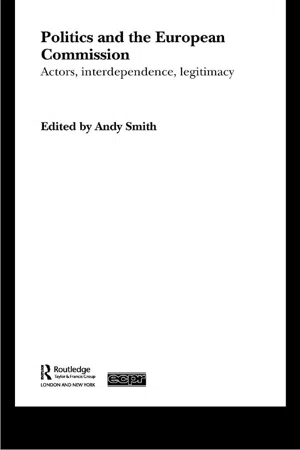
The European Commission is an organization which has come to fascinate or repulse a range of national politicians, journalists and social scientists. In contrast to the prevailing image of the Commission as a 'bureaucrat's paradise', however, and by using the results of original research, this book deliberately sets out to investigate this organization's relationship to politics. It does so first by developing a variety of case-studies (health, development aid, preparations for Eastern enlargement, etc.) as a means of studying the relationships, networks and interdependencies which link commissioners and Commission officials to national politicians, civil servants and interest groups. Second, by looking in detail at how the Commission publicizes its work, notably through producing public information and liaising with the media, fresh light is shone upon the complex question of the Commission's legitimacy. Politics and the European Commission provides a framework for generating new information about, and interpretations of, the power struggles at the heart of the EU.
- 248 pages
- English
- ePUB (mobile friendly)
- Available on iOS & Android
eBook - ePub
About this book
Information
Part I
Actors, institutions and
interdependence
1 Doing politics and pretending not to
The Commission’s role in distributing aid to Eastern Europe
Introduction
Academic research on the European Union (EU) has undergone a series of evolutions, one of which is the increasing attention given to the European administration. This concern is twofold: on one hand, the growing number of studies on EU policies has chiefly led to acknowledging the decisive role played by the Commission in setting the agenda and formulating European public policies (Christiansen 1996; Cini 1997; Cram 1999; Fouilleux 2003; Jourdain 1995; Nugent 1995; Peters 1992; Smith 1995); on the other hand, observations made from a more anthropological perspective looking at the new meanings ascribed to notions of administration and policy in Brussels, have revealed the specificity of EU institutions in comparison to existing administrative models (Abélès, Bellier and MacDonald 1993; Abélès and Bellier 1996; Bellier 1999).
Denying the political dimension of the Commission’s work – observed in the strategies it implements in order to enforce both its own understanding of issues to be considered and the solutions it propounds – is thus out of the question. Yet few publications draw a parallel between this political activity and the distinct position held by the European Commission in the European institutional system. The fact that it may simultaneously be deprived of democratic legitimacy while dependent upon political circumstances for its work and the translation of intentions into achievements, does not prevent the Commission from exerting a decisive influence upon the European Union’s decision-making process and the definition of the broad orientations of European integration. In another way, anthropological studies have also highlighted the constraints of the Commission’s institutional position, particularly its incapacity to claim political legitimacy, and shown how these constraints are apprehended within the organization itself. However, they have not systematically questioned the effects of these representations on the daily practices of Commission officials and the way they contribute to shaping public action.
Standing exactly at the crossroad of both approaches, I attempt to take both sets of results and interpretations a stage further. Once it is admitted that the classical opposition between administration and politics cannot account for the particular roles of the European Commission and its institutional partners (Parliament, Council), understanding the resilience of this opposition in the discourse and perceptions of real actors, as well as its consequences on the strategies and behaviours they adopt, is of considerable importance.1
From such a perspective, this paper analyses how the Commission relates to the political dimension of its action starting from two complementary hypotheses. First, the Commission constantly seeks to play a political role, without ever attaining the political legitimacy required to endorse such a role. It is therefore involved in acts seeking to legitimize the power it handles, and simultaneously to mask the political dimension of its activity. Second, this form of self-censorship is substantiated through several modes: modes of action and management within the Commission (through resorting to technicization and juridicization), or the officials’ self perception of their role and function in the Commission, within which the operation of defining what politics, and what political officials should be, takes a central place. The Commission’s relationship to the political dimension of its own action is thus used as a lens for examining the dynamics behind the production of European public policies.
These hypotheses are verified in the two parts of this chapter. The first observes and describes the different dimensions of the European Commission’s relationship to politics as it manifests itself in the discourse the institution and its members produce about themselves and about their partners in the EU.2 Centred upon EU policy towards Central and Eastern European countries (Robert 2001b), the second part endeavours to reveal to what extent the Commission’s relationship to politics inspires and structures the daily practices of its civil servants and leads their organization as a whole to select particular types of policy-making.
The European Commission’s relationship(s) to politics
The European Commission’s relationship to politics is specific and manifold. More precisely, the hypothesis developed here considers the activity of the Commission to be political in nature, despite the fact that this institution and the actors who belong to it constantly strive to camouflage this reality. From this angle, two distinct and complementary aspects of the effort made to shrug off politics are examined: how civil servants construct their professional identity around specific characteristics which oppose those they attribute to their various opposite numbers – MEPs, Council personnel and members; the modes of legitimation favoured by the European administration in order to justify and account for its action within the European political system.
With regard to research carried out on the EU in the past two decades, the Commission’s political role and ambition today appear unquestioned and unquestionable (Christiansen 1997). In particular, specialists on EU public policy-making have established that the European administration often plays a decisive role in the different steps surrounding reforms and new measures, from agenda setting to implementation, during which its work stretches much further than the mere execution of rules and decisions adopted by the Council (Eichener 1992). Moreover, numerous studies carried out on the Commission’s personnel have shown the growing place and importance taken by political careers and resources (Donnelly and Ritchie 1994; Joana and Smith 2002; Page 1997; Smith 1996, 2002).
In this respect, the PHARE programme of technical assistance to the Eastern and Central European states represents a clear example. First of all, its genesis owes a great deal to Jacques Delors, President of the Commission from 1985 to 1995, who developed resources through a whole array of relations built during the course of his political career to convince and compel his partners outside and inside the EU to entrust the European administration with Western aid to Eastern Europe (Deloche- Gaudez and Lequesne 1996; Niemann 1998). Beside revealing this institution’s ability to impose its own understanding of the key issues, such institutional activism as displayed by the Commission’s representatives in creating PHARE shows that their organization, just like the Council or the Parliament, acts to further its own ends. These objectives more often than not amount to a willingness to expand its own institutional prerogatives (see Chapters 6 and 10). In short, obtaining the management of the PHARE programme was perceived by activists within the Commission as a means for the European administration to gain access to a domain of EU foreign policy that had previously been kept out of its reach.
Second, the room for manoeuvre left to the Commission by the successive and rather vague regulations adopted by the Council on PHARE,3 emphasizes the creative dimension of the Commission’s management of this programme. In fact, this legislation allowed the Commission to define for itself the priority sectors of Western aid, the nature of this assistance, the conditions of its implementation, as well as the personnel who would be in charge of it, i.e. companies and consultants entrusted with running projects in the field.
Finally, progressive institutionalization of the programme throughout the 1990s and the fact that it was clearly identified as one of the main instruments of European policy to applicant states, must be attributed to the Commission’s capacity to hinge together technical and political patterns. In other words, the Commission’s ability to enlist technical knowledge and aptitudes to produce solutions which also take into account political imperatives and constraints to which public choices are subjected (anticipatory management of conflict between member states, anticipation of the symbolic consequences of its activity on relationships with Eastern Europe, and/or their electoral impact (Robert 2001a).
If the fact that the activity of the European Commission is political in nature is now fully acknowledged, another characteristic of this institution is less frequently emphasized by researchers: the discourse the European administration produces about itself and its action tends to systematically lessen, even deny, the political dimension of its work. More generally, this dicourse institutes ‘a-politicism’ as the raison d’être of this institution and the very basis of its legitimacy.
On the one hand, ‘a-politicism’ is exhibited as a special disposition presented as a set of know-how and behaviour which belong exclusively to the Commission’s civil servants. Interviews carried out with members of the Commission in the course of our research tended to show how, when referring to their professional identity, they make constant allusions to MEPs and Council members. This allows them to claim a whole pack of specific qualities – neutrality, independence, disinterestedness, scientific knowledge, technical competence, objectivity, ability to think in the long term – which are set against the ‘defaults and weaknesses’ of those involved in ‘politics’: national interest and selfishness, ignorance and remoteness from the field, pretence, inconsistency and incoherence, short term and electoral vision. As illustrated in the following citation, actors from the Commission draw upon this contrasted picture in order to apprehend and lend meaning to the daily tasks involved in implementing PHARE. They also use this classification to decipher their relationships with their institutional partners:
When we worked together on the PHARE programme, Member States were always very careful about protecting [their own interest] (i.e. to offer European contracts to national consultants and enterprises). They played their part as a Member State, their role of defending a national interest, and we [the Commission] have represented the interest of the European Community, as usual, and the interests of applicant countries . . . The European Parliament members were very enthusiastic about the PHARE programme but we have had to rationalize their mobilisation. For example, they wanted Romanian orphanages to become as modern as those of Western Europe overnight . . . We [the Commission] were there to reason with them and take the actual needs of the Romanian people into account. To build luxury orphanages could have been a provocation for Romanian families. This story of the Romanian orphanages is a good example of our daily work with MEPs.4
Although perhaps more obvious among agents of the PHARE programme owing to its particular history, such dispositions are not, however, a particular specificity of DG IA. Instead they should be regarded as pervasive characteristics of the Commission’s administrative culture:
Whatever their grade, European civil servants are supposed to act on a non-emotional basis and remain above influences, whilst listening to the demands of different representatives who make up part of their sources of information. In theory, they act rationally, which means they must use certain techniques for making choices, impartially, which is linked to concepts of independence and ethics. According to the insider viewpoint, even if the actions of the Commission and its agents are imperfect, they are founded upon quantifiable and evaluable criteria which are linked to established and controllable frameworks. According to the civil servants themselves, this is seen as being the opposite of how politicians behave because they are more open to the risks of elections which means they are not assured of permanency and are thus inclined to ‘give in to emotions’.
(Bellier 1999: 47)
On the other hand, the claim to ‘a-politicism’ also translates into another discourse propagated by the Commission which describes its activity and supports the relevance of its proposals. What sets it apart from its institutional partners (Parliament, Councils, member states) is not so much its purely technical, juridical or administrative tasks, but the efforts it spends to present it as such, and appear as a mere tool with which to deal with social trends and fundamental principles. The Commission’s effort to play down the political dimension of its work relates to the following two types of operation which, in reality, are frequently inter-twined:
- concealment of the creative dimension of its work through denying the extent of interpretative activity and the room for manoeuvre when implementing Council decisions and European rules;
- obliteration of the ‘ideological’ dimension – i.e. based upon a reference to values and involving making choices – of its positions and proposals, by presenting them as dictated by a certain rationale (juridical, technical) or as the obvious product of a European common interest.
Examples of EU policy towards Eastern European countries yet again help to illustrate this claim. First, when presenting the programming activity of the Commission in annual PHARE reports to Council, the Parliament and the general public, European civil servants are depicted as mere underlings while the Council’s declarations and regulations are highlighted as guidelines that are precise enough to set the framework and content of their mission. Moreover, these reports never hint that certain choices may need to be made during implementation: programming is presented as a simple process that is both well controlled and objective because it is based upon seasoned techniques (particularly the so-called ‘demand-driven’ technique which consists in co-operating with aid beneficiaries) and relying upon a ‘scientific’ vision of the overall process of the transition to democracy. Thus identification of so-called priority sectors is presented as the twin outcome of preferences expressed by partner states, and as a practical exercise based upon unquestionable knowledge about the changes being experienced in the Eastern countries. This latter observation is similar to conclusions reached in studies carried out of other European policies, especially research (Jourdain 1996) or development aid for South American states (Le Naëlou 1995). These studies have all revealed a process whereby choices made during the implementation of these projects are naturalized, notably through constant reference to technical rationality as the ultimate and insurmountable justification for decisions made by the Commission.
This chapter is unable to address every explanation behind the Commission’s relationship to politics. Suffice to say that camouflaging politics is a means for the European administration to solve some of the contradictions of its institutional position. Resorting to law and technical issues to make its positioning appear ‘natural’, allows the Commission to justify its prerogatives and proposals without calling upon a political argument, which it considers as prohibited anyway for want of democratic legitimacy. The qualities of independence, disinterestedness and expertise put forward by officials, attest to the capacity and legitimacy of these unelected and ‘nation-less’ men and women to define where Europe’s general interest lies. Furthermore, European civil servants’ relationship to politics and their conflicts of legitimacy with member states manifest common features with representations and behaviours typical of national administrative staff, already well studied by sociology and political science (Duran 1999; De Baecque and Quermonne 1982; Grémion 1979; Suleiman 1974). These similarities have a partial explanation in administrative history and, more precisely, in the types of legitimacy of each civil service. Nonetheless, such conflicts take on a particular aspect in the case of the European administrat...
Table of contents
- Cover Page
- Title Page
- Copyright Page
- Contributors
- Series Editor’s Preface
- Abbreviations
- Introduction
- Part I: Actors, Institutions and Interdependence
- Part II: The Media, the Commission and Its Legitimacy
- Bibliography
Trusted by 375,005 students
Access to over 1.5 million titles for a fair monthly price.
Study more efficiently using our study tools.
Frequently asked questions
Yes, you can cancel anytime from the Subscription tab in your account settings on the Perlego website. Your subscription will stay active until the end of your current billing period. Learn how to cancel your subscription
No, books cannot be downloaded as external files, such as PDFs, for use outside of Perlego. However, you can download books within the Perlego app for offline reading on mobile or tablet. Learn how to download books offline
Perlego offers two plans: Essential and Complete
- Essential is ideal for learners and professionals who enjoy exploring a wide range of subjects. Access the Essential Library with 800,000+ trusted titles and best-sellers across business, personal growth, and the humanities. Includes unlimited reading time and Standard Read Aloud voice.
- Complete: Perfect for advanced learners and researchers needing full, unrestricted access. Unlock 1.5M+ books across hundreds of subjects, including academic and specialized titles. The Complete Plan also includes advanced features like Premium Read Aloud and Research Assistant.
We are an online textbook subscription service, where you can get access to an entire online library for less than the price of a single book per month. With over 1.5 million books across 990+ topics, we’ve got you covered! Learn about our mission
Look out for the read-aloud symbol on your next book to see if you can listen to it. The read-aloud tool reads text aloud for you, highlighting the text as it is being read. You can pause it, speed it up and slow it down. Learn more about Read Aloud
Yes! You can use the Perlego app on both iOS and Android devices to read anytime, anywhere — even offline. Perfect for commutes or when you’re on the go.
Please note we cannot support devices running on iOS 13 and Android 7 or earlier. Learn more about using the app
Please note we cannot support devices running on iOS 13 and Android 7 or earlier. Learn more about using the app
Yes, you can access Politics and the European Commission by Andy Smith in PDF and/or ePUB format, as well as other popular books in Politics & International Relations & Political Economy. We have over 1.5 million books available in our catalogue for you to explore.