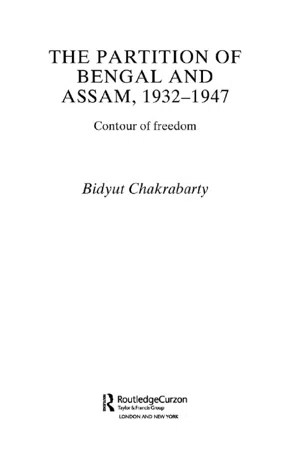
The fragmentation of Bengal and Assam in 1947 was a crucial moment in India's socio-political history as a nation state. Both the British Indian provinces were divided as much through the actions of the Muslim League as by those of Congress and the British colonial power. Attributing partition largely to Hindu communalists is, therefore, historically inaccurate and factually misleading. The Partition of Bengal and Assam provides a review of constitutional and party politics as well as of popular attitudes and perceptions. The primary aim of this book is to unravel the intricate socio-economic and political processes that led up to partition, as Hindus and Muslims competed ferociously for the new power and privileges to be conferred on them with independence. As shown in the book, well before they divorced at a political level, Hindus and Muslims had been cleaved apart by their socio-economic differences. Partition was probably inevitable.
- 288 pages
- English
- ePUB (mobile friendly)
- Available on iOS & Android
eBook - ePub
1
THE HINDU–MUSLIM DIFFERENCES
The socio-economic and cultural dimensions
The nature of agrarian relations and their impact on political development in the pre-1947 Bengal had a decisive influence on the complexion and articulation of institutional politics. The Hindu–Muslim differences in both socio-political and cultural terms laid the foundation of communal political groups. Capitalising on the disproportionate economic development between the two communities, the Muslim political forces strengthened their claims for a separate state. Among the Hindus, the rise of the lower castes and their challenge to the domination of the upper castes also had a noticeable impact on provincial political arithmetic. The aim of this chapter is to elucidate this socio-economic background, since this was both the source and context of political articulation in Bengal. Ecological and demographic influences brought about variations in the political economy of the province. By concentrating on these influences, an attempt will be made to show how they caused differential development in the rapidly changing economy of pre-partition Bengal.
The political economy of Hindu–Muslim relations
Bengal’s socio-economic configurations provided a crucial structural condition in which the Hindu–Muslim relations were articulated. The fact that the peasantry in east Bengal was predominantly Muslim and landlords largely Hindu remained important in organising one community against another. In view of a well-defined borderline between the two communities, the clash of economic interests between the Muslim peasantry and their oppressors, the high caste landlords and moneylenders with whom the entire Hindu community came to be identified in the Muslim mind, seemed to be inevitable. In other words, ‘[a]lthough the conflicts were basically economic, the prevailing ideological atmosphere of grievance of the Muslim peasantry soon acquired a communal colour’.1 The Muslim vested interests who had grievances against the Hindu landlords and moneylenders undertook a well-planned campaign to draw mileage out of this. The combination of religious appeal with economic interests created ‘a politically volatile situation highly susceptible to communalist propaganda’. 2 Those who organised the Muslim peasantry under these peculiar circumstances continued to emphasise this dimension, underplaying, if not ignoring, the exploitative role of the Muslim landlords. According to the available evidence, the rent-receiving classes expanded rapidly between 1921 and 1931 (see Table 1.1). The religious composition of these rent-receiving classes, however, in Table 1.2, challenges the established hypothesis that communalism owed its growth predominantly (if not exclusively) to a disproportionate economic development between the two communities. In view of a specific pattern of crowd behaviour in the communal riots – some were agrarian conflicts – it is easy to discern the role of communalism in uniting one community against another.
Table 1.2 clearly demonstrates that in these Muslim-majority divisions, the number of Muslim rent-receivers was no less significant than anywhere else in Bengal. The fact that the Muslim anti-zamindari movement in these areas was directed predominantly against the Hindu zamindars and talukdars confirms the role of communalism in consolidating one community against another.
The situation deteriorated especially after the Great Depression of the 1930s, which brought a decisive change in the balance of class power in rural Bengal. As the recent work of Sugata Bose has shown, the rupture in the system of rural credit relations deprived Hindu talukdars and traders of their dominance. With their reluctance to provide credit to the peasants as mahajans (money lenders and lenders of food grain during the lean period), they lost social credibility in the Muslim-dominated small peasant economy of east Bengal in particular. As Bose argues, the rentier and trading classes ‘ceased to perform any useful function. Once a political challenge came within the realm of possibility, the strength of a religious identity was exploited in a readily available and, for the privileged co-religionist, a safe ideology’.3 So at a critical juncture of Bengal’s history, religious–communal identity did impart a sense of collectivity and an ideological legitimation once the balance of class power had undergone a decisive shift. Since they no longer played any useful role, they were considered parasites and hence, Bose has argued, Muslims were easily convinced of their exploitative role. The control of the state machinery by the KPP–Muslim League alliance after the 1937 elections changed ‘organised politics’ significantly. Once the political division at the institutional level of politics came to correspond to a religious cleavage, and religion in the countryside came to provide an ideology uniting Muslims with different political commitments under the same banner, the communal schism was unbridgeable.4
Table 1.1 Categories of agricultural workers as a percentage of the total agricultural workforce in British Bengal, 1911–31
Table 1.2 Percentage of total population and rent-receivers in majority Muslim divisions, 1911
The discussion pursued so far has drawn attention to a gradual deterioration in the income of the Bengali agrarian population. Until 1929, Bengal agriculture accommodated rapidly growing demographic pressure without any substantial change in its structure. This was due to the extension of the cultivated area,5 and the growth of high-value cash crops like rice and jute. It has been well demonstrated in various works on the Bengal agrarian economy how jute strengthened ‘the small peasant economy’ and how the sudden decline of price as a result of the Depression affected it adversely. According to B. B. Chaudhuri, by the turn of the twentieth century there was very little cultivable land in Bengal that was not fully employed.6 It has also been shown how developments within the Bengal agrarian economy contributed to the rise of a rentier class, the basic root of which lay perhaps in the size of the gap between the fixed rent payable to the government and the total rent extracted from the actual tiller. According to a 1918–19 estimate, ‘proprietors and tenure-holders intercepted as much as 76.7 percentage of the gross rent of Rs. 12.85 Crores, only Rs. 2.99 Crores being collected as land revenue’.7
The gap between rent and revenue along with income from other sources, like trade and commerce or incomes from professional activity, constituted the financial basis of the madhyabitta sreni (middle class) as they were identified in the contemporary literature.8 Since there was no grave dislocation within the agrarian economy until the Great Depression, this class continued to thrive, but their income from rent began decreasing from the mid-nineteenth century with the proliferation of estates and tenures. With the exception of two districts in north Bengal, by the end of the nineteenth century the zamindari property became increasingly characterised by extensive fragmentation due to inheritance customs. The position was particularly bad in west and central Bengal because the limit to the natural expansion of land had virtually been reached by the second half of the nineteenth century. The situation in east Bengal was not as gloomy as it was elsewhere because land was more fertile and the process of natural expansion of land continued almost until 1932 (see Table 1.3).
Moreover, the fact that jute was a high-value crop for the world market and grown in east Bengal, enabled the peasants to meet the rent demands of an expanding class of rentiers. However, there was a limit as well. Since the demand for jute in the world market was a determining factor, the peasants themselves could not expand jute cultivation. The demand for jute in the international market increased by 35 percent between 1922 and 1929,9 but the Depression affected its market adversely. Thus with the sudden decline of its demand in the world market during the depression, the fragility of ‘the small peasant production’ was exposed in east Bengal. Everybody associated with land was hard-hit. As Table 1.4 shows, between 1928–29 and 1940–41, the fall in the collection of rent was alarming in the major jute-growing districts.
Table 1.3 Changes in cultivated areas in the moribund and active delta regions (in acres)
It is evident that rental incomes declined drastically between 1929 and 1941. The rent-receiving classes and small landlords adopted ‘the certificate procedure’ to realise the arrears of rent but, given peasants’ inability to pay because there was little/less money for jute, the certificate procedure never became effective. Even the old device of ‘selling the defaulters’ holdings’10 did not work because there was little money available for the purchase. The situation took an alarming turn in view of the growing ‘no rent mentality’ of the late 1930s in the jute-growing areas of east Bengal which, according to the Dhaka Divisional Commissioner, posed ‘a serious threat to the zamindari system itself’.11
The Great Slump brought about drastic changes in the Bengal political economy. As a result of a sudden decrease of income from land, the moneyed class (with whatever money they had), in large numbers, started investing in houses in cities, in shares and in other securities rather than in land.12 The sudden fall in the demand for jute in the world market adversely affected the jute-cultivators; in the absence of an alternative source of livelihood, their economic conditions were more precarious than ever. Thus...
Table of contents
- COVER PAGE
- TITLE PAGE
- COPYRIGHT PAGE
- TABLES
- ACKNOWLEDGEMENTS
- ABBREVIATIONS
- INTRODUCTION
- 1: THE HINDU–MUSLIM DIFFERENCES
- 2: DIVIDE AND RULE
- 3: POLITICS OF ACCOMMODATION AND CONFRONTATION
- 4: AN ALTERNATIVE TO PARTITION
- 5: REDEFINING BORDERS
- 6: CONSTRUCTION AND CONSOLIDATION OF IDENTITIES
- 7: HISTORY OF PARTITION OR PARTITION OF HISTORY?
- CONCLUSION
- GLOSSARY
- BIBLIOGRAPHICAL ESSAY
- BIBLIOGRAPHY
Trusted by 375,005 students
Access to over 1.5 million titles for a fair monthly price.
Study more efficiently using our study tools.
Frequently asked questions
Yes, you can cancel anytime from the Subscription tab in your account settings on the Perlego website. Your subscription will stay active until the end of your current billing period. Learn how to cancel your subscription
No, books cannot be downloaded as external files, such as PDFs, for use outside of Perlego. However, you can download books within the Perlego app for offline reading on mobile or tablet. Learn how to download books offline
Perlego offers two plans: Essential and Complete
- Essential is ideal for learners and professionals who enjoy exploring a wide range of subjects. Access the Essential Library with 800,000+ trusted titles and best-sellers across business, personal growth, and the humanities. Includes unlimited reading time and Standard Read Aloud voice.
- Complete: Perfect for advanced learners and researchers needing full, unrestricted access. Unlock 1.5M+ books across hundreds of subjects, including academic and specialized titles. The Complete Plan also includes advanced features like Premium Read Aloud and Research Assistant.
We are an online textbook subscription service, where you can get access to an entire online library for less than the price of a single book per month. With over 1.5 million books across 990+ topics, we’ve got you covered! Learn about our mission
Look out for the read-aloud symbol on your next book to see if you can listen to it. The read-aloud tool reads text aloud for you, highlighting the text as it is being read. You can pause it, speed it up and slow it down. Learn more about Read Aloud
Yes! You can use the Perlego app on both iOS and Android devices to read anytime, anywhere — even offline. Perfect for commutes or when you’re on the go.
Please note we cannot support devices running on iOS 13 and Android 7 or earlier. Learn more about using the app
Please note we cannot support devices running on iOS 13 and Android 7 or earlier. Learn more about using the app
Yes, you can access The Partition of Bengal and Assam, 1932-1947 by Bidyut Chakrabarty in PDF and/or ePUB format, as well as other popular books in History & Asian History. We have over 1.5 million books available in our catalogue for you to explore.