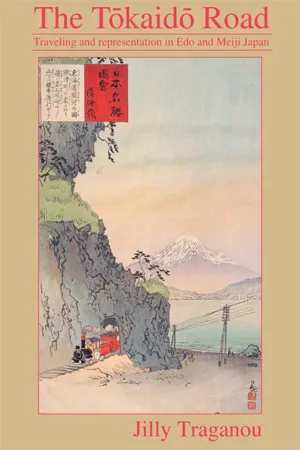
The Tôkaidô Road offers a comparative study of the Tôkaidô road's representations during the Edo (1600-1868) and Meiji (1868-1912) eras. Throughout the Edo era, the Tôkaidô highway was the most important route of Japan and transportation was confined to foot travel. In 1889, the Tôkaidô Railway was established, at first paralleling and eventually almost eliminating the use of the highway. During both periods, the Tôkaidô was a popular topic of representation and was depicted in a variety of visual and literary media. After the installation of the railway in the Meiji era, the Tôkaidô was presented as a landscape of progress, modernity and westernisation. Such representations were fundamental in shaping the Tôkaidô and the realm of travelling in the collective consciousness of the Japanese people.
- 304 pages
- English
- ePUB (mobile friendly)
- Available on iOS & Android
eBook - ePub
1
INTRODUCTION
The metaphorical road of the Tōkaidō: traveling and representation, traveling as representation
Metaphora in modern Greek not only means ‘metaphor’ as in English, but also stands for the notion of transportation. I would like the readers of this book to establish an analogous associative mechanism so that they think of the functional and the conceptual aspects of the Tōkaidō—Tōkaidō as a transportation route and Tōkaidō as a metaphor—as two closely related and often reversible realms. As I will argue in the pages to follow, the Tōkaidō of Edo (1603–1868) and Meiji Japan (1868–1912) was not simply a means of transportation, but carried a strong figurative capacity, embodying a multitude of ideologies and imaginings that shaped travelers, artists and spectators.
Throughout the Edo period, transportation in Japan was confined to foot travel and the Tōkaidō highway was the most important route of the country. The Tōkaidō railway was established in 1889, at first paralleling and eventually almost eradicating the use of the highway. During both periods, the Tōkaidō was a popular subject of representation and was depicted in a variety of visual and literary media that were produced before0 and after Hiroshige's (1797–1858) famous Tōkaidō gojūsan tsugi (The fifty-three stations of the Tōkaidō). During the Edo period, the Tōkaidō figured in the collective imagination as a space of play and release, while at the same time it was the locus of famous places (meisho), poetically attested locales that were scattered within the territory of Japan. After the installation of the railway in the Meiji era, the Tōkaidō was presented as a landscape of progress, modernity and westernization expressing the positive or negative connotations that such notions carried. Such representations were fundamental in shaping the Tōkaidō and the realm of traveling in the collective consciousness of the Japanese. In the following chapters I will examine a diversity of material that have the Tōkaidō as their subject matter, including such forms as maps, diaries, guidebooks, printed or painted images, geographical treatises and songs. Notions and concepts embodied by such material expand beyond the narrow definition of the road as a traveling route. The study of these diverse, evolving and sometimes contradictory representations of the Tōkaidō during the transitional period from the Edo to the Meiji era will interrogate the will to fabricate and consume visual or literal images of the Tōkaidō, and the function of such representations in forming identities in Edo and Meiji Japan.
The title of the book also implies a relationship between traveling and representation; a relation that is not limited to the case of Japan. This book postulates that both traveling and representation are conditioned more upon conceptual and imaginary notions, than on the realm of corporeality and direct experience. This conceptual or imaginary repository from which traveling and representation derive their resources is broader than the directly physical contexts that surround viewers, travelers or art-producers and affects their subjectivities in multifaceted ways. Following Jonathan Crary, I would say that overall ‘discursive, social, technological, and institutional’ contexts affect the realms of traveling and representation, as well as the construction of subject-positions (Crary 1990:6). Such contexts are to be found as the subtexts of traveling and representation, affecting in fundamental ways the treatment of the specific subject-matter and the issues that underlie the physical encounter between traveling subjects and sites/sights of traveling. I would not like the reader to assume that the individual capacity to overcome or to reflect upon such encompassing paradigms, or the ability of a traveler or an artist to look at his environment with ‘one's own eyes’ are disregarded. Rather I would like to reiterate what Crary has postulated: namely that subjects are not only producers but also products of representation, in the sense that they not only formulate but are also formulated by it. Moreover, as Karatani Kōjin (1994) maintained, the interiority of the subject in Japan was initiated as late as the nineteenth century, being itself a construct of modernity, and part of a long and complicated process. Thus, what contemporary western society often assumes as given, namely individuality as the cornerstone of the self, has not always been the case, at least not in Japan—and I would assume not in the west either to the degree that is generally believed. Hence, looking with ‘one's own eyes’ is not a spectator's natural capacity, but rather a constructed condition that has been valorized through the modern faith in the power of individuality.
The above stipulations are strongly related to the constructionist approach to representation, which readers of the field of cultural studies will find familiar.1 This view differentiates itself from essentialist art interpretations, namely the reflective or the intentional approaches. According to a reflective approach, representation is accounted as ‘mimesis’ of what exists in the ‘real world,’ while the intentional approach is based upon a consideration of the artist as the only authority who controls the meaning of his/her work. The constructionist approach, which I will take in this book, is based on the stipulation that the meaning of art, or more broadly visual or material culture, is constantly under construction and is affected by social as well as individual implications deriving from both artists and readers (Hall 1997a: 24–6). For the constructionist approach, representation does not simply reflect the ‘real world;’ it is rather seen precisely as constitutive of the experience of the ‘real,’ which is being shaped by the conceptual and imaginary notions that are configured through representations (Hall 1997c). At the same time, the study of representation should not try to dig out merely what is in an artist's mind but also what exists in the minds of the readers, the dynamically changing audience and succeeding artists who reflect upon, consume or ‘reproduce’ the work.
This type of approach will be applied in the study of the Tōkaidō and its representation during the passage from the Edo to the Meiji era. In the chapters to follow, I will attempt to avoid a deterministic or essentialist scheme that subordinates traveling and representation to the field of perception, namely the alterations of the landscape that modernization and industrialization brought to Japan. According to such a rather deterministic scheme, representational changes should be attributed to the rupture brought about by the development of infrastructure from a highway to a railway, the accompanying physical transformations of the natural and urban setting, and their influence upon human vision or, more broadly, the perceptible realm that surrounded travelers, artists and spectators. As I will claim through the following examination, traveling along the Tōkaidō has itself been a framework of representation, upon which various sets of conceptual, literary or visual ‘images’ have been projected. However, most of those images are not direct products of a gaze and might have little to do with the actual field of perception, vision or physical reality. Rather, they are related to major epistemological and sociopolitical transformations that shaped not only landscapes and representations, but also the geographical desires and imaginations of travelers and spectators.
Such a view, that attributes both material and illusionary notions to the realm of traveling, is not necessarily tied up with traveling per se and can indeed be projected onto the examination of any given spatial configuration. According to Henri Lefebvre, the notion of space is a physical, social and mental entity. Space is a product of social and authoritative actions that attain material manifestations that are perceived by sensory organs, but also includes immaterial products ‘of the imagination, such as projects and projections, symbols and utopias’ (Lefebvre 1991:11–12). There is however something distinctive happening during traveling (and all the surrounding notions of displacement, diaspora, borderlands, immigration, migration, exodus, tourism, pilgrimage, exile; see Clifford 1997:11) which cannot be encountered to such an extent at the place of inhabitation, the place with which we relate in a habitual manner. It is within the field of cultural studies that studies on traveling have found their own raison d’être. While traditionally studies of the humanities have privileged ‘roots over routes’ (Clifford 1997:3), in the past few decades, anthropologists such as James Clifford, Caren Kaplan and others have emphasized the ideological function of travel and displacement within modern and postmodern discourses. Traveling, both in its physical and conceptual manifestation, is indeed the locus where metaphors of subjectivity and familiarity obtain a spatial definition, but is also the locus of ‘trans-local cultures’ and ‘contact zones’ where hybridity and cultural interaction occur (Clifford 1997:7).
The representation of the Tōkaidō in its expansion is a topic of inquiry that bridges cartographic with artistic concerns; in other words, issues of national territoriality with cultural and individual interests. Not many roads have been represented in their totality; in Japan it is mostly the Tōkaidō (and much less the Kisokaidō) that have attracted the interest of such a varied range of artists and scholars. Before we start examining the Tōkaidō’s representation we should first ask whether the Tōkaidō—a 500 km route— is an entity that is qualified to attain a unified image. Cities are registered in the public memory through perceptual elements that assemble their ‘mental map,’2 and nations are based upon visible or invisible notions that are the products of symbolic constructions.3 A road obtains its distinctiveness in its trespassing on a variety of natural or urban entities while maintaining its own physical and regulatory order. Travelers thus experience the road not only as a path to a diversity of places but also as a distinct topology, a place in its own right, or even a template invested with variable notions. Because of its size, the Tōkaidō lies at the borders between the cognitive scale of ‘geography,’ that goes beyond the direct experience of space and ‘is thought more than lived,’ and that of the ‘landscape,’ a ‘ground’ but also ‘a structure of its own’ as distinguished by Norberg-Schulz (1971:28).4 Roads, despite the fact that related social groups cannot directly identify with them —as citizens can with their city or with their nation—still function as parts of a group's milieu, in other words as loci of symbolic attachment that configure a group's set of values. I would argue that the Tōkaidō—either by its being imagined as the realm of the margin in Edo Japan, or by its being appropriated under the auspices of the ‘central’ ideology in the Meiji era— has been a locus of identity formation, if not for the whole of Japan, at least for the residents of the main urban centers (Tokyo, Kyoto, Osaka) and their intermediary areas. At home or away from home, the Tōkaidō provided a part of an ‘alphabet’ for understanding the world, defining the evolving notions of ‘center and home’ vs. ‘the realm of the margin and the other.’ At the same time the Tōkaidō was also strongly entangled with the country's modernization, introducing novelties, liberties, but also procedures for conforming to an international order. Indeed, as historians of Japanese studies have claimed, Edo Japan, despite the feudal regime, developed major characteristics of modernity especially after the Genroku era (1688–1704): rapid urbanization, literacy, increase of social and physical mobility, to mention but a few. Within such an environment the Tōkaidō played a major role, not only by including the three major urban centers of the country, but also by facilitating exchanges between populations of different regions—including those between Japanese and foreigners—and giving rise to consumerism. In the Meiji era the Tōkaidō introduced technological innovations that came, unavoidably, with new disciplinary procedures that led into the development of the industrious subject of modern Japan.
Mobility and the Tōkaidō as scholarly subjects
Throughout Japanese history, the Tōkaidō has acquired four distinct functional identities: (1) Tōkaidō as a highway until the early Meiji era, (2) Tōkaidō as a railway from the Meiji era, (3) Tōkaidō as a region (dō) established in ancient Japan5 and (4) Tōkaidō as a megalopolis6 in the 1960 and 1970s. These transformations indicate that the Tōkaidō evolved from an on-foot traveling route that trespassed on distinct urban and rural entities giving cohesion to a region to a conglomeration of urban units that functions as a mega-city. Besides such functional definitions, we can identify four broader fields of inquiry related to the Tōkaidō: (1) the Tōkaidō as a field of traveling-tourism studied by history, cultural geography and anthropology; (2) the Tōkaidō as part of Japan's inland infrastructure, studied by history and transportation geography; (3) the Tōkaidō as a megalopolis, studied by geography and planning; and (4) the Tōkaidō as a subject of cartographic, literary and visual representation, studied by cartography, literature and art history. The chapters that follow provide information about the social and institutional contexts that surrounded the Tōkaidō during the Edo and Meiji eras and indicate how both traveling along the Tōkaidō and representing the Tōkaidō functioned as meta-languages that introduced notions far surpassing the topographical subject-matter.
As historians have indicated, the borders between the Edo and the Meiji era are not clear-cut and a fusion of ideas and forms may be easily detected. Thus a direct comparison between these two diverse, though sequential periods is particularly problematic. It is most of all because of the differences between the institutional bodies that regulated traveling and its representations that symmetries—which would ideally allow for direct comparisons— are difficult to identify. It is implicit in the argument of this book, that in order to study such transitions in a manner that would avoid formalist reductionisms, an interdisciplinary view has to be established. By looking at the representation of Edo and Meiji Japan, it may not be too difficult to locate similarities and differences in a formal level. This book goes beyond formal analogies, looking at the symbolic contents that representations of mobility carry, as they are embedded and appropriated by the diverse epistemological and sociopolitical contexts of each era.
Indeed, mobility and its representation have never functioned in a vacuum; rather they always operate as powerful tools for expressing broader sociopolitical tendencies. The ‘travel boom’ that was characteristic of Edo Japan was a sign of departure from the feudal condition and, in combination with the newly created middle class, denoted the concoction of a ‘protonation-state’ (Mitani 1997). The sites of traveling—highways and post-stations— although they had been established initially as a means of facilitating the centralization and control of the country un0der the bakufu, were appropriated by the commoners’ culture indicating the empowering of the, until then, lesser classes. In the Meiji era, the establishment of the railway epitomized Japan's technological achievement and paved the way to equalize itself with western powers. The Tōkaidō attracted major capital investments and along its route numerous tourist facilities introduced western lifestyles and modes of leisure. From the Meiji era until World War II, the accelerated development of the railway was in accord with the expansive nationalist ideology of Japan, and the railway became an icon of Japan's military machine. In the postwar period, mobility facilitated rapid urbanization and exchanges between what had, until then, been remote regions. Commuting and suburbanization expanded the formation of the three major metropolitan areas of modern times (Tokyo, Nagoya and Kyoto-Osaka-Kobe) to a continuous conurbation, characterized by geographers as the Tōkaidō megalopolis. The Tōkaidō Shinkansen became the symbol of Japan's economic miracle and boundless faith in technology, while recently, the Tōkaidō highway has resurfaced as an asset from Japan's pre-modern history, becoming the subject of a tourist campaign named Tōkaidō Renaissance. Throughout this history, we should notice that particular areas became mobilized while others remained static, and also that traveling accumulated a multitude of nuances, promoting diverse subject positions: wandering, pilgrimage, displacement, tourism, migrancy, commuting, self-discovery and so forth.
Comparisons between railway and pre-railway modes of perception have often provided the basis for negative reviews of modernity. Since its establishment, the railway has been presented as symbolic of the repression and anguish of rationalized modern life. In Europe, Flaubert described the boredom of the railway traveler in comparison to the previous excitement of journeys on foot. In the Meiji era, when the railway was introduced to Japan, a number of prominent Japanese saw the train as a major expression of the negative side of modernity. Natsume Sōseki (1867–1916), who believed there was nothing more typical of twentieth-century civilization in its contempt for individuality than the train, wrote in his novel Kusamakura (The three-cornered world) written in 1906:
Whenever I see the violent way in which a train runs along, indiscriminately regarding all human beings as so much freight, I look at the individuals cooped up in the carriages, and at the iron monster itself… and I think, ‘Look out, look out, or you'll find yourselves in trouble.’ The railway train which blunders ahead blindly into pitch darkness is one example of the very obvious dangers which abound in modern civilization.(Natsume 1965:181)
In recent times, geographer David Harvey has argued that the sensuous qualities of spatial representation within the ‘enduring’ time of pre-modern ages were eliminated by the objectivity and rationalization of modernity (Harvey 1989: 240). Within the same framework, according to Schivelbusch, the railway network deprived the traveler of a holistic perception, reducing the position of the individual to that of passive observer. The aversion towards the railway is followed by an apotheosis of the ‘sensual’ character of pre-industrial modes of perception and representation. Traveling by railway is considered to have ‘annihilated’ the traditional space-time continuum which characterized an old transport technology ‘organically embedded in nature’ (Schivelbusch 1979:36). Contrastingly, the traveler-walker (voyager) is considered as someone who perceives space in its duration (durée, time understood not as a mathematical unity but as subjective perception). De Certeau praises ‘walking practices’ contrary to the ‘speculative experience of the world’ through the railway, ‘a module of imprisonment that makes possible the production of an order’ (de Certeau 1988:97–111). Thus a set of polarities is being assumed: walker versus railway traveler, nature versus artificiality, continuity versus fragmentation, sensuality versus automation, intensity versus abstraction. Contrary to that established perception, I will suggest that many of the negative characteristics that are attributed to the mechanized mode of mobility, such as fragmentation and abstraction, are not absent from the structure and representation of traveling in the pre-railway era. In order to draw comparisons, this book will look at the ‘perception’ mode not of the individual traveler, but rather of the social subjectivities that are involved in the business of traveling, replacing the emphasis on ‘perception’ with a set of mental faculties much broader than the direct bodily view of the world.
The represent...
Table of contents
- Front Cover
- Half Title
- Title Page
- Copyright
- Dedication
- Contents
- Illustrations
- Acknowledgements
- 1 Introduction
- 2 Infrastructure and cartography of the Tōkaidō in macro
- 3 Traveling practices and literary Tōkaidō
- 4 Performance, visuality and imagination at the Tōkaidō’s micro-scale
- 5 Conclusions and openings: the Tōkaidō as medium of national knowledge
- Glossary
- Notes
- Bibliography
- Index
Trusted by 375,005 students
Access to over 1.5 million titles for a fair monthly price.
Study more efficiently using our study tools.
Frequently asked questions
Yes, you can cancel anytime from the Subscription tab in your account settings on the Perlego website. Your subscription will stay active until the end of your current billing period. Learn how to cancel your subscription
No, books cannot be downloaded as external files, such as PDFs, for use outside of Perlego. However, you can download books within the Perlego app for offline reading on mobile or tablet. Learn how to download books offline
Perlego offers two plans: Essential and Complete
- Essential is ideal for learners and professionals who enjoy exploring a wide range of subjects. Access the Essential Library with 800,000+ trusted titles and best-sellers across business, personal growth, and the humanities. Includes unlimited reading time and Standard Read Aloud voice.
- Complete: Perfect for advanced learners and researchers needing full, unrestricted access. Unlock 1.5M+ books across hundreds of subjects, including academic and specialized titles. The Complete Plan also includes advanced features like Premium Read Aloud and Research Assistant.
We are an online textbook subscription service, where you can get access to an entire online library for less than the price of a single book per month. With over 1.5 million books across 990+ topics, we’ve got you covered! Learn about our mission
Look out for the read-aloud symbol on your next book to see if you can listen to it. The read-aloud tool reads text aloud for you, highlighting the text as it is being read. You can pause it, speed it up and slow it down. Learn more about Read Aloud
Yes! You can use the Perlego app on both iOS and Android devices to read anytime, anywhere — even offline. Perfect for commutes or when you’re on the go.
Please note we cannot support devices running on iOS 13 and Android 7 or earlier. Learn more about using the app
Please note we cannot support devices running on iOS 13 and Android 7 or earlier. Learn more about using the app
Yes, you can access The Tôkaidô Road by Jilly Traganou in PDF and/or ePUB format, as well as other popular books in History & Japanese History. We have over 1.5 million books available in our catalogue for you to explore.