eBook - ePub
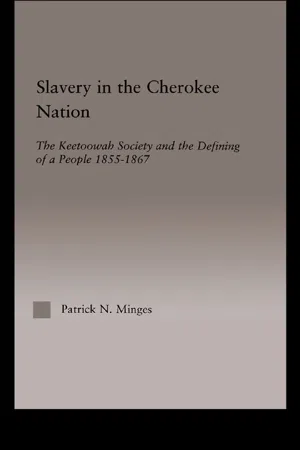
Slavery in the Cherokee Nation
The Keetoowah Society and the Defining of a People, 1855-1867
- 316 pages
- English
- ePUB (mobile friendly)
- Available on iOS & Android
eBook - ePub
Slavery in the Cherokee Nation
The Keetoowah Society and the Defining of a People, 1855-1867
About this book
This work explores the dynamic issues of race and religion within the Cherokee Nation and to look at the role of secret societies in shaping these forces during the nineteenth century.
CHAPTER ONE
Red, White, and Black in the Old South
In truth, sacred bonds between blacks and Native Americans, bonds of blood and metaphysical kinship, cannot be documented solely by fac-tual evidence confirming extensive interaction and intermingling—they are also matters of the heart. These ties are best addressed by those who are not simply concerned with the cold data of history, but who have “history written in the hearts of our people,” who then feel for history, not just because it offers facts but because it awakens and sustains connections, renews and nourishes current relations. Before that which is in our hearts can be spoken, remembered with passion and love, we must discuss the myriad ways white supremacy works to impose forgetful-ness, creating estrangement between red and black peoples, who though different lived as One.1
—bell hooks, Black Looks: Race and Representation
MATTERS OF THE HEART
As she approached the bank of the river, their eyes met for the first time. She, the “Queen” of Cofitachiqui, was seated upon pillows, borne upon a royal vessel, and surrounded by the canoes of her principal men. He, the slave of Andre de Vasconcelos, was a follower of Hernando De Soto and the Spanish expedition to explore and exploit the natural resources of the American Southeast. Another of De Soto’s followers described this first encounter, “She was a young girl of fine bearing…and she spoke to the governor quite gracefully and at her ease.”2 She placed pearls upon the neck of De Soto and declared that she would, “with sincerest and purest goodwill tender you my person, my lands, my people, and make you these small gifts.”3
Without a doubt, the “Queen” had heard of De Soto’s coming. When her fellow countrymen refused to show De Soto to her village, he burned them alive. When a misguided warrior challenged De Soto to a manly duel of skill, the Spaniard set his huge Mastiffs upon him and they tore him to pieces. Word spread quickly of the coming of these dark men. In this first encounter, the Beloved Woman of Cofitachiqui knew that she was reckoning with an overwhelming force of power and that her steps must be delicate.
If De Soto attracted the lady’s attention, she was also distracted by a different person—the African slave standing only a short distance from the main party. She had perhaps encountered Africans before and her people most certainly had, but there was something particularly captivating about this one. Their eyes met and spoke a language beyond words. In a matter of seconds, the vast expanse that had once separated the “old world” and the “new world” was bridged and former matters of state had become matters of the heart. Over the next couple a days, it was an attraction she could not resist.
On the third day, the Queen disappeared. De Soto sent his guards to find her, but to no avail…she did not wish to be found. Taking advantage of her absence, De Soto entered one of the ancient temple mounds that were scattered about the town of Talimico, the religious and political center of Cofitachiqui. The mound was one hundred feet long and forty feet wide with massive doors; as he entered the doors, he encountered paired rows of immense wooden statues with diamond shaped heads. The guardians of the sacred world bore first batons, then knives, and lastly bows and arrows.4 Like the ancient pyramids of Egypt, these temple mounds contained statues of notable persons of antiquity and chests filled with the remains of the elders. Scattered about the temples were bundles of fur, breastplates, and weapons—tools for the next life—covered with pearls, colored leather, and “something green like an emerald.”5
De Soto and his men quickly plundered the ancient temple mound. Among the booty were items of a European make, “Biscayan axes or iron and rosaries with their crosses.”6 De Soto and his men determined that these materials were the remnants of the earlier expedition of Lucas Vazquez de Ayllon and his aborted settlement on the Carolina coast. Just as with De Soto’s expedition, African slaves had accompanied de Ayllon’s settlement colony on the Peedee River in 1526. When there was a crisis over leadership, the colony fell into disarray. In the midst of this crisis, a slave revolt further ripped the settlement apart. With the colony in shambles, many of the African slaves fled to live among the nearby native people.7 According to De Soto, these refugees must have lived among the Cofitachiqui and taught them the craftwork of the Europeans.8
When the Lady of Cofitachiqui finally returned, De Soto seized her and forced her to tell him where more wealth such as had been found in the temple was to be gained. She said that there were greater riches further inland. De Soto and his men set out in search of this land carrying with them the “woman chief” of Cofitachiqui “in return for the good treatment they had received from her.”9 After seven days of travel over the lofty ridges of the Appalachians Mountains in the Western Carolinas, the party arrived at the “province of Chalaque.”10 After staying a few days in Xuala, the party set out for the further lands near “Guaxule” where “there were more indications that there were gold mines.”11
As they were making their way on their journey, the Lady of Cofitachiqui “left the road, with the excuse of going in the thicket, where, deceiving them, she so concealed herself that for all their search she could not be found.”12 De Soto, all the more frustrated because the Beloved Woman had fled with a box of “unbored pearls” of great value, decided to move on to Guaxule.13 However, it seems that the Lady had made other plans and had arranged for a rendezvous with other members from De Soto’s party. These included an “Indian slave boy from Cuba,” a “slave belonging to Don Carlos, a Berber, well versed in Spanish,” and “Gomez, a negro belonging to Vasco Goncalvez who spoke good Spanish.”14 Alimamos, a horseman sent by De Soto to find the fugitives, “got lost,” and happened upon the refugee slaves. He “labored with the slaves to make leave of their evil designs.” Two of the slaves did just that and returned to De Soto but “when they arrived, the Governor wished to hang them.”15
However, the horseman Alimamos reported yet another story that was something altogether shocking. He stated that “The Cacica remained in Xuala, with a slave of Andre de Vasconcelas, who would not come with him (Alimamos), and that it was very very sure that they lived together as man and wife, and were to go together to Cutafichiqui.”16 In an effort that would be repeated countless times over the next three hundred years, refugee slaves fled from their masters to the sanctuary villages of the Cherokee and Mvskoke and were thus given welcome and protected by friendly Indians. Equally important to our collective history, the “Queen of Cofitachiqui” and the “slave of Andre de Vasconcelas” returned to their “village of the dogwoods” on the banks of the Savannah River near Silver Bluff, S.C. where they would begin a life together in what would become a prominent Aframerindian community.17
EARLY POINTS OF CONTACT
When the enslaved Africans of De Allyon and De Soto’s expeditions fled their Spanish masters, they found refuge among the native peoples of the American Southeast. In so doing, they found a people not unlike themselves. The indigenous peoples of West Africa and the American Southeast possessed similar worldviews rooted in their historic relationship to the subtropical coastlands of the middle Atlantic.18 Physical appearance aside, these runaway African slaves found that the similarities between themselves and those who provided them sanctuary far outweighed their differences.
There is every possibility that the relationship between Africans and Native Americans stretches much further back than many historians are willing to acknowledge. Though it is a highly controversial topic, it seems possible that the first contact between Africans and Indians did not occur in the early sixteenth century as is commonly assumed. This possibility has been underscored by the discovery in Brazil of a “Negroid” skull dating back some 11,500 years. “Luzia,” as she has been called, could transform thinking about the peopling of the Americas.19 “We can no longer say that the first colonizers of the Americas came from North of Asia, as previous models have proposed,” says Dr. Walter Neves, discoverer of the skull.20
Most texts detailing red/black relations in North America begin with Africans among the explorations of de Ayllon, de Soto, Ponce de Leon, and Panfilo Narvaez. However, in his work Africans and Native Americans: The Language of Race and the Evolution of Red-Black Peoples, Jack Forbes cites myths from South America that feature a close cooperative relationship between the spirit-powers of Africa and of the Americas. He concludes his discussion of this relationship with the statement, “Thus in spiritual as well as secular sense, the American and African peoples have interacted with each other in a variety of settings and situations. These interactions may well have begun in very early times.”21
Long before Christopher Columbus, Africans may have been using favorable sea currents and small boats to come to the Americas.22 One of the reasons Columbus was sent return voyages to the new world was “a report of the Indians of this Espaniola who said that there had come to Espaniola from the south and south-east, a black people who have the tops of their spears made of a metal which they call ‘guanin’ (gold).”23 The Canary Current, which runs off the coast of Senegal and then turns into the Atlantic to the Caribbean, is strong enough to carry vessels from Africa to the Americas.24 Thor Heyerdahl, in his RA expeditions, proved that even the smallest boats could make the passage from Africa to the Caribbean.25
There are also other indications of pre-Columbian contact with Africans in a variety of settings in the Americas. Megalithic heads carved by the ancient Olmec bear distinctly African facial features; similarities between African pyramids and reed boats and their counterparts in the Americas, and pictographic/linguistic similarities between Northern African and Native American cultures all offer evidence to support the idea of ancient contact.26 Upon observing the Olmec sculptures in Mexico in 1869, Dr. Jose Melgar y Serrana reported, “As a work of art, it is without exaggeration a magnificent sculpture, but what astonished me was the Ethiopic type represented. I reflect that there had undoubtedly been Negroes in this country.”27 William Bartram, an early botanist who spent time among the Southeastern Indians, also noted “great pyramidical, or Conical Mounds of Earth, Tetragon Terraces & Cubican Yards.”28 James Adair, an early trader among the Creek and Cherokee, described these “state houses and temples” as “following the Jerusalem copy in a suprizing manner” and having a “strong imitation of Solomon’s temple.”29
Dr. Leo Wiener has proposed that African traders from Guinea founded a colony near Mexico City from which they exerted a cultural and commercial influence extending north to Canada and south to Peru. He also suggested that indigenous cultures, including the Maya, Aztec, and Inca civilizations, were strongly influenced through contact with African civilization.30 Historians and scientists from Augustus Le Plongeon in the nineteenth century to Barry Fell in the latter half of the twentieth century have asserted possible African contact with ancient America.31 Whatever the truth is, it is certain that along the coastal rim of the Caribbean and the Gulf of Mexico, early explorers encountered numerous African-Indians and tri-racial mixtures.32
When the indigenous peoples ...
Table of contents
- COVER PAGE
- TITLE PAGE
- COPYRIGHT PAGE
- ILLUSTRATIONS
- ACKNOWLEDGMENTS
- INTRODUCTION
- CHAPTER ONE: RED, WHITE, AND BLACK IN THE OLD SOUTH
- CHAPTER TWO: “CIVILIZATION” AND ITS DISCONTENTS
- CHAPTER THREE: THE BIRTH AND GROWTH OF THE KEETOOWAH SOCIETY
- CHAPTER FOUR: “BETWEEN TWO FIRES”
- CHAPTER FIVE: “SO LAUDABLE AN ENTERPRISE”
- CHAPTER SIX: “THE MOST SACRED OBLIGATIONS”
- CONCLUSION: IDENTITY AND IDEOLOGY
- EPILOGUE
- NOTES
- BIBLIOGRAPHY
Trusted by 375,005 students
Access to over 1.5 million titles for a fair monthly price.
Study more efficiently using our study tools.
Frequently asked questions
Yes, you can cancel anytime from the Subscription tab in your account settings on the Perlego website. Your subscription will stay active until the end of your current billing period. Learn how to cancel your subscription
No, books cannot be downloaded as external files, such as PDFs, for use outside of Perlego. However, you can download books within the Perlego app for offline reading on mobile or tablet. Learn how to download books offline
Perlego offers two plans: Essential and Complete
- Essential is ideal for learners and professionals who enjoy exploring a wide range of subjects. Access the Essential Library with 800,000+ trusted titles and best-sellers across business, personal growth, and the humanities. Includes unlimited reading time and Standard Read Aloud voice.
- Complete: Perfect for advanced learners and researchers needing full, unrestricted access. Unlock 1.5M+ books across hundreds of subjects, including academic and specialized titles. The Complete Plan also includes advanced features like Premium Read Aloud and Research Assistant.
We are an online textbook subscription service, where you can get access to an entire online library for less than the price of a single book per month. With over 1.5 million books across 990+ topics, we’ve got you covered! Learn about our mission
Look out for the read-aloud symbol on your next book to see if you can listen to it. The read-aloud tool reads text aloud for you, highlighting the text as it is being read. You can pause it, speed it up and slow it down. Learn more about Read Aloud
Yes! You can use the Perlego app on both iOS and Android devices to read anytime, anywhere — even offline. Perfect for commutes or when you’re on the go.
Please note we cannot support devices running on iOS 13 and Android 7 or earlier. Learn more about using the app
Please note we cannot support devices running on iOS 13 and Android 7 or earlier. Learn more about using the app
Yes, you can access Slavery in the Cherokee Nation by Patrick Neal Minges in PDF and/or ePUB format, as well as other popular books in History & North American History. We have over 1.5 million books available in our catalogue for you to explore.