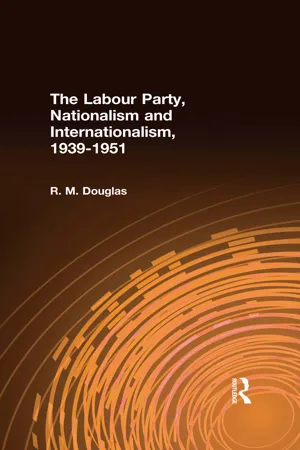
The Second World War was a watershed moment in foreign policy for the Labour Party in Britain. This book traces how the British democratic left set about the task of defining the principles of a radically new international system for the post-war world. The author shows how the experience of total war fundamentally reshaped the left's attitudes toward national identity and international policy.
Breaking with the traditional accounts that place Cold War tensions at the centre of the Attlee government's activities in the immediate postwar years, R. M. Douglas's book provides an entirely new framework for reassessing British foreign policy and left-wing concepts of national identity during the most turbulent mement of Britain's modern history.
‘Half a League Onward’: The Labour Critique of the Nation-State, 1900–39
The Labour Party’s emergence in the aftermath of the Great War as Europe’s leading champion of internationalist doctrine was neither a necessary, nor even a likely, consequence of its self-identification as a movement of the democratic left. To the contrary, the socialist tradition out of which Labour emerged at the beginning of the twentieth century was marked by a strong element of British nationalism, if not outright chauvinism. Stung by accusations that socialism was an ‘alien’ import, associated with dictatorship and violence, Labour’s founders were at pains to emphasise both the indigenous roots of their ideology and their repudiation of all taint of ‘continental revolutionism’.1 Few members of the British democratic left, moreover, considered foreign affairs to be more than a diversion from the real business of improving living conditions for the proletariat, until the advent of a war that, by abruptly terminating the existence of several hundred thousand British workers, made such parochial attitudes no longer tenable.
By the 1920s, the mainstream of the Labour movement had swung round in favour of the ideal of an international government as the ultimate aim of socialist foreign policy, and of the League of Nations as the preferred vehicle through which to achieve that objective. Such dissent as existed came from those who objected not to the League’s purposes, but to its methods. Accustomed as we are in retrospect to regard the League as an ineffectual talking shop, it is easy to forget that for most of its history the principal criticism levelled by the left against the new international organisation was that it was an instrument of coercion rather than conciliation. Despite these concerns, the Labour Party seemed by the end of the postwar decade to have found in the League an external analogue of the gradualist and pacific path to socialism that it was simultaneously pursuing in the domestic sphere.
Such optimism, it soon became apparent, was misplaced. The series of crises that overtook the League in the 1930s brutally exposed the contradictions not only of the Wilsonian world order in which it had originated, but Labour’s equation of internationalism and historical inevitability. If the League, as its supporters believed, was truly the expression of a chastened humanity’s desire to turn away from the international system that had produced the horrors of the Great War, it was impossible to account for the rise of a succession of totalitarian régimes that repudiated everything for which it stood. If, on the other hand, the growth of totalitarianism proved that humanity had not yet learned its lesson, adherence to the League represented the continuation of a policy whose inadequacy had already been demonstrated by its failure to check the advance of ultra-nationalist and anti-communitarian doctrines in Europe and Asia. In the closing years of peace, therefore, the Labour Party found itself impaled on the horns of an ideological dilemma – one that could be resolved only by abandoning internationalism altogether, or reformulating it in such a way as to permit its achievement by other than co-operative and consensual means.
IDEOLOGICAL ORIGINS OF LABOUR INTERNATIONALISM
It is only a small exaggeration to say that, until the Great War, the Labour Party considered foreign policy a luxury it could comfortably do without. Labour Members of Parliament were as a rule content to follow the lead of their counterparts on the Radical wing of the Liberal Party, a course which was all but dictated for them by the absence of any party machinery capable of giving guidance on external affairs. Although Labour did become a member of the Second International in 1907, it bore its obligations to universal socialist brotherhood lightly. In a report that attempted to justify its inactivity in this area, for example, James Ramsay MacDonald, Secretary of Labour’s Parliamentary Party, lamely protested that he and his colleagues ‘would have gladly raised various … matters of international importance in accordance with the advice issued by the International Bureau, but could not do so under the Rules and Standing Orders of the House of Commons’.2 Nor, in its internal arrangements, did Labour manifest any higher priority to the Second International than was suggested by its meagre parliamentary record on this question. The Secretary of the organisation’s British branch from 1912, Arthur Henderson – who combined this position with that of Secretary of the Labour Party itself – was undeterred from accepting the appointment by the fact that he ‘had few contacts in Europe, was appallingly ignorant of geography, and spoke no foreign languages’.3 It is hardly surprising, therefore, that in this period Labour thinking about foreign affairs was on the whole narrow and unsophisticated.
Much of it, as the party’s future leader Clement Attlee was later to concede, was little more than a gloss upon long-established Liberal and Radical principles.4 From T.H. Green Labour inherited the conviction that the common people of the world constituted an international community whose interests were fundamentally compatible both within and between states.5 From Cobden and Bright it derived a belief in the immorality of state-directed force, and from Gladstone and Hobhouse a contradictory certitude that strong and free nations had a moral obligation to come to the rescue of weak and oppressed ones even at the risk of war. Overlying these core philosophies was a theory of international conflict as the external manifestation of domestic economic inequality which, again, had been appropriated from the work of a Left-Liberal collectivist, John A. Hobson. In a highly influential analysis of imperialism published in 1902, Hobson linked the drive towards overseas expansion with its attendant militarism, arms races, jingoism and periodic war scares to domestic over-production and the search for new markets, a theme that was amplified 12 years later by the Independent Labour Party (ILP) journalist H.N. Brailsford in The War of Steel and Gold.6 For both Hobson and Brailsford, international diplomacy was essentially a rarified form of commercial rivalry in which the interests of entire peoples were held hostage to those of a short-sighted capitalist élite: the solution to conflicts between nations, consequently, was to be sought at home rather than overseas. There was in addition a third variant of Liberal thought – Liberal Imperialism – represented in the Labour Party. Its clearest exposition was to be found in George Bernard Shaw’s pamphlet Fabianism and the Empire (1900) which held the ‘White Man’s Burden’ to be an inevitable, if sometimes regrettable, feature of modern life: the question for socialists was not whether Great Powers ought to possess empires, but whether these territories were being administered in a fashion consistent with the interests of worldwide ‘civilisation’.7
All of these doctrines, however, were of interest only to a relatively few middle-class Labour activists. Neither Hobson and Brailsford’s quasi-Marxist variant of traditional Radical Little-Englandism nor Shaw’s intriguing vision of the spread of collectivist paternalism at the point of a gun found much resonance among the party at large before the war, although both were to have a growing influence thereafter. For the moment, the Fabian-affiliated academic R.C.K. Ensor spoke for many when he doubted ‘whether any view of foreign policy could be so far deduced from the principles of Socialism that only Socialists could hold it’.8 Notwithstanding his own fervent commitment to the worldwide unity of interest among his class, James Keir Hardie, Labour’s chairman, could be more dismissive still in his attitude, reminding delegates at the 1907 Annual Conference that, while individual members had dealt with questions of foreign affairs on behalf of their colleagues, such issues were ‘merely incidental to the real work of the Party’.9
The outbreak of the Great War highlighted, although it initially did little to change, Labour’s sense of complacent insularity. With the partial exception of the ILP, the most internationally conscious of Labour’s three constituent societies, whose basic anti-war stance remained consistent throughout the conflict, the party – almost uniquely among European socialist movements – rallied unitedly and with little sense of inconsistency to the defence of the capitalist state to whose supersession it was nominally committed. The very abruptness of its volte-face – from a public call for ‘vast demonstrations against war in every industrial centre’ in the first week of August 1914, to nearly unanimous support for the government in the second – provided a further indication of the shallow roots of Labour’s approach to foreign affairs. Nor did defectors from the new consensus like Ramsay MacDonald, who had succeeded Hardie as party chairman in 1911, display significantly more doctrinal consistency than the acquiescent majority. MacDonald’s opposition to the war owed little to his sense of obligation to the International, and much to his disbelief in the probity of the Entente leaders and his erroneous conviction, fostered by the ‘scientific’ pacifism of authors like Norman Angell, that the conflict would prove economically ruinous to Britain and lead to bread riots within three months. Thus MacDonald found his natural home not in the principled internationalism of a Keir Hardie,10 but in the company of disaffected Left-Liberal politicians like Arthur Ponsonby, E.D. Morel and Charles Trevelyan, with whom he founded the Union of Democratic Control (UDC) as a vehicle to press for a liberal peace agreement and popular involvement in the formulation of foreign policy.11
That a distinctive Labour programme on international government did ultimately emerge was in large measure due to the independent effort of four remarkable individuals: Hobson and Brailsford from the ILP, and Sidney Webb and Leonard Woolf of the Fabian Society. Here too, however, it is necessary to acknowledge the extent to which they were indebted to the pioneering work of Liberal intellectuals. In the autumn of 1914, a number of Liberal foreign policy theorists began a study of how the war might have been prevented, concentrating especially upon the extension and reinforcement of the system of international arbitration established by the First Hague Conference in 1900. As originally conceived, the Hague system possessed serious defects which a second conference, held in 1907, had failed to redress. Its core consisted of a Permanent Court of Arbitration which was ‘in truth neither permanent nor a court’12 but rather a panel of advisers to which disputes might be submitted by agreement between the contending parties. As such, it was equipped to deal only with ‘justiciable’ disputes, or those whose parameters had already been defined by treaty or otherwise by the disputants and hence were capable of being adjudicated in a court of law – that is to say, the very type of disagreement that was least likely to result in war. There was no obligation to submit even ‘justiciable’ matters to the Hague Court, or to accept its verdicts. Nevertheless, as the most widely established agency of international conciliation, the Hague system seemed to offer a model for a more comprehensive structure for the settlement of disputes, the urgent necessity for which the war was daily underlining.
The first steps in this direction were taken by the Cambridge classicist, G. Lowes Dickinson, author of an outline scheme for a ‘League of Nations of Europe’ and future member of the Labour Party Advisory Committee on International Questions, and Richard Cross, business manager of the Nation and solicitor to the Rowntrees, a wealthy family of Quaker confectioners with a long-standing interest in pacifist causes. Dickinson and Cross were the leading lights of the Bryce Group, named after its most prominent member,13 composed of academics, journalists and politicians who shared an interest in international organisation. With the collaboration of Brailsford and Graham Wallas, its two most important contributors from the Labour Party, the Bryce Group drew up a set of ‘Proposals for the Avoidance of War’, drafted by Cross, in the winter of 1914–15. This document called for the creation of an international council of conciliation for ‘non-justiciable’ disputes, analogous to the Hague Court, which would enforce a ‘cooling-off’ period pending consideration of the question at issue and publication of a report.14
The Bryce proposals were neither startlingly original nor, in the short term, influential – to no small extent the consequence of Bryce’s reluctance to publicise the group’s work for fear that it would be attacked as a ‘stop-the-war’ society. Their true importance lies in the stimulus they provided for deeper and more intensive analysis of the problem. In December 1914, Beatrice Webb solicited a donation from Joseph Rowntree to enable the Fabian Society to pursue research into the means by which future wars might be prevented. Rowntree’s modest gift of £100 financed the creation of an ‘International Affairs Committee’ of the Fabian Research Department, to whose secretary, Leonard Woolf, a former member of the Ceylonese civil service, Mrs Webb delegated the project. Although Woolf and Sidney Webb were the only active members of the Committee, within a few months they had created the skeleton of what may have been the first practical proposal for a true League of Nations. Though Woolf maintained subsequently that the scheme originated with him, it appears that the key ideas were first set out in a letter by Webb in January 1915:
Could we not move to a supersession of national conflicts on the same lines as those on which we have superseded personal and municipal conflicts, viz. by an overriding law, made by a superior authority, interpreted by a tribunal with power to fine, and enforced by the power of the Superior Authority? Why should not a Council of all the Powers not [sic] impose the Treaty of Peace on the world as a law, constitute a permanent tribunal to try all issues between nations … and pledge all the signatories to contribute their share towards the sanction enforcing the tribunal’s decision?15
Woolf and Webb published their proposals in a series of New Statesman articles six months later. The structure of their mooted international authority followed closely the pattern contained in the Bryce proposals, incorporating an international high court and an international council. Member states would be bound to submit all justiciable cases to the court, and all other disputes to the council, for enquiry, mediation and eventual report. The concept of a year-long ‘cooling-off’ period, too, was adopted in the new scheme. What was truly radical and original about the Fabian plan was its enforcement provision, which it described as ‘possibly the most essential of all these proposals’. By subscribing to the international organisation, member states would pledge themselves ‘to make common cause, even to the extent of war, against any constituent State which violates this fundamental agreement’.16
Although the Woolf–Webb scheme’s significance is more apparent in retrospect than it was to its contemporaries, virtually every Labour proposal for an international political authority during the next three years was in essence an elaboration of this basic formula. It ...
Table of contents
Cover
Halftitle
Title
Copyright
Dedication
Contents
Series Editor’s Preface
Acknowledgements
Abbreviations
Introduction
1. ‘Half a League Onward’: The Labour Critique of the Nation-State, 1900–39
2. Dictatorship of the Secretariat: Transport House and the Rise of ‘Muscular’ Internationalism
3. Internationalism or Anti-Nationalism?: Backbench and Backroom Visions of World Order, 1939–45
4. Trustees for Humanity: Ministerial Planning for International Government, 1940–45
5. Utopia Deferred: The Attlee Administration and the United Nations, 1945–51
6. An Offer They Couldn’t Refuse: Labour Internationalism and Colonial Trusteeship
7. Socialism in One Country: The Failure of Labour Europeanism
Conclusion
Bibliography
Index
Trusted by 375,005 students
Access to over 1.5 million titles for a fair monthly price.
Study more efficiently using our study tools.
Frequently asked questions
Yes, you can cancel anytime from the Subscription tab in your account settings on the Perlego website. Your subscription will stay active until the end of your current billing period. Learn how to cancel your subscription
No, books cannot be downloaded as external files, such as PDFs, for use outside of Perlego. However, you can download books within the Perlego app for offline reading on mobile or tablet. Learn how to download books offline
Perlego offers two plans: Essential and Complete
Essential is ideal for learners and professionals who enjoy exploring a wide range of subjects. Access the Essential Library with 800,000+ trusted titles and best-sellers across business, personal growth, and the humanities. Includes unlimited reading time and Standard Read Aloud voice.
Complete: Perfect for advanced learners and researchers needing full, unrestricted access. Unlock 1.5M+ books across hundreds of subjects, including academic and specialized titles. The Complete Plan also includes advanced features like Premium Read Aloud and Research Assistant.
Both plans are available with monthly, semester, or annual billing cycles.
We are an online textbook subscription service, where you can get access to an entire online library for less than the price of a single book per month. With over 1.5 million books across 990+ topics, we’ve got you covered! Learn about our mission
Look out for the read-aloud symbol on your next book to see if you can listen to it. The read-aloud tool reads text aloud for you, highlighting the text as it is being read. You can pause it, speed it up and slow it down. Learn more about Read Aloud
Yes! You can use the Perlego app on both iOS and Android devices to read anytime, anywhere — even offline. Perfect for commutes or when you’re on the go. Please note we cannot support devices running on iOS 13 and Android 7 or earlier. Learn more about using the app
Yes, you can access The Labour Party, Nationalism and Internationalism, 1939-1951 by R. M. Douglas in PDF and/or ePUB format, as well as other popular books in Politics & International Relations & Politics. We have over 1.5 million books available in our catalogue for you to explore.