- 224 pages
- English
- ePUB (mobile friendly)
- Available on iOS & Android
eBook - ePub
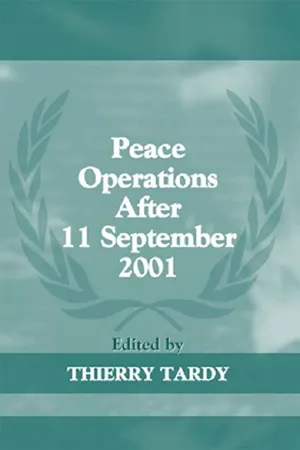
Peace Operations After 11 September 2001
About this book
This book explores the possible consequences of the events of 11 September 2001, and of the 'fight against terrorism', the way peace operations are perceived and conducted, and the way that states, international organizations such as NATO or the EU and non-state actors, consider these operations.
The 11 September attacks illustrate the widening of the security agenda, the persistence of instability and the need to deal with it in both a preventive and a curative way. The events have had a major impact on US foreign and defence policies, on security policies, on the hierarchy of priorities, and US views of peace operations around the world.
This book shows that these different elements mean that the 'international' environment of peace operations is likely to be modified, while the 'local' environment has remained largely unchanged.
Part I:
The Response of State Actors
ONE

UN Peace Operations in Light of the Events of 11 September 2001
The fundamental evolutions that UN peace operations faced during the 1990s were to a large extent a consequence of the end of the cold war. This defining moment in the life of the international system led to a revitalized United Nations, which was directly reflected in the field of peacekeeping. Peacekeeping operations became more and more numerous, and above all embraced new and quite challenging activities. The era of ‘traditional peacekeeping’ seemed to come to an end, to be replaced by the ill-defined ‘multidimensional peacekeeping’, which in reality was much broader than mere peacekeeping.
More generally, throughout the 1990s peace operations were reflections of some of the evolutions of the international system itself. The difficulty in identifying security interests, and therefore security policies, the growing contest of state primacy (with eroding state sovereignty and the increasing weight of non-state actors), the evolving role of international institutions (true actors of the system or simply tools used by the states), and the barely contested American domination were all factors that have had a direct impact on the way UN peace operations were defined and conducted.
This said, insofar as they constitute another defining moment of international life,1 the events of 11 September may as well have had some impact on peace operations, at a time when the whole field of peace operations is being reconsidered. This chapter aims to present and analyze the possible consequences of the events of 11 September on the way UN peace operations are created and conducted, and on the way that states see the role of the UN in this field. Briefly presented, the argument is that the events of 11 September have had no fundamental and observable consequences on the UN's role in maintaining peace and security in general, and on peace operations in particular. The fight against terrorism might imply some modifications in the mandates and practices of peace operations; the two fields of conflict prevention and peacebuilding could be affected in particular, but the overall approach should not be dramatically altered.
To address this issue, the chapter will look first at the role of the UN before the events of 11 September. It will then examine what the UN response to the attacks has been. Finally, it will assess the extent to which those events have modified or can influence peace operations policies on the longer term.
THE UN ROLE BEFORE 11 SEPTEMBER 2001
A ‘marginalized’ UN role in peace operations
The 1990s have undoubtedly been the richest period in the life of UN peace operations. These have been thoroughly studied and extensively criticized.2 To summarize, one can distinguish two main periods of activity in UN peace operations, with the Dayton Peace Agreement in Bosnia and Herzegovina in November 1995 constituting a symbolic turning point.
In the early 1990s, the revitalized UN was the uncontested central actor in peace operations at the legal, political and operational levels. No other organization was in a position to compete with the UN, and states had not really begun to consider the possibility of conducting peacekeeping outside of the UN framework. From Cambodia to Somalia, El Salvador to Bosnia and Herzegovina, UN peace operations were ambitious, multifunctional and above all considered as appropriate responses to the so-called new conflicts. This period of euphoria, marked at the theoretical level by the release of An Agenda for Peace in June 1992,3 did not last very long. By 1993, the many difficulties encountered by the operations in Somalia and Bosnia led to a reappraisal of UN capability. The credibility of the UN started to erode, and the organization progressively lost its centrality.
In the United States as well as in Europe, governments grew sceptical about the UN's ability to manage crises, while ‘regional organizations’, if one includes NATO, and to a certain extent the Western European Union (WEU), the Organization for Security and Cooperation in Europe (OSCE) and later the European Union, acquired some competence, and therefore comparative advantages, at the expense of the UN. In parallel, states got involved in peacekeeping activities in coalitions, outside of the UN framework at the operational level, but in missions legally sanctioned by the Security Council. The UN was discredited and held responsible for the failures of state policies in Somalia and Bosnia and Herzegovina. Consequently, the second part of the 1990s – at least until 1999 – was characterized by the UN being set aside as a peacekeeping actor. The UN kept its legal role, but was marginalized in its political and operational capacity, especially insofar as complex and coercive activities were concerned.4 The implementation of the Dayton Peace Agreement in Bosnia and Herzegovina illustrates the shift, as NATO and the OSCE were substantially involved, and the UN confined to a small observation mission, in no respect comparable to its role in the early 1990s. In parallel, the number of personnel deployed within UN peace operations substantially decreased, with fewer than 15,000 troops being deployed at the end of 1998, compared with some 76,612 in August 1994.5
The year 1999 then marked a new evolution in the life of the UN, with three series of disparate events. First, the UN, as a legal authority, was bypassed by NATO and its member states in Operation Allied Force in Kosovo, adding to the UN's marginalization. Second, and in spite of being discredited, the Organization made a kind of come back, with the creation and conduct of three ambitious operations: in Kosovo (UNMIK in June), East Timor (UNTAET in October) and Sierra Leone (UNAMSIL in October), giving the UN a new role in different configurations. And third, the UN Secretariat and its Secretary-General Kofi Annan displayed a fair degree of self-criticism, with the release of the reports on the fall of Srebrenica and on the genocide in Rwanda.6
To summarize, the role of the UN in the second half of the 1990s, and on the eve of 11 September 2001, can be encapsulated by the three following points:
- The UN went through a period of discredit, and was no longer considered as the central actor in the field of crisis management, especially by western states (see table 1 and 2 in the appendix on page 33). It was consequently relatively marginalized, in favour of regional institutions (in Europe) or coalitions of states.7
- The UN tried to focus its activities on conflict prevention on the one hand, and on peacebuilding on the other, at the expense of peacekeeping activities per se at least until 1999. The UN has therefore been increasingly involved in consent-based activities.8
- In spite of this trend, the UN created and conducted three important operations from 1999 onwards, and in August 2001 deployed about 47,000 military personnel and civilian police in 15 operations, demonstrating that the UN's role in peacekeeping was far from insignificant, both in terms of personnel being deployed and in terms of mandate, especially in Africa.
The Brahimi Report on peace operations
It is in this mixed context that the ‘Report of the Panel on UN Peace Operations’, known as the Brahimi Report, was released in August 2000.9 This simultaneously recognized the limited capacity of the UN and advocated a restored central role. To achieve this objective, the emphasis was placed on three key elements: the reform of the organization, and especially the Secretariat and its Department of Peacekeeping Operations (DPKO); the necessity to have better defined operations and clear mandates, with the means to implement them (robust force, rapid deployment capabilities, and so on); and the necessity to get stronger political commitment from the states, especially western states.10
At these different levels, in spite of the repeated official support coming from the states, and despite the ongoing restructuring of the DPKO, on the eve of 11 September 2001 the full implementation of the Brahimi Report was still a sensitive issue.11 Beyond the practical and financial aspects of the implementation of the Report, thinking about it in the context of the lasting discredit of the UN, and the general reluctance of western states to get involved in peace operations, leads us to question the link between the efficacy of the ‘tool’ (UN/Secretariat), and the will of the states to use it. In other words, to what extent would western states be willing to participate in UN peace operations (in Africa for example) when/if the UN is better equipped? What is the link between the efficacy of the structure and the political will of states to act through it? The answer to these questions probably lies in the nature of the operations contemplated. Western states might want to resort to a reformed UN more than they do today if the organization were dealing with non-coercive/civilian activities. But they would avoid the UN anyway if peace operations were complex, multidimensional, and contained a militarily coercive dimension. Despite reform of the institution, the tendency to set the UN aside is likely to endure when it comes to politically and militarily risky crisis management.
It is against this background that the events of 11 September have to be examined. Here, a distinction has to be drawn between the UN role in dealing with the events of 11 September and with the ‘Afghan crisis’ on the one hand, and what such events and roles tell us about UN peace operations for the longer run on the other.
THE UN RESPONSE TO THE 11 SEPTEMBER ATTACKS AND TO THE ‘AFGHAN CRISIS’
The immediate response
The different decisions and actions taken by the ‘international community’ immediately after the attacks of 11 September do not directly relate to peace operations, but they are informative about the place of the UN in the international system. Three issues need to be considered which reveal both a relatively important role for the UN as well as its limits as a security actor primarily aimed at maintaining international peace and security. First was the adoption of resolution 1368 by the Security Council; second the adoption of resolution 1373; and third the immediate US posture towards the UN.12
The unanimity behind resolution 1368
The UN Security Council, and also the General Assembly,13 displayed an uncontested unity following the 11 September attacks, though this can hardly be considered an achievement of the organization given the nature of the attacks. The adoption of resolution 1368 on 12 September 2001 instantly involved the Security Council in its legal and political capacity.14 It was adopted unanimously, with the concurring votes of China and Russia. The text unsurprisingly recognized the ‘inherent right of individual or collective self-defence’ for the United States, and may therefore be considered as the legal ground for Operation Enduring Freedom, unless the right of self-defence is the legal basis in itself, without the need for a specific resolution.
The right to respond is theoretically ‘strictly limited in time’,15 until, under article 51 of the Charter, the Security Council ‘has taken measures necessary to maintain international peace and security’. In resolution 1368 the Council expressed ‘its readiness to take all necessary steps to respond to the terrorist attacks’. Yet, it was in no position to go much further at this stage, and therefore arguably did not play its role of guarantor of international peace and security. A related issue is the question of the length of time that the United States can enjoy th...
Table of contents
- Cover
- Half Title
- The Cass Series on Peacekeeping
- Full Title
- Copyright
- Contents
- Contributors
- Foreword by Fred Tanner
- Acknowledgements
- Abbreviations
- Introduction
- The Response of State Actors
- Inside Peace Operations
- Select Bibliography
- Abstracts
- Index
Trusted by 375,005 students
Access to over 1.5 million titles for a fair monthly price.
Study more efficiently using our study tools.
Frequently asked questions
Yes, you can cancel anytime from the Subscription tab in your account settings on the Perlego website. Your subscription will stay active until the end of your current billing period. Learn how to cancel your subscription
No, books cannot be downloaded as external files, such as PDFs, for use outside of Perlego. However, you can download books within the Perlego app for offline reading on mobile or tablet. Learn how to download books offline
Perlego offers two plans: Essential and Complete
- Essential is ideal for learners and professionals who enjoy exploring a wide range of subjects. Access the Essential Library with 800,000+ trusted titles and best-sellers across business, personal growth, and the humanities. Includes unlimited reading time and Standard Read Aloud voice.
- Complete: Perfect for advanced learners and researchers needing full, unrestricted access. Unlock 1.5M+ books across hundreds of subjects, including academic and specialized titles. The Complete Plan also includes advanced features like Premium Read Aloud and Research Assistant.
We are an online textbook subscription service, where you can get access to an entire online library for less than the price of a single book per month. With over 1.5 million books across 990+ topics, we’ve got you covered! Learn about our mission
Look out for the read-aloud symbol on your next book to see if you can listen to it. The read-aloud tool reads text aloud for you, highlighting the text as it is being read. You can pause it, speed it up and slow it down. Learn more about Read Aloud
Yes! You can use the Perlego app on both iOS and Android devices to read anytime, anywhere — even offline. Perfect for commutes or when you’re on the go.
Please note we cannot support devices running on iOS 13 and Android 7 or earlier. Learn more about using the app
Please note we cannot support devices running on iOS 13 and Android 7 or earlier. Learn more about using the app
Yes, you can access Peace Operations After 11 September 2001 by Thierry Tardy in PDF and/or ePUB format, as well as other popular books in History & Military & Maritime History. We have over 1.5 million books available in our catalogue for you to explore.