- 240 pages
- English
- ePUB (mobile friendly)
- Available on iOS & Android
eBook - ePub
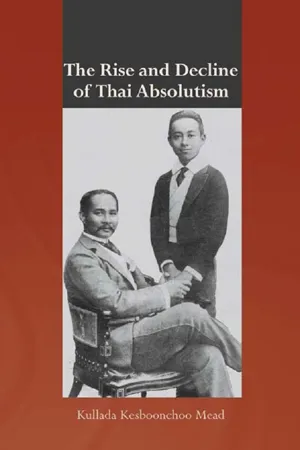
The Rise and Decline of Thai Absolutism
About this book
This book examines the development of Thailand from the integration of Siam into the European world economy at the beginning of the nineteenth century, up to the emergence of Thailand as a modern nation state in the twentieth century. It concentrates in particular on the reign of King Chulalongkorn (1868-1910), during which period the state was modernized, the power of the great nobles was subordinated to the state, and a modern bureaucracy and education system were created.
Trusted by 375,005 students
Access to over 1.5 million titles for a fair monthly price.
Study more efficiently using our study tools.
1 The Siamese state, society and the world-economies before absolutism
Introduction
The absolutist state, which evolved from the pre-modern state in nineteenth-century Siam, involved radical changes in structure while also displaying many characteristics of its predecessor. Hence, the pre-modern Thai state must be understood in order to make sense of what followed. Most studies have labelled the pre-modern system as the sakdina1 state, the meaning of which is still subject to debate among historians. But most of them maintained that its major elements persisted until the nineteenth century. Some even suggested that they survived the 1932 revolution and continued well into the 1970s.2
This chapter argues, however, that the Siamese state during the Ayudhyan period was far from being static and its development was influenced by various world-economies. Moreover, in the early Bangkok period, the Siamese state's contacts with the Chinese world-economy and the European world-economy brought about a long process of state transformation into absolutism. The Thai absolutist state acted as a transition between the pre-modern state and the nation-state which succeeded the fall of absolutism in 1932.
There were many significant developments during the early Bangkok period which marked a departure from the Ayudhyan state. However, we will consider both systems as pre-modern as opposed to the modern state which arose from Siamese absolutism during the second half of the nineteen century. Its modern characteristics include modern bureaucracy and the centralisation of power, elements obviously lacking in the pre-modern state. The chapter has the following sections: the Ayudhyan state; Siam and the Chinese world-economy; changes in the fiscal structure of the early Bangkok state; Siam and the European world-economy; and the impact of the Bowring Treaty on the early Bangkok state.
The Ayudhyan state
The emergence of the Ayudhyan state, in the lower river basins of Siam during the mid-fourteenth century, coincided with the resurgence of maritime trade in the region. Earlier, Ayudhya had been the regional gateway to the Chinese market, and during the fourteenth century there was also increase in trade from India, the Middle East and Europe. This expansion was caused partly by the growing demand of the West for spices and partly by China's increasing commercial involvement in the region.3
From a Braudelian perspective, this meant that the European world-economy centred in Venice began to interact with other world-economies elsewhere: the Middle East, India and China.4 During this period, state formation was occurring in many parts of Southeast Asia. Ayudhya was particularly affected as it was strategically located, commanding a vast rice-growing area as well as being an entrepôt for forest products.
Ayudhya's strategic position as a city port also explains its dominance over other inland centres such as Suphanburi and Lopburi in the lower Chao Phraya basin. Uthong (1351–1369), the first king of Ayudhya, was in effect the king of local lords (chao muang), and Ayudhya had the status of city (krung) as against a town (muang),5 the appellation of other local centres surrounding it.
Under the Ayudhyan system (as with western feudalism) the king had great difficulty in maintaining a steady flow of resources and keeping control over powerful lords and outlying centres. Initially, the king entrusted members of the royal family with the task of controlling these centres, and the Ayudhyan state at this stage was merely a cluster of power centres linked by personal relationships among the rulers. Soon enough, however, the decentralising process started and these centres posed a challenge to Ayudhya. The Ayudhyan kings relied upon redistribution and other devices such as ideology, state ceremonies, intermarriage with leading muang families, the appointment of royal kin to leading positions in outlying regions and warfare to keep the empire together. In spite of these measures, the history of the first hundred years of Ayudhya was plagued with revolts and warfare between the central and peripheral powers.
It was not until the middle of the fifteenth century, after Ayudhya had consolidated power over other centres, especially Sukhothai, another northern centre of power (krung) which lay on the overland trade route linking Pagan with the northern part of the Chao Phraya basin, northern Laos and Cambodia,6 that the formal structure of the Ayudhyan state emerged under the design of King Trilokkanat (1448–1488).
Under the new structure, the centres of the lower river basins such as Suphanburi and Lopburi formed the core area of the Ayudhyan state. They maintained their muang status but were incorporated into a central bureaucracy. Beyond the core area, outer muang (hua muang chan nok) were mostly ruled by local elite who became Ayudhyan nobles. The exception was Phitsanulok which was ruled by a royal prince who was an heir apparent and called heir apparent muang (muang luk luang).7 Each muang as well as Phitsanulok had its own bureaucracy and Phitsanulok was allowed to extract resources from its own muang and pass them on to Ayudhya in the form of tax in kind (suai). The core area and these centres constituted the territory of the Ayudhyan state (phra ratchaanakhet).
At the periphery were the small tributary or suzerain states (prathetsarat). They maintained their autonomy, provided a buffer zone between Ayudhya and other kingdoms, and were responsible for paying tribute every three years.8 This tribute took the traditional form of silver and gold trees.
This state structure was designed to consolidate manpower for three major activities; production, trade and warfare. The central administration created by King Trilokkanat reflects an attempt to create a highly centralised and hierarchical bureaucracy. Immediately below him were two chief ministers: the minister responsible for civilian affairs (Samuhanayok), and the minister responsible for military affairs (Samuhakalahom). Four lesser ministers also reported to the king; they were those responsible for Treasury and Foreign Affairs (Khlang), the palace (Wang), the City (Muang), and the Land (Na). Further down in the hierarchy were nobles responsible for administrative units (krom) and sub-units (kong). Some of these units had specialised functions whereas most were simply manpower units.9
In the Ayudhyan state, the primary role of manpower in the river basins was for production and warfare, and the state also allocated manpower to the ruling class as a means of support. In the outlying areas, manpower provided the state with goods for internal consumption as well as foreign trade. They could also be called up for military service.
The achievement of King Trilokkanat's system was to formalise the social arrangements between leaders and their peasant followers that had existed before the development of the Ayudhyan state, and transform these loose clientships into rigidly enforced ones. All males were incorporated into a single social hierarchy called the sakdina system, with each man, except the king, given a place in the pecking order (sakdina) starting from a high-ranking prince with 100,000 sakdina to a that (slave) with five sakdina. The state dictated that all male members of the peasant class or commoners (phrai) who had a sakdina mark of twenty-five must register under a master (nai) who was a noble and had a sakdina mark of 400 or higher.10 Every phrai subjected to this corvée system had to spend six months a year serving his nai, who was supposed to look after the welfare of his phrai. Each nai was given a number of phrai as private property, called phrai som, and as manpower belonging to an administrative unit (krom) or office (kong) called phrai luang. Those who submitted tax in kind were called phrai suai. The last group of manpower was slaves (that), who achieved this status either through debt bondage or as prisoners of war. They had a sakdina mark of five. A that was considered the private property of his nai and had to work full time for his master.11
Bonds between the king and the nobles were also based on patron-client relationships which had existed between leaders and followers long before the formation of the state itself. These relationships fulfilled the needs for protection on the part of the followers and for power on the part of the warrior-leaders. The tie between the king and his aspirant noble client was established by an act of homage (thawai tua), whereby the son of a noble was presented to the king in order to be trained in the affairs of state, usually in the capacity of a royal page. Once proved capable, he would be appointed to the bureaucracy as a noble in his own right. In his role as patron, the king was the source of a noble's livelihood, and he performed this function, first, by granting his client manpower and when his client already had manpower, guaranteeing it. Second, he granted symbols of power, such as a gold tray on a pedestal or foreign brocaded silk.
In return, the client noble was expected to contribute his resources for the king's use. In time of war, he was expected to supply the king with fighting men under the noble's command. During peace, his men might serve the king in the military or in other state services. Corvée might be substituted for monetary payment, in which case the noble nai was responsible for forwarding their corvée payment to the state.12 Furthermore, the noble client was expected to demonstrate his gratitude to his royal patron by taking an oath of allegiance in ceremonies held twice a year. Anyone absent from the rite was severely punished. That such punishments had to be levied shows how tenuous was the relationship between the king and the nobility in the Ayudhyan state.
Although theoretically absolute, the actual extent of the king's power depended on (and was demonstrated by his nobles' willingness to supply him) with manpower. Thus, in practice, the Ayudhyan kings faced similar problems to the European feudal monarchs: the fragmented nature of the state, the fact that the central administration received resources only after lesser lords had taken their cut, dependence on the co-operation of great families who controlled manpower and strategic territories, etc. After all, the two primary means of accumulating power and resources were through warfare and agriculture. The former was a risky and intermittent business; the latter, given the technology and administrative resources of the day (accentuated by the existing constraints of the supposedly highly centralised state), relied on a trickle-up system that minimised royal take.
One way of overcoming the centre's weakness was by ideological means; emphasising the glory and sacredness of the monarch and the need to obey his will. The Ayudhyan kings relied on two sources of legitimacy: the Devaraja cult and Buddhism. The Devaraja cult, versions of which were exploited widely in the region by states that benefited from maritime trade, justified the king's claim that he was a reincarnation of the Hindu god, Vishnu, and hence could claim absolute power. It was important that the notion of reincarnation be acknowledged by the ruling class who were always ready to challenge his power, and this was reinforced throughout the year in elaborate state ceremonies.13
Buddhist ideology, the other component of legitimacy, was highly compatible with Thai social organisation based on patron-client relationships. One's place in the social hierarchy was determined by the merit accumulated in this and previous incarnations (bun). The ten most important virtues that the Buddha practised before reaching enlightenment are called barami. The notion of barami encompassed the concept of bun but included an additional meaning of accumulated merit; it was the privilege of those at the higher echelons of society, close to the king. Barami also acquired the social meaning of the ability to bestow patronage.14 The king, who was portrayed as a reincarnation of the Bhodisattavara (the Buddha's previous incarnation), supposedly possessed the highest degrees of bun and barami. Accordingly, the king was considered the supreme patron of everyone in his kingdom and also of the Buddhist sangha.
Buddhism provided a stronger basis for legitimacy than the Devaraja cult because it functioned in social interactions between patron and client. The extent of the individual's bun and barami was r...
Table of contents
- Cover
- Half_title
- RoutledgeCurzon studies in the modern history of Asia
- Full Title
- Copyright
- Dedication
- Contents
- Acknowledgements
- Explanatory notes
- Introduction
- 1 The Siamese state, society and the world-economies before absolutism
- 2 The first stage of state-building
- 3 Creating a modern bureaucracy through education
- 4 Contradictions within the bureaucracy
- 5 The defence of absolutism
- 6 The 1912 revolt: the first great challenge to absolutism
- Conclusion
- Notes
- Selected bibliography
- Index
Frequently asked questions
Yes, you can cancel anytime from the Subscription tab in your account settings on the Perlego website. Your subscription will stay active until the end of your current billing period. Learn how to cancel your subscription
No, books cannot be downloaded as external files, such as PDFs, for use outside of Perlego. However, you can download books within the Perlego app for offline reading on mobile or tablet. Learn how to download books offline
Perlego offers two plans: Essential and Complete
- Essential is ideal for learners and professionals who enjoy exploring a wide range of subjects. Access the Essential Library with 800,000+ trusted titles and best-sellers across business, personal growth, and the humanities. Includes unlimited reading time and Standard Read Aloud voice.
- Complete: Perfect for advanced learners and researchers needing full, unrestricted access. Unlock 1.5M+ books across hundreds of subjects, including academic and specialized titles. The Complete Plan also includes advanced features like Premium Read Aloud and Research Assistant.
We are an online textbook subscription service, where you can get access to an entire online library for less than the price of a single book per month. With over 1.5 million books across 990+ topics, we’ve got you covered! Learn about our mission
Look out for the read-aloud symbol on your next book to see if you can listen to it. The read-aloud tool reads text aloud for you, highlighting the text as it is being read. You can pause it, speed it up and slow it down. Learn more about Read Aloud
Yes! You can use the Perlego app on both iOS and Android devices to read anytime, anywhere — even offline. Perfect for commutes or when you’re on the go.
Please note we cannot support devices running on iOS 13 and Android 7 or earlier. Learn more about using the app
Please note we cannot support devices running on iOS 13 and Android 7 or earlier. Learn more about using the app
Yes, you can access The Rise and Decline of Thai Absolutism by Kullada Kesboonchoo Mead in PDF and/or ePUB format, as well as other popular books in History & 19th Century History. We have over 1.5 million books available in our catalogue for you to explore.