eBook - ePub
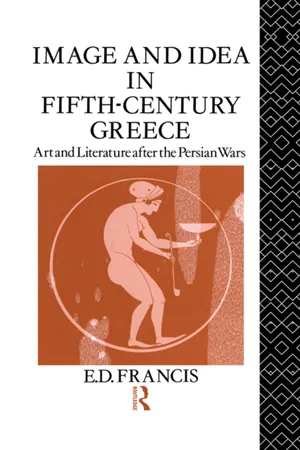
Image and Idea in Fifth Century Greece
Art and Literature After the Persian Wars
- 192 pages
- English
- ePUB (mobile friendly)
- Available on iOS & Android
eBook - ePub
About this book
The Wayneflete Lectures, given under the auspices of Magdalen College, Oxford, delivered in 1983 by Professor Francis, and published here under the title Image and Idea in Fifth Century Greece , are important because they challenge the way that the ancient world and its artistic and literary productions are often viewed. Francis believed that the ancient world was a unity in which issues of the day were reflected in the language of pictorial and sculptural representation and in the works of literature. If Professor Francis's case is valid, then the pan-Hellenic construction of temples, erection of dedicatory statues, and the general joie de vivre to be found in the artefacts of the `late archaic period' can be seen as the physical manifestations of Greek victory over the Persians in 480 and 479.
Trusted by 375,005 students
Access to over 1.5 million titles for a fair monthly price.
Study more efficiently using our study tools.
Information
Subtopic
Ancient HistoryIndex
History1
GREEK ART IN AN HISTORICAL SETTING
‘Can it be that Athens’ city still is undestroyed?’ ‘For so long as men live’, the courier replies to Queen Atossa, ‘Athens’ defence is secure’ (herkos estin asphales).1 In this exchange Aeschylus’ characters seem to echo language in which Apollo’s priestess had earlier prophesied the survival of Athens, for when that city’s representatives had come to supplicate the oracle, Aristonice declared ‘in words than adamantine firmer: … may Zeus wide-seeing grant Athena that her wall of wood alone be undestroyed the which shall be of profit to you and to your children’.2 Responding to these words Themistocles persuaded his fellow Athenians in the face of Persia’s army to evacuate their city, man their newly-built fleet and entrust their fate to ‘omnipotent Zeus, Athena Victory and Poseidon asphaleios, who forwards security’.3 A decade before at Marathon, these same Athenians turned back from Attic soil the generals of Darius. Now at Artemisium and Salamis his son’s navy was shattered by storms from the north, Themistocles’ strategy and the favour of the gods. In the following year Xerxes’ land army was no less decisively beaten at Plataea.
So when, at the beginning of the fifth century, Athenians had confronted the invading armies of Persia, they drove the stranger from their gate and sent the king in defeat and disarray back up the Royal Road to Susa. At once the victors celebrated this triumph in festival, art, and song, and, as Athens asserted a new hegemony by sea and land, her citizens alongside their allies pressed their advantage in order to liberate their Ionian kin and all the Greeks of Asia from the yoke of Persian rule. Victory, however, had not been easily won: in 480 Athens had indeed been sacked and her city twice occupied by Xerxes’ army. Her citizens had watched helplessly from across the bay of Salamis as the smoke rose from the fires of their pillaged sanctuaries. When these Athenians returned to rebuild their city, they transformed an alliance among states bent upon revenge into an empire which, in its turn, was to become no less an instrument of exploitation and repression. As a consequence, some Athenians at least began to reflect upon the nature of conquest and rule, and to reconsider the social and civic values their new power put at stake.
In the wake of victory Athenian politics was factionalized, but the son of Miltiades, strategist of Athens’ victory at Marathon, soon and successfully seized the occasion to assert himself as Athens’ leader. To Cimon, Joseph Wells has remarked, ‘the humiliation of Persia was at least as important as the exaltation of Athens, in fact the two aims were with him largely identical’.4 Like Alexander in the next century, Cimon was indeed a ‘hammer of the Persians’,5 but his role in guiding Athenian policy at home as well as abroad in these years of post-war reconstruction and expansion was decisive for the future of his nation. ‘It was the military genius and the diplomacy of Cimon which used the material and moral forces provided by Themistocles and Aristeides, and which won the conquests which Pericles organised only too thoroughly.’6 Cimon or his political patrons chose Theseus as an heroic archetype for their policies since, unlike Heracles, Theseus’ ancestry and mythical enterprise were pre-eminently Athenian. It may well be that local traditions already associated with him in Athenian folklore had not yet been formulated into an epic poem or indeed in any systematic programme. But whether or not the legends of Theseus had previously existed only in some disconnected form, it seems likely that they were now brought together, at times with significantly new variations, to support the propaganda of Cimon’s career by expressing the image of a young leader, victorious by land and sea, at home and abroad. Theseus became, as it were, Cimon’s signature – his sphragis – and the memories of Athenian triumph during the Persian wars from Marathon to Mycale, and his own double victory at the battle of the Eurymedon supplied recurrent subjects for contemporary art and song.
The Greeks had first come to know the Medes and the Persians when Cyrus moved west against the kingdoms of Phrygia and Croesus’ Lydia in the middle of the previous century. As a consequence of Cyrus’ victories, the eastern Greeks became subjects of the Great King and some of their artisans helped to build Pasargadae, Susa and Darius’ ceremonial palace at Persepolis.7 Greeks of the Aegean and the mainland to its west thus gained the opportunity to grow familiar, at least by hearsay, with Persian customs and the grandeur associated with the court of the Achaemenid monarch, and this experience came at a time when most Greek states, and Athens among them, were in the throes of rebellion or had already abolished the rule of tyrants in preference for more democratic forms of government.
The Greek attitude towards outsiders was a complex one: they referred to all who could not speak their language as ‘barbarian’, and frequently attributed demeaning ethical stereotypes to those who lived beyond the Hellenic pale. At the same time, the Greeks recognized some hereditary relationship with the peoples of the east. The eponymous ancestors of the Medes and Persians – Perses and Medus – were both sons of Greek heroes, albeit sired of exotic women, one of whom, though oriental herself, could nonetheless claim Corinthian descent. Zeus’ first human son became lord of Egypt and those who returned to Greece to found the great cities of Argos and Thebes were his descendants. When Argive Diomedes met Glaucus at Troy, the Lycian warrior was able to assert his own Corinthian ancestry traced from Bellerophon who had himself once come east to fight the chimaera. As Greeks in the fifth century sought paradigms from their own mythology to express their experience of the oriental as an enemy of Hellenic order, an exemplar of ethical confusion, they found parallels in the generation of giants who had opposed Zeus’ attempt to establish his new Olympian government; in physiological hybrids like the chimaera, constructed of male parts, but once compounded, Giftmädchen to national security; and likewise in the tribe of Amazons, an army of barbarous viragos doomed as women to succumb to the sword of the Greek soldier; and so the Trojan War itself came to provide a popular analogue for recent historical events.8
In the fifth century the Persians represented the ‘barbarian’ par excellence and an Athenian was characteristically taught to disdain those habits of luxury that had rendered the mighty kingdom of Darius and Xerxes an adversary whom the Greeks against all odds had successfully vanquished. They had reason to feel confident that they could repel the invader from without, but the real dangers to their survival lay inside their own communities as the Thebes of Sophocles’ Oedipus or Euripides’ Dionysus was to discover to her cost. Persian behaviour, as an image of the exotic, though at times it might attract could also provide a paradigm of what to avoid. As Persia’s kings, like Xerxes on Aeschylus’ stage, became models of despotism whose inherent weakness must inevitably bring about their collapse, so Athens’ leaders sought to define their own political identity by reference to the enterprise of those who in myth and act had punished such arrogance and guaranteed liberty for their countrymen.
It is the reflection of ideas such as these in Greek (and particularly, but by no means synonymously, Athenian) art, poetry, and public buildings during the generation following Xerxes’ retreat which I wish to discuss today in these lectures. Towards the end of the fifth century, with Sparta closing in by land and concluding an alliance with Persia,9 the Milesian poet Timotheus used the occasion of Athens’ renewed success at sea to celebrate her enemies’ defeat at Salamis some seventy years before.10 Seeing the outcome of that battle from his throne above the bay, Xerxes calls out to his attendants:
Come, no delay,
Yoke my four-horse chariot,
Bring my countless wealth
To the wagons and burn the tents:
May none of them profit from my treasure.11
Yoke my four-horse chariot,
Bring my countless wealth
To the wagons and burn the tents:
May none of them profit from my treasure.11
But against the monarch’s wish, Greece did indeed profit from his treasure’, and Herodotus describes the victors of Plataea as they gazed upon the wealth of ‘many tents richly adorned with furniture of gold and silver, gilded and silver-plated couches, golden bowls, mixing vessels, and drinking-cups … bracelets, torques, and daggers of gold’,12 and in particular Xerxes’ war-tent left in the care of his field general, Mardonius, in which Pausanias, the Greek commander-in-chief, amazed at its opulence, ordered the cooks and bakers to prepare a Persian feast.13 There is no need to recall in detail the inventories of these spoils divided up among the victors to be dedicated at both their pan-Hellenic and civic sanctuaries,14 but I select three examples from the artefacts of Greek private and public life upon which Persian antecedents may have exercized their influence.
First, the development of Greek drinking vessels known as rhyta has been much discussed in terms of Persian prototypes (Fig. 1)15 and even if East Greek intermediaries played a part in the early history of this vase-shape,16 the increasing popularity of these vessels is likely to reflect Athenian acquaintance with the spoils of victory. Second, there can be little doubt, in view of Hubertus von Gall’s recent demonstration, that Pericles’ music hall, the Athenian Odeion, was constructed under the influence of Achaemenid architecture,17 and Plutarch may well have been correct in reporting that the tent of Xerxes I have just mentioned provided its specific model.18 Von Gall accordingly draws attention to Broneer’s tempting if controversial thesis that, in the 470s, this tent actually entered service at Athens as the scene (Gk. skene) for the temporary theatre of Dionysus.19 Imagine the spectacular effect that Aeschylus may have achieved in 472 if he presented Atossa, Darius, and the whole court of Susa, with Xerxes paraded in desolation and defeat before an audience of triumphant Athenians, and telling the news of his astounding humiliation in what had lately been a pre-eminent symbol of his own majesty. Again, one may wonder if the conical roof of the Athenian Tholos, known as ‘Skias’, the ‘parasol’, reflects more than merely the technical invention of a skilful architect. Dorothy Thompson has noted the resemblance between the design of this building and the round, pointed tents which the Persians used on campaign,20 but a parasol itself may provide an even more relevant point of departure. Not only was the parasol regarded as a foppish conceit, asiatically bizarre,21 but we can see Achaemenid kings themselves portrayed in procession or upon their thrones protected by such sunshades (Fig. 2).22 I shall presently return to the building programme of which the Tholos in the Athenian Agora seems to have been a part, but for the moment it is enough to recall P.J. Rhodes’ hypothesis that the Tholos may have been constructed after Ephialtes’ death to house the presidents of Athens’ council, newly established according to the constitutional reforms associated with his name.23 In these terms the function of the parasol has been fundamentally recast. No longer does it shade an oriental and hereditary despot from the sun, but instead houses the temporary leaders of a democratically elected government of the free.
I have undertaken to present some aspects of fifth-century Athenian art in an historical setting and shall choose two monuments which may illustrate both the point and the difficulty of such an undertaking. Many practical obstacles indeed confront this enquiry, not least those derived from fundamental questions of principle. Let me summarize some of these obstacles at once and I shall return in due course to each of them in more detail. While much may be known of the military, political and social history of Athens during the first half of the fifth century, no one will deny that the historian of this period swiftly moves beyond securely ascertainable fact to the reconstruction of events and political movements whose record is often at best ambiguous. In interpreting Greek art and poetry as, in some sense, occasional, one would prefer to be more precisely certain than is usually possible at this period about not only the character, but indeed the date of the occasion being celebrated. Even the qualified assertion that poetry and art in the early fifth century may allude to any specific occasion is likely in some quarters to arouse suspicion, for many hold to the view that Greek art and literature conform to their own independent and autonomous conventions and that to consider their imagery in terms of some topical reference represents an ignorant and fruitless attempt to vandalize their integrity.
I shall not discuss literary issues in this chapter, but rather Greek material culture whose students have often been hesitant, especially in minor arts like vase-painting, to interpret mythical scenes in a topical sense, preferring instead to analyse stylistic relations both of the decoration and of the proportions of the building or vessel that include it. ‘An influential school of thought’, so Andrew Stewart tells us, ‘holds that the evolution of Greek art is so logical, undeviating and regular as to leave no room for the operation of social factors upon it’. Stewart takes particular issue with the attitude he attributes by way of example to Rhys Carpenter and which he describes as the ‘exaltation of the formal imperative to the status of a universal law … buttressed by a curiously mechanistic … psychology that attempts to reduce all sensory experience to simple physiological processes in the eye of the observer’.24 The vision of such an eye, trained to observing Wölfflin’s Prinzipien, is likely also to systematize the objects of its gaze through the lens of yet another principle, the ‘principle of continuous evolution’. This is no casual use of the term ‘evolution’. The principle entered the study of Greek art in the nineteenth century as the deliberate offspring of Darwinian gradualism. What was newly deemed valid in the work of nature, not least geological nature, was extended to the explanation of the material culture of antiquity. While Percy Gardner was not the first to draw this analogy, he does so with disarming frankness:
there is not in the whole history of art any so regular and gradual progress to be observed as in Greek sculpture…. The whole process is an evolution which may be compared for regularity and order with the geological evolution of the earth. It is precisely this rule of law which makes the study of Greek art so excellent a training in historic research.25
How, one may wonder, can it be ‘so excellent a training’ if such a state of affairs is without parallel ‘in the whole history ...
Table of contents
- Cover
- Halftitle
- Title
- Copyright
- Contents
- Acknowledgements
- Foreword
- 1 Greek Art in an Historical Setting
- 2 Images of Glory and the Art of Power
- 3 Word and Ceremony
- 4 ‘Silent Poetry’
- 5 Trophies for the Gods
- Appendix: The Mother, the demos, and the demosion
- Notes
- Abbreviations
- Bibliography
- Indexes: Index of classical authors
- General index
Frequently asked questions
Yes, you can cancel anytime from the Subscription tab in your account settings on the Perlego website. Your subscription will stay active until the end of your current billing period. Learn how to cancel your subscription
No, books cannot be downloaded as external files, such as PDFs, for use outside of Perlego. However, you can download books within the Perlego app for offline reading on mobile or tablet. Learn how to download books offline
Perlego offers two plans: Essential and Complete
- Essential is ideal for learners and professionals who enjoy exploring a wide range of subjects. Access the Essential Library with 800,000+ trusted titles and best-sellers across business, personal growth, and the humanities. Includes unlimited reading time and Standard Read Aloud voice.
- Complete: Perfect for advanced learners and researchers needing full, unrestricted access. Unlock 1.5M+ books across hundreds of subjects, including academic and specialized titles. The Complete Plan also includes advanced features like Premium Read Aloud and Research Assistant.
We are an online textbook subscription service, where you can get access to an entire online library for less than the price of a single book per month. With over 1.5 million books across 990+ topics, we’ve got you covered! Learn about our mission
Look out for the read-aloud symbol on your next book to see if you can listen to it. The read-aloud tool reads text aloud for you, highlighting the text as it is being read. You can pause it, speed it up and slow it down. Learn more about Read Aloud
Yes! You can use the Perlego app on both iOS and Android devices to read anytime, anywhere — even offline. Perfect for commutes or when you’re on the go.
Please note we cannot support devices running on iOS 13 and Android 7 or earlier. Learn more about using the app
Please note we cannot support devices running on iOS 13 and Android 7 or earlier. Learn more about using the app
Yes, you can access Image and Idea in Fifth Century Greece by E. D. Francis in PDF and/or ePUB format, as well as other popular books in History & Ancient History. We have over 1.5 million books available in our catalogue for you to explore.