eBook - ePub
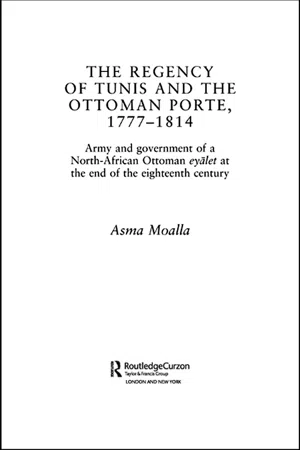
The Regency of Tunis and the Ottoman Porte, 1777-1814
Army and Government of a North-African Eyâlet at the End of the Eighteenth Century
- 200 pages
- English
- ePUB (mobile friendly)
- Available on iOS & Android
eBook - ePub
The Regency of Tunis and the Ottoman Porte, 1777-1814
Army and Government of a North-African Eyâlet at the End of the Eighteenth Century
About this book
This study of the Tunisian army and government in the time of the pasha-bey Hammûda the Husaynid (1777--1814) stresses the deeply Ottoman character of these institutions and the political and administrative impact of the jurisdictional authority of the Ottoman Porte on the province in general. This work thus initiates a systematic revision of a major thesis that has prevailed in the body of contemporary research on the Tunisian Regency. Asma Moalla shows that the Regency's administrative and political evolution from the end of the sixteenth century to the end of the nineteenth was not a process of a gradual and irreversible emancipation from the influence and authority of the central Ottoman state.
Information
Part 1
PROLOGUE
The Tunisian eyālet from the Ottoman conquest until the end of the eighteenth century (1574–1777)
1
FROM THE CONQUEST TO DEYLICAL RULE (1574–1647)
The corsairs, the Ottoman Porte and the conquest of Tunis
The conquest of Tunis in 982/1574 sealed Ottoman domination of the eastern and central Arab Maghrib, over which the Hafsid dynasty, established in 1229, had extended its influence during the period of its apogee in the fourteenth and part of the fifteenth centuries. The region, which had been plunged, since the end of the latter century, into economic decline and political anarchy, had become the stake of a duel between the Ottoman and Spanish Empires for the control of the southwestern Mediterranean. The confrontation between the two powers pitted against each other the corsair forces affiliated to them - a frequent feature of naval warfare in those times. In the Ottoman camp, an original and far reaching partnership was struck between the Porte and the Muslim corsairs, of whom the most prestigious was the famous Khayr al-Dīn Barbarossa. The latter, having succeeded his brother ‘Aruj as ruler of the small coastal town of Algiers, placed himself under Ottoman protection, and received from Sultan Selīm I a firman (sultanic decree) investing him with the governorship of Algiers, as well as an important janissary force. The new beylerbey (provincial governor) and his successors were thus provided with the symbols of legitimacy as well as the human and material resources that enabled them to resist Spanish attacks and embark on further conquests along the central coast of the Maghrib (Bona in 1522, Constantine in 1524). Another famous corsair, Dragut Re’is, who had been operating with frequent success against the Spaniards along the south-eastern coast of the Maghrib, was rewarded in the same way in 1556 by being appointed beylerbey of Tripoli. From there, he was able to conquer Jirba in 1560 and, progressing in the hinterland, occupied Qayrawān, which had been ruled by the Shābbiya religious order that had successfully defied Hafsid authority in the region (Julien 1952: 250–75; Barbour 1969: 76–90).
Tunis, the capital of the Hafsid sultans and their last remaining stronghold, did not fall easily under Ottoman domination. The city, twice conquered and occupied by Algerian corsair-beylerbeys: Khayr al-Dīn, from 1529 to 1534, and Ilij ‘Alī from 1569 to 1572, was both times surrendered to Spanish troops, who restored Hafsid rule there. Finally, in the summer of 1574, a naval expedition under the command of the grand vizier Sinān Pasha, seconded by Ilij ‘Alī who had, in the meantime, been appointed kapudan pasha (grand admiral of the Ottoman fleet) sailed from Istanbul to the Tunisian shores. There it was reinforced by contingents sent from Qayrawān, Tripoli, Algiers and Mashriq provinces of the Porte. The Ottoman fighters first successfully stormed the fortress of Halq al-Wād, near Tunis, where a Spanish force had been garrisoned for the protection of the Hafsid monarch, Mulāy Muḥammad, and then finally secured the capital (von Hammer-Pürgstall 1840–4: II, 191–2; Ibn Abī Dīnār 1967: 287–99). The campaign lasted two months and its victorious outcome resulted in the creation of the third, and last, Ottoman province of the Arab Maghrib, or the Barbary region, as it was denominated by Europeans.
The successive conquest of the eyālets (provinces) of Algiers, Tripoli and Tunis, known as the ‘western hearths’ (Ott.: ġarp ocakları) of the Porte, and situated on the western frontier of the Empire, had represented important territorial assets in the war waged by the Ottomans against their main European foe, Charles V of the House of Habsburg, whose dominions extended to Spain in the western Mediterranean. It is interesting to note, however, that this strategic consideration lost most of its importance soon after the conquest of Tunis (or maybe as a result of it): in 1578, the signing of a truce between Murād III and Philip II, who had succeeded Charles V as king of Spain, led to the definitive cessation of large-scale naval warfare between the two powers (although this did not, for the next century and more, exclude corsair operations). From then on, while Spain turned to its new Atlantic possessions, the Ottomans shifted their attention to the Safawi threat in Anatolia and to their European territories (Hess 1977: 75).
More importantly, the addition of the Maghrib provinces to the realm of the Ottoman sultans represented a further extension of the latter’s domination over the Muslim Arab world. We may attempt, at this point, to make some conjectures on the effect of the victorious campaign of Sinān Pasha and the solemn institution of Ottoman rule on the minds and perceptions of the Tunisian population. The authority of the Hafsid dynasty had certainly been increasingly eroded since the end of the fifteenth century and, especially, under its last monarchs who could only keep their throne by entrusting it to the protection of a Christian power. To the memory of the brutalities committed by the Spanish army against the inhabitants of the capital in 1534, were added rumours, real or fictitious, probably spread by pro-Ottoman propagandists, on profanations perpetrated after the second occupation of Tunis by Don Juan’s forces in 1572.1 After the city had been snatched twice from the weak control of Khayr al-Din and Ilij ‘Alī,2 the 1574 expedition dispatched from Istanbul and led by the grand vizier Sinān Pasha himself, probably appeared to many as ushering in a new radiant era. The country was now, at last, closely reunited with the dār-al-islām (the realm of Islam) under the rule of the Turkish sultans, whose military excellence was seen as evidence of their true Islamic faith, and whose victories proclaimed that God was on their side. We may, furthermore, presume that the setting-up of Ottoman rule in the new province was received by the local ulama (religious authorities and doctors of law), not with the resigned acquiescence reserved to mighty usurpers, but with a measure of genuine enthusiasm. The religious propaganda sanctioning Ottoman rule, amplified and spread in the cities by the ulama’s Friday sermons, would also filter down to the countryside and to the ever turbulent, but not totally impervious, tribes. Furthermore, the population in towns must have welcomed the army and administration of the powerful gunpower Empire as an effective protection against anarchy and Beduin raids.
The beginning of Ottoman rule in Tunis (1574–91)
The Ottoman administrative structure set up by Sinān Pasha in the newly-created Tunisian eyālet conformed to the general pattern established for provincial governments throughout the Empire. Supreme power in the province devolved on the sultan’s representative, the pasha, or beylerbey, appointed for a limited period. The victorious Ottoman conquest army, or wajaq (from the Ott.: ocak) the greatest part of which remained in the province after their commander’s departure to Istanbul, was now entrusted with implementing Ottoman law and order in the province, and protecting it from the threat of Christian attacks. The wajaq, in Tunis, soon became more commonly designated by the Arabic word jund (army). Its members, upholding the Muslim Ḥanefite rite followed by the Turkish Ottomans, in contradistinction to the local population who adhered to the Malekite rite, formed the privileged tax-exempted group of the ‘askeris of the province. Although the jund was formally placed under the supreme authority of the pasha, its dīwān, constituted by the body of janissary officers who were empowered with prerogatives for settling all legal and administrative matters concerning their corps, enjoyed a large measure of autonomy. Of this dīwān, and, indeed, of the whole ‘askeri structure of which it was in charge in the Tunisian eyālet, the eighteenth-century chronicler Ḥusayn Khūja asserts that ‘it was copied on those of Algiers and Egypt’ (Khūja 1975: 88). The jund, in addition to fighters, included various categories of officers principally entrusted with administrative and accountancy duties, since the public service, throughout the Ottoman Empire, was an integral part of the ‘askeri class. The highest-ranking of these officers was the bey. The jund also included the Hanefite qādis (judges and religious jurisconsults), who were appointed by the ser ‘asker (supreme military commander) of Rumelia (Raymond 1989: 351). Finally, a group composed of its highest-ranking officers, to whom were added a few city notables,3 formed an influential political council, called (like the administrative body regulating the affairs of the jund), the dīwān, which assisted the pasha in making decisions and implementing sultanic orders in the province.
The Tunisian eyālet was ruled, at its incipience, by a sort of condominium set up between the Porte and Ilij ‘Alī, corsair-beylerbey of Algiers and kapudan pasha of the Ottoman fleet, until the latter’s death in 1587 (Julien 1952: 265). It is worth noting here, that, since the fifteenth century, the process of extension of Ottoman rule over new territories was almost systematically divided into two stages, as has been noted by Halil Inalcik: ‘[The Ottomans] first sought to establish some sort of suzerainty over the neighbouring states. They then sought direct control over these countries by the elimination of the native dynasties’ (quoted by Holt 1968: 83–4).
This observation applies also to Tunisian eyālet, with the difference that, in the first stage, the native Hafsid dynasty, which sank into total oblivion after Sinān Pasha’s victory over its Spanish protectors, was replaced by the corsairs, who had preceded the Porte in the conquest of the Maghrib. Sources on this brief period, however, have provided no detail on the nature and extent of the jurisdiction of Ilij ‘Alī on that province. In order to probe further this issue, it is worth recalling that the supreme commanders of the Ottoman navy, in the fifteenth century, were granted the governorship of some coastal territories in the Greek archipelago as an appanage to their office. To these were added, at least, the governorships of Algiers and of the town of Mahdiyya on the eastern Maghrebi coast, when Khayr al-Dīn Barbarossa was appointed at the head of the admiralty by Sultan Sulayman in 1528 (Ozbaran 1978). It seems, therefore, that as the Ottoman conquest progressed in the Maghrib, coinciding with the period when the first Algerian beylerbeys, from Khayr al-Dīn to Ilij ‘Alī, monopolized the command of the Ottoman navy, the coastal territories of Tunis and Tripoli (with the whole of the Algiers province) were integrated into what came to be called ‘the eyālet of the kapudan pasha’. By the end of the sixteenth century, however (presumably from the death of Ilij ‘Alī), the domination of the Algerian corsairs over the Ottoman admiralty had been successfully fought off by the government of the Porte, and the territorial scope of that eyālet, in spite of an increase in its geographical dimensions, became, again, limited to the eastern Mediterranean region (Beckingham 1965). The Maghrib provinces, which became directly ruled by the Porte after 1587, nonetheless remained after that date, to an important extent, under the jurisdiction of the kapudan pasha, as we shall see below.
It was also during the years from 1574 to 1587 that the initial territory covered by the Tunisian eyālet in the period following the conquest was, by sultanic decree, considerably extended to the south and east, to cover new regions that had previously been placed under Tripolitan jurisdiction (Bachrouch 1977: 1634). As concerns Ottoman rule in Tunis in that period (and the few following years, until the military uprising that broke out in 1591), it has been described by Tunisian historiography as marked by acts of exploitation and violence, inherent to any foreign military occupation. Two specific instances of these abuses in Tunis have, indeed, been recorded by sources: first, Rajab Pasha’s policies of extortion (1576–7), which led to complaints being filed against him and resulted in his quick dismissal (Bachrouch 1977: 135, 139); second, the exactions of an Ottoman qādi, against whom a group of local ulama and notables voiced their protests (and eventually probably won their case) (Chérif 1972: 37–50). It is worth noting, however, that in these two cases, at least, the abuses were stamped out. This, in addition to several admonitory letters sent to high officials in Tunis by the Porte, following reports about abusive practices in the new province at that period (Samih 1969: 261–2; Témimi 1995: 198–207), should therefore rather lead us to infer that the new ruling power and its representatives paid some attention to the rights and grievances of the local population.
In 1591, the uprising of the Tunisian jund led to important changes being made in the Ottoman administrative structure set up by Sinān Pasha in the province. Before studying this episode and its consequences, it is necessary to deal, first, with the origins and composition of the Ottoman army in Tunis on the morrow of the conquest.
The Tunisian Ottoman army and the 1591 uprising
The armies of the Ottoman sultans in the sixteenth century were of a heterogeneous composition. There was, first, the prestigious imperial janissary corps, originally exclusively manned by Christian Rumelian youth recruited and trained to follow a military or an administrative career in the Ottoman government, after having converted to Islam. These young men, who enjoyed the envied status of kapı kulus (slaves of the Porte), monopolized, since the fifteenth century, most of the high posts in the army and administration of the Empire. In addition to the janissaries, a variety of auxiliary contingents fought in the sultan’s wars. The greatest proportion of these contingents was recruited among groups of armed Muslim young men from the Anatolian plateau, where they were known as the sekbans. The increasing financial difficulties of the Porte, from the middle of the sixteenth century on, led it to resort increasingly to the sekbans, who represented a cheap fighting force, paid only for the duration of each campaign. The sekbans, who were organized by the Ottoman military authorities into various formations, are mentioned for instance, in sources on Selīm I’s campaigns in Syria and Egypt in 1517, or on the wars in Hungary between 1594 and 1607 (Finkel 1988: 37). We may, therefore, presume that there was a number of these contingents among Sinān Pasha’s expeditionary force against Tunis and, thence, among the first Tunisian jund. This fact may also be deduced indirectly by assembling two pieces of information provided by Ibn Abī Dīnār on that army: first, that it included the 101st janissary orta (division), which Sinān Pasha had brought with him from Istanbul and, second, that its total number was 3,000 fighters (Ibn Abī Dīnār 1967: 199 and 301). Since the ortas of the imperial janissary corps, even in wartime, did not, according to the most liberal evaluations, number more than 500 men (Gibb and Bowen 1950: I, 61n.) this would imply that the Tunisian jund included only a small proportion of regular janissaries, and that the remaining number was made up of sekbans and other auxiliary forces.
Discontented or idle sekbans, disbanded between campaigns, became an increasingly serious cause of social unrest in Anatolia in the second half of the sixteenth century. The Porte, therefore, hoped to alleviate that problem by allowing these young men to settle in the territories that they had helped conquer. Whereas posts in the Ottoman central government and army remained (theoretically) reserved for Rumelians, these Muslim Anatolians of humble origins found an outlet for their ambitions, particularly in the faraway dominions of the Porte. An opportunity was thus offered for the sekbans to begin a new life in Tunis as the ‘askeris of the province. In addition to enjoying the benefit of regular pay, they were granted one of the most strenuously upheld claims of the sekbans across the Ottoman Empire, i.e. their promotion to janissary status (Inalcik 1970: 346, 348): thence their denomination as the kul ‘asker of the province in Tunisian Ottoman documents (see Archives Générales Tunisiennes, Carton 220, Dossier 346, document 3).
The incipient Tunisian jund, placed under the supreme command of an āgha from the janissary corps of Istanbul, was also structured on the pattern of their corps, being divided into sections of 20 to 25 men, placed under the orders of officers called the bulūk bāshīs (Ott.: bölük başis, or section commanders), presumably sent from Istanbul, or, at least, appointed from among the small contingent of imperial janissaries that had participated in Sinān Pasha’s campaign. According to the eighteenth-century historian Muḥammad al-Wazīr, furthermore, the jund also included, from its beginning, another category of officers called the deys (Ott.: dåy, i.e. maternal uncle), who were placed in command of divisions of 100 men (al-Wazīr 1985: II, 338). This assertion, however, is contradicted by Ibn Abī Dīnār, according to whom the deys only emerged after the revolt of the jund in 1591, as the elected spokesmen of the rebel janissaries (Ibn Abī Dīnār 1967: 201). Several historians on Ottoman Tunisia have sanctioned the latter account, thus rejecting, implicitly or explicitly, al-Wazīr’s assertion (Pignon 1950: 102; Bachrouch 1977: 134–5; Raymond 1994: II, 32). This choice may have been based on the assumption that, since Ibn Abī Dīnār lived at an earlier period than al-Wazīr, and therefore nearer in time to the 1591 uprising (he died in the last years of the seventeenth century), his account of the circumstances of that event would be more precise and reliable. It may be argued, however, against this assumption, that Ibn Abī Dīnār, being a client and propagandist of the Muradite beys of his time who were engaged in a bitter conflict against the deys, was particularly anxious to deny any formal Ottoman status or legitimacy to his patrons’ enemies....
Table of contents
- COVER PAGE
- THE REGENCY OF TUNIS AND THE OTTOMAN PORTE, 1777–1814
- TITLE PAGE
- COPYRIGHT PAGE
- ACKNOWLEDGEMENTS
- NOTE ON TRANSLITERATION
- SOURCES AND HISTORIOGRAPHY ON OTTOMAN TUNISIA: FOR A REVISION OF THE ‘AUTONOMY THESIS’
- PART 1: PROLOGUE: THE TUNISIAN EYĀLET FROM THE OTTOMAN CONQUEST UNTIL THE END OF THE EIGHTEENTH CENTURY (1574–1777)
- PART 2: THE POLICIES AND GOVERNMENT OF ḤAMMŪDA PASHA (1777–1814)
- CONCLUSION: THE EVOLUTION OF THE TUNISIAN GOVERNMENT FROM 1574 TO 1814
- APPENDIX A
- APPENDIX B
- NOTES
- BIBLIOGRAPHY
Trusted by 375,005 students
Access to over 1.5 million titles for a fair monthly price.
Study more efficiently using our study tools.
Frequently asked questions
Yes, you can cancel anytime from the Subscription tab in your account settings on the Perlego website. Your subscription will stay active until the end of your current billing period. Learn how to cancel your subscription
No, books cannot be downloaded as external files, such as PDFs, for use outside of Perlego. However, you can download books within the Perlego app for offline reading on mobile or tablet. Learn how to download books offline
Perlego offers two plans: Essential and Complete
- Essential is ideal for learners and professionals who enjoy exploring a wide range of subjects. Access the Essential Library with 800,000+ trusted titles and best-sellers across business, personal growth, and the humanities. Includes unlimited reading time and Standard Read Aloud voice.
- Complete: Perfect for advanced learners and researchers needing full, unrestricted access. Unlock 1.5M+ books across hundreds of subjects, including academic and specialized titles. The Complete Plan also includes advanced features like Premium Read Aloud and Research Assistant.
We are an online textbook subscription service, where you can get access to an entire online library for less than the price of a single book per month. With over 1.5 million books across 990+ topics, we’ve got you covered! Learn about our mission
Look out for the read-aloud symbol on your next book to see if you can listen to it. The read-aloud tool reads text aloud for you, highlighting the text as it is being read. You can pause it, speed it up and slow it down. Learn more about Read Aloud
Yes! You can use the Perlego app on both iOS and Android devices to read anytime, anywhere — even offline. Perfect for commutes or when you’re on the go.
Please note we cannot support devices running on iOS 13 and Android 7 or earlier. Learn more about using the app
Please note we cannot support devices running on iOS 13 and Android 7 or earlier. Learn more about using the app
Yes, you can access The Regency of Tunis and the Ottoman Porte, 1777-1814 by Asma Moalla in PDF and/or ePUB format, as well as other popular books in Social Sciences & Ethnic Studies. We have over 1.5 million books available in our catalogue for you to explore.