eBook - ePub
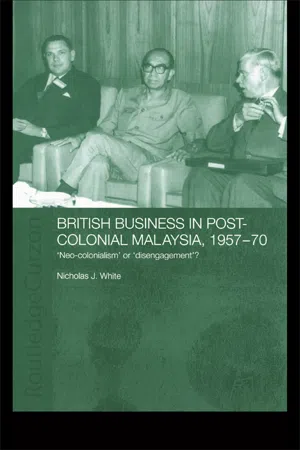
British Business in Post-Colonial Malaysia, 1957-70
Neo-colonialism or Disengagement?
- 272 pages
- English
- ePUB (mobile friendly)
- Available on iOS & Android
eBook - ePub
British Business in Post-Colonial Malaysia, 1957-70
Neo-colonialism or Disengagement?
About this book
This book explores the limits of the idea of 'neo-colonialism' - the idea that in the period immediately after independence Malaya/Malaysia enjoyed only a 'pseudo-independence', largely because of the entrenched and dominant position of British business interests allied to indigenous elites. The author argues that, although British business did indeed have a strong position in Malaysia in this period, Malaysian politicians and administrators were able to utilise British business, which was relatively weak vis-a-vis the Malaysian state, for their own ends, at the same time as indigenous businesses and foreign, non-British competitors were gathering strength. In addition, despite the commitment of both Conservative and Labour governments in the UK to preserving British influence worldwide through the Commonwealth relationship, British firms in Malaysia received only limited support from the British post-imperial state.
Information
1
Moments of anguish
The making and unmaking of ‘Greater Malaysia’
A neo-colonialist plot?
In May 1961, Tunku Abdul Rahman first publicly announced his desire to bring Malaya ‘closer together’ with Singapore, Sarawak, North Borneo and Brunei in ‘a political and economic co-operation’.1 For President Sukarno of Indonesia, the ‘Greater Malaysia’ project was nothing more than a ‘neocolonialist plot’. In justifying his policy of Konfrontasi (‘Confrontation’) against the new state, the veteran anti-colonial revolutionary declared that Malaysia was designed to secure tin, rubber and oil supplies ‘for the imperialists’.2 For socialist and Islamicist opposition politicians in the Federation, the Tunku’s plans were merely a cloak under which Britain would continue to dominate Southeast Asia through a sinister shift of imperial technique from ‘divide and rule’ to ‘unite and rule’. Independence, it was claimed, ‘made no sense if [Malaysia’s] economic heart’ remained lodged in London.3 Writing in the 1980s, Hua Wu Yin also regarded the final creation of Malaysia in September 1963 as a triumph for British ‘neo-colonialism’. Although Singapore split from the Federation in August 1965 while Brunei never joined, Malaysia ‘was the ideal solution to enable British imperialism to maintain its hold on the rich resources of the North Bornean states…and at the same time deal with the left-wing threat in Singapore’.4 In a similar vein, a more recent study by Greg Poulgrain views the Malaysia scheme as propelled primarily by British economic interests. The making of Malaysia proved a ‘masterstroke of…decolonization’ because it allowed Britain to secure its investments while appearing to transfer power. Brunei’s decision to stay out of the Federation was hardly disastrous since the Anglo-Dutch oil monopoly in the sultanate was secured from the end of 1962 by troops of the former colonial power. As such, ‘the dominant policy in the saga of British decolonization in Southeast Asia stemmed…from an unidentifled amalgam of oil-company executives and British intelligence personnel’.5
Greater integration of the Malaysia area under the leadership of the proWestern, pro-capitalist Alliance government in Kuala Lumpur certainly made sound ‘neocolonial’ sense and, as the first part of this chapter shows, we can identify broad support from British business interests on both economic and political grounds for the ‘grand design’. However, British firms exercised little influence over official decision-making on the ‘Greater Malaysia’ project and the interests of expatriate business were not uppermost in the minds of either British or Southeast Asian policy-making elites. Moreover, Malaysia’s final format—with the failure to incorporate Brunei, the separation of Singapore, and the subordination of Sabah and Sarawak—disappointed significant sectors of the British business network and illustrates the autonomy of local political actors from seemingly omnipotent foreign investment.
The lure of ‘Greater Malaysia’
The economic attractions
As a means of integrating the various economies of Commonwealth Southeast Asia, the Malaysia project had considerable attractions for British firms. Indeed, the big business groups had been disappointed by the postwar administrative reorganisation, which brought together the Malay States and the settlements of Penang and Melaka for the first time but left Singapore as a separate colony (despite the long-standing economic interconnections of the island and the mainland). Shipping interests complained in May 1946 that ‘our official dealings are made immeasurably difficult by our having…to approach two governments instead of one’.6 The long-term ‘grand design’ of British officialdom since the Second World War was the creation of a ‘Dominion of Southeast Asia’. Yet progress towards ‘closer association’ between Malaya and Singapore, let alone between Malaya and Singapore and the more distant and less-integrated Borneo territories, proved protracted.7 Moreover, in economic development, full independence for the Federation of Malaya in August 1957, while Singapore retained its colonial status, appeared to tear the two territories further apart. In 1959, the British exchange bankers and merchants were soothed by the preservation of monetary union between Malaya, Singapore and the Borneo territories when a central bank with limited powers (the Bank Negara) was created in Kuala Lumpur.8 But the increase in protective tariffs introduced by the Federation government to assist industrialisation on the mainland was a ‘severe blow’ to Singapore’s nascent manufacturers who relied on the ‘up country’ market. The Singapore Manufacturers’ Association (SMA)—which included as members the subsidiaries of British multinationals and agency houses—complained that it was ‘difficult to reconcile the Federation Government’s much-publicised desire for economic co-operation with other countries in this area with their unsympathetic attitude towards Singapore manufacturers’.9 The heads of the agency houses in Singapore blamed the fall in trade with the Federation by some M$38 million between 1957 and 1958 partially on Kuala Lumpur’s tariff policy. Meanwhile, the North Kelang Straits port facilities at Port Swettenham and plans to develop an east coast road from Kuantan to Kota Bharu were further evidence that long-established complementarities between island and mainland were breaking down.10
With the prospect of further divergence when Singapore achieved a further dose of self-government after elections in May 1959, the leaders of the SCC met secretly with the island’s chief minister, Lim Yew Hock. The British businessmen emphasised that even if a political merger was impossible, ‘surely there was a crying need for some sort of economic fusion and a common understanding on economic problems’. Lim’s government was set to introduce its own pioneer industry legislation, suggesting that both governments were ‘now indulging in a mad scramble for such new capital as was likely to come in, and to pursue this on a unilateral basis must be harmful to both’. Hence, the taipans became increasingly attracted to Lim’s moderate Singapore Peoples’ Alliance (SPA) when the chief minister suggested that his close relationship with the Tunku would permit Singapore’s political incorporation into the Federation, and hence the development of a common economic policy between the two governments. However, if Lee Kuan Yew’s left-wing People’s Action Party (PAP) came to power there would be ‘no hope of a merger’.11 European commercial interests may have directed funds to the SPA,12 but the PAP triumphed in the elections for internal self-government. As such, business anxieties about economic divergence only intensified: in March 1960, A.W.Scott, the head of Sime Darby in Singapore, appealed for the ‘maximum degree of co-operation with the Federation together with the establishment of…[a] common market’.13
Hence, the Tunku’s encouragement of closer association was welcomed in expatriate commercial circles. In February 1962, the editor of the pro-business Straits Times saw the distinct economic advantages of linking ‘the Five’ politically. The four primary commodity producers—Malaya, Brunei, Sarawak and Sabah—would be united with their principal port at Singapore. Competitive development would be potentially ruinous to Singapore, especially if the Federation continued to develop port facilities to rival the island’s and came to operate its own currency system.14 UK financial interests had indeed been alarmed during 1960 and 1961 by the possibility that the Federation would ditch the agreement (dating from 1952), which, despite merdeka and the creation of a central bank, continued to permit the operation of a common currency throughout Malaya, Singapore and the Borneo territories. But, as the Federation’s finance minister, Tan Siew Sin, pointed out in January 1962, the creation of Malaysia would resolve independent Malaya’s currency dilemma: when Malaysia came into being, the Bank Negara would issue currency over all the existing currency area.15
Yet the principal economic attraction of ‘Greater Malaysia’ for the British agency houses lay in the prospects for the expansion of secondary industry. During 1962 and 1963, the SCC viewed ‘the economic benefits of Malaysia’ as being primarily in the development of a ‘common market’. A free trade zone would provide a ‘fillip…to industrialization in all the participating countries’. Nascent industrial projects—for example, at the Jurong development zone on Singapore— would expand in a politically stable Malaysia with unified tariffs and a ‘judicious blending’ of commerce, manufacturing and shipping.16 Not surprisingly, the managers of the agency houses in Kuala Lumpur agreed: ‘One of the most important economic advantages of Malaysia’, according to the president of the SMCC, ‘is the opportunity for accelerated industrial development as a result of the creation of a larger domestic market’.17
The larger agency houses could certainly capitalise on this wider, pan- Malaysian market because, as we noted in the introductory chapter, during the 1950s many of them had expanded from Malaya and Singapore into the colonial states of northern Borneo. BCL, H&C and Sime Darby were also to be found in the Brunei protectorate. ‘Greater Malaysia’ might also serve as a means of offsetting economic stagnation in Sarawak and Brunei. Certainly, the firms in Borneo supported a federation of the three Borneo territories, as advocated by the British governors of the region after February 1958.18 North Borneo, with expanding agricultural estates, considerable timber resources, and important strategic and military value, had healthy economic prospects. But Sarawak’s resources were limited while its population was increasing and its education policy was ‘out of balance, with the Chinese forging ahead of the numerically equal but educationally backward tribes people’. Brunei, having obtained a large measure of internal autonomy in 1959, appeared to be ‘grinding to a halt’, and unless the government got ‘cracking soon’ with constructive development schemes and secondary industries, there would be ‘trouble before long’. The sultanate’s oil production had passed its peak, and Brunei had no other resources, while there were 10,000 children at school ‘now beginning to look for jobs which don’t exist’.19 Under the late-imperial mission after the Second World War, there had been an upsurge in publicly funded economic development in British Borneo. Between 1946 and 1963, M$291 million (about £34 million) was spent on projects in Sarawak alone, largely financed from UK Colonial Development and Welfare grants. In parallel with tropical Africa, however, much of this development push can be classified as a failure. Cash crop exports declined, imports of rice increased, bauxite production proved short-lived and nothing commercially viable was found to replace the declining Miri oilfield. On British withdrawal, Sarawak still had no road network connecting the major population centres.20 Hence, once a wider federation became a possibility, the economic attraction for the agency houses, as for the Bornean politicians, was the prospect of a net transfer of development funds from Singapore and Malaya to the less developed, Bornean states.21 The M$300 million dollars (about £35 million) promised by Kuala Lumpur in 1963 for development over five years in Sabah and Sarawak was particularly welcome.22
The political attractions
As the above discussion suggests, the investment groups saw the federation of the former British territories in maritime Southeast Asia in political as well as economic terms. As a means of diluting Singapore’s radicalism in a conservative-dominated Federation, the Malaysia scheme had obvious advantages. The early 1960s in Singapore witnessed a struggle for political power in which a battle for the control over unionised labour was a key feature. The principal problem for British firms in a semi-independent Singapore was expected to derive from the policies of the PAP regime. As early as the autumn of 1958, Lee Kuan Yew was predicted to defeat Lim Yew Hock. In an interview with the PAP leader, Sir John Barlow was shocked to discover that Lee ‘could not imagine anyone investing new money in Singapore and certainly would not do so himself if he had any’. After taking office, the PAP hoped to ‘retain what capital there is in Singapore and the accrued profits as far as possible’.23 When the PAP’s election victory of May 1959 was even more overwhelming than the boxwallahs anticipated, it is no surprise that HSBC’s manager in Singapore reported on ‘a general feeling of depression’ and much speculation regarding the ‘burdens’ which were sure to be imposed on the commercial community.24 As it turned out, however, a remarkable concordat was reached between the expatriate business community and the anticommunist PAP The opening of the new Legislative Assembly was accompanied by promises that no restrictions would be placed on the activities of foreign investors. Moreover, in introducing his first budget in November 1959, the PAP’s finance minister, Goh Keng Swee, proposed the formation of a limited common market with Malaya and an industrialisation strategy which would be integrated with that of the Federation’s.25
Thus, in May 1961, lan MacEwen, the managing director of BCL in London, wrote to Singapore that ‘one needs a sense of humour to appreciate that British businessmen…are anxiously hoping for the survival of the PAP’. The abilities of Lee and Goh were now beyond doubt, and, ‘If anything happened to these two men, we would…be in for difficult, if not troublesome times’.26 Two months later, troublesome times seemed imminent. PAP left-wingers—alienated by Lee’s pragmatic socialism and frustrated by Singapore’s slow progress towards full independence—chose...
Table of contents
- Cover Page
- Title Page
- Copyright Page
- Illustrations
- Preface
- Acknowledgements
- Abbreviations and acronyms
- Introduction: Dependence, interdependence and disengagement in the Malaysian context
- 1 Moments of anguish
- 2 Political business Politics and economic nationalism in the post-colonial state
- 3 The years of living dangerously
- 4 Looking after the old staples
- 5 Oil palms and factories
- Conclusion
- Glossary
- Select who’s who
- Bibliography
Trusted by 375,005 students
Access to over 1.5 million titles for a fair monthly price.
Study more efficiently using our study tools.
Frequently asked questions
Yes, you can cancel anytime from the Subscription tab in your account settings on the Perlego website. Your subscription will stay active until the end of your current billing period. Learn how to cancel your subscription
No, books cannot be downloaded as external files, such as PDFs, for use outside of Perlego. However, you can download books within the Perlego app for offline reading on mobile or tablet. Learn how to download books offline
Perlego offers two plans: Essential and Complete
- Essential is ideal for learners and professionals who enjoy exploring a wide range of subjects. Access the Essential Library with 800,000+ trusted titles and best-sellers across business, personal growth, and the humanities. Includes unlimited reading time and Standard Read Aloud voice.
- Complete: Perfect for advanced learners and researchers needing full, unrestricted access. Unlock 1.5M+ books across hundreds of subjects, including academic and specialized titles. The Complete Plan also includes advanced features like Premium Read Aloud and Research Assistant.
We are an online textbook subscription service, where you can get access to an entire online library for less than the price of a single book per month. With over 1.5 million books across 990+ topics, we’ve got you covered! Learn about our mission
Look out for the read-aloud symbol on your next book to see if you can listen to it. The read-aloud tool reads text aloud for you, highlighting the text as it is being read. You can pause it, speed it up and slow it down. Learn more about Read Aloud
Yes! You can use the Perlego app on both iOS and Android devices to read anytime, anywhere — even offline. Perfect for commutes or when you’re on the go.
Please note we cannot support devices running on iOS 13 and Android 7 or earlier. Learn more about using the app
Please note we cannot support devices running on iOS 13 and Android 7 or earlier. Learn more about using the app
Yes, you can access British Business in Post-Colonial Malaysia, 1957-70 by Nicholas J. White in PDF and/or ePUB format, as well as other popular books in Politics & International Relations & Politics. We have over 1.5 million books available in our catalogue for you to explore.