- 240 pages
- English
- ePUB (mobile friendly)
- Available on iOS & Android
eBook - ePub
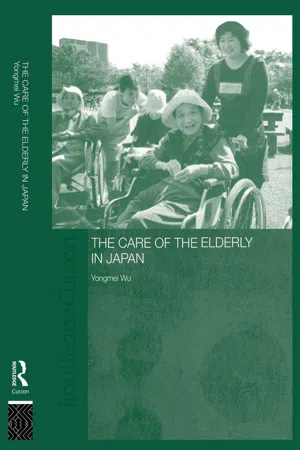
The Care of the Elderly in Japan
About this book
The problems of an ageing population are particularly acute in Japan. These problems include people living longer, with many needing more care, and the problems of supporting them by a diminishing working population and a diminishing tax base. This book, based on extensive fieldwork in a Japanese institution for the elderly, explores the whole issue of ageing and responses to it in Japan, and compares the Japanese approach in these matters with Western approaches. It discusses how people in Japan have changed their perceptions towards family responsibility, the institutionalization of the elderly, and rights of welfare. It also discusses how institutions for the elderly are run in Japan and how their management differs from that in the West.
Information
1 Introduction
The population in China is ageing rapidly. In a country where social security programmes have been scarce and care for the elderly has largely depended on the family, it remains a question whether younger generations will be able to take care of the increasing elderly population. China's one-child policy means that the number of children who can share the responsibility for caring for their elderly parents is decreasing, while the care burden is increasing because a young married couple have to take care of four old parents. Urbanisation and the nuclearisation of the family have made co-residence more difficult; financial difficulties as well as the scarcity of social services have also made it impossible for families to rely on social support. Under such conditions, what can we do for our old people?
To search for a solution, I turned my eyes to Japan, the only non-Western post-industrial country that is strenuously coping with the problems generated by population ageing and the side-effects of modernisation. The reasons for this were, first, because Japan became an ageing society earlier than China, and because its welfare systems and social services are more advanced than other Asian countries. Second, I think that although the nations are different, because the physical process of ageing is the same, and because the Confucian norm of filial piety is shared by both countries, there should be some common problems and challenges. Third, knowledge derived from Japan can help us build more relevant strategies and social policies for the aged in our own society.
This book, thus, is the first English publication of an anthropological study on Japanese institutional care for the elderly people by a Chinese researcher. Treating institutions for the elderly that Japanese refer to as 'homes' as a small-scale culture, I have explored both what constitutes good quality of life, and the reality of living and working in Kotobuki, a Japanese welfare institution for the elderly in suburban Tokyo. I attempt to answer questions such as: What has brought the elderly, their caregivers and outside visitors to the institution? How do these persons perceive their institutional experiences and adapt to the institutional world? How do these men and women think about institutional life and institutionalisation?
Based on the findings of the study, I examine how the Japanese general public think about ageing, institutionalisation and welfare, whether institutionalisation is a good option for family care for the elderly, what factors can affect the quality of life of the elderly residents, and what suggestions can be made for improving institutional care and work. Thus, the aim of this study is not only to further understanding of the cultural meaning of ageing and responses to it in another society, but also to discover whether there are any implications for other societies in general, and for practical institutional care in particular. The book is intended to contribute to the study of social gerontology, the anthropology of ageing, cross-cultural studies and social work for the elderly.
Background information on ageing in Japan
Demographic trends
Due to the decline of fertility rate and the extension of life expectancy, the population of Japan is ageing fast. The proportion of older persons, aged 65 or over, was 7.06 per cent in 1970 and increased to 12.05 per cent in 1990. In 2000 Japan moved past Sweden to become the world's 'greyest country', with its elderly reaching 17 per cent of the population. This trend will accelerate further in the future. The greying process will reach its first peak around 2020 when one in four Japanese will be elderly.
The average life expectancy in Japan is the longest in the world. After the war, as standards of hygiene improved and medical science and technology advanced, the average life span of Japanese people increased remarkably. In 1947, the average life span in Japan was 50.06 years for men and 53.96 years for women. In 1997, the average life expectancy had risen to 77.19 years for men and 83.82 years for women. Some of this increase is due to a drop in the child mortality rate. There are still 17.02 years and 21.75 years respectively left for a 65-year-old man and a 65-year-old woman to live (Sōmuchō 1999: 45).
Among the elderly persons aged 65 and over, the number of the 'old-old' (those aged 75 years or more) has significantly increased and will increase as follows: from 371,000 in 1950, to as many as 7.17 million in 1995, and to more than 17 million in the year 2020. Also it is supposed that among the elderly people aged 65 and above, half will be old-old by around 2015 (Japan Aging Research Center 1996; Maeda and Nakatani 1992; National Census 1997).
This increasing number of old-old persons also means that the elderly are more likely to suffer from disabling physical ailments. According to the 1995 Basic Survey of National Life, the percentages of elderly persons who answered that their health conditions had effects on daily life such as ADL,'1 doing housework, and sports, etc. were extremely high in the 74-85 years age group and the 85 years and above group (Kōseishō 1995).
Compared with other age groups, elderly persons, especially the old-old are more likely to have such diseases as cerebral arteries' diseases, cancer, heart ailments, hypertension, cataracts, arthritis and articulator rheumatism, etc. (Kōseishō 1996). Most of these diseases easily lead to the sufferers' being bedridden and developing senile dementia. Hospitalised elderly enter the hospitals mainly because of such diseases and other ailments such as broken bones and mental illnesses (Kōseishō 1996).
In 1993, there were about one million bedridden elderly, 0.1 million demented elderly and 0.9 million weak elderly in Japan. The figures were expected to reach 1.3, 0.2 and 1.2 million respectively in 2000, and the numbers will double again by 2025 (MHW 1998). Among these elderly who need care, 245,500 were living in special nursing homes (tokubetsu yōgo rōjinhōmu),2 137,200 in geriatric health care facilities (rōjin hoken shisetsu),3 296,900 in hospitals, and 861,000 in their own homes (Kōseishō 1995, 1996, 1997b, 1997~).
This means that the family and the society will shoulder the increasing burden of caring for the very old elderly, who are so vulnerable to debilitating illness that they have to depend on others totally. Because of the longer life expectancy of women, there will be more women in the category of 'old-old'. And there will be more mentally or physically disabled 'old-old' females than males. The care recipients are increasingly ageing women.
Socialpolicy in an ageing society
Population ageing is viewed as a process causing the shortage of young labour, sluggish economic growth and higher tax burdens to support social security for the elderly. It is one of the most pressing issues in contemporary Japan. How does the Japanese government deal with problems caused by the ageing society?
According to John Campbell (1992, 2000), there are three periods of development of policy towards elderly persons from the 1950s to the 1990s. The Grst period, beginning from the first year after the Second World War to the early 1960s is characterised by the 'ageing problem' (rōgo mondai). Policy towards the elderly focused on the future security of the current workers. Pensions were the only old-age-specific public policies. Those already old were taken care of by their families and the marginal leftovers were covered by public assistance or in houses for the aged (yōrō-in). Although a significant old-age policy regulating welfare services for the elderly including institutional services, community care services and recreational services the Law for the Welfare of the Elderly (Rōjin Fukushi-hō), was enacted in 1963, it was only a compilation of existing services of the time.
From the late 1960s to the 1970s, is the 'old-people problem' (rōjin mondai) period. As Japan began to feel heavy demographic pressure, it started to take ageing problems into serious consideration. With the rapid economic growth and the arrival of the affluent society, both 'normal' elderly, who live in the same household with a child and 'left-out' old people, without family caretakers, were provided with many programmes such as pension benefits and free medical care. For the former, special loans were provided to add an extra room to their house, senior centres could accommodate the mother-in-law for a while, and various sorts of life-enrichment programmes were expanded. For the latter, programmes such as homes for the elderly, nursing homes, home-helpers and other services were provided.
From 1980s to the early 1990s, a period of moderate economic growth, the increasing number of elderly and the more expensive programmes began to become a burden on the society and the economy. This period, characterised as the period of 'ageing-society problem' (kōrei shakai mondai), shifted the main concerns to controlling current cost for social security and to worrying about how prosperity could be maintained in the future. Social policies regarding welfare and health care services in this period were mainly addressed to ordinary old people. For instance, the Law for Health Care of the Elderly (Rōjin Hoken-hō) was put into practice in 1983 to strengthen and expand the health and medical services for the elderly and to relieve the National Health Insurance System (Kokumin Kenkō Hoken Seido) from the serious financial deficits resulting from the lack of cooperation in the overall health care insurance system (Maeda 2000).
Many Japanese policy-makers and welfare specialists visited Sweden and other European welfare states to learn from their experience in order to solve the big problems of ageing faced by Japan. They suggested creating a 'Japanese-style welfare system' emphasising traditional Japanese values such as mutual dependency, obligation to the family and self-responsibility. It also promoted cooperation between central and local governments, and between the public and private sectors. With this framework, the government consecutively formulated several policies for the elderly during the late 1980s (Asano 1992; Nishio 1994; Shibata 1998). The governmental subsidy programme for the establishment of the Geriatric Health Care Facilities in 1988 to provide long-term care for elderly who are suffering from chronic diseases and need skilled care, is said to be the important 'starting point of recent changes in the Japanese elderly care service policy with regard to the legal responsibility of the family' (Maeda 2000: 44).
In 1989, the government began to address a comprehensive policy for long-term care for the elderly. The long-term care study group organised in the Ministry of Health and Welfare suggested developing in-home services to support family caretakers (Hashimoto 1998). In the same year, the 'Ten-year Strategy for the Promotion of Health and Welfare Services for the Elderly' (the so-called Gold Plan) was established with quantified goals to enhance the unification of community care and institutional care for the elderly. It is composed of an expansion of community care services and long-term care facilities, a campaign for the reduction of bedridden elderly, promotion of measures for the well-being of the elderly, a 10-year project for the promotion of research on ageing (Shimizu and Wake 1994).
In 1990 a consumption tax was introduced for the purpose of securing a new source of revenue necessary for the impending 'aged society'. The same year, with the revisions of the Law for the Welfare of the Elderly, the Law for the Health and Medical Services for the Elderly and eight other welfare related laws, the authority to decide the admission of an older person into a home for the elderly4 or a special nursing home for the elderly was transferred from the prefectural government to the local government. It becomes local government's responsibility to plan and implement public health and welfare services for the elderly, from long-term institutional care to preventive, promotional and recreational services.
According to the plans for health and welfare of the aged drawn up by prefectures and local governments, the goals set in the Gold Plan were expanded substantially in 1994. This is referred to as the New Gold Plan. It intends to promote some new community-based in-home services, such as round-the-clock visiting care services, meals-on-wheels services, rehabilitation services, group-home services for the senile aged, etc. It propagates the development of educational facilities and training programmes for care workers, social workers and PT5 /OT6 professionals engaging in welfare enterprises for the elderly. The participation of private profit-making sectors in the social service delivery system is also encouraged (Maeda 1996a; Mineruva Shobō Henshtūbu 1997). Table 1.1 compares the goals of the 1990 Gold Plan and the New Gold Plan.
Following the New Gold Plan, the most important reform of the social welfare system was the introduction of the Long-term Care Insurance (LTCI) scheme in 1996. This LTCI system aims at the collection of necessary revenue resources to expand social services for the elderly as was established in the Gold plans. It also aims to enhance cooperation of the welfare services system and the healthlmedical care system, to reduce the 'social hospitalisation'7 phenomenon so as to relieve the burden of medical care for elderly on the health insurance system, and to balance the distribution of social security expenditure between pensions, healthlmedical care and welfare (Tochimoto 1999).
The LTCI system means a social services system in whlch, by contributing to the programme, all the needs for care of the elderly, including both institutional and in-home care, are met regardless of income (Kyōgoku 1996). Under the LTCI system, it becomes the right of the older persons to demand that the insurance body provide suitable care services to meet hislher assessed needs for care. It is a system in which the most suitable services are provided based on the self-determination of the elderly clients while referring to the advice of professionals, and in which the care cost is borne fairly by all of the citizens. The concept of care management is introduced into the system. In addition, the LTCI system also brings the market principle into the welfare service area: private profit-making enterprises will compete with the existing non-profit welfare providers to attract elderly clients. This is a thorough transformation of the former welfare system, which was traditionally thought to be one providing charity services for the needy. This LTCI policy started to be implemented in 2000. Appendix 1 shows the basic contents of the LTCI programme.
Table 1.1 Comparison of the Gold Plan (1990) and the New Gold Plan (1994)
Changes in the family
The Japanese family has long been regarded as a care institution that bears the main responsibility for looking after the elderly. This derives from the Confucian ethic of filial piety, the tradition of respect for the elderly and the ancient idea of ancestor worship (Benedict 1946; Palmore 1975).And the patriarchal ie system, which was firmly institutionalised during the Meiji period, is often cited as a system that entitles the aged to receive support from their children, especially the eldest son.8
Under the ie system, one must practice filial piety towards one's parents. Filial piety prescribes four responsibilities for the children: 'to show and feel respect toward one's parents, to promote the honour of one's family through achievements, to support one's parents in their old age, and to worship one's ancestors' (Kinoshita and Kiefer 1992: 49). With such legitimacy, an old person is able to reap repayment from many years of hard work and sacrifice invested in his or her children. And the most successful elderly person is thought to be the one who lives with hislher eldest son and his family, surrounded by beloved grandchildren and receiving attentive services and care from the daughter-in-law, who is supposed to be responsib...
Table of contents
- Cover Page
- Title Page
- Copyright Page
- Dedication
- Illustrations
- Series preface
- Foreword
- Acknowledgements
- Notes on language conventions and style
- 1 Introduction
- 2 The setting: Kotobuki
- 3 The residents
- 4 The staff
- 5 The visitors
- 6 A problematic issue in Kotobuki
- 7 Beyond the homes
- 8 Conclusions
- Appendix 1
- Appendix 2
Trusted by 375,005 students
Access to over 1.5 million titles for a fair monthly price.
Study more efficiently using our study tools.
Frequently asked questions
Yes, you can cancel anytime from the Subscription tab in your account settings on the Perlego website. Your subscription will stay active until the end of your current billing period. Learn how to cancel your subscription
No, books cannot be downloaded as external files, such as PDFs, for use outside of Perlego. However, you can download books within the Perlego app for offline reading on mobile or tablet. Learn how to download books offline
Perlego offers two plans: Essential and Complete
- Essential is ideal for learners and professionals who enjoy exploring a wide range of subjects. Access the Essential Library with 800,000+ trusted titles and best-sellers across business, personal growth, and the humanities. Includes unlimited reading time and Standard Read Aloud voice.
- Complete: Perfect for advanced learners and researchers needing full, unrestricted access. Unlock 1.5M+ books across hundreds of subjects, including academic and specialized titles. The Complete Plan also includes advanced features like Premium Read Aloud and Research Assistant.
We are an online textbook subscription service, where you can get access to an entire online library for less than the price of a single book per month. With over 1.5 million books across 990+ topics, we’ve got you covered! Learn about our mission
Look out for the read-aloud symbol on your next book to see if you can listen to it. The read-aloud tool reads text aloud for you, highlighting the text as it is being read. You can pause it, speed it up and slow it down. Learn more about Read Aloud
Yes! You can use the Perlego app on both iOS and Android devices to read anytime, anywhere — even offline. Perfect for commutes or when you’re on the go.
Please note we cannot support devices running on iOS 13 and Android 7 or earlier. Learn more about using the app
Please note we cannot support devices running on iOS 13 and Android 7 or earlier. Learn more about using the app
Yes, you can access The Care of the Elderly in Japan by Yongmei Wu in PDF and/or ePUB format, as well as other popular books in Politics & International Relations & Politics. We have over 1.5 million books available in our catalogue for you to explore.