- 552 pages
- English
- ePUB (mobile friendly)
- Available on iOS & Android
eBook - ePub
About this book
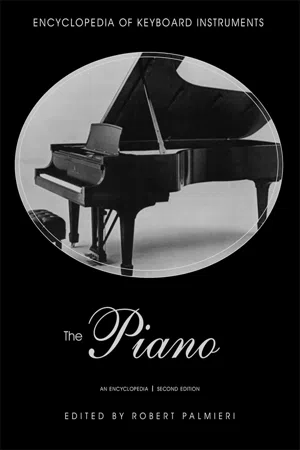
The Encyclopedia of the Piano was selected in its first edition as a Choice Outstanding Book and remains a fascinating and unparalleled reference work. The instrument has been at the center of music history with even composers of large symphonic work asserting that they do not write anything without sketching it out first on a piano; its limitations and expressive capacity have done much to shape the contours of the western musical idiom. Within the scope of this user-friendly guide is everything from the acoustics and construction of the piano to the history of the companies that have built them. The piano-lover might also be surprised to find an entry for Thomas Jefferson, and will no doubt read intently the passages about the changing history of the piano's place in the home. Uniformly well-written and authoritative, this guide will channel anyone's love for the instrument, through social, intellectual, art history and beyond into the electronic age.
Information
C
CABINET PIANOFORTE
Cabinet pianoforte, also called “Cabinet Upright” and “Cabinet Grand,” is a GRAND PIANO placed vertically: the PINBLOCK is at the top, while the TAIL rests on the floor. The KEYBOARD is supported by two legs, and panels hide the STRINGS.
See also Upright Piano
MARTHA NOVAK CLINKSCALE
CABLE-NELSON PIANO COMPANY
Cable-Nelson Piano Company was a major Midwestern piano manufacturer. In 1903 Fayette S.Cable, the youngest of three brothers prominent in the industry, left the Cable Company, Chicago, Illinois, after purchasing the Lakeside Piano Company and E. Sweetland Company and combining them to form the Fayette S. Cable Company in South Haven, Michigan. The name was changed to Cable-Nelson Company when Nelson joined the firm in 1905. The firm manufactured UPRIGHT and PLAYER PIANOS, ranking among the leaders in total sales during the 1920s.
In 1926 Cable-Nelson acquired the EVERETT PIANO COMPANY in Boston, closed the Boston factory and moved Everett production to South Haven. The South Haven firm then adopted the name “The Everett Piano Company,” although Cable-Nelson was kept as a label name.
JACK GREENFIELD
Bibiliography
Dolge, Alfred. Men Who Made Piano History. Vestal, N.Y.: Vestal Press, 1980. Covina, Calif.: Covina Publishing Co., 1913.
“Everett Marks 100th with Townwide Celebration.” The Music Trades (September 1983): 38.
Presto Buyers Guide to Pianos. Vestal, N.Y.: Vestal Press reprint (undated) of 1926 Presto edition.
CANADA—PIANO INDUSTRY
Piano manufacturing was a thriving industry in Canada during the period 1880–1920, at its peak employing about five thousand people in more than one hundred companies.
To meet the demand of the growing population, pianos were imported from Europe in the early nineteenth century. However, if they did not suffer in the long transport, they were often unable to withstand the variable Canadian climate. Skilled German and British immigrant craftsmen such as Frederick Hund (Quebec City, fl. 1816) and John Thomas (Montreal, fl. 1832; Toronto, fl. 1839) first operated repair businesses and then began constructing pianos in their small workshops at a rate of one or two per month. According to early census figures, there were seventeen piano builders in Canada, all in Montreal, Quebec City, or Toronto.
At the time of Confederation (1867) larger firms were being established (listed geographically, east to west) in Halifax (W.Fraser & Sons, ca. 1856-ca. 1890), Montreal (Craig Piano Co., 1856–1930), Kingston (John C.Fox, 1862–1868—later Weber, 1871– 1939), Toronto (HEINTZMAN & Co., 1866–1986), Hamilton (Ennis Co., 1863–1911), Ingersoll, Ontario (Evans Bros., ca. 1871–1933), and Victoria (John Bagnall, ca. 1871–1885—later Charles Goodwin & Co. to 1891).
By the end of the nineteenth century most of the firms that existed throughout the history of Canada’s piano industry were actively operating. Many of them had begun in the late nineteenth century as manufacturers of reed organs. As piano production was introduced, reed-organ building began to wane and ceased altogether with many companies in the first decade of the twentieth century. The major firms, in addition to some of those mentioned above, were in Montreal and vicinity: LESAGE PIANOS, 1891–1987; Pratte Piano, 1889–1926; Willis & Company, ca. 1900–1979; Ottawa: Martin-Orme, 1902– ca. 1924; Bowmanville, Ontario: Dominion Organ & Piano, 1879–ca. 1935; Toronto: Gourlay, Winter & Leeming, 1904– 1924; Gerhard Heintzman, 1877–1927; Mason & Risch, 1877–ca. 1970; Nordheimer Piano and Music, 1890– 1927;
R.S.Williams, 1873–1930s; Guelph: Bell Piano and Organ, 1888–1934; Woodstock: Karn Piano, 1880s–1920; London, later Clinton: Sherlock-Manning Piano, 1902–; Clinton: Doherty Pianos, 1875– 1920 (dates represent piano manufacture).
Although the industry was centered in the Montreal region and southern Ontario, pianos were shipped to retail outlets across the country after the completion of the railway in 1885. Import-export trade existed between other countries of the Commonwealth and with the United States (though tariffs in both countries stifled trade with the latter). In 1903 business statistics reported 367 pianos imported and 509 exported. HAMMERS, ACTIONS, STRINGS, KEYS, and so forth, were imported at first, but gradually companies were formed to manufacture these accessory parts (Otto Higel Co., A.A.Barthelmes, D.M.Best, J.M.Loose, W.Bohne, Sterling Action and Keys). The Canadian Piano and Organ Manufacturers Association was formed in 1899 (to 1975) and a trade magazine, Canadian Music Trades Journal, was published ca. 1899-ca. 1933.
The industry recovered from the setback caused by World War I but went into serious decline during the 1920s, owing to factors such as the decreasing popularity of the PLAYER PIANO, the increasing popularity of the radio and the phonograph, and the general economic instability of the time. Firms were taken over or amalgamated until only a few remained active by the end of the Depression era, notably: Lesage, Willis, Heintzman, Sherlock-Manning, and Mason & Risch.
Stability returned during the next two decades, but production demand was never again as high as those peak years preceding World War I. The piano was displaced as the focus of home entertainment by more sophisticated home sound systems, the electronic organ, and the advent of television. Its importance in the field of music education was lessened to an extent by interest in other instruments, especially guitar and accordion.
Foreign manufacturers began to move into the Canadian market, first with the purchase of Mason & Risch by the U.S. AEOLIAN Corporation, and by the 1960s with the invasion of lower-priced, competitivequality Asian imports. Most of the Canadian firms had been managed either by the families who founded them or by piano tradesmen (often employees) who acquired them. The oldest and most revered company, Heintzman, was sold to a furniture manufacturer and ceased production five years later (1986). The two other survivors during the 1980s, Sherlock-Manning and Lesage, were purchased by PSC Management in 1984 and 1986 respectively. Lesage closed the following year (1987); Sherlock-Manning has changed owners twice since then. In 1991 Sherlock-Manning remained as the last manufacturer of pianos in Canada, although it has suspended production pending refinancing of the firm.
FLORENCE HAYES
Bibliography
Draper, D. Murray. W.D.: The Story of Doherty and Sherlock-Manning, Clinton, Ontario: the author, 1986.
Hayes, Florence. “Piano Building.” In Encyclopedia of Music in Canada. Edited by Helmut Kallmann, Gilles Potvin, and Kenneth Winters.
Toronto: University of Toronto Press, 1981.
Toronto: University of Toronto Press, 1981.
Kelly, Wayne. Downright Upright. Toronto: Natural History, Natural Heritage, 1991.
Nixon, D.C. “Making Canadian Pianos.” Canadian Courier (October 12, 1912).
“The Piano and Organ Industry.” Industrial Canada (February 1904).
Roback, Frances. “Advertising Canadian Pianos and Organs, 1850–1914.” Material History Bulletin 20 (Fall 1984): 31– 44.
CAPO TASTO/CAPO D’ASTRO/V-BAR
In the GRAND PIANO, the capo tasto is an integral part of the PLATE that forms one end of the speaking length of the STRINGS (the BRIDGE forms the other), typically in the treble section where the strings run perpendicular to the KEYBOARD. As the strings fan out, AGRAFFES may be used instead of a capo tasto. Normally the capo is cast as part of the plate, but there are some constructions (e.g., BÖSENDORFER of Vienna) that use a separate, adjustable piece that is finely positioned, then bolted into place. The strings run under this rounded V-shaped bar, the bottom of which should be hardened so that the strings do not easily indent into the relatively soft cast-iron. Some capo bars have a groove into which a hardened steel rod can be inserted. (See illustration under ALIQUOT SCALING.)
JOEL AND PRISCILLA RAPPAPORT
CAPSTAN
Used on both vertical and GRAND ACTIONS, this screw adjusts the height of the WIPPEN and, in the case of the grand action, the height of the HAMMER. The part is so called because one design resembles a ship’s capstan.
See also Actions
PHILIP JAMISON III
CARE AND MAINTENANCE
All musical instruments require maintenance in order to assure optimum playing efficiency. Most wind and string players are able to tune and maintain their own instruments. Because the pianist is compelled to rely on a professional technician for TUNING, VOICING, and repairs, the first and most important aspect of piano maintenance is to obtain the services of an experienced, reliable piano technician.
Temperature and humidity control are also critical elements in maintaining a valuable instrument. Central heating, without some kind of humidity control, poses a great danger for musical instruments made of wood. The worst possible environment for a piano is one with radical swings in humidity and temperature. In regions with hot, humid summers, and dry, cold winters, special attention must be given to humidifying in the winter and dehumidifying in the summer. Wood is hygroscopic and it expands and contracts across the grain with changes in humidity. The PITCH of the STRINGS depends to a certain extent on the amount of humidity present in the SOUNDBOARD, which expands and contracts with changes ...
Table of contents
- Cover Page
- Title Page
- Copyright Page
- Encyclopedia Of Keyboard Instruments
- Dedication
- List of Illustrations
- Introduction
- A
- B
- C
- D
- E
- F
- G
- H
- I
- J
- K
- L
- M
- N
- O
- P
- Q
- R
- S
- T
- U
- V
- W
- Y
- Z
- CONTRIBUTORS
Trusted by 375,005 students
Access to over 1.5 million titles for a fair monthly price.
Study more efficiently using our study tools.
Frequently asked questions
Yes, you can cancel anytime from the Subscription tab in your account settings on the Perlego website. Your subscription will stay active until the end of your current billing period. Learn how to cancel your subscription
No, books cannot be downloaded as external files, such as PDFs, for use outside of Perlego. However, you can download books within the Perlego app for offline reading on mobile or tablet. Learn how to download books offline
Perlego offers two plans: Essential and Complete
- Essential is ideal for learners and professionals who enjoy exploring a wide range of subjects. Access the Essential Library with 800,000+ trusted titles and best-sellers across business, personal growth, and the humanities. Includes unlimited reading time and Standard Read Aloud voice.
- Complete: Perfect for advanced learners and researchers needing full, unrestricted access. Unlock 1.5M+ books across hundreds of subjects, including academic and specialized titles. The Complete Plan also includes advanced features like Premium Read Aloud and Research Assistant.
We are an online textbook subscription service, where you can get access to an entire online library for less than the price of a single book per month. With over 1.5 million books across 990+ topics, we’ve got you covered! Learn about our mission
Look out for the read-aloud symbol on your next book to see if you can listen to it. The read-aloud tool reads text aloud for you, highlighting the text as it is being read. You can pause it, speed it up and slow it down. Learn more about Read Aloud
Yes! You can use the Perlego app on both iOS and Android devices to read anytime, anywhere — even offline. Perfect for commutes or when you’re on the go.
Please note we cannot support devices running on iOS 13 and Android 7 or earlier. Learn more about using the app
Please note we cannot support devices running on iOS 13 and Android 7 or earlier. Learn more about using the app
Yes, you can access The Piano by Robert Palmieri in PDF and/or ePUB format, as well as other popular books in Media & Performing Arts & Music. We have over 1.5 million books available in our catalogue for you to explore.