eBook - ePub
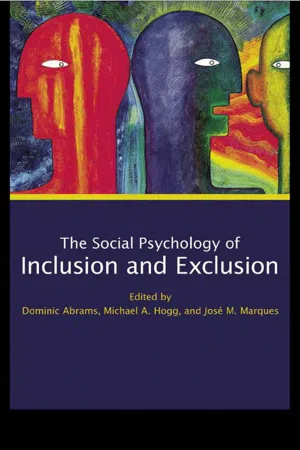
Social Psychology of Inclusion and Exclusion
- 376 pages
- English
- ePUB (mobile friendly)
- Available on iOS & Android
eBook - ePub
Social Psychology of Inclusion and Exclusion
About this book
This book is about the social psychological dynamics and phenomenology of social inclusion and exclusion. The editors take as their starting point the assumption that social life is conducted in a framework of relationships in which individuals seek inclusion and belongingness. Relationships necessarily include others, but equally they have boundaries that exclude. Frequently these boundaries are challenged or crossed. The book will draw together research on individual motivation, small group processes, stigmatization and intergroup relations, to provide a comprehensive social psychological account of social inclusion and exclusion.
Information
Publisher
Psychology PressYear
2004Print ISBN
9780415651813
9781841690735
Edition
1eBook ISBN
9781135432829
1
A Social Psychological Framework for Understanding Social Inclusion and Exclusion
DOMINIC ABRAMS, MICHAEL A. HOGG, and JOSÉ M. MARQUES
This book draws together social psychological theory and research on social inclusion and exclusion. The rationale for the book is to understand inclusion and exclusion at different levels of explanation, and as involving different types of social psychological process. This chapter describes the central points made by each of the other chapters, and highlights key conclusions from each about evidence and its practical implications. This evidence is drawn together and provides the basis for an integrative conceptual framework that distinguishes features of social inclusion in terms of i) different levels of exclusionary relationship, ii) different modes of exclusion, and iii) different dynamics of exclusion within the relationship.
This book is about the social psychological phenomenology and dynamics of social inclusion and exclusion. We take as our starting point the assumption that social life is played out within a framework of relationships within which people seek inclusion and belongingness. Relationships necessarily include people, but they also have boundaries that by definition exclude other people. Frequently these boundaries are challenged or crossed. For example, families gain and lose new members through birth, death, marriage, and divorce; schools gain and lose students by virtue of time and age; adolescent peer groups hold the potential to enhance or to jeopardize the identities of their members; sports teams select and reject players as a function of ability and performance; judicial and political decisions are often intended to create the conditions for fairness, welfare, peace, but these decisions are influenced by the group’s way of dealing with divergences and disagreement. At a macro-social level, countries may attract and repel individuals on the basis of race, ethnicity, occupation, or other statuses. Political or cultural alliances can provide a basis for the inclusion or exclusion of whole sections of the global community. In short, much of social life is about who we include, who we exclude, and how we all feel about it. The human passion for walls (e.g., Hadrian’s Wall, the Berlin Wall, The Great Wall of China), fences (that between Mexico and the United States), dykes (e.g., Offa’s Dyke), and ditches (around any number of British Castles) is no accident—it is a material manifestation of our need to manage inclusion and exclusion.
This book is intended both to reflect ongoing research and to contribute to a new research agenda that emphasizes the value of analyzing important aspects of social inclusion and exclusion from a social psychological perspective. The book brings together leading researchers in social psychology to explore different explanations and theories of how, when and why people become outsiders and insiders, and what the personal, social and cultural consequences may be. The book will be of central interest to social psychologists, and as it explores processes at the heart of human social existence it should have much to offer students of intercultural relations, sociology, political science, and social and public policy. It should also serve as a useful source for decision-makers and social policy makers, and provide an informative framework for practicing social scientists.
In this introductory chapter we have intentionally avoided extensive referencing (that is available throughout the book) and provided an overview and framework that maps out the central ideas developed in the book. There is a variety of different approaches to the theme of inclusion and exclusion. Within sociology these include classic sociological theory of alienation and anomie (e.g., Durkheim (1895), Merton (1938), the work of Simmel (1955), as well as ethnomethodological and symbolic interactionist accounts offered by Lemert (1967), Becker(1963), Scheff (1963), and Goffman (1961). However, until relatively recently there has not been a corresponding empirical analysis of mediating psychological processes. Societal diversity means that people may differ on various dimensions of comparison (e.g., ethnic, opinion, physiognomic). Sometimes people may consider diversity to be positive in the sense that it provides valued distinctiveness. At other times being separated from others may be highly aversive. The question is why particular differences are treated as so central a basis for social inclusion or exclusion at particular times.
SCOPE AND AIMS OF SOCIAL PSYCHOLOGICAL RESEARCH ON INCLUSION AND EXCLUSION
To address the question of what it is that transforms a person from being just “the same” or “different” to being an insider, an outsider or a “deviant” it is useful to think in terms of several different perspectives and levels of analysis. We have organized the book to reflect differences in emphasis within the research literature. The chapters focus on different forms and types of actors and targets in the processes of inclusion and exclusion, ranging from the inclusion of others as part of the self-concept to societal level inclusion and exclusion of minority ethnic and immigrant groups. Social exclusion may cause harm but also bring psychological benefits, though not usually for both parties. Social inclusion and exclusion is a dialectic in which the parties may vary in their complicity or dispute. Some excluded parties may ultimately find ways to create a positive outcome for themselves; for instance, by redefining what is important or by exposing and challenging the legitimacy of the bases of exclusion.
Taken together the chapters provide a basis for a conceptual framework for analyzing and understanding social inclusion and exclusion. We draw this framework together at the end of this chapter. In general terms, we can characterize targets and sources of exclusion as either individuals or groups; the relationship context as ranging from transnational to intrapersonal; and the dynamics as involving degrees of interdependence, material or symbolic resources, a temporal dimension, and as invoking motives that center on opportunities or threats. Exclusion can arise in several forms or modes, ranging from the ideological to the physical, communicative, and purely cognitive.
Among the aims of this book is to help sustain the case for social psychology as a useful social science that is a worthwhile investment for public funds. Contributors to this volume were asked to describe their theoretical framework and research evidence, and also to explore some practical and policy implications of their work. Social psychologists tend to be cautious about forays into the policy arena, but increasingly it is the case that other social science disciplines are framing policy agendas, for example in economics, education, social welfare, health, and justice. Whereas some disciplines are guided by grand theory or statistical models, social psychologists are (necessarily) conservative and unwilling to generalize from evidence. However, there are undoubtedly clear and important regularities in the relationships between social contexts and behavior that are mediated by psychological processes, and we need to be able to make a case that we have something useful to say about these (see Brewer, 1995).
THE CHAPTERS
The book is organized into three sections, emphasizing individual, group and intergroup inclusion and exclusion, respectively.
Section A: Individual Inclusion and Exclusion
This section focuses on people’s responses to being excluded in the context of interpersonal relationships (Jean Twenge & Roy Baumeister) and intragroup situations (Kipling Williams & Cassandra Govan), or because of stigmatizing features (Collette Ecclestone & Brenda Major). It also considers the cognitive processes and consequences of including others in the self-concept (Tracy McLaughlin-Volpe, Arthur Aron, & Stephen Wright), and the processes that narrow or broaden the range of others that include or exclude the self (Cynthia Pickett & Marilynn Brewer).
Jean Twenge and Roy Baumeister examine the nature of not belonging. Their premise is that the need to belong is fundamental to human life. How does an excluded person react to being left out of a relationship or isolated within society? Their thesis is that typically such rejected individuals react with anger and resentment, and retaliation. Social exclusion can set in train a dynamic that results in further exclusion, and ultimately conflict. Across a series of more than twenty vivid and powerful experiments they demonstrate the profoundly negative cycle that affects people who are excluded, either directly or prospectively (e.g., by the belief that they may spend their future alone and isolated). Excluded people become aggressive (even when unprovoked), defensive, uncooperative, unhelpful, self-defeating (e.g., they make less rational, healthy choices), and they shut off their emotional responses, perhaps engaging in defensive denial. They also perform worse on tasks such as intellectual tests.
The clear message is that being and feeling excluded is bad for people both psychologically and materially. Moreover, it is bad for the communities in which they exist, creating conditions that give rise to conflict, increased inequality, and mistrust. Surprisingly, reactions to rejection do not seem to depend on the rejected person’s level of self-esteem. Instead, people who are more narcissistic are most likely to react hostilely following rejection—a finding that may be relevant to why particular individuals take extreme actions such as the Columbine High School shootings. However, the better news is that socially rejected people respond positively when offered acceptance; the cycle can be broken.
Kipling Williams and Cassandra Govan consider both the negative and more socially constructive reactions that result when people are ostracized within a group. They describe evidence from real interacting, as well as virtual, internet, groups in which individuals are ostracized. The evidence shows that ostracism from within a small group often prompts actions aimed at re-inclusion, such as conforming more to the group’s norms.
An interesting difference between Williams and Govan and Twenge and Baumeister is that the latter do not find that self-esteem is implicated. However, Williams and Govan propose that whether positive or negative reactions follow ostracism depends on how a person can act to regain the four fundamental needs of belonging, self-esteem, control, and meaningful existence. Whereas threats to belonging and self-esteem should promote efforts to regain inclusion (generally pro-social action), threats to control and recognition provoke reactions to validate existence and regain control over others. Moreover, the public reactions of ostracized individuals may be conciliatory but implicitly or privately they may feel hurt and angry, and this may be conveyed implicitly in their behavior. Williams and Govan draw attention to the widely used method of “time out” to control children’s behavior in classroom situations or in the home. They suggest that the particular method used for time outs could easily trigger more antisocial and negative reactions, rather than the compliance and desire for re-inclusion that teachers and parents aim for.
Brenda Major and Collette Eccleston move the focus from the particular to the general—to the experience of exclusion among people who are societally stigmatized. Stigmatization is dependent on specific societal contexts rather than inherent qualities of the stigmatized. Some stigmas are more pervasive (across situations) than others. However, exclusion based on stigma is distinguishable from other forms of exclusion because it depends on social consensus about the targets, tends to be shared among a set of people, and is often accompanied by a social justification or supportive ideology for moral exclusion.
Reasons for exclusion include the alleviation of discomfort, system justification, and status preservation for the members of majority groups. There may also be evolutionary reasons (Kurzban & Leary, 2001) that include avoiding poor partners for exchange, those who are diseased and outgroup members, or those who undermine group living. However, reactions to being stigmatized are not always negative. Different reactions are captured in a model of stress and coping that focuses on how stigmatized people regulate exposure to, cognitively appraise, and cope with stigma-based exclusion. For example, one reaction is to enhance one’s desirability as a relationship partner for a non-stigmatized individual. Another reaction is to withdraw from situations that embody the threat of rejection. A third reaction is to find alternative bases of inclusion (e.g., within the stigmatized group), particularly when one’s stigma is visible and associated with a group identity. A final response is to blame stigmatization on the prejudices of others. Indeed many stigmatized groups may provide a buffer against exclusion by providing their members with protected self-esteem and an ideological perspective that rejects the legitimacy of unfavorable evaluations.
Cynthia Pickett and Marilynn Brewer consider why group memberships are so important to people and how they respond to the threat of exclusion from their groups. Although marginalized individuals may attempt to become more prototypical (i.e., normative), another way that individuals can preserve an optimal identity is by clarifying the nature of intergroup distinctions and boundaries. Thus, it may be the marginal, rather than central, group members that display the most criticism, vigilance, and stringency over who is or is not included within the group. The, perhaps surprising, result is that those group members who are closest to outgroups are also those who resist similarities with the outgroups most energetically, and who perceive the groups in the most stereotypical way—perhaps a manifestation of the zealotry of new members whose membership credentials still need to be proven?
Couched in terms of the theory that people strive for an optimal balance between distinctiveness and assimilation in group memberships, the implications for pluralistic societies are interesting. Members of majority groups are likely to be able to enjoy both inclusiveness at a superordinate (e.g., national) level and distinctiveness at a subordinate (e.g., ethnic) level. However, minority group members face being peripheral in the superordinate context which may motivate either eschewing their subgroup identity or adopting it at the risk of becoming excluded from the mainstream.
Tracy McLaughlin-Volpe, Arthur Aron and Stephen Wright examine social inclusion and exclusion using their model of self-expansion. To the extent that the self can be expanded to encompass others, one’s potential self-efficacy is increased (because of the associated access to resources those others imply), and this sense of self-efficacy is rewarding in itself. Much of the research described in the chapter concentrates on exclusion from close relationships (e.g., separation, divorce, loss of close friends), but the principles of the model apply also to groups. The model holds that people are selective in the relationships they incorporate into the self—only those that offer opportunities for self-expansion are likely to be attractive. As a result, the instability of a person’s personal network, and potential losses from that network represent threats to the self-concept, and result in more negative self-descriptions and lowered self-efficacy.
McLaughlin-Volpe, Aron and Wright also propose people who are excluded do not merely feel miserable, they also feel frustrated that their capacity to act and achieve has been thwarted. An interesting implication of the self-expansion model is that responses to rejection may not always focus on the specific relationship that has been lost. If the bases of exclusion are unambiguous, the person may seek new relationships that allow self-expansion in other ways, or may re-emphasize existing relationships to bolster their importance. There may even be instances of exclusion that are experienced positively, such as when a relationship has broken down. If a relationship provides fewer benefits than expected, limits personal growth, or creates a barrier to forming relationships that bring better self-expansion prospects, people may actively provoke dissolution of the relationship.
There are policy implications for educational and organizational settings in which inclusion and exclusion are inevitable. Within such contexts more positive outcomes could be achieved if more attention was paid to the way exclusion may affect self-expansion, the social skills that are required to develop adequate self-expansion, the ways in which rejection is communicated, and the structural opportunities for members to find alternative routes for self-expansion (such as clubs, and small groups).
Section B: Group Dynamics of Inclusion and Exclusion
Section B focuses on mechanisms of inclusion and exclusion within groups, either as a natural part of the development and socialization processes of small groups (John Levine & Richard Moreland), as a function of the intergroup context in which people judge groups and individuals simultaneously (Dominic Abrams, Georgina Randsley de Moura, Paul Hutchison, & Tendayi Viki) or as a result of the motivational dynamics of self-categorization under uncertainty (Michael Hogg, Kelly Fielding, & John Darley). Nicholas Emler and Stephen Reicher concentrate on the specific group-based exclusion processes that surround delinquency.
A central proble...
Table of contents
- COVER PAGE
- TITLE PAGE
- COPYRIGHT PAGE
- ACKNOWLEDGMENTS
- NOTES ON CONTRIBUTORS
- 1. A SOCIAL PSYCHOLOGICAL FRAMEWORK FOR UNDERSTANDING SOCIAL INCLUSION AND EXCLUSION
- SECTION I: INDIVIDUAL INCLUSION AND EXCLUSION
- 2. SOCIAL EXCLUSION INCREASES AGGRESSION AND SELF-DEFEATING BEHAVIOR WHILE REDUCING INTELLIGENT THOUGHT AND PROSOCIAL BEHAVIOR
- 3. REACTING TO OSTRACISM: RETALIATION OR RECONCILIATION?
- 4. STIGMA AND SOCIAL EXCLUSION
- 5. THE ROLE OF EXCLUSION IN MAINTAINING INGROUP INCLUSION
- 6. EXCLUSION OF THE SELF BY CLOSE OTHERS AND BY GROUPS: IMPLICATIONS OF THE SELF-EXPANSION MODEL
- SECTION II: GROUP DYNAMICS OF INCLUSION AND EXCLUSION
- 7. MANAGING GROUP COMPOSITION: INCLUSIVE AND EXCLUSIVE ROLE TRANSITIONS
- 8. WHEN BAD BECOMES GOOD (AND VICE VERSA): WHY SOCIAL EXCLUSION IS NOT BASED ON DIFFERENCE
- 9. FRINGE DWELLERS: PROCESSES OF DEVIANCE AND MARGINALIZATION IN GROUPS
- 10. DELINQUENCY: CAUSE OR CONSEQUENCE OF SOCIAL EXCLUSION?
- SECTION III: INTERGROUP INCLUSION AND EXCLUSION
- 11. SOCIAL INCLUSION AND EXCLUSION: RECATEGORIZATION AND THE PERCEPTION OF INTERGROUP BOUNDARIES
- 12. INTERGROUP CONTACT IN A DIVIDED SOCIETY: CHALLENGING SEGREGATION IN NORTHERN IRELAND
- 13. COGNITIVE REPRESENTATIONS AND EXCLUSION OF IMMIGRANTS: WHY RED-NOSED REINDEER DON’T PLAY GAMES
- 14. ATTITUDES TOWARD IMMIGRANTS AND IMMIGRATION: THE ROLE OF NATIONAL AND INTERNATIONAL IDENTITY
Trusted by 375,005 students
Access to over 1.5 million titles for a fair monthly price.
Study more efficiently using our study tools.
Frequently asked questions
Yes, you can cancel anytime from the Subscription tab in your account settings on the Perlego website. Your subscription will stay active until the end of your current billing period. Learn how to cancel your subscription
No, books cannot be downloaded as external files, such as PDFs, for use outside of Perlego. However, you can download books within the Perlego app for offline reading on mobile or tablet. Learn how to download books offline
Perlego offers two plans: Essential and Complete
- Essential is ideal for learners and professionals who enjoy exploring a wide range of subjects. Access the Essential Library with 800,000+ trusted titles and best-sellers across business, personal growth, and the humanities. Includes unlimited reading time and Standard Read Aloud voice.
- Complete: Perfect for advanced learners and researchers needing full, unrestricted access. Unlock 1.5M+ books across hundreds of subjects, including academic and specialized titles. The Complete Plan also includes advanced features like Premium Read Aloud and Research Assistant.
We are an online textbook subscription service, where you can get access to an entire online library for less than the price of a single book per month. With over 1.5 million books across 990+ topics, we’ve got you covered! Learn about our mission
Look out for the read-aloud symbol on your next book to see if you can listen to it. The read-aloud tool reads text aloud for you, highlighting the text as it is being read. You can pause it, speed it up and slow it down. Learn more about Read Aloud
Yes! You can use the Perlego app on both iOS and Android devices to read anytime, anywhere — even offline. Perfect for commutes or when you’re on the go.
Please note we cannot support devices running on iOS 13 and Android 7 or earlier. Learn more about using the app
Please note we cannot support devices running on iOS 13 and Android 7 or earlier. Learn more about using the app
Yes, you can access Social Psychology of Inclusion and Exclusion by Dominic Abrams, Michael A. Hogg, José M. Marques, Dominic Abrams,Michael A. Hogg,José M. Marques in PDF and/or ePUB format, as well as other popular books in Psychology & History & Theory in Psychology. We have over 1.5 million books available in our catalogue for you to explore.