- 240 pages
- English
- ePUB (mobile friendly)
- Available on iOS & Android
eBook - ePub
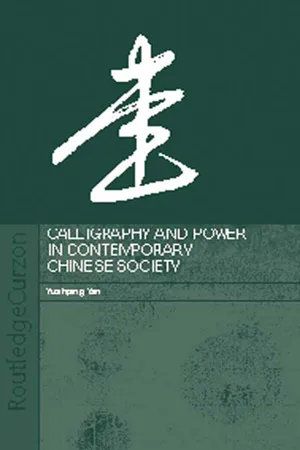
Calligraphy and Power in Contemporary Chinese Society
About this book
This unusual and interesting book is a fascinating account of the world of Chinese writing. It examines Chinese space and the political and social use of writing as propaganda, a publicity booster and as a ladder for social climbing.
Information
1 Dances with power
Public calligraphy and its social effects
Why is calligraphy socially important to the Chinese? Apart from being a means of communication and an art form, its most immediately obvious importance is its long association with social power. The intimate link between political leadership and calligraphy or written words is a widely recognized fact in imperial China (Ledderose 1979, 1986; Kraus 1991: 36–44; Rawson 1992; Leys 1996; Zito 1997). As Jenner (1992) points out, emperors and officials in China did not speak in public in order to persuade or convince people. Instead they instructed or issued orders to their subjects through written words, rather than speech. This tendency survives into modern-day China. Political speeches made by national leaders are often meant to be read, rather than spoken in public (De Beaufort 1978: 51). This may partially account for the general lack of public speechmaking skills of Chinese politicians. In other words, ‘In China power does not speak — it writes’ (Jenner 1992: 184).1 The preference of the written over the spoken is immediately significant.
Political orders and communications did not just appear primarily as written texts, they had to be written in the author’s original calligraphy as well. It was as if only the author’s own calligraphy could authenticate the contents of the text, therefore endowing it with the power and force it was supposed to carry. The same reverence for the ruler’s own calligraphy survives into the modern age of advanced technology (De Beaufort 1978: 52). Even though speedy reproduction of written texts is now easily available, Chinese leaders still regularly pick up the brush and write down social slogans and directives in their own brush calligraphy. If power writes, it is only logical to suspect that a good handwriting speaks more powerfully than a bad one. This is true to an extent because good (brush) handwriting was considered absolutely essential for the advancement of one’s political career in imperial China. Even modern-day Chinese statesmen are still under great pressure to master the skill of brush calligraphy. Without good command of calligraphic skills, a leader’s social prestige and intellectual reputation could both be jeopardized (Leys 1996).
Not only in the human realm is power expressed by writing; a parallel function of writing can be found also in the spiritual realm. Being thoroughly incorporated in religious activities, written material does not simply communicate ideas and beliefs of religious importance. It is in itself often the very object of religious and ritual veneration (Cohen 1970: xv, quoted in Yan 1996: 51). In Chinese popular religion, spirits communicate with each other in the same way that people do. Therefore, written mandates and injunctions used by humans to convey power and command have their equivalents as ‘charms’ in the spiritual world. ‘Charms are efforts to confront evilly disposed beings with the superior authority of gods, through the ordinary bureaucratic medium of written messages’ (Ahern 1981: 24). And just as spoken words from imperial rulers carried less weight than their written words, ‘written prayers were generally considered more efficacious than spoken prayers, just as written charms were more powerful than mere incantation’ (Smith 1992: 201).
The political power of written words can be found also in its integrative force. It is almost a truism to say that the unified writing system plays a significant role in keeping the Chinese people, who otherwise divers in languages as well as in regional customs, under one political entity 2 (see Anderson 1983; Smith 1992: 6; Hannas 1997). Since Chinese script became standardized in the third century B.C., Chinese characters can be read by any literate person in China even though they may be pronounced differently in accordance with the person’s vernacular tradition. This has helped to provide extraordinary social continuity and cohesion across time and space. The unifying force of the Chinese written language is also seen as an essential factor in the integration of the elite culture (Rawski 1985: 12–13). However, this integrative power has more to do with writing as art, i.e. calligraphy, than with written words as such. Calligraphy was an important means of self-identification for the Chinese elite. Its aesthetic and stylistic unity contributed significantly to the cohesiveness of the educated ruling class (Ledderose 1986).3 Because everyone who aspired to a career in the government office was required to be proficient in calligraphy, it was therefore the most widely practised art form in imperial China. It is therefore not surprising that the majority of celebrated calligraphers in Chinese history were members of the politically powerful, educated elite.
Faced with such a firmly established emblem of power and its association with the elite culture, the reactions from the Communist revolutionaries were understandably ambivalent. In fact, the tradition of calligraphy was, rather than being banished as feudal, adapted to serve the needs of a modernizing society (Kraus 1991: x). Chinese calligraphy, as Kraus argues, is a cogent example of how revolutionary China, like any other nation, preserves and reinvigorates parts of its tradition when confronted with the challenging task of updating its cultural contents. Calligraphy was given a new role in revolutionary China. This was seen in the propagandist mass media and in the public calligraphic performances by political leaders, as will be discussed soon. In other words, the umbilical cord between calligraphy and power in China has not been severed in the tempestuous history of modern China. On the contrary, while the Communist elite enjoyed reciting poems and wielding brushes, the political significance of calligraphy was also pushed to a new height. Interestingly, national politicians’ reinvigorated brushes have also brought about a new twist to the traditional practice of tizi — calligraphy in its most public form.
Public calligraphy
Seeking to account for the social power that Chinese calligraphy and written characters are endowed with, one cannot help noticing the practice of public calligraphic inscription, tizi — the writing of inscriptions in public spaces by famous people — simply because it tends to strike an outsider as interestingly bizarre. If the British Prime Minister or American President freely inscribe their handwriting on buildings or on the natural landscape, it would probably be regarded as vandalism. In contrast, the Chinese are more inclined to consider bare landscape unadorned with calligraphic inscriptions unpolished and lacking in sophistication. Beautiful natural and artificial landscape await beautiful calligraphy to consummate its perfection. This peculiar phenomena is even more striking for its sheer scale — it is done by perhaps all the provincial governors, county governors, mayors, and many other socially influential figures all over China. I shall commence the investigation of the ‘social calligraphy’ from the category of public calligraphy — tizi.
Tizi means to write a few words for the purpose of highlighting something for private or public view. These few words can be written on buildings, paintings, books, in fact practically anything. The content of tizi is varied, ranging from something as simple as the title of a book, the name of a building or the signature of the person to a literary text of encouragement, appreciation or commentary. What is central to tizi is that these words are intended to be seen and read by people other than the person who writes them, and are often written in response to requests. For this reason, I shall call tizi ‘public calligraphy’ in this book. The common translation of tizi as ‘inscription’ is also used sometimes as an interchangeable term. There are many ways in which tizi can be implicated in the functioning of the social fabric of the PRC. By pointing out how tizi works in and is used to work the system, I hope to show that tizi is a social matter, as well as — most literary Chinese would think — an artistic one. As I shall show, the ‘tizi phenomenon’ opens up a whole dimension of calligraphy or writing as a practice pregnant with socio-anthropological significance.
Public calligraphy as an instrument of propaganda
In the PRC, the genteel art of Chinese calligraphy has been reshaped and turned into an instrument of propaganda. Political leaders of all levels, when they pay an official visit to an institution, are often asked to ‘write a few characters’ (xie jige zi, zi means written characters or handwriting4) for the host institution.5 The content of their calligraphic gifts is often a political message coherent with the Party’s policies on various subjects. These calligraphic inscriptions are then properly mounted and displayed in prominent locations in either the workplace or public spaces. Sometimes they are blown up in size and carved on wood or stone and become a permanent architectural fixture. Political leaders also endorse party projects by ‘writing a few characters’ on them.6 For example, Mao wrote ‘Heighten our vigilance and eliminate all spies; Prevent bias and wrong no innocent person’ for the proposal of the Elimination of Counter-Revolutionaries Project raised in the Supreme State Conference in 1955 (Wang and Zhang 1992: 521). Though criticizing the century-old calligraphic tradition of copying ancient masters’ work in the Beijing Evening News (Kraus 1991: 80), Deng Xiaoping could not completely avoid the Communist elite’s tizi convention. As part of his project to modernize China, Deng set forth to reform the education system. For this project, he also had to follow the convention and wrote a few words — ‘Education must face modernization, face the world and face the future.’ This piece of calligraphy was given to a school as a gift7 and its enlarged copies can now be seen in numerous educational institutions across the whole country.
Public calligraphy as public display of loyalty and revolutionary zeal
It is also the tradition of Communist Party leaders to tizi for the memorial halls of revolutionary heroes and martyrs. For example, the inscription on the Monument to the People’s Heroes at Tiananmen Square was composed and written by Chairman Mao on the eve of the founding of the PRC. And in the Northeast Revolutionary Martyrs’ Memorial Hall, Premier Zhou Enlai wrote ‘Eternal glory to the revolutionary martyrs!’ In 1977, to carry on Mao’s legacy in a symbolic manner after his death, Chairman Hua Guofeng tried to consolidate his tentative grasp on power by leaving a frenzy of inscriptions all over the country (Kraus 1991: 123–37). He left his calligraphic handwriting on two memorial towers and stelae in Jiangxi province and a memorial hall in Hebei province to mark three significant revolutionary insurrections during the Communists’ fight for power.8 In 1977, Hua also wrote ‘Learn from Lei Feng; Carry through to the end our proletarian revolutionary cause pioneered by Chairman Mao’ to show his determination to follow Mao’s path.9 Hua was not the only politician who exhibited his loyalty to Mao by his loyal brush. Hand-copying Mao’s poems and quotations in brush calligraphy was a standard way for politicians, such as Zhou Enlai, Zhu De, Ye Jianying, Kang Sheng and Guo Moruo, and non-politicians alike to show their unfailing devotion to Mao and his ideological path.10 Calligraphic contests often teemed with these loyal examples.
It was also customary for Communist elites to write inscriptions for the funerals of their revolutionary comrades, although the practice also existed before and outside the Communist regime. After ‘People’s Musician’ Nie Er writer of many revolutionary songs about the hard-working proletariat filled with revolutionary combative spirit drowned in Japan at the age of twenty-four, leading Communist literary intellectual Guo Moruo11 wrote an inscription for him, honouring him as ‘the bugle of China’s revolution; the drum of People’s liberation’.12 More dramatically, in 1976, the death of widely loved Premier Zhou plunged many people into deep grief and evoked eruptive rage against the Gang of Four.13 Guo Moruo, bedridden at the time and distraught with anger and grief, picked up his brush and wrote a famous poem in memory of Zhou, ‘His great virtue shall be for ever remembered among the people; His legacies shall continue through centuries. His loyalty shines glaringly alongside the sun, never dying under the sky or buried beneath the earth.’14
Public calligraphy as political barometer
Public calligraphy works also as a political barometer. As Kraus (1991) points out, one of the social functions of celebrity calligraphy is to display patronage by influential people. This is particularly true in the case of newspaper mastheads or magazine titles. These celebrity inscriptions serve to ‘delineate networks of patronage that might otherwise remain invisible’ (Kraus 1991: 12). In years of stability, celebrity inscriptions add frill to the favoured establishment; whereas, during political upheavals, backstage support in the form of calligraphy works like a handwritten certificate for relative freedom and authority of expression. As a result, the calligraphic writing of patrons who have fallen out of favour in the rough sea of modern Chinese politics is in equal disfavour. It is often erased from magazine covers or simply replaced by another glamorous hand still in power. In other words, the change of inscribed title can be seen as a practical record of the rise and fall of the careers of these public figures. This form of political weather forecast can be applied also to celebrity inscriptions displayed in public spaces. More importantly, people actually read these inscriptions as political messages. I was told by Wen Wu, a young man in his late twenties working for a Yunnan provincial newspaper, about an incident that happened in 1987, when he was about nineteen years old.
The title of Kunming Gongren Wenhua Gong (Workers’ Cultural Palace), used to be Kunming Renmin Wenhua Gong (People’s Cultural Palace), which was inscribed by Hu Yaobang. He was dismissed from post in the party in 1987.15 I remember very clearly th...
Table of contents
- Cover
- Half Title
- ANTHROPOLOGY OF ASIA SERIES
- Full Title
- Copyright
- Dedication
- Contents
- List of figures
- Acknowledgements
- Brief chronology of Chinese history
- Introduction: the abode of calligraphic inscriptions
- 1 Dances with power: Public calligraphy and its social effects
- 2 Becoming a person through wen
- 3 Handwriting and personhood
- 4 Body-person engineering through ink and brush: Brush techniques and calligraphic composition
- 5 Brush work: Alternative bodybuilding
- 6 Ideograms and knowledge
- 7 Characters reloaded
- Notes
- Bibliography
- List of Chinese characters for terms used in the text
- Index
Trusted by 375,005 students
Access to over 1.5 million titles for a fair monthly price.
Study more efficiently using our study tools.
Frequently asked questions
Yes, you can cancel anytime from the Subscription tab in your account settings on the Perlego website. Your subscription will stay active until the end of your current billing period. Learn how to cancel your subscription
No, books cannot be downloaded as external files, such as PDFs, for use outside of Perlego. However, you can download books within the Perlego app for offline reading on mobile or tablet. Learn how to download books offline
Perlego offers two plans: Essential and Complete
- Essential is ideal for learners and professionals who enjoy exploring a wide range of subjects. Access the Essential Library with 800,000+ trusted titles and best-sellers across business, personal growth, and the humanities. Includes unlimited reading time and Standard Read Aloud voice.
- Complete: Perfect for advanced learners and researchers needing full, unrestricted access. Unlock 1.5M+ books across hundreds of subjects, including academic and specialized titles. The Complete Plan also includes advanced features like Premium Read Aloud and Research Assistant.
We are an online textbook subscription service, where you can get access to an entire online library for less than the price of a single book per month. With over 1.5 million books across 990+ topics, we’ve got you covered! Learn about our mission
Look out for the read-aloud symbol on your next book to see if you can listen to it. The read-aloud tool reads text aloud for you, highlighting the text as it is being read. You can pause it, speed it up and slow it down. Learn more about Read Aloud
Yes! You can use the Perlego app on both iOS and Android devices to read anytime, anywhere — even offline. Perfect for commutes or when you’re on the go.
Please note we cannot support devices running on iOS 13 and Android 7 or earlier. Learn more about using the app
Please note we cannot support devices running on iOS 13 and Android 7 or earlier. Learn more about using the app
Yes, you can access Calligraphy and Power in Contemporary Chinese Society by Yuehping Yen in PDF and/or ePUB format, as well as other popular books in Histoire & Histoire de la Chine. We have over 1.5 million books available in our catalogue for you to explore.