eBook - ePub
Language, Identity and Conflict
A Comparative Study of Language in Ethnic Conflict in Europe and Eurasia
- 256 pages
- English
- ePUB (mobile friendly)
- Available on iOS & Android
eBook - ePub
Language, Identity and Conflict
A Comparative Study of Language in Ethnic Conflict in Europe and Eurasia
About this book
This innovative study of language and identity in recent and contemporary cases of ethnic conflict in Europe and Eurasia sets out a response to the limitations in the fields of linguistics and political science. Using examples of language policy and planning in conflict situations, it examines the functions of language as a marker of identity in ethnic conflict, and the extent to which language may be a causal factor in ethnic conflict.
Information
1 Introduction
Any assessment of conflict involving ethnic identity requires delicate treatment of language.(Independent International Commission on Kosovo. Introduction p. 5
http://www.kosovocommission.org/reports/3-introduction.html)
[L]anguage is the ultimate measure of human society. More than any other of life's faculties, it is language that tells us who we are, what we mean and where we are going.(Fischer, 1999: 203)
Europe, like nature itself, cannot abide a vacuum.(Davies, 1997: 1136)
Language, identity and conflict
This study arises from a widespread failure to respond to the way in which language functions in situations of conflict (e.g. Baker and Jones, 1998: 276–286 and 333–338; Fishman, 1989: 605–626). That problem results from the fact that language policy and planning as undertaken by linguists is inadequately grounded in political theory and that political scientists are inadequately versed in language policy and planning concerns. The primary aim of this work is to correct the resulting situation by responding to a number of critical questions regarding relationships between language and identity in recent and contemporary cases of ethnic conflict in Europe and Eurasia. These concern:
| i | The functions of language as a marker of identity in ethnic conflict. |
| ii | The extent to which theoretical conceptualisations of language in ethnic conflict studies adequately reflect the full range of those functions. |
| iii | The extent to which language may be a causal factor in ethnic conflict. |
| iv | The possibilities for language policy and planning as tools in the resolution of conflict. |
| v | The theoretical innovations which may be necessary in the fields of the sociology of language and political science in order to develop a more adequate framework for understanding the role of language in ethnic conflict and its resolution. |
The need for the serious academic study of the relationships between language, identity and conflict has been made clear by some within the academic community itself and also by other institutions, agencies and professionals engaged with language issues. For example, some promotional material for the UNESCO World Languages Project highlights the following words of Felix Martí, President of the International Committee of LINGUAPAX:
The observation of the fact that the conflicts which occur in the world are always linked to questions of cultural and linguistic identity leads us to realise that when a good linguistic policy is put into place, we are setting up bastions of peace.
An early reference to the neglect on the part of academia of ‘the much more widespread and universal generation of conflict through cultural difference’ explained that this was the result of the dominance of Marxist interpretations of the class-based nature of conflict (Carter in Williams, 1988: vii–viii; see also Carter, 1988). The postmodern shifts which have transformed European society in the last quarter of the twentieth century and the collapse of the Soviet order serve to add greater urgency to that insight. Phillipson affirms the salience of language issues in many of the major ethnic upheavals of recent decades and argues that language policy must become a central concern to sociology and political science:
It is still widely felt that language policy and planning as undertaken by language specialists is inadequately grounded in political theory and that political scientists accord too little attention to language policy.(Phillipson, 1999: 94)
Similarly, Burke et al. assert that:
Finding or articulating a voice has been the key aim of many previously silenced groups; insisting on a cultural identity has been the priority of others; fighting for the right to use a language has been an issue from Africa to Ireland. It is a modern fact that in situations of civil conflict or war, whereas in the past soldiers were used to defend (or storm) the palace or parliament buildings, in the last half century it has been at least as likely that they would have been employed to guard (or commandeer) the television and radio stations. Control over language has been a key priority.(Burke, Crowley and Girvin, 2000: 9)
This is the raison d'être of this text.
The work draws on material from a range of academic disciplines. The interdisciplinarity of the text is grounded, however, in the first place, in ecolinguistics (e.g. Haarmann, 1986) and, in the second place, structuration theory (Giddens, 1984 and 1985), and finally in cultural analyses in conflict resolution (Avruch, 1998). The interweaving of these conceptual frameworks provides a prisme à thèse through which the critical concerns regarding inter-relationships between ideas of the state, the individual, institutions and conflict are refracted and it is this theoretical innovation which is at the heart of the originality of the work. The model drawn from ecolinguistics is shown to open the possibility of arriving at the most comprehensive view of language in society but, it is also shown that this model does not encompass societies in conflict and language as a feature of conflict. Structuration theory is drawn upon as a sociological model which appropriately locates conflict in society. The particular attention given to fractures between individuals and institutions is demonstrated in this work to be clearly applicable to language in conflict. On turning to conflict resolution theory, ways are indicated in which language, while a feature of conflict, has enormous potential as a function of processes towards the resolution of conflict. These insights are applied to Haarmann's model thereby extending the descriptive reach and explanatory capacity of ecological views of relationships between language, identity and conflict.
The approach to ethnic conflict adopted in this work relates to Gottlieb's (1993) assertion that while no two conflicts are identical, many conflicts share certain features, thereby no single conflict is sui generis. This allows for this work to be set within a comparative framework, avoiding deterministic approaches to the subject and allowing for the illumination of transcultural and transnational patterns in language, identity and conflict. A range of sources (e.g. Bourdieu, 1977 and 1991) are drawn upon in critically reflecting upon models through which such language issues are currently viewed. A number of themes are integral to this comparative framework and these enable exploration of the structural, phenomenological and ideological factors underlying these issues. These themes comprise (i) states, nations and their borders, (ii) the physical and cultural environment, (iii) mythology, ideology and technology, (iv) politics, the state and conflict and (v) conflict resolution. Implications of the findings of the study for language policy and planning are offered, highlighting the value of language-driven strategies in three phases of conflict in particular (Lund and West, 1997), namely prevention, management and resolution.
The structure of the book orders these various concerns into five parts.Part one outlines the theoretical context in which the work is set. Part two comprises an overview of the key issues in historical and geographical context. Part three moves the work beyond the traditional concerns of history and geography, and draws from a range of disciplines in examining further the key issues at the heart of the work. Part four draws together the reticulate conceptualisations of parts one, two and three, thereby illuminating the nature of contemporary ethnic conflict and the locating of language in fractious ethno-political landscapes. Part five explores the applications of the findings of the research to theory and to public policy in the area of study, while indicating fruitful points of reference for comparative work in areas of the globe beyond Europe and Eurasia.
This work takes Europe as its area of study. The idea of Europe as a particular space, however, has recently become problematic. For example, Ely (1992) notes a postmodern anxiety which is afflicting western Europe, a phenomenon which is reinforced by the collapse of the USSR. The historical juncture he describes as a constitution-defining epoch in which European identity is entirely recast. The sense of crisis is confirmed by others. Deighton, for example, diagnoses the postmodern condition of European identity in the following terms:
The pressures of a global economy and global competition, of the imperatives of large-scale economic management, and of a European regional presence on the world political stage, on the one hand, and nationalism, social fragmentation, and disillusionment with integration, on the other, have never been more acute. Further, new issues of concern, ranging from uncontrolled nuclear proliferation to environmental hazards and social disaffection, present challenges of a quite different nature. Europeans are now trying to resolve the problems of defining their borders, especially to the east and south, without the presence of Cold War superpower hegemons, and to map out afresh the security, political, and social characteristics of a ‘European’ identity in the post-Cold War world.(Deighton, 1998: 201)
In working towards the idea of the identity of Europe, Delanty (1996) suggests that while Europe has always been characterised by diversity, the idea (never a reality) of unity was located in the imaginative frontier in the east and that due to the collapse of the USSR the frontier has at present ‘lost its orientation, its driving force’ (Delanty, 1996: 101). As a result there exists no bulwark in the east marking the limits of Europe. Smith (1999) explores this ambiguous post-Soviet space to the east from the perspective of Russian political rhetoric. He reveals a complex discourse on Eurasia as, variously, a bridging point between Europe and Asia and a Russian diasporic space. Elsewhere Robins asserts the necessity of exposing the whole range of the European experience to its own conceptions of ‘non-Europe’ as ‘[h]istory is created out of cultures in relation and interaction: interrupting identities’ (Robins, 1996: 82). This work, in engaging with issues in language, identity and conflict not only in what has been conventionally regarded as Europe but in the ambiguous space that is Eurasia as well, may also be regarded as a contribution to the current debate on the nature of the identity of Europe.
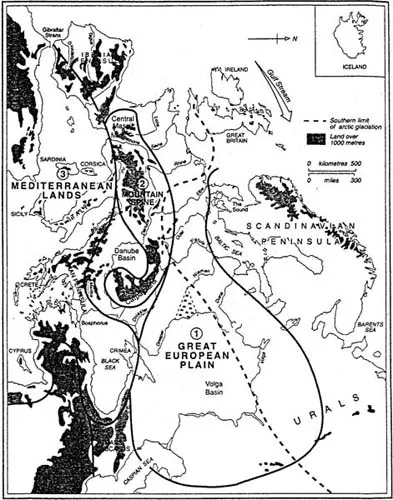
Map 1 Area of study
Adapted from Davies, 1997: 48
Part 1
Initial theoretical
interrogations
2 Language and society
To say language is to say society.(Lévi-Strauss in Duranti 1997: 337)
Habitus … in aliqua perfecta et constanti animi aut corporis absolution consistit.(M. Tullius Cicero De Inventione Rhetorica 2, 9, 30)
Introduction
The idea of language, in part, and especially of language in conflict, resides in a complexity of relationships between self-identification, group cohesion and world-view. In this opening chapter the trajectory of this work is set here with regard to these concerns. From this it will be clear that this work is related to a view of language and society in which the two are locked in a relationship which may be characterised as dialectic. In a general sense it may be seen to follow DeBernardi in this, for example:
Contemporary ethnographic linguistics are driven by functional questions regarding the role of linguistic interaction in expressing social identity and shaping value. Research into the pragmatics of language use suggests that people not only speak about the world ‘out there’; they also create a good deal of their social reality in the very act of speaking. Thus the acquisition of a language is not only the internalization of a linguistic code, but also entails the learning of status and role, of appropriate social effect, and (ultimately) of worldview. Language provides both the foundation of a shared cultural identity and the means for the reproduction of social difference.(DeBernardi, 1994: 861)
That language is central to the individuals’ sense of place in the world is, in many ways taken as given and, while this chapter is not to be read as an attempt to engage with the extensive debate on the intrinsic nature of language, it is emphasised that both language and social reality are dynamic and that...
Table of contents
- Cover
- Half Title
- Routledge advances in sociology
- Full Title
- Copyright
- Dedication
- Contents
- List of illustrations
- Acknowledgements
- 1 Introduction
- PART 1 Initial theoretical interrogations
- PART 2 Borders and frontiers
- PART 3 Landscapes and institutions
- PART 4 Conflicts
- PART 5 Resolutions
- Bibliography
- Index
Trusted by 375,005 students
Access to over 1.5 million titles for a fair monthly price.
Study more efficiently using our study tools.
Frequently asked questions
Yes, you can cancel anytime from the Subscription tab in your account settings on the Perlego website. Your subscription will stay active until the end of your current billing period. Learn how to cancel your subscription
No, books cannot be downloaded as external files, such as PDFs, for use outside of Perlego. However, you can download books within the Perlego app for offline reading on mobile or tablet. Learn how to download books offline
Perlego offers two plans: Essential and Complete
- Essential is ideal for learners and professionals who enjoy exploring a wide range of subjects. Access the Essential Library with 800,000+ trusted titles and best-sellers across business, personal growth, and the humanities. Includes unlimited reading time and Standard Read Aloud voice.
- Complete: Perfect for advanced learners and researchers needing full, unrestricted access. Unlock 1.5M+ books across hundreds of subjects, including academic and specialized titles. The Complete Plan also includes advanced features like Premium Read Aloud and Research Assistant.
We are an online textbook subscription service, where you can get access to an entire online library for less than the price of a single book per month. With over 1.5 million books across 990+ topics, we’ve got you covered! Learn about our mission
Look out for the read-aloud symbol on your next book to see if you can listen to it. The read-aloud tool reads text aloud for you, highlighting the text as it is being read. You can pause it, speed it up and slow it down. Learn more about Read Aloud
Yes! You can use the Perlego app on both iOS and Android devices to read anytime, anywhere — even offline. Perfect for commutes or when you’re on the go.
Please note we cannot support devices running on iOS 13 and Android 7 or earlier. Learn more about using the app
Please note we cannot support devices running on iOS 13 and Android 7 or earlier. Learn more about using the app
Yes, you can access Language, Identity and Conflict by Diarmait Mac Giolla Chríost in PDF and/or ePUB format, as well as other popular books in Social Sciences & Ethnic Studies. We have over 1.5 million books available in our catalogue for you to explore.