Many recent studies of French politics have tended to concentrate on the French political system in isolation. Contemporary France aims to set the working of the French political system into its historical, social and economic context. The first section gives a succinct description of the main developments since 1944 in all major contexts - economy, society, domestic politics and foreign relations. The authors then analyse the economic, social and cultural structures of present-day France, and discuss the institutional framework of decision-making and the major political forces involved in it. There are also chapters on French external and defence policy and on the education system, all of which are set in the context of the political system as a whole. Aimed primarily at students of European history and politics or of French society and culture, the book assumes little knowledge in the social sciences and will be readily accessible to beginners in this field.
eBook - ePub
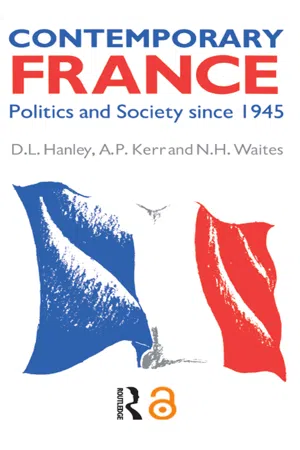
Contemporary France
Politics and Society since 1945
- 384 pages
- English
- ePUB (mobile friendly)
- Available on iOS & Android
eBook - ePub
Contemporary France
Politics and Society since 1945
About this book
Chapter 1
The French experience since 1944
(1) The liberation era and the Fourth Republic, 1944–58
The years 1944–58 are decisive ones for the development of modern France. During them France experienced major change in all her main structures—economic, social, political and diplomatic. In many ways the France of 1944 was more like that of 1900 than that of 1958; but by 1958 France was already clearly moving towards the rank she enjoys today—that of a foremost second-rank power. The following pages will outline some of these changes.
Our analysis must begin, however, with some attempt, brief though it may be, to evoke the peculiar atmosphere of liberation France—a moral and political climate which it is quite difficult to understand a generation later. In 1944 France was emerging from a foreign occupation, following on the humiliating defeat of 1940; her economy lay in ruins. Her status as an international power, taken for granted before 1939, was now open to question: the very liberation of French territory had been achieved largely by the force of Allied arms, with the Free French forces and various resistance groups playing an ancillary role. Above all, the field of domestic politics was one of bitter strife, with in the latter stages of the war a virtual civil war being waged between the various groups who collaborated with the Nazi occupier and the resistance, pledged to overthrow the occupier and his supporters. Paradoxically, though, the climate of the liberation was one of exhilaration, almost of lightheartedness, despite the enormous tasks confronting France. The newly emerged élites and many of the great mass of French people seemed to feel that as the country had reached a nadir, it could only set a new and better course. The different resistance groups which provided the forcing-ground, as it were, of the new generation of political and economic élites had already caught the mood of optimism in their various pronouncements which called for a radical shake-up of the whole of the French social structure.
Changes there were to be, of course, and they would be many and far reaching. On the whole, though, they would fall short of what many of the élites and many ordinary Frenchmen expected. In many ways, then, the years after 1944 are a long, slow descent from the peaks of optimism. We shall now try to seize the most important changes as they occurred in the fields of economic and social life, domestic politics and international relations.
At the liberation in 1944 the economy lay in ruins after the defeat of 1940, a Nazi occupation which pillaged French resources systematically and the effects of Allied bombing and invasion. Much infrastructure (ports, roads, rail) was destroyed or unusable; there was a chronic housing shortage: energy and industrial output were below the level of 1938 and much industrial plant was in any case antiquated, due to pre-war failure to invest in new equipment. There was insufficient food available to feed a population which had lost 600,000 killed or missing and a further half million of whom were still in German prisons—a grave loss to a country whose population decline had been a source of worry even before 1939. Finally, France faced acute inflationary problems connected with money supply. Given these accumulated difficulties, the economic and political leaders of 1944 had very much the feeling that they were starting from zero—which helps perhaps to explain the bold nature of some of their reconstruction policies.
Their strategy had two axes: first, structural reforms of certain areas of the economy and second, use of limited economic planning. As regards structural reforms, nationalizations were to play a key role. The Renault car company was the first, in January 1945 (its owner had collaborated with the Nazis, which made the operation more acceptable politically). It was followed by the major part of the aerospace industry, the coalmines and Air France: in January 1946 came gas, electricity and the four main deposit banks, plus a large part of the insurance sector. The state now employed directly one-tenth of the workforce and was responsible for one-quarter of all investment: indeed thanks to its control of banking it was in effect directly influencing some 47 per cent of all investment by 1949.
The state could not rebuild the economy on its own, however; clearly, the co-operation of the working classes and of employers was crucial. To enlist the aid of the former, the post-war governments created, like their counterparts in much of western Europe, the nucleus of a welfare state. By April 1946 a system of social security had been extended to all wage-earners, replacing the previous rather patchy system of private or co-operative schemes and giving protection against the major hazards of sickness, accident and old age. It was supported by a generous system of family allowances, aimed at raising the birth-rate, which was crucial if France were to have a labour force capable of expanding production. The policy would pay off handsomely, with population rising by 5.6 per cent by 1954 and by 8.8 per cent in the eight years following. Inside the workplace, the decree of February 1945 set up the comités d’entreprise and the délégué syndical was given official recognition. The latter’s task was to transmit workers’ grievances to management; the former body, where labour and management sat together, was supposed to discuss the general workings of the firm (it was restricted to large firms). In practice its powers would turn out to extend no further than organizing social activities within the firm; and the hope that workers would participate in the running of industry remained no more than a hope.
To secure the help of private industry, governments adopted the system of five-year plans advocated by J.Monnet, who would be the first Planning Commissioner. Unlike the Soviet plans, which set compulsory targets for industry, French plans were indicative. They brought together in committee employers, state experts and in the early stages at least, representatives of organized labour. The committees were to assess the resources and possibilities of their sector of the economy and propose targets which might realistically be achieved given the co-operation of all partners, especially government. The latter had, in fact, extensive statutory powers at its disposal, whereby it could requisition goods and services from firms if required; but these were never used. Collaboration was forthcoming, because the plans were modest in their aims and suited a wide spectrum of interests. The first (1947–53) aimed to rebuild the infrastructure vital for basic economic activity—coal, electricity, transport, agricultural equipment. The second (1954–7) continued on the same lines, but branched out more into housing and regional development.
It is important to point out that although during the decisive period of reforms from 1944–6 socialist and communist influence was strong both in government and administration, the reforms described did not mean that France was embarking upon a socialist economy, with control of the means of production in the hands of workers. The presence of General de Gaulle at the head of the provisional government until January 1946 and of the strong christian democrat party MRP in the governing coalition were insurance against that. Rather the reforms of 1944–6 are symptomatic of a desire for renewal arising in the resistance organizations which had fought against the occupiers and had hoped for a new republic after the war. The charter of the main resistance organization CNR (conseil national de la résistance) had spoken in 1943 of ‘une véritable democratic économique et sociale, impliquant l’éviction des grandes féodalités économiques et financières de la direction de l’économie’. But such a project requires that power be firmly in the hands of socialist forces with unambiguous aims, and this was not the case in 1944. Post-war economic reconstruction is really the prolongation of an old French tradition of dirigisme (the state giving clear and precise leadership to the private sector), to revive a moribund capitalism. But as such the operation succeeded very well.
Table 1.1 shows the steady rise of French GDP (and within it, of industrial production) during the Fourth Republic. It is a rapid growth of around 5 per cent per annum and a fairly even one overall. Unfortunately it was marred for some years by monetary problems.
Table 1.1 Growth of French production, 1947–58 (indices)*
At the root of the inflation lay the fact that too much money was in circulation at the liberation; in the run-down economy of the period, with less goods available, this inevitably meant higher prices. Governments were reluctant to grasp the nettle, either by reducing the value of the currency or by soaking up the excess with stiff taxation; either of these measures would have upset some of the better-off, though they would have prevented an inflationary spiral. As it was, wage-earners could only press for higher wages to cover higher costs of living, and so the spiral began. All sectors of the population lost confidence in the value of money. The only actions taken by government were attempts at wage and price freezes, which were unsuccessful and only aroused the hostility of capital and labour alike.
The loss of confidence was compounded by another related problem, the inadequacy of government finance. As well as the usual state debts, the post-war liberation governments inherited the legacy of reparations paid to the occupant, the cost of maintaining a war effort through 1945 and a major share of reconstruction investment. As economic activity was at a low ebb and it was in any case difficult to evaluate resources available, the government could never raise enough by taxation. Moreover, French governments had long preferred indirect tax to direct; in other words they had taxed the poorer end of the population proportionally more heavily than the rich. There was little real change in this policy for several years after 1944, with the result that the budget was in constant deficit—a factor which hardly encouraged non-inflationary behaviour in the population at large.
To bring down the spiral it took the injection of Marshall Aid from the USA1 and some classic deflationary policies applied after 1948 by governments of more conservative hue (in particular reducing expenditure, raising rents and costs of some public services and selective taxation). By 1949 these measures, together with the effects of post-war investment that were beginning to show through, meant that prices could remain fairly stable while real expansion got under way. Although this situation would be perturbed in the 1950s (especially as a result of the Korean war), it did mean that the economy had turned a corner. But the modernization had been achieved by inflation, and this meant that the wage-earners had carried a major share of the burden.
There is no doubt either that the nature of the economy was now changed. Before 1939 it was often described as ‘Malthusian’: the family firm predominated, modest in scale (though there were exceptions, notably in steel and motors), fearful of expansion, and prone to hiding behind tariff barriers. Instead of profits being ploughed back into expanded production, they were often immobilized in safe but unproductive outlets, like government stock. The modernizers aimed to break this structure, and part of their strategy was to encourage mergers so as to give bigger units of production. This process was well under way by 1958: Parodi shows that for limited companies in the period 1950–60 there was an average of eighty-five mergers per year.2 The other axis of the modernizing strategy was to open up the economy to international competition, with the aim of forcing it into greater rationalization and efficiency. Thus it was that in 1950 France joined the European Coal and Steel Community and in 1957 a much wider trade area, the European Economic Community.
This streamlining and directing outwards of the economy had inevitable repercussions on social structure. Growth implies always a move away from the primary sector (agriculture and fisheries) into the secondary (manufacturing) and tertiary (commerce, services, administration). France was typical of this after 1945. Before 1939 the peasantry had been the largest and most inert class in France; after 1945 it declined by 1 or 2 per cent annually. By 1958 the percentage of workforce on the land had fallen from 35 to 23, and 300,000 farmers had disappeared. In 1947 agriculture still took 25.4 per cent of the national income; after 1951 it would take between 11 and 14 per cent.3 Post-war growth told against the farmer. There were limits to how much produce he could sell (families spent progressively less of their income on food) and at the same time the price of machinery (tractors, etc.) rose faster than the prices he received. Modernization meant in fact that only the bigger farmers using advanced techniques could be assured of survival; many of the smaller ones could linger on for a few years at the level of subsistence farming (G.Wright estimates that half of them were in these straits by 1958), or else leave the land and go to work in one of the new factories springing up, perhaps selling off their land to a bigger operator. Thus agriculture underwent concentration of productive units as did industry. The process was resisted by farmers, sometimes violently; but the rural exodus went on, with governments reluctant to tackle the problem of agricultural structures till the 1960s.
The other main victims of modernization were also old social groups, the artisans or craftsmen (especially those in the older trades, whose skills were made obsolete by mechanization) and the small shop-keepers, squeezed by the growth of co-operatives and supermarkets, and finding taxes difficult to pay once inflation had slowed down. Like the peasants, such categories were too numerous for a developed economy, and a certain thinning-out was bound to occur. A shop-keeper from the Lot, P.Poujade, organized resistance to tax inspectors, which developed into a political movement. Battening on the dis-content of the self-employed and of the poor farmers, especially in the centre and south-west, Poujadism was the violent and anarchic protest movement par excellence. Although it had over fifty deputies elected to the 1956 parliament, they were able to do little about the structural problem which explained their presence there, viz. that of obsolescent economic groups, squeezed out by a developing economy.
Other social changes included the emergence of new managerial strata (cadres), whose numbers rose sharply and whose self-awareness was reflected in the creation of their own professional organization, the CGC. Beside them there emerged, in the advanced industries, highly skilled types of worker, whose knowledge and sophistication seemed to contrast increasingly with the subaltern roles assigned them in the productive process. By the end of the 1950s, observers were wondering if they might not be the beginnings of a ‘new working class’.
The social and economic changes of the period were not accompanied, however, by a similar renovation in the field of politics.
Politically, liberation France was in a vacuum. The Third Republic had committed suicide in July 1940, when most of the deputies and senators, panicked by the French collapse, voted the abolition of the republic and passed over full powers to Marshal Pétain. The latter ruled over the état français (the part of France not occupied by the Nazis); this was a régime of personal power, based largely on the prestige and moral authority of the Marshal. It collaborated fairly willingly with Nazism in all domains, even to the extent of helping the Nazis implement their policies of genocide. Its own domestic policies were an odd mixture of cultural archaism and economic dynamism, with an increasingly fascist influence predominating in the later stages. By 1943 the Vichy régime, as it was called (Vichy being its capital), was engaged in virtual civil war with the resistance, those who had decided to oppose the occupant and his allies by armed force. This explains the savagery with which collaborationists were punished when France was liberated.4 When the Nazis withdrew in 1944, Vichy collapsed. In its place was installed a provisional government, based on personalities and groups from the resistance and the Free French forces which had fought outside France; this included representatives of the political left as well as followers of de Gaulle, widely recognized as head of the resistance. De Gaulle was head of the provisional governments (until he resigned in January 1946) but his authority was moral. To obtain the legitimacy conferred by universal suffrage the government had to organize elections for a constituent assembly, which would devise a constitution and submit it to the French people in a referendum for approval or rejection. In this way regular political life could restart.
In fact it proved hard to devise an acceptable constitution. A constituent assembly was duly elected in October 1945, but its draft constitution was rejected in May 1946 by 10.5 million to 9.5 million votes, mainly because it had no provision for an upper chamber. A second constituent assembly elected in June 1946 produced another draft, which was voted on in October. This time it scraped the barest measure of popular approval with 9 million for, 8 million against and 8.5 million abstaining. But France now had a constitution and elections for a national assembly (lower house) were held in November 1946. Thus was the Fourth Republic born with grudging approval; it is perhaps unsurprising that it was only to last twelve years.
Its politics fall into several phases. First there is tripartisme, with government shared between socialists, communists and MRP. This is a period of social and economic reform and inflation; it ends in May 1947 when the socialists evict the communists from government as the Cold War begins. Governments now need an alternative basis, which means that Radicals and conservatives now enter ruling coalitions; their influence helps bring some financial stability. We are now in the period of the ‘third force’, i.e. groups supporting the republic and opposed both to communism and a new challenger, Gaullism. The 1951 elections give the right a majority, and governments are now based mainly on conservatives and radicals; economic growth continues, but problems of foreign policy loom larger, as France adjusts traumatically to its new role as a second-rank power. Social discontent from the victims of modernization takes the shape of farmers’ revolts and Poujadism. The 1956 elections give a majority to the socialists and their allies in the ‘republican front’; but by now the dominant problem is the colonial war in Algeria. This will tax both the economic resources of governments and their political authority to a point where in 1958 the republic will emulate its predecessor and call in a saviour, de Gaulle. We shall now explore in detail the political failure of the republic.
Discerning observers had seen that the new constitution promised to be very like that of the late Third Republic, which many still blamed for the collapse of 1940. It had been characterized by a clear lack of governmental authority, which was due to several factors. One was cultural. It was widely felt among republican politicians that firm government was only one step away from the authoritarianism (césarisme) which has often marked French political life. Weakness or at least pliability was almost a civic virtue: energetic personalities with strong ideas about policy were kept carefully away from office, unless needed in times of crisis. But behind this lay a more structural factor. French society, economically underdeveloped...
Table of contents
- Cover Page
- Title Page
- Copyright Page
- Figures
- Tables
- Preface and acknowledgments
- Abbreviations
- Chapter 1 The French experience since 1944
- Chapter 2 The structures of contemporary France
- Chapter 3 The political framework
- Chapter 4 Political forces
- Chapter 5 External relations
- Chapter 6 The education system
- Notes
- Bibliographical essay
Trusted by 375,005 students
Access to over 1.5 million titles for a fair monthly price.
Study more efficiently using our study tools.
Frequently asked questions
Yes, you can cancel anytime from the Subscription tab in your account settings on the Perlego website. Your subscription will stay active until the end of your current billing period. Learn how to cancel your subscription
No, books cannot be downloaded as external files, such as PDFs, for use outside of Perlego. However, you can download books within the Perlego app for offline reading on mobile or tablet. Learn how to download books offline
Perlego offers two plans: Essential and Complete
- Essential is ideal for learners and professionals who enjoy exploring a wide range of subjects. Access the Essential Library with 800,000+ trusted titles and best-sellers across business, personal growth, and the humanities. Includes unlimited reading time and Standard Read Aloud voice.
- Complete: Perfect for advanced learners and researchers needing full, unrestricted access. Unlock 1.5M+ books across hundreds of subjects, including academic and specialized titles. The Complete Plan also includes advanced features like Premium Read Aloud and Research Assistant.
We are an online textbook subscription service, where you can get access to an entire online library for less than the price of a single book per month. With over 1.5 million books across 990+ topics, we’ve got you covered! Learn about our mission
Look out for the read-aloud symbol on your next book to see if you can listen to it. The read-aloud tool reads text aloud for you, highlighting the text as it is being read. You can pause it, speed it up and slow it down. Learn more about Read Aloud
Yes! You can use the Perlego app on both iOS and Android devices to read anytime, anywhere — even offline. Perfect for commutes or when you’re on the go.
Please note we cannot support devices running on iOS 13 and Android 7 or earlier. Learn more about using the app
Please note we cannot support devices running on iOS 13 and Android 7 or earlier. Learn more about using the app
Yes, you can access Contemporary France by D. L. Hanley,A. P. Kerr,Miss A P Kerr,N. H. Waites in PDF and/or ePUB format, as well as other popular books in History & World History. We have over 1.5 million books available in our catalogue for you to explore.