eBook - ePub
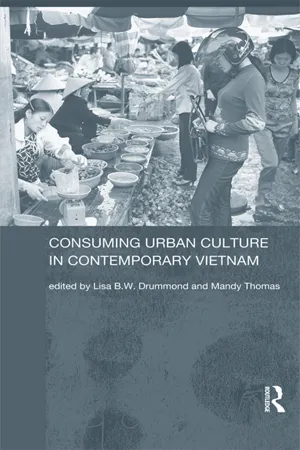
Consuming Urban Culture in Contemporary Vietnam
- 272 pages
- English
- ePUB (mobile friendly)
- Available on iOS & Android
eBook - ePub
Consuming Urban Culture in Contemporary Vietnam
About this book
Vietnam is currently undergoing a metamorphosis from a relatively closed society with a centrally planned economy, to a rapidly urbanising one with a global outlook. These changes have been the catalyst for an exciting ferment of activity in popular culture. This volume contains contributions from scholars engaged in the most up-to-date social research in Vietnam, as well as some of Vietnam's most popular cultural producers who are forging new ways of imagining the present whilst at the same time engaging actively in reinterpreting the past. The diverse ways that Vietnam is culturally and socially negotiating the future are examined as the book addresses issues of indigenisation of cultural influences, ambivalence surrounding change, and the consistent blurring of boundaries between informal, non-state cultural activities and formal institutional structures in the evolution of a civil society in Vietnam.
Information
Chapter 1
Introduction
Mandy Thomas and Lisa B.W. Drummond
Present-day Vietnam: contradictions and dilemmas
Everyday cultural life dramatically reflects and embodies changes in society at large. In this volume, a range of authors discuss the impact on everyday lived experience of the key political and economic transformations that have occurred in Vietnam over the last few years. Since the late 1980s, Vietnam has undergone a metamorphosis from a relatively closed society with a centrally planned economy to a rapidly urbanising one with a globalising cultural outlook. As the experience of other modernising Southeast Asian nations has shown, however, it is nigh impossible to open oneself up to global flows of capital without also opening oneself up to global flows of culture and information. It is because of this that Vietnam is on the brink of becoming a fully fledged media culture in which the popular narratives and cultural icons are reshaping political views, constructing tastes and values, crystallising the market economy and ‘providing the materials out of which people forge their very identities’ (Hartley 1996: 1). These changes have been the catalyst for an exciting ferment of activity in the domain of pop culture. Artists, musicians, writers, television producers and film directors have all benefited from the diversification in patterns of consumption, the slowly increasing levels of wealth and the gradual freeing up of state control over the activities of the populace.
Street culture in the cities of Vietnam is one in which street vendors carrying baskets of fresh produce from their farms jostle with young men in crisp, white, business shirts rushing to their offices, where cyclos carry groups of students loudly communicating on their mobile phones, where the pavement noodle shops double as internet cafés and the latest glimmering paintjob on a motorbike is being admired by a group of savvy young consumers. The streets in urban Vietnam are predominantly youth-focused, reflecting the demographic situation in which well over half of the population is under 16 years old. However, it is not so much the age of people that marks the cities as being forward-focused and energetically engaged in the future, but the technologies, music, fashion and leisure activities which symbolise a population urgently acquiring the emblems of modernity. At the same time traditional practices are being modified and transformed, religious practices reinvested with meaning and traditional arts and crafts revived.
The papers collected in this volume represent the work of not only many scholars who are carrying out some of the most exciting social research in Vietnam today, but also some of Vietnam's most popular cultural producers who are forging new ways of imagining the present while at the same time engaging actively in reinterpreting the past. In Vietnam, the embrace of pop culture has arisen simultaneously with a nostalgia for modes of life swallowed up by modernity's relentless progress. The quest to preserve, to salvage, comes precisely at that moment when the sense of inevitable global homogenisation and subsequent extinguishing of cultural diversity is at its most compelling.
But this volume does not just provide a celebration of contemporary cultural life and artistic creativity in Vietnam, it also reveals a dark side of Vietnamese urban existence. There has recently been an explosion in the incidence of marriage breakdown, HIV/AIDS, drug and alcohol abuse, petty crime and teenage suicide, particularly in vulnerable and minority groups. At the same time, wider evidence of ‘social unrest’ – as manifest in demonstrations and other forms of civil disorder in both urban and rural areas – reveals, among other things, a country struggling to confront the brave new world of economic restructuring with which the region has now been forced to engage. The Asian economic and political crises of the last few years have wreaked some havoc in Vietnam, cutting down many promising economic, political and social signifiers of movement forward. The papers in this volume reveal the diverse ways that Vietnam is culturally and socially negotiating the future.
Money and consumerism: new forms of longing
The dramatic changes in the Vietnamese economy, begun by doi moi (the economic ‘renovation’ policy of 1986) and fuelled by increasing levels of international investment and aid in the early nineties, have had a profound impact upon the social life and consumer practices of the Vietnamese populace, particularly in the cities. Shopping centres are springing up in every major city. In early 2002 the luxurious Trang Tien Plaza in Hanoi was opened on the site of the former spartan Hanoi State General Department Store on Hoan Kiem Lake as a very visible demonstration of the evolution in consumer tastes of the last decade. Not only has there been an increasing availability of consumer items, particularly imported ones, but these consumer items are being taken up as markers of success. Whereas in the early eighties most families used bicycles for transport, today motorbikes are prevalent. Not only are they widespread, but certain brands and engine capacities are keenly sought after. Fashion has developed to such an extent that girls now go on shopping expeditions after school to look at the range of new fabrics and styles available. The market for popular culture in the form of music and film has expanded to include not only regional musicians and films but also some US and other international products. When the film Titanic was released in 1998, thousands of pirated video copies of it were readily available in Vietnam (where first-run movies are not released) and teenagers were seen wearing Leonardo DiCaprio T-shirts. There is a housing boom throughout the country with cement factories recording a dramatic increase in sales and the opening up of homeware stores for the wealthy. Private clubs with bars and sports facilities are also being opened with membership prices many times more than the average yearly income.
The emerging more affluent youth market is hungry for products, but always with a Vietnamese flavour. Global trends such as cafés have taken off but with their own unique Vietnamese twist. For example, what is being called the Vietnamese Starbucks, the chain of more than 400 Trung Nguyen cafés, was started by a young entrepreneur as the first nation-wide franchise.1 In Hanoi one of these cafés seats over 400 people and at weekends attracts hundreds of young people on motorbikes.
Changing consumption patterns have been interwoven with popular holidays and festivals. At the same time as the interest in state-organised events such as May Day celebrations has seriously declined, pilgrimages and religious festivals are flourishing. With the rise of popular festivals comes an array of consumer practices associated with leisure activities – tourism, drinking, eating, souvenir purchasing and the enjoyment of popular entertainment such as karaoke, music and dancing. While the Tet and Autumn festivals remain the holiday highlights of the Vietnamese calendar, celebration of Christmas and the Western New Year has in recent years become popular. In 2002, Valentine's Day had its first obvious commercial presence, with greeting cards stores and chocolate sales registering the moment (Jim Kennedy, New Haven Register, 14 February 2002).
It is clear that consumption has become one of the prime leisure activities of the urban population. However these new patterns of spending have revealed new social divisions and hierarchies. While sales of gold have skyrocketed, there has been a rise in petty crimes such as bag-snatching and pick-pocketing, increasing use of illegal drugs such as heroin and a flood of contraband goods from across the border in southern China pouring into the markets. There has also been a surprising lack of development of manufacturing industries. So while the pleasures of purchasing have been enjoyed by a few and there has been a proliferation in advertising, the continuing economic woes of the country have not been positively affected by such a change in spending patterns.
The changing media and new technologies
In a recent volume on the media in Vietnam, Marr (1998) argues that the mass media has undergone a radical face-lift over the last decade and has fuelled consumer interest in new products. If the media is, as Hartley suggests, ‘a visualisation of society’ (1996: 210), then the recent foray into media culture is a dramatic turnaround from that which existed previously.2 Until the policy of renovation (doi moi) was instituted in 1986, the Vietnamese media had the role of spreading propaganda and consequently focused less on reporting news than on educating the populace.
As evidenced in the memoirs of northern journalist turned political refugee, Bui Tin, many journalists from 1954 onwards were integrated into the party and felt honoured to be spreading the party's messages (Bui Tin 1995). Public criticism of the regime in the north has been apparent mainly in literature rather than in journalism, and writers such as Duong Thu Huong and Nguyen Huy Thiep, who examine forms of social deterioration and dislocation, have often found themselves censured by the party.3 In general, however, the nationalist cause and the socialist ideals were promoted through the arts, which were ‘to be purged of the perfidious influence of Western bourgeois culture and provided with a new focus, nationalist in form and socialist in content’ (Duiker 1995: 181–2). In the south after 1975, journalists and writers were singled out for particular punishment by the party, with many sent to forced labour camps or imprisoned (Jamieson 1993: 364). Awareness of the power of the printed word has led the party to harness journalists and writers to its cause at the same time as it harbours a tenacious suspicion and distrust of their products.
At the time of writing, reports in the major Vietnamese newspapers remain dominated by party-related events highlighting activities which represent the socialist society of Vietnam as a success. Other stories that predominate in the newspapers are those that convey moral lessons or provide information on public issues of health and safety. Although there are increasing media reports of corruption, crime and social upheaval, these are often framed so that the information appears to be for the protection of the masses and thus such reports continue to represent the party as a body interested in rooting out social and political ‘problems’. While criticism may be directed at officials, the leaders of the party and the overriding system of rule never come under direct attack, nor are they placed under the critical spotlight.
Since doi moi, there has been a dramatic increase in the number of news-papers and magazines available. Journalists have also been permitted to investigate cases of wrongdoing by police and local party officials as well as instances of high-level corruption. However, there is still a demand for greater freedom of the press. Journalists are in the difficult situation of serving two masters, of wanting to attract a readership at the same time as not being permitted to exacerbate political instability.4 While there are no private presses and all publishing has to be licensed by the Culture and Information Ministry, there has been a widening range of material available as well as a dramatic rise in the overall number of publications, including foreign literature. The shift from a ‘public relations state’ (Schudson 1989: 160) to one in which the public takes an active role in the choice of media information they receive has been bumpy and the media has on occasions reverted to dictatorial state control (see Hiang-Khng Heng 1997; Unger 1991).
The growth in television ownership has coincided with more sophisticated and varied programming, with some popular programmes capturing a large audience (see Drummond, this volume, Chapter 10). In recent years the number of illegal satellite dishes has grown rapidly, with the public's demand for a more diverse range of information such as that which they can now see on channels such as Star World, Star Sport, MTV, Discovery, Cartoon Network, CNN: ‘Chinese satellite dishes have flooded the domestic market, selling for just $100 each and enabling users to receive transmissions from Hong Kong, China, Indonesia and Australia. Others include dishes from Taiwan, Korea and the US’ (Bich Ngoc, VIR, 16 August 2002).
Throughout Vietnam, there is a revival of the radio, particularly programmes that feature listener participation, for example Green Wave, an hour-long weekly youth programme in Ho Chi Minh City which is ‘credited with setting the pace for Vietnamese musical tastes’ (Margaret Cohen, Far Eastern Economic Review, 3 January 2002). But perhaps the greatest media intrusion into the social and political life of the country will be the internet. The popularity of the internet is growing rapidly. Although Vietnam has only 250,000 internet subscribers, due largely to high sign-up costs and user fees (Reuters, 8 August 2002), internet cafés are exploding in number to accommodate the number of young people wanting to chat on-line and surf the net. While it is still too early to see what impact the net may have on consumption patterns and upon political change, the state has tried to censor its use and limit circulation of some types of information through nation-wide firewalls (electronic filters) (Knight Ridder News Service, 2 September 2001). However, in reality electronic political censorship is difficult, with politically sensitive material easily being sent via email, fax and radio. How successful such manoeuvres will be in the long term, given the ability of the internet and its users to ‘work around’ such obstacles, is uncertain, although it is fair to note that the Singapore government has seemingly implemented this method with on-going success.
While the use of new technologies such as mobile phones and text messaging is common throughout the region, communication via technology has also grown and in particularly Vietnamese ways. In Ho Chi Minh City, for example, ‘chat phone cafés’ are becoming very popular, as reported in the following news article:
These days, the tables at Chat Phone Cafe in Ho Chi Minh City are filled with twenty-somethings who talk not among themselves, but into telephones. Customers visit the cafe specifically to talk to complete strangers over the phone. These cafes, which could be considered the Vietnamese version of a telephone club, have become increasingly popular among young Vietnamese. Chat Phone Cafe, Vietnam's first telephone cafe, is run by former journalist Dang Hong Tuyen and her husband. The cafe has eight two-person tables equipped with one telephone. The idea to open the cafe came to Tuyen, who mainly covered domestic issues during her 15-year career as a reporter, when a 17-year-old girl approached her for advice after she broke up with her boyfriend. Tuyen recalled that the girl had told her that she wanted someone to listen to her problems. For an annual membership fee of 50,000 dong, clients can register their telephone numbers with the cafe, along with their age, gender and interests. Currently, Chat Phone Cafe has about 1,000 members. Telephone numbers are managed by the cafe. Visitors inform the cafe of the type of person they would like to talk to. The cafe then pairs them up with a suitable candidate from their members, whom visitors are introduced to over the telephone.(Kenichi Okumura, Yomiuri Shimbun
(Daily Yomiuri), 16 April 2002)
While romance fuels the motivation to engage in these forms of communication, an epiphenomenon of these changing practices is the opening up of spaces for critical discussion and sharing of ideas. Internet cafés, coffee shops and leisure sites will undoubtedly also be key sites for the fuller development of civil society in Vietnam, with students playing an increasing...
Table of contents
- Cover
- Half Title
- Full Title
- Copyright
- Contents
- List of illustrations
- Notes on contributors
- Acknowledgements
- 1 Introduction
- PART I The background to recent changes
- PART II Everyday life and cultural change in contemporary Vietnam
- PART III Vietnamese popular culture
- PART IV The view from within: the changing world of Vietnamese cultural practitioners
- Index
Trusted by 375,005 students
Access to over 1.5 million titles for a fair monthly price.
Study more efficiently using our study tools.
Frequently asked questions
Yes, you can cancel anytime from the Subscription tab in your account settings on the Perlego website. Your subscription will stay active until the end of your current billing period. Learn how to cancel your subscription
No, books cannot be downloaded as external files, such as PDFs, for use outside of Perlego. However, you can download books within the Perlego app for offline reading on mobile or tablet. Learn how to download books offline
Perlego offers two plans: Essential and Complete
- Essential is ideal for learners and professionals who enjoy exploring a wide range of subjects. Access the Essential Library with 800,000+ trusted titles and best-sellers across business, personal growth, and the humanities. Includes unlimited reading time and Standard Read Aloud voice.
- Complete: Perfect for advanced learners and researchers needing full, unrestricted access. Unlock 1.5M+ books across hundreds of subjects, including academic and specialized titles. The Complete Plan also includes advanced features like Premium Read Aloud and Research Assistant.
We are an online textbook subscription service, where you can get access to an entire online library for less than the price of a single book per month. With over 1.5 million books across 990+ topics, we’ve got you covered! Learn about our mission
Look out for the read-aloud symbol on your next book to see if you can listen to it. The read-aloud tool reads text aloud for you, highlighting the text as it is being read. You can pause it, speed it up and slow it down. Learn more about Read Aloud
Yes! You can use the Perlego app on both iOS and Android devices to read anytime, anywhere — even offline. Perfect for commutes or when you’re on the go.
Please note we cannot support devices running on iOS 13 and Android 7 or earlier. Learn more about using the app
Please note we cannot support devices running on iOS 13 and Android 7 or earlier. Learn more about using the app
Yes, you can access Consuming Urban Culture in Contemporary Vietnam by Lisa Drummond, Mandy Thomas, Lisa Drummond,Mandy Thomas in PDF and/or ePUB format, as well as other popular books in Social Sciences & Cultural & Social Anthropology. We have over 1.5 million books available in our catalogue for you to explore.