- 187 pages
- English
- ePUB (mobile friendly)
- Available on iOS & Android
eBook - ePub
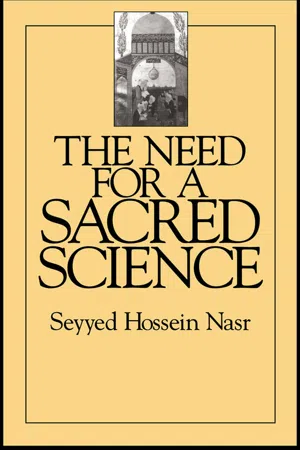
The Need For a Sacred Science
About this book
The meaning of a science rooted in the sacred, its contrast to modern science and its pertinence to us today.
Information
PART ONE
The World of the Spirit—A Metaphysical Context for the Cultivation of Sacred Science
CHAPTER ONE
God Is Reality
The sensualist and empirical epistemology, which has dominated the horizon of Western man in the modern period, has succeeded in reducing reality to the world experienced by the external senses, hence limiting the meaning of reality and removing the concept of ‘reality’ as a category pertaining to God. The consequence of this change in the very meaning of reality has been nothing less than catastrophic, reducing God and in fact all spiritual realms of being to the category of the abstract and finally to the unreal. At the base of the loss of the sense of the reality of God by modern man in his daily life lies the philosophical error of reducing the meaning of reality to the externally experienced world, of altering the meaning of realist in its early medieval sense to the connotation it has gained in various schools of philosophy since the rise of nominalism at the end of the Middle Ages. Cut off from the twin sources of metaphysical knowledge, namely revelation and intellection,1 and also deprived of that inner spiritual experience which makes possible the concrete realization of higher levels of being, modern man has been confined to such a truncated and limited aspect of reality that of necessity he has lost sight of God as Reality. Also, even if he continues to have faith in the Divinity, the conception of the Divinity as Reality does not at all accord with that empirically determined worldview2 within which he lives and whose premisses he accepts unwittingly or often unconsciously.
It is possible for man to gain knowledge of God and to come to know Him as Reality because of the very nature of human intelligence, which was made to know the Absolute as such. But to gain this knowledge, it is necessary to have access to those twin sources of metaphysical knowledge and certitude, namely revelation and intellection. Moreover, the second is accessible to man in his present state only by virtue of the first, while the fruit of wisdom which it bears lies at the heart of revelation and it also resides at the center of man’s own being. To reach the inner man or the heart which is the seat of the intellect with the aid of the grace issuing from revelation, and to reach the heart of revelation by means of the penetrating rays of this sanctified intellect, enables man to gain an adequate metaphysical knowledge of God as Ultimate Reality and in the light of this knowledge an awareness of relativity as relativity or more precisely as veil.
It can be said that not only does modern man not possess an adequate doctrine of God as Reality in its absolute sense, but also that because of this lack of knowledge he is deprived of an adequate understanding of relativity as veil. To conceive the Absolute in relative terms is also to absolutize the relative in some sense. To remove from God the attribute of reality is also to fail to see the world as only partial reality, as a veil which at once hides and manifests, the veil which as al-ḥijāb in Islam or māyā in Hinduism plays such a basic role in Oriental metaphysics.
Moreover, it is necessary to mention that whereas an adequate metaphysical doctrine pertaining to God as Reality can be found in traditional Christian metaphysics as seen in the works of such masters as Erigena, St.Bonaventure and St.Thomas, the doctrine of the veil is more implicit and less clearly stated even in traditional schools in the West than it is in either Islam or Hinduism, although there are certainly allusions to it in the works of such sages as Meister Eckhart. The reformulation of an adequate metaphysical doctrine concerning the nature of God in a contemporary language requires, therefore, not only a doctrine concerning God as Ultimate Reality or the absolutely Real but also the doctrine of cosmic illusion, the veil, or that creative power which at once manifests the Divine Principle as relativity and veils the Principle through that very manifestation which is none other than the veil—so that a Sufi could address God as “O Thou who hidest Thyself by that which is none other than Thee.”
God as Ultimate Reality is not only the Supreme Person but also the source of all that is, hence at once Supra-Being and Being, God as Person and the Godhead or Infinite Essence of which Being is the first determination. Both He or She and It and yet beyond all pronominal categories, God as Ultimate Reality is the Essence which is the origin of all forms, the Substance compared to which all else is accident, the One who alone is and who stands even above the category of being as usually understood.
God as Reality is at once absolute, infinite and, good or perfect. In Himself He is the Absolute which partakes of no relativity in Itself or in Its Essence. The Divine Essence cannot but be absolute and one. All other considerations must belong to the order of relativity, to a level below that of the Essence. To assert that God is one is to assert His absoluteness and to envisage Him in Himself, as such. The Divine Order partakes of relativity in the sense that there is a Divine Relativity or Multiplicity which is included in the Divine Order, but this relativity does not reach the abode of the Divine Essence. God in His Essence cannot but be one, cannot but be the Absolute. To speak of God as Reality is to speak of God as the Absolute.3
God as Reality is also infinite, the Infinite, as this term is to be understood metaphysically and not what it means mathematically. Ultimate Reality contains the source of all cosmic possibilities and in fact all possibilities as such even the metacosmic. God is infinite not only in the sense that no limit can be set upon Him, but also in the sense that, as Ultimate Reality, He contains all possibilities. Metaphysically, He is the All-Possibility.4 When the Bible states that with God all things are possible or the Quran asserts that God has power over all things, these scriptural statements must not be understood only in the usual theological sense of alluding to God’s infinite power. They also refer to God’s nature as the All-Possibility and confirm in other language the Quranic verse, “In His hands is to be found the dominion (malakut) of all things” (XXXVI.83), that is, the essential reality of all things is to be found in the Divine Nature. It is useful to recall here that the words possibility, puissance and potentiality are from the same root. To say that God is the All-Powerful, the All-Potent, is also to say that He is the All-Possibility.
The understanding of the Divine Infinity is so essential to an adequate doctrine of the nature of God, that its neglect has been the main cause for the philosophical objections to the religious idea of God as goodness and perfection, the source of all that is good and at the same time creator of an imperfect world. No problem has been as troublesome to Western man’s understanding of God as presented in the mainstream of Christian theology and philosophy as the famous problem of theodicy, that is, the question of the creation of a world in which there is evil by a Creator who is good. The lack of a complete metaphysical doctrine in the modern West has brought about the eclipse of the doctrine of Divine Infinity and the grades of manifestation or levels of being with the help of which it is possible to understand perfectly well why a world in which there is evil has its origin in God who is pure goodness.5
Here it is necessary to add that there would in fact be no agnostics around if only it were possible to teach metaphysics to everyone. One cannot expect every person to comprehend metaphysics any more than one could expect everyone to understand physics or mathematics. But strangely enough, whereas modern man accepts the discoveries of physics on faith and is willing to undergo the necessary training to master the subject if he wishes to understand physics himself, unlike traditional man he does not extend this faith to the fruits of metaphysical knowledge. Without willing to undergo the necessary discipline and training, which in traditional metaphysics, and in contrast to modern science, includes also moral and spiritual considerations, modern man expects to understand metaphysics immediately and without any intellectual or spiritual preparation. If he fails to comprehend the subject, then he rejects the very possibility of that knowledge which alone can solve the antinomies and apparent contradictions of the problem of theodicy and evil. In fact many people in the modern world do not even accept the revealed truths on the basis of faith, as was the case of traditional man, who usually possessed a greater awareness of his own limitations than does his modern counterpart.
In any case, the doctrine of the Divine Infinity makes it possible to understand why there is a world which is limited and imperfect. The Divine contains all possibilities, including the possibility of its own negation, without which it would not be infinite. But this possibility implies a projection toward nothingness which, however, is never reached. This projection constitutes the world, or rather the many worlds standing below their Divine Origin. Since only God is good, this projection means, of necessary, separation from the source of goodness and hence the appearance of evil, which is a kind of “crystallization of nothingness,” real on its own level of existence but an illusion before God, who alone is Reality as such. The root of the world resides in the infinity of the Divine Nature.
The metaphysical doctrine of God as absolute and infinite is contained in an explicit fashion in the Quranic chapter called Unity or Sincerity, al-Tawḥid, or al-Ikhlāṣ (CXIII), which according to Muslims summarizes the Islamic doctrine of God:6
In the Name of God—Most Merciful, Most Compassionate
Say: He is God, the One (al-Aḥad)!
God, the eternal cause of all beings (al-Ṣamad)!
He begetteth not nor was He begotten.
And there is none like unto Him.
The “Say” (qul) already refers to the source of manifestation in the Divine Principle, to the Logos which is at once the Divine Instrument of Manifestation and the source of manifestation in the Divine Order. He (huwa) is the Divine Essence, God in Himself, God as such or in His suchness. Al-Aḥad attests not only to God’s oneness but also to His absoluteness. God is one because He is absolute and absolute because He is one, al-aḥadiyyah or quality of oneness implying both meanings in Arabic. Al-Ṣamad, a most difficult term to render in English, implies eternal fullness or richness which is the source of everything; it refers to the Divine Infinity, to God being the All-Possibility. The last two verses emphasize the truth that God in His Essence is both above all relations and all comparisons. The chapter as a whole is therefore the revealed and scriptural counterpart of the metaphysical doctrine of the Divine Nature as absolute and infinite, this knowledge also being “revealed” in the sense that it issues from that inner revelation which is the intellect.7
There is, however, one more statement in this Quranic chapter with which in fact the other chapters of the Quran also open and which is related to the third aspect of the Divine Nature referred to above, namely goodness. God is not only absolute and infinite, but also goodness and perfection. To use the Quranic terminology, He is al-Raḥmah, mercy in Himself, and being mercy and goodness cannot but manifest Himself. The expansive or creative power of the Divinity, which “breathing upon the Divine Possibilities” manifests the world, issues from this fundamental aspect of the Divine Nature as goodness or mercy. That is why the Sufis consider the very substance of the universe to be nothing other than the “Breath of the Compassionate” (nafas al-raḥmān).8 If God is both absolute and infinite, goodness or mercy also reside in His very nature for as Ibn ‘Arabi has said, “Mercy pertains to the essence of the Absolute because the latter is by essence ‘Bounteous’.”9 To reinstate the integral metaphysical doctrine of the Divine Nature in the contemporary world, it is necessary to go beyond the relativity of various prevalent formulations to gain access to the total and complete doctrine of God as that Reality which is absolute, infinite, and good, perfect, and merciful.
Such a doctrine of the Divine requires not only an adequate knowledge of the Principle as absolute but also an adequate grasp of the meaning of relativity, of levels and the hierarchy of existence, of the relatively real and even of the ‘relatively absolute,’ an elliptical term which far from being contradictory contains an indispensable key to the understanding of the science of God. To use the two mutually exclusive categories of Creator and created, as is done theologically, is to fall into certain dichotomies which can only be bridged over by an act of faith, in the absence of which there is usually skepticism concerning the very tenets of revealed religion. To begin with the world considered as reality, as is done by most modern philosophy, is to reach an even more dangerous impasse. This of necessity leads to nihilism and skepticism by reducing God to an abstraction, to the ‘unreal,’ and philosophy itself to the discussion of more or less secondary questions or to providing clever answers to ill-posed problems.
To avoid such impasses, it is essential to revive the doctrine of the veil already alluded to above and to rediscover the traditional teaching about the gradations of reality or of being. To understand God as Reality, it is necessary to understand that there are levels of reality and that reality is not only an empirically definable psychophysical continuum “out there.” The world is real to the extent that it reveals God who alone is Real. But the world is also unreal to the extent that it hides and veils God as Reality. Only the saint who sees God everywhere can claim that what is seen and experienced “everywhere” is real.
Moreover, a particular object cannot be said to be real or unreal in only one sense of these terms, but it partakes of levels of reality, or one might say unreality, from being an opaque object, an “it” or “fact” as understood in modern science which is its face as māyā in the sense of illusion, to its being a transparent symbol, a theophany, a reflection of the Divine Presence and a witness to the Divine māyā which is none other than the Divine Creativity.10 To understand God as Reality is also to grasp the world as unreality, not nothingness pure and simple but as relative reality. It is to be saved from that central error of false attribution which issues from our ignorance and which causes us to attribute reality to the illusory and, as a consequence, the character of illusion to that which is Reality as such and which ultimately is alone Real.
To reinstate the doctrine of God as Reality is, needless to say, impossible without a change in the way we envisage the question and possibility of knowledge. As long as the prevalent empiricism or its complementary rationalism continue to reign or are replaced by that irrationalism which erupted in the nineteenth-century Europe from below, there is no possibility to grasp the validity of that traditional wisdom, or that sophia perennis, which has always seen God as Reality and the world as a dream from which the sage awakens through realization and remembrance and the ordinary man through death. To grasp this doctrine, the traditional sapiential perspective based on the possibility of principial knowledge from the twin sources of the intellect and revelation must be rein...
Table of contents
- COVER PAGE
- TITLE PAGE
- COPYRIGHT PAGE
- INTRODUCTION
- PART ONE: THE WORLD OF THE SPIRIT—A METAPHYSICAL CONTEXT FOR THE CULTIVATION OF SACRED SCIENCE
- PART TWO: THE UNITY OF THE DIVINE STRATOSPHERE— THE DIVERSITY OF THE HUMAN ATMOSPHERE
- PART THREE: SCIENCE: TRADITIONAL AND MODERN
- PART FOUR: TRADITION, SACRED SCIENCE AND THE MODERN PREDICAMENT
- POSTSCRIPT
Trusted by 375,005 students
Access to over 1.5 million titles for a fair monthly price.
Study more efficiently using our study tools.
Frequently asked questions
Yes, you can cancel anytime from the Subscription tab in your account settings on the Perlego website. Your subscription will stay active until the end of your current billing period. Learn how to cancel your subscription
No, books cannot be downloaded as external files, such as PDFs, for use outside of Perlego. However, you can download books within the Perlego app for offline reading on mobile or tablet. Learn how to download books offline
Perlego offers two plans: Essential and Complete
- Essential is ideal for learners and professionals who enjoy exploring a wide range of subjects. Access the Essential Library with 800,000+ trusted titles and best-sellers across business, personal growth, and the humanities. Includes unlimited reading time and Standard Read Aloud voice.
- Complete: Perfect for advanced learners and researchers needing full, unrestricted access. Unlock 1.5M+ books across hundreds of subjects, including academic and specialized titles. The Complete Plan also includes advanced features like Premium Read Aloud and Research Assistant.
We are an online textbook subscription service, where you can get access to an entire online library for less than the price of a single book per month. With over 1.5 million books across 990+ topics, we’ve got you covered! Learn about our mission
Look out for the read-aloud symbol on your next book to see if you can listen to it. The read-aloud tool reads text aloud for you, highlighting the text as it is being read. You can pause it, speed it up and slow it down. Learn more about Read Aloud
Yes! You can use the Perlego app on both iOS and Android devices to read anytime, anywhere — even offline. Perfect for commutes or when you’re on the go.
Please note we cannot support devices running on iOS 13 and Android 7 or earlier. Learn more about using the app
Please note we cannot support devices running on iOS 13 and Android 7 or earlier. Learn more about using the app
Yes, you can access The Need For a Sacred Science by Seyyed Hossein Nasr in PDF and/or ePUB format, as well as other popular books in Social Sciences & Ethnic Studies. We have over 1.5 million books available in our catalogue for you to explore.