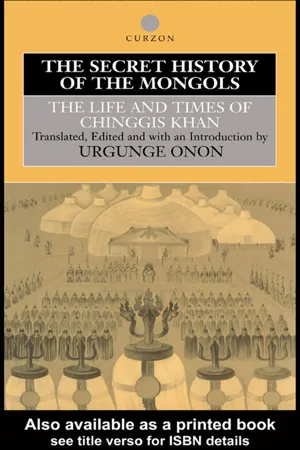
There has long been a need for a scholarly English edition of the great 13th century historical epic, The Secret History of the Mongols, the only surviving Mongol source about the empire. The book is mainly about the life and the career of Chinggis Khan, his ancestors and his rise to power.
Chinggis Khan was not only a military genius, but also a great statesman and diplomat. Through a combination of armed force and diplomacy, he managed to merge the complex system of alliances which existed between diverse tribes into a powerful confederacy that swept across most of Eurasia, starting in 1219.
Urgunge Onon's fresh translation brings out the excitement of this epic with its wide-ranging commentaries on military and social conditions, religion and philosophy, while remaining faithful to the original text. This fully annotated edition is prefaced by a 36 page introduction setting the work in its cultural and historical context.
eBook - ePub
The Secret History of the Mongols
The Life and Times of Chinggis Khan
- 298 pages
- English
- ePUB (mobile friendly)
- Available on iOS & Android
eBook - ePub
The Secret History of the Mongols
The Life and Times of Chinggis Khan
About this book
Information
CHAPTER ONE
[1] Chinggis69 Qahan was born with his destiny ordained by Heaven above.70 He was descended from Börte Chino, whose name means ‘greyish white wolf’,71 and Qo’ai-maral, the wolf’s spouse, whose name means beautiful doe, who crossed the lake72 and settled at the source of the Onon River at Burqan-qaldun,73 where Batachi-qan74 was born to them.
[2] The son of Batachi-qan was Tamacha. The son of Tamacha was Qorichar-mergen. The son of Qoricharmergen was A’ujamboro’ul. The son of A’ujam-boro’ul was Sali-qacha’u. The son of Sali-qacha’u was Yeke-nidün. The son of Yeke-nidün was Sem-sochi. The son of Sem-sochi was Qarchu.75
[3] The son of Qarchu, Borjiigidai-mergen, had Mongqoljinqo’a as his wife. The son of Borjigidai-mergen, Toroqoljin-bayan, had a wife called Boroqchin-qo’a, a young manservant called Boroldai-suyalbi, and two fine geldings,76 Dayir77 and Boro.78 Toroqoljin had two sons, Duwa-soqor and Dobun-mergen.79
[4] Duwa-soqor had a single eye in the middle of his forehead. Through it, he could see for a distance of three journeys.80
[5] One day, Duwa-soqor climbed Burqan-qaldun with his younger brother, Dobun-mergen. Looking down from Burqan-qaldun, Duwa-soqor spied a group of people coming downstream along the Tünggelik.81
[6] He said: ‘Among those people moving camp towards us is a beautiful girl in the front seat of a black-covered wooden cart. If she has not already been given to anyone, let us request her for you, young brother Dobun-mergen.’ He sent his younger brother Dobun-mergen to take a look.
[7] Having reached the group, Dobun-mergen found a girl of true beauty and good reputation. Her name, Alan Qo’a,82 was well known; she had not yet been given to any man.
[8] Barqujin-qo’a, the daughter of Barqudai-mergen, Lord of the Köl Barqujin lowland,83 who had been given to Qorilartai-mergen, the Lord of the Qori-Tümeds,84 was a member of the group. In the land of the Qori-Tümeds, at Ariq-usun,85 Barqujin-qo’a, wife of Qorilartai-mergen, had given birth to the girl Alan Qo’a.
[9] Qorilartai-mergen had fallen out with his people when they banned each other from hunting sable, squirrel, and other wild animals in the Qori-Tümed lands. Because of this ban, they formed the Qorilar86 clan. He deemed Burqan-qaldun, rich in wild animals and gazelles, a good place. Shinchi-bayan87 established [shamanistic] deities as the spirit-lords88 of Burqan-galdun89 while he was travelling in the direction of Uri[y]angqai. Alan Qo’a, daughter of the Qori Tümed Qorilartal-mergen born at Ariqusun, was there requested [by Duwa-soqor] in marriage. This is how she came to be the wife of Dobun-mergen.
[10] Having joined Dobun-mergen, Alan Qo’a bore him two sons, Bügünütei and Belgünütei.
[11] Duwa-soqor, the older brother, had four sons. Duwasoqor died soon afterwards. After Duwa-soqor’s death, his four sons no longer looked upon their uncle Dobun-mergen as kin, but despised him and moved away. They split into four clans that became the Four Peoples.90
[12] One day, Dobun-mergen set out to go hunting on Toqochaq Peak. In a forest, he met an Uri[y]angqad[ai] man who had killed a three-year-old deer and was roasting its ribs and rectum.
[13] Dobun-mergen said: ‘Friend,91 give me some of the meat, as my share.’92 ‘I will,’ said the hunter. Keeping the lungs, head, and skin,93 he gave [the rest of] the meat of the three-year-old deer to Dobun-mergen.
[14] Dobun-mergen loaded up the three-year-old deer. While continuing on his way, he met a poor man leading his young son.
[15] Dobun-mergen asked: ‘Who are you?’ The man replied: ‘I am a man called Ma’aliq of the Baya’uds and in distress. I will give you this son of mine in exchange for part of that beast’s flesh.’
[16] On hearing those words, Dobun-mergen tore off one of the deer’s hind-legs and gave it to the man. He then took the boy back to his yurt, where the boy worked as a servant.
[17] Not long afterwards, Dobun-mergen died. After his death, despite the loss of her husband, Alan Qo’a bore three more sons called Buqu-qadagi, Buqatu-salji, and Bodonchar-mungqaq.94
[18] Belgünütei and Bügünütei, the two sons born earlier to Dobun-mergen, talked together about their mother Alan Qo’a behind her back: This mother of ours has produced three sons, without [our father’s] older brother, younger brother, or cousins95 or any husband. Only the Ma’aliq Baya’ud man lives in this yurt. They are probably his three sons.’ Alan Qo’a sensed what they were saying behind her back.
[19] One spring day, after boiling some dried mutton, she made her five sons, Belgünütei, Bügünütei, Buqu-qatagi, Buqatu-salji, and Bodonchar-mungqaq, sit down in a row. She gave each an arrow-shaft, saying: ‘Break it.’ They broke the arrow-shafts easily and threw them aside. Again, she took five arrow-shafts96 and bound them together. She gave the five bound shafts to each in turn, saying: ‘Break them.’ Each tried, but none succeeded.
[20] At this, Alan Qo’a said to her two sons Belgünütei and Bügünütei: ‘You have doubted me. You have talked together, saying: “Whose are these three sons that she has borne? Whence did they come?” It is right for you to be suspicious.
[21] Every night, a shining yellow man came into the yurt through the light of the smoke-hole and over the top of the door. He caressed my belly and his light sank into it. He [slunk] sheepishly away like a yellow dog by the light of the sun and moon.’
Why do you talk unwisely?
Evidently it is a sign
that they are sons of Heaven.
Why do you compare them
to the black-haired commoners?97
When they become lords of all,
the common people must understand.
[22] Again, Alan Qo’a spoke with her five sons: ‘All five of you were all born of this same belly. Alone, you can be broken easily by anyone. Together and of one mind, like bound arrow-shafts, none can easily vanquish you.’ Not long afterwards, their mother Alan Qo’a passed away.
[23] After Alan Qo’a’s death, the five elder and younger brothers divided the livestock and property among themselves. Four of them—Belgününtei, Bügünütei, Buquqatagi, and Buqatu-salji—each took a share. Only Bodonchar Mungqaq got no share, for they thought him stupid and dull98 and therefore did not count him as their kin.
[24] No longer counted as a member of the family, Bodonchar thought to himself: ‘Why have I lived here until now?’ He...
Table of contents
- Cover Page
- Title Page
- Dedication
- Contents
- Copyright Page
- INTRODUCTION
- CHAPTER ONE
- CHAPTER TWO
- CHAPTER THREE
- CHAPTER FOUR
- CHAPTER FIVE
- CHAPTER SIX
- CHAPTER SEVEN
- CHAPTER EIGHT
- CHAPTER NINE
- CHAPTER TEN
- CHAPTER ELEVEN
- CHAPTER TWELVE
- APPENDIX
- BIBLIOGRAPHY
- INDEX
Trusted by 375,005 students
Access to over 1.5 million titles for a fair monthly price.
Study more efficiently using our study tools.
Frequently asked questions
Yes, you can cancel anytime from the Subscription tab in your account settings on the Perlego website. Your subscription will stay active until the end of your current billing period. Learn how to cancel your subscription
No, books cannot be downloaded as external files, such as PDFs, for use outside of Perlego. However, you can download books within the Perlego app for offline reading on mobile or tablet. Learn how to download books offline
Perlego offers two plans: Essential and Complete
- Essential is ideal for learners and professionals who enjoy exploring a wide range of subjects. Access the Essential Library with 800,000+ trusted titles and best-sellers across business, personal growth, and the humanities. Includes unlimited reading time and Standard Read Aloud voice.
- Complete: Perfect for advanced learners and researchers needing full, unrestricted access. Unlock 1.5M+ books across hundreds of subjects, including academic and specialized titles. The Complete Plan also includes advanced features like Premium Read Aloud and Research Assistant.
We are an online textbook subscription service, where you can get access to an entire online library for less than the price of a single book per month. With over 1.5 million books across 990+ topics, we’ve got you covered! Learn about our mission
Look out for the read-aloud symbol on your next book to see if you can listen to it. The read-aloud tool reads text aloud for you, highlighting the text as it is being read. You can pause it, speed it up and slow it down. Learn more about Read Aloud
Yes! You can use the Perlego app on both iOS and Android devices to read anytime, anywhere — even offline. Perfect for commutes or when you’re on the go.
Please note we cannot support devices running on iOS 13 and Android 7 or earlier. Learn more about using the app
Please note we cannot support devices running on iOS 13 and Android 7 or earlier. Learn more about using the app
Yes, you can access The Secret History of the Mongols by Professor Urgunge Onon,Urgunge Onon in PDF and/or ePUB format, as well as other popular books in Ciencias sociales & Estudios étnicos. We have over 1.5 million books available in our catalogue for you to explore.