eBook - ePub
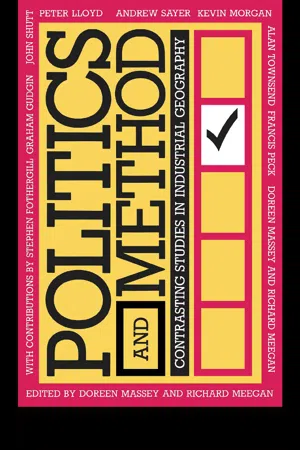
Politics and Method
Contrasting Studies in Industrial Geography
- 200 pages
- English
- ePUB (mobile friendly)
- Available on iOS & Android
eBook - ePub
About this book
First Published in 1985. For more than a decade now a number of debates have been taking place within industrial geography. The period has been one in which issues of the geography of industry—of the spatial form of industrial decline and growth—have often been at the forefront of wider political debate. The issue of the relationship between theory, method, politics and policies is common to all the social sciences, and the debate which is presented here has relevance beyond industrial geography —in economics, in sociology, in other branches of human geography. This book is built around a seminar which was held in 1983. It was organized under the auspices of the then SSRC, now ESRC, as part of the programme of Doreen Massey's Fellowship in Industrial Location Research. The aim was explicitly to allow time for a small group of participants to discuss the range of issues around the question of the relationship between policies, politics, theory and method.
Information
1
Introduction: the debate
For more than a decade now a number of debates have been taking place within industrial geography. The period has been one in which issues of the geography of industry—of the spatial form of industrial decline and growth—have often been at the forefront of wider political debate. And in the discipline of geography there have been long discussions—in conferences, seminar-rooms, books, journals and special reports—on regional policy and what form it should take, and on the rapid-fire series of policies for the inner-city in which ‘solution’ after ‘solution’ has been flung in the direction of the latest areas of industrial dereliction to gain political recognition. There have been debates about the relationship which should exist, if there is to be any chance of success in the declared aim of evening-out the unequal geographical, industrial and social development of the UK, between national economic policies and more specifically spatial ones; the relevance of spatial policies at all has been questioned. There have been arguments over the significance and behaviour of big corporations, variously called monopoly capital, multinationals and the meso-economic sector. And related to this has been the question of the degree to which, and the way in which, the changing
internal geography of the UK is a product of the UK’s own changing position within the international division of labour. New, or newish, problems of the quality of jobs, the geography of technology, of branch-plant economies and of external control, and new proposals for solutions, from science parks to enterprise zones; all have been on the agenda for debate within industrial geography.
At the same time, over the same period, and often in the same journals, we have been conducting a debate about theory and method. Having largely divested itself of the baggage of mathematical models and, at least in terms of their formal application, the theoretical models of (neo-) classical industrial location theory, British industrial geography went off down a number of paths in search of new approaches. Perhaps the longest established, and for long dominant approach, is that of extensive empirical analysis and the identification of location factors and common properties. This approach itself has changed in form over the years, possibly in part due to the debate with other approaches which were soon to arise to challenge it, and it is now based—as this volume demonstrates—on a more explicit and sophisticated exposition of method than has previously been the case. The other approaches which have arisen have themselves been varied. There has been a behavioural school shading off into purely empirical studies of individual corporations. And the period has also seen the development of a range of alternative approaches, structuralist, Marxist and realist, which have focused on setting changes in individual industries and companies within a wider framework which could take account both of underlying capitalist social relations and of the broader context of shifts in the national and international political economy.
These two debates, about the nature of the changes under way and about strategies towards them on the one hand, and about theory and method on the other, have sometimes merged and occasionally been explicitly related; but all too often they have been conducted in parallel. Time has too often seemed too short for self-conscious reflection on the nature of the relation between theoretical, methodological and policy perspectives. This omission has been problematical in a number of ways. It has led to misunderstandings of each other’s positions (some of which we finally discovered in the seminar of which this book is the outcome!). It has led to situations where too much is, implicitly, being piled into one debate, and where a lack of distinction between the elements of difference has led to non-communication (‘A’ does not accept ‘B”s formulation in the first place; ‘B’ finds ‘A”s criteria for evaluating a good explanation utterly spurious, and so forth). It has also led to problems for students in trying to grapple with such a confusion of argument and to fathom out the, often only implicit, different levels of debate.
The issue of the relationship between theory, method, politics and policies is common to all the social sciences, and the debate which we present here has relevance beyond industrial geography —in economics, in sociology, in other branches of human geography. Ever since the ‘social sciences’ were recognized as such there has been fierce debate over methodology and the status of policy recommendations. In the early days there was perhaps much wider acceptance of the links between the two than now. The classical economists, for example, were not slow to draw out policies from their theorizing (Ricardo’s decisive intervention in the debate over the Corn Laws being one notable example) and criticisms of their policies invariably involved a critique of their theories and methodologies. The subsequent rise of empiricism and the philosophy of logical positivism, however, brought in its train the socalled ‘quantitative revolution’ and the development of ‘value-free’ analytical techniques which had the aim of making a separation between theory, methodology and policy. In economics, this was epitomized by the writings of Lipsey and Samuelson (Lipsey 1971; Samuelson 1967), whose introductory textbooks still dominate the teaching of the subject. But this broad school of thought in the social sciences has come increasingly under attack, particularly from structuralist and realist critiques—an attack which has meant that the whole question of the link between methodology and politics is now very much back on the debating table.
This book is built around a seminar which was held in 1983. It was organized under the auspices of the then SSRC, now ESRC, as part of the programme of Doreen Massey’s Fellowship in Industrial Location Research. The aim was explicitly to allow time for a small group of participants to discuss the range of issues around the question of the relationship between policies, politics, theory and method. The day did not produce agreement on the relations between these terms. Indeed it did not even produce consensus on the precise meaning of all the terms themselves. But it did allow us the space for real clarification of each other’s arguments, and also, we found, for the relief of not being simply defensive. Most of us were self-critical about some past position or other, all of us reflected on the way in which our own approaches had developed, on the twists and turns they had taken and on the problems which had been faced, and sometimes overcome. There were points, certainly, in the debate where an impasse was reached, but as someone said at lunchtime, voicing the thoughts of us all, ‘I wonder why we’ve never done this before?’
The central issues
The papers which were presented at the seminar approached the question of the changing geography of employment from a number of different methodological standpoints. We have picked out what we think are the most important features of these positions, and the main differences between them, in short prefaces to each chapter. The differences are certainly marked and wide-ranging. Major contrasts exist, for example, in the conceptualization of the underlying forces of change and the structural relations through which these operate. The different approaches also have contrasting expectations regarding the generalizability of research findings and very different views on the generation and ‘testing’ of research hypotheses. The extent to which the process of production is explicitly integrated into geographical analysis varies markedly between the different methods, and even where production considerations are directly addressed there remain widely divergent emphases and interpretations. And these differences in methodological approach also reveal themselves in the kind of information collected and in the specific research techniques adopted.
There are also marked differences in policy recommendations between the different approaches. They run the range from traditional incentives-based regional policy, indicative local economic planning and policies aimed specifically at influencing the employment and production strategies of major corporations, to strategies involving increased public ownership of production and control of investment and plans for non-profit production and alternative technology.
In this collection what we are specifically interested in is the extent to which these different policy recommendations are related to the different methodologies adopted. Indeed, is there any connection? Most of the contributors here accept that some interrelationship does exist, although this is not seen as being determinate or one-way, with methodology automatically deciding policy conclusions. Stephen Fothergill and Graham Gudgin, however, disagree with this view. While they accept that there is a clear link between methodology and research findings, they do not see any integral relation between methodology and policy recommendations. This view could be challenged on the grounds that if methodology and findings are linked and findings and policy recommendations in turn are connected, then logically there must be some connection, however slight, between methodology and research conclusions. Fothergill and Gudgin would reply, however, that what intrudes to rupture this simple connection is ‘ideology’. In their view ideology has a key influence in determining both the issues to be studied and the recommendations to be drawn from research findings.
In the discussion, there was general agreement that ideological position has an important role to play in the use that is made of research findings. A recent classic example of this is provided by the reception given to the finding by David Birch that small firms were responsible for some two-thirds of net employment growth in the US (Birch 1979). As Fothergill and Gudgin note in their contribution to the collection (chapter 4) this work was eagerly seized upon in the US and in the UK by those ideologically committed to the promotion of small firms. Policies aimed at encouraging the growth of small firms were developed accordingly. Yet, as Fothergill and Gudgin also point out, a quite different interpretation of Birch’s finding could have been made by those not sharing the same ideological predilection towards small business. Why was it not seen, for example, as an argument for developing policies to help large firms which dominate overall employment and which were clearly in difficulties?
More contentious in this context, however, is the argument that researchers of different political persuasions are drawn more to the study of some topics than others. Although we failed to resolve this issue in discussion, basic differences in interpretation were brought into the open. Thus, in one usage, and one on which we were all generally agreed, ‘ideology’ is taken to mean a set of ideas or beliefs promoting, but at the same time hiding, the interests of particular groups—like the small-business lobby just referred to. Yet lurking in the discussion was another view, on which there was much disagreement, namely that ideas and theorizing can be divided into two categories: the autonomous and ‘value-free’ and the ‘ideological’, and consequently false.
An important methodological issue which emerged was whether ideology (in either sense) influences where researchers attempt to break into the system of causation. One suggestion was that ‘radicals’ may be more likely to break in at the level of the system as a whole; less radical researchers, on the other hand, might accept the system as given and confine themselves to exploring causal relationships within it. While these different levels of analysis inevitably influence the nature of any policy recommendations in the sense that one (the radical) will come up with policies addressed more towards systemic level changes than the other, the suggestion was that this is because of ideology— through its influence on the selection of the level of analysis— rather than the research methodologies adopted once this choice has been taken.
In the discussion two dangers were identified in taking this argument too literally. First, it was argued by Doreen Massey and Richard Meegan that ‘taking the system as given’ does not remove the need to understand its specific nature. Even if research is quite prepared to take the capitalist system as given, it is still necessary to conceptualize it as capitalist. Breaking into the system of causation ‘below the level of the system as a whole’ does not change this—the parts of the system must still be conceptualized in terms of the specific nature of their social relations. Second, and what a number of us were agreed upon in the discussion, is the danger that different research methods might be seen as being more appropriate at different scales/levels of analysis. Thus Andrew Sayer and Kevin Morgan make a useful distinction in their contribution (chapter 6) between ‘extensive’ and ‘intensive’ research. The former, defined as relying on the use of aggregate statistics, surveys and statistical analyses, has been most commonly used in economic geography with the preoccupation with discovering general patterns of spatial change. Intensive research, in contrast, is increasingly being used to explore in detail how causal processes work out in specific cases. With its emphasis on abstraction rather than on the empirical generalization common to extensive research design, it is heavily dependent on non-standardized and qualitative analytical techniques. Sayer and Morgan and others, argued that it would be a mistake, however, to view these very different methods as being applicable at different levels of analysis: the extensive at macro-level, say, and the intensive at micro-level. Their differences lie in their explanatory frameworks, not in their analytical scope.
The question then arises as to whether the two research designs are complementary: does one (the extensive) set the agenda for the other (the intensive)? To be compatible they must share the same conceptual framework. The issue is most simply explored by concentrating on polar positions within extensive and intensive research. Extensive research design is often based on a taxonomic approach, aimed at identifying pervasive systematic trends in aggregate variables and exploring common features and relationships within these aggregate patterns. Having identified aggregate trends, the procedure then is to disaggregate these into separate components. Indeed, ‘components of change’ analysis has become a widely-used technique for this, with its disaggregation of employment change into such categories as plant closure, openings, in situ employment expansion and contraction, and locational transfer. A crucial question here is the explanatory status given to these components. There are some who would see them as in themselves explanatory. None of the participants in the seminar would take that position. It was argued, however, that they might be stepping-stones towards a subsequent explanatory stage; in other words that they might be the extensive analysis before the intensive.
There was disagreement as to whether this was, in most cases, likely to be successful. Taxonomic procedures such as these are essentially classifications by outcomes, rather than by causes. A‘closure’, for example, is not a category with explanatory power in the context of the studies we were discussing. A closure is an outcome—a description of the cessation of production and employment at a particular site, but it does not explain why this occurred. As Alan Townsend and Franc Peck pointed out, closures are not everywhere the same, and can occur in very different economic circumstances. They can be the result of the failure of a company, or can be the outcome of the geographical transfer of production within a multi-plant company, as part of the latter’s growth strategy. So what sense does it make in those two very different scenarios to say that job loss was caused by plant closure? Explanation, it was argued, lies in the underlying forces producing this outcome. Why did one company fail? Why did the other company have to transfer production geographically to maintain its growth? To the extent that extensive research remains with identifying and categorizing outcomes, then, there is a degree of compatibility between the two research designs, in the sense that extensive research may well uncover patterns which require explanation. Compatibility in terms of explanation, however, is a totally different matter. The categories which are produced out of extensive research may not be meaningful for intensive analysis.
There is also the question of conceptualizing the components, once roughly sketched out. There was disagreement over the importance of conceptualizing ‘a new firm’, for instance, as a social form with a particular structure of internal social relations. From the intensive corner Massey and Meegan argued that such conceptualization was essential to understanding causal processes. It is, however, admittedly a difficult task. Fothergill and Gudgin felt that it was anyway unnecessary—‘a trivial semantic problem’. Again, compatibility between intensive and extensive seemed elusive, certainly something which needs careful construction and cannot simply be assumed to exist.
An important factor in this compatibility is the way in which the different research designs conceptualize the relationship between factors. By isolating individual factors, extensive research tends to treat these different categories as separable phenomena which can be added together to explain the aggregate patterns being studied (a kind of additive causality). This procedure, to the proponents of intensive research designs, is fundamentally mistaken because factors in their approach are viewed as being structurally interconnected. Because of this interdependency, there is no simple way in which factors can be first disaggregated and then added together again. ‘Structural’ in this sense does not mean ‘aggregate’. It means the form of explanation adopted, the fact that processes (not ‘factors’ or Variables’) are structured together (not added) to produce any one actual empirical outcome.
Moreover, because individual factors may be structured together their combination can, it is argued by Sayer and Morgan, and Massey and Meegan, radically alter the way in which each individually works. Thus extensive research would expect a single national cause (say, changing interest rates) to affect all regions equally, any differences being due to the addition of other factors which can be separately accounted for. Intensive research, in contrast, works on the assumption that the same national cause can produce very different effects in different regions/locations because of the way in which the factor in question is articulated in those locations in relation to other factors. Thus a single national policy, like regional policy for example, may well produce one effect in one situation and a completely different effect in another precisely because of the way in which different processes interact In one set of circumstances changing product and process technology within an industry, and trade union militancy on existing sites, may well encourage plant closure and transfer of production elsewhere. Yet in another situation, the perceived militancy of organized labour might well discourage companies from transferring work elsewhere and result perhaps in new capacity being added to existing sites. Disaggregating the factors involved into, in this example, regional policy, technical change and trade union militancy would clearly not help in explaining the outcome. It is argued, from this position, that ‘factors’ need to be conceptualized as processes and structured together interactively rather than just added up. The qualitative relationships between parts of an explanation, in this view, are not amenable to explanation by statistically identifiable cross-effects between variables. This argument was disputed by Fothergill and Gudgin in the seminar, who argued that statistical methods were indeed available which could make allowances for such cross-effects, but that, anyway, conceptually this was not a problem. Both sides of the argument here stubbornly refused to concede, and in the end an agreement to differ on this point was the only way in which the overall discussion could proceed!
Another irresolvable difference between the two research designs became clear in the related discussion over the appropriateness of different methods at different spatial levels and the status of corporate studies. And the basic difference in the conceptualization of structural interrelationships already referred to lay at the heart of this disagreement. Proponents of extensive research designs would not deny the need for study of individual corporate behaviour, but in their view this is only necessary when the company concerned is the pattern to be studied— a company-town, for example. In such a situation there is no problem for any case-study of the behaviour of the corporation being idiosyncratic But in other circumstances the idiosyncratic behaviour of individual firms needs to be ironed out to get at the pervasive trends, the general causes. In the extensive research design, these causes are empirically identifiable through common outcomes after idiosyncratic behaviour has been cancelled-out in the aggregate pattern. It is therefore necessary to study a large number of firms (the statistical law of large numbers) and consequently this research design is p...
Table of contents
- Cover Page
- Title Page
- Copyright Page
- Notes On Contributors
- 1. Introduction: The Debate
- 2. Editorial Introduction
- 2. Recession and Restructuring In the North-West Region, 1975–82: The Implications of Recent Events
- 3. Editorial Introduction
- 3. An Approach to the Analysis of Redundancies In the UK (Post-1976): Some Methodological Problems and Policy Implications
- 4. Editorial Introduction
- 4. Ideology and Methods In Industrial Location Research
- 5. Editorial Introduction
- 5. Profits and Job Loss
- 6. Editorial Introduction
- 6. A Modern Industry In a Declining Region: Links Between Method, Theory and Policy
- 7. Postscript: Doing Research
- Bibliography
Trusted by 375,005 students
Access to over 1.5 million titles for a fair monthly price.
Study more efficiently using our study tools.
Frequently asked questions
Yes, you can cancel anytime from the Subscription tab in your account settings on the Perlego website. Your subscription will stay active until the end of your current billing period. Learn how to cancel your subscription
No, books cannot be downloaded as external files, such as PDFs, for use outside of Perlego. However, you can download books within the Perlego app for offline reading on mobile or tablet. Learn how to download books offline
Perlego offers two plans: Essential and Complete
- Essential is ideal for learners and professionals who enjoy exploring a wide range of subjects. Access the Essential Library with 800,000+ trusted titles and best-sellers across business, personal growth, and the humanities. Includes unlimited reading time and Standard Read Aloud voice.
- Complete: Perfect for advanced learners and researchers needing full, unrestricted access. Unlock 1.5M+ books across hundreds of subjects, including academic and specialized titles. The Complete Plan also includes advanced features like Premium Read Aloud and Research Assistant.
We are an online textbook subscription service, where you can get access to an entire online library for less than the price of a single book per month. With over 1.5 million books across 990+ topics, we’ve got you covered! Learn about our mission
Look out for the read-aloud symbol on your next book to see if you can listen to it. The read-aloud tool reads text aloud for you, highlighting the text as it is being read. You can pause it, speed it up and slow it down. Learn more about Read Aloud
Yes! You can use the Perlego app on both iOS and Android devices to read anytime, anywhere — even offline. Perfect for commutes or when you’re on the go.
Please note we cannot support devices running on iOS 13 and Android 7 or earlier. Learn more about using the app
Please note we cannot support devices running on iOS 13 and Android 7 or earlier. Learn more about using the app
Yes, you can access Politics and Method by Doreen Massey,Richard Meegan in PDF and/or ePUB format, as well as other popular books in Social Sciences & City Planning & Urban Development. We have over 1.5 million books available in our catalogue for you to explore.