eBook - ePub
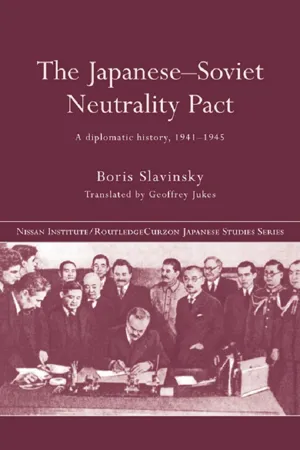
The Japanese-Soviet Neutrality Pact
A Diplomatic History 1941-1945
- 256 pages
- English
- ePUB (mobile friendly)
- Available on iOS & Android
eBook - ePub
About this book
The neutrality pact between Japan and the Soviet Union, signed in April 1941, lapsed only nine months before its expiry date of April 1946 when the Soviet Union attacked Japan. Japan's neutrality had enabled Stalin to move Far Eastern forces to the German front where they contributed significantly to Soviet victories from Moscow to Berlin. Slavinsky suggests that Stalin's agreement with Churchill and Roosevelt to attack Japan after Germany's surrender allowed him to keep Japan in the war until he was ready to attack and thus avenge Russia's defeat in the war of 1904-1905. The Soviet Union's violation of the pact and the detention of Japanese prisoners for up to ten years after the end of the war created a sense of victimization in Japan to the extent that there is still no formal Peace Treaty between the two countries to this day.
Slavinsky draws on recently opened Russian archival material to demonstrate that the Soviet Union was passing information about the Allies to Japan during the Second World War. He also persuasively argues that vengeance and the (re)acquistion of land were the primary motives for the attack on Japan. The book contains empirical data previously unavailable in English and will fascinate anyone with an interest in the history of Japan, the Soviet Union and the events of the Second World War.
Information
1 Historiography of the problem
In Soviet historiography there was not one book entirely devoted to the Japanese-Soviet neutrality pact, even though studies by the American scholar George Lensen1 and the Japanese researcher Kudo Michihiro2 dealt with the subject. The theme is analysed broadly in various Soviet books on Japanese-Soviet relations, but only individual isolated sections deal with it. A few articles have also been published.
The basic source for elucidating Japanese policy towards the USSR, and justifying Soviet policy towards Japan in the pre-war and wartime years, is the ‘Proceedings of the International Military Tribunal for the Far East’, held during 1946–8 in Tokyo. These total 100,000 pages of text, not counting materials prepared before the trial.
The Soviet Government approached the Tokyo trial very seriously, as the USSR's position there was radically different from that in the Nuremberg trials of the principal German war criminals. The Soviet Union had a moral right to judge the latter, because they had invaded it. But Japan had not attacked the USSR; quite the reverse, it was the Soviet Union that on 8 August 1945 declared war on Japan, in breach of a Neutrality Pact supposed to remain in force until April 1946. To justify this, Soviet propaganda had to show, first, that Japan from the outset had been insincere in signing the Pact, since it wished to use it to mask preparations to attack the USSR, and second, that over all those years Japan systematically violated the pact by cooperating with Germany.
On Communist Party Central Committee instructions, the Ministries of Foreign Affairs, State Security, the Interior, Marine and Fisheries, Red Army General Staff and Frontier Force Headquarters, USSR Procurator's office and various research institutes prepared dozens of notes, documents and maps. These distorted figures, twisted facts and falsified the history of Soviet-Japanese relations. They were then disseminated and published as separate books.3 In later years, and until quite recently, highly tendentious and maliciously anti-Japanese books were added,4 indicating that there are still those who need to foster anti-Japanese attitudes among our people.
The tragedy of post-1945 Soviet-Japanese relations is that the Tokyo trial materials were placed as ‘historical truth’ at the foundations of Soviet policy towards Japan. Then accusations of militarism, complicity with American imperialism, territorial ambitions and revanchism, i.e. attempts to revise the results of the Second World War, were added. So images of Japan as aggressive and anti-Soviet were copied from one book to another. The roots of these attitudes go back to pre-war and Second World War years. To restore historical truth and flush out Cold War ideological sediment necessitates careful scholarly analysis of everything written about Soviet-Japanese relations in the post-war years.
Soon after the war, in 1951, a fundamental work International Relations in the Far East (1870–1945) was published in the USSR. A team of the most authoritative Soviet scholars of those years examined Soviet-Japanese relations, but touched only indirectly on the Neutrality Pact, which they did not think merited even a separate section, much less a chapter. Here is what they wrote.
The Soviet government, which had been offering Japan a non-aggression pact since 1931, agreed to conclude a neutrality pact with Japan. This was signed on 13 April 1941. It played a positive role in restraining the spread of the war to Soviet Far Eastern borders, even though the Japanese imperialists viewed it as a mere manoeuvre. Foreign Minister Matsuoka, who signed the pact when he came to Moscow from Berlin, already knew of the attack Nazi Germany was preparing against the USSR. News of the signing of the Japanese-Soviet pact evoked extreme dissatisfaction in Washington, where they were very disappointed at the collapse of their hopes that war between Japan and the USSR was imminent.4
From there the assertion that for Japan the Neutrality Pact was just a cunning manoeuvre began making its way through Soviet publications.
An entire section was allotted to ‘investigating Japan's provocative acts and violations of the Soviet-Japanese Neutrality pact’. Although written by ‘respected’ Soviet scholars, the book was weakly argued. Their sources were basically the press and Soviet leaders' speeches. No archive materials were cited.
The weightiest scholarly work in the Soviet literature is L.N. Kutakov's History of Soviet-Japanese Diplomatic Relations.5 Kutakov worked for many years in the Soviet Foreign Ministry, and used archival documents extensively. But the book's spirit, and the way facts were analysed and conclusions drawn, were intended exclusively to justify all Soviet actions towards Japan. Kutakov expressed no view of his own about any event in Soviet-Japanese relations. Like other Soviet Japanologists, Kutakov justified the USSR's Japan policy on the basis of the Tokyo trial materials.
G.V. Yefimov and A.M. Dubinskiy's book International Relations in the Far East (1917–1945), published in 1973,6 is considered one of the most ‘authoritative’, and views the Neutrality Pact at the general level of the region's international affairs. Its scholarly apparatus is very comprehensive, and includes works by both Soviet and foreign scholars. But the Tokyo trial's fundamental judgments remain unchallenged, and all the argumentation is the same as in other Soviet books. They claim, for example, that ‘while signing the Neutrality Pact, the Japanese imperialists were hatching a treacherous plan to seize the Soviet Far East’. Following their account of the Yalta conference, they write ‘The deterioration in militarist Japan's military situation did not change its policy's general aggressive, anti-Soviet course’.7 This assessment can only be termed tendentious and, putting it mildly, unproven.
Another fact deserves attention. This book, published in 1973, says that ‘over the period 1941–1944 Japanese armed forces detained 178 Soviet merchant ships, using weapons in a number of cases’.8 And on page 595 of another book, published in 1951, we find exactly the same phrase.9 So the same material, borrowed from the Tokyo trial, and aimed at instilling a negative attitude towards Japan and its people among Soviet readers, has migrated from book to book. Such uniformity is scarcely achievable unless directed. And this continues even now. At the end of 1994 A.A. Koshkin again mentioned the mythical 178 ships, citing a 1946 publication.10
There is also confusion about which treaty the USSR and Japan were discussing in mid–1940. Thus the History of Diplomacy says that at the beginning of July Japanese ambassador Togo proposed opening negotiations for a Neutrality Pact.11 But the aforementioned Koshkin writes that in the same month Togo officially proposed negotiating a non-aggression pact.12
Although Koshkin's monograph The Collapse of the Ripe Persimmon Strategy was published during the ‘new thinking’ period (1989), it conveys a particular, I might even say malicious, anti-Japanese spirit. The third of its six chapters is entitled ‘Preparation to strike at the USSR’. Well, yes, the ‘Kantokuen’ and other plans did exist. Any country with an army and General Staff drafts all kinds of military plans. But the next chapter's title, ‘The reasons for changing the dates for Japan's attack on the USSR’, is puzzling. After all, Japan did not attack the USSR, quite the reverse.
Koshkin devotes one whole paragraph to the Neutrality Pact, and writes there that after conclusion of the Tripartite Pact, Japan's desire to ‘neutralise’ the Soviet Union increased. ‘It was a question not of establishing normal relations with the USSR and rejecting an aggressive anti-Soviet policy, but of increasing political pressure on it.’13
Koshkin asserts that in concluding the Neutrality Pact, Japan's leaders were least of all trying to ‘stay out of the German-Soviet war’, nor, as Japanese historians write, aiming to ‘secure’ the northern axis. He says that Kimura, Kwantung Army Chief of Staff, said something quite different, and here or there someone or other also wrote something different.
This epitomises the rubbishy methodology of many Soviet scholars, who were guided by Marxist-Leninist theory and the class approach, and did not analyse the actual course of events, state policy as affirmed by a government, or the views prevalent among a country's leaders. Instead they justified the predetermined answer required of them by selecting this or that utterance from among many, and saying ‘here, see what he said’, although in fact there were many differing viewpoints, and a final decision came only after tumultuous debates and sharp clashes of views. In the summer of 1941 that was precisely the situation in the Japanese Cabinet; there were profound differences over whether Japan should attack northwards or southwards.
As for the Neutrality Pact, the attention all Soviet publications give to Matsuoka's reply to Ambassador Smetanin after Germany's attack on the USSR is typical. Kutakov wrote,
On 23 June 1941 Matsuoka refused a direct answer to the Soviet Ambassador's question about Japan's position on the Soviet-German war. He emphasised there and then that ‘the basis of Japan's foreign policy is the Tripartite Pact, and if the present war and the Neutrality Pact find themselves in contradiction with that basis and with the Tripartite Pact, then the Neutrality Pact will have no force’.14
Thus, Kutakov concludes, Matsuoka pronounced the Pact null and void.
Of course, Matsuoka's reply cast doubt on the obligations Japan had earlier accepted under the Pact, because he was Japan's Foreign Minister, and had personally signed the Pact only 2 months previously. But we also know that this was very much just Matsuoka's personal opinion. The overwhelming majority of cabinet ministers and the military opposed an immediate attack on the USSR, and Matsuoka was soon dismissed from Konoe's cabinet, because of his fundamental disagreements with most of its members.
We should note that Koshkin's interest in the Neutrality Pact was maintained into the future. At the end of 1993 he published an article ’The pre-history of the conclusion of the Molotov-Matsuoka Pact (1941)’,, and a year later ‘The Soviet-Japanese Neutrality Pact of 1941 and its consequences’. Like his monograph, these articles retained the tendentious, one-sided approach. For example, he affirmed that the Pact enabled Japan to gain time to prepare carefully for war against the USSR. And he ‘juggled’ with Prince Konoe's statement that ‘Japan will need another 2 years to reach the level of equipment, armaments and mechanisation displayed by the Red Army in the Khalkhin-Gol battles’, so as to have Konoe saying that in 2 years' time Japan would attack the USSR.15 But it is well known that Konoe was firmly against war with the USSR, defended his view after Germany attacked it, and even demanded dissolution of the Tripartite Pact because of Hitler's treachery.
Soviet publications hardly ever mentioned that one of Japan's main reasons for concluding the Neutrality Pact with the USSR was to induce Moscow to cease giving military aid to Chiang Kai-Shek. This is proved by the specific instructions Matsuoka received for his journey to Europe, and statements by people who accompanied him. For example, his secretary, Toshikazu Kase, wrote
ostensibly our intention was to meet Hitler and Mussolini, but in reality our covert objective was a meeting with Stalin and improvement in Japanese-Soviet relations….By negotiating with the Soviets, we hoped to stop Soviet aid to China, and thus deal a strong blow at Chiang (Kai-Shek)’.16
This was also mentioned in a book Notes on the Soviet Union, by Maeshiba, special correspondent of the Nichi-Nichi, published in 1942. He wrote that after signing the Neutrality Pact, Ambassador Tatekawa said: ‘When a non-aggression pact was concluded between Germany and the USSR, I thought then that for Japan, striving to resolve the China conflict, there was also no alternative to rapprochement with the Soviet Union.’17
I suppose this omission has to do with reluctance by those who directed Soviet propaganda to cast any shadow on the ‘decency’ of Stalin's foreign policy, always carefully protected by Soviet censorship, under which the USSR always gave China ‘disinterested internationalist help in the struggle with Japanese aggression’. However, it is openly mentioned in the memoirs of A.S. Panyushkin, a Soviet ambassador in China, issued by the Soviet Institute of the Far East ‘for official use’ only.
I would like to amplif...
Table of contents
- Cover
- Half Title
- Full Title
- Copyright
- Contents
- List of figures
- Translator's note
- Series editor's preface
- Preface
- 1 Historiography of the problem
- 2 Non-aggression pact or neutrality pact?
- 3 Matsuoka's negotiations in Moscow: Signature and evaluation of the Neutrality Pact
- 4 Germany's attack on the USSR, and Japan's position
- 5 Japan's Pearl Harbor attack and the Neutrality Pact
- 6 The Neutrality Pact when Japan seemed to be winning the East Asian War, 1941–2
- 7 Implementing the Neutrality Pact, 1943-mid-1944: Problems and achievements
- 8 The last year of the USSR's war with Germany
- 9 The denunciation of the Neutrality Pact
- 10 Japan seeks Soviet mediation: May-July 1945
- 11 The USSR joins the war against Japan
- Afterword
- Notes
- Bibliography
- Index
Trusted by 375,005 students
Access to over 1.5 million titles for a fair monthly price.
Study more efficiently using our study tools.
Frequently asked questions
Yes, you can cancel anytime from the Subscription tab in your account settings on the Perlego website. Your subscription will stay active until the end of your current billing period. Learn how to cancel your subscription
No, books cannot be downloaded as external files, such as PDFs, for use outside of Perlego. However, you can download books within the Perlego app for offline reading on mobile or tablet. Learn how to download books offline
Perlego offers two plans: Essential and Complete
- Essential is ideal for learners and professionals who enjoy exploring a wide range of subjects. Access the Essential Library with 800,000+ trusted titles and best-sellers across business, personal growth, and the humanities. Includes unlimited reading time and Standard Read Aloud voice.
- Complete: Perfect for advanced learners and researchers needing full, unrestricted access. Unlock 1.5M+ books across hundreds of subjects, including academic and specialized titles. The Complete Plan also includes advanced features like Premium Read Aloud and Research Assistant.
We are an online textbook subscription service, where you can get access to an entire online library for less than the price of a single book per month. With over 1.5 million books across 990+ topics, we’ve got you covered! Learn about our mission
Look out for the read-aloud symbol on your next book to see if you can listen to it. The read-aloud tool reads text aloud for you, highlighting the text as it is being read. You can pause it, speed it up and slow it down. Learn more about Read Aloud
Yes! You can use the Perlego app on both iOS and Android devices to read anytime, anywhere — even offline. Perfect for commutes or when you’re on the go.
Please note we cannot support devices running on iOS 13 and Android 7 or earlier. Learn more about using the app
Please note we cannot support devices running on iOS 13 and Android 7 or earlier. Learn more about using the app
Yes, you can access The Japanese-Soviet Neutrality Pact by Boris Slavinsky, Geoffrey Jukes in PDF and/or ePUB format, as well as other popular books in Politics & International Relations & Comparative Politics. We have over 1.5 million books available in our catalogue for you to explore.