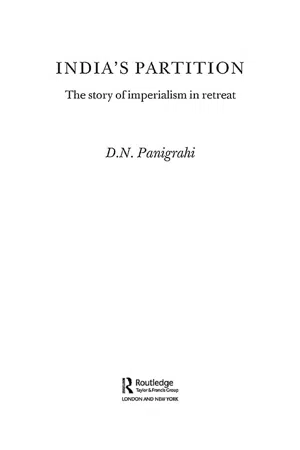
Based on new source material available in both England and India, India's Partition examines the partition in the context of the retreat of the British Empire. The freeing of India from British rule was the result of internal forces in both countries, while the split of the subcontinent along religious lines served as a harbinger for things to come. Panigrahi argues that partition was not a foregone conclusion and was not the favoured option for most of the main parties, but rather was the result of a unique set of circumstances.
An erudite exploration of the highly complex relations between India and Britain leading up to independence and the split, India's Partition looks at the leaders who made far-reaching decisions - and their motivations - during this critical time.
- 400 pages
- English
- ePUB (mobile friendly)
- Available on iOS & Android
eBook - ePub
About this book
1
THE MAKING OF JINNAH
Jinnah’s early life is shrouded in mystery. Jinnah himself was reluctant to speak about his ancestry, parentage, kith and kin, or immediate blood relations. It is not known whether any of his five brothers or his father’s brothers or their relations ever met him in his heyday at the Bar in Bombay or while he was emerging as a distinguished political figure in India or when he actually adorned the highest position in Pakistan, that of the Governor-General of Pakistan. M.C. Chagla, a close associate of Jinnah, who worked as his junior at the Bar for eight years and later served as the secretary of the Muslim League when Jinnah was its president, tells us in his autobiography Roses in December that Jinnah was ‘the uncrowned king’ of Bombay in 1918 and ‘an idol of the youth’.1 But not so, it seems, for his own brothers and sisters – except Fatima, his youngest sister, who kept his house after the death of Ruttie Jinnah in 1928, and remained a constant companion of Jinnah throughout his life until he died in 1948. It appears Jinnah was not fond of maintaining close contact with his family relations nor did he seem to be proud of his ancestry. If anything, he wished to forget his past for ever, as stated by his biographer, Hector Bolitho.2 Like Kemal Atatürk of Turkey, whose biography by H.C. Armstrong, Grey Wolf, An Intimate Study of a Dictator, was purchased and read by Jinnah in London around 1932, Jinnah seemed inclined to break away from the past: ‘Away with dreams and shadows! They have cost us dear in the past’3 Atatürk had said. For many days, Jinnah talked of nothing but Kemal Atatürk to his daughter Dina, who was then 13 years old. Dina, nicknamed her father Grey Wolf.4
Jinnah was neither a diarist nor a great letter writer. No letters of the early days written to his father or others are extant. Some dedicated biographers have attempted to piece together the story of Jinnah’s life through interviews and personal contacts with his close acquaintances. Hector Bolitho’s Jinnah: Creator of Pakistan is a laudable effort which is not only well researched, but is also based on the remiscences and memories of well-known and not so well-known personalities: British, Indians and Pakistanis. Other authors include Syed Sharifuddin Pirzada, whose numerous writings date from 1941 onwards;5 Aziz Beg, Jinnah and His Times6 and M.H. Saiyid, Mohammed Ali Jinnah: A Political Study.7 Several contemporary authors and their writings exist: they are of great research value but they hardly touch upon Jinnah’s personal life, as if it was of no consequence at all in the evolution of his personality or in the making of Pakistan. Authentic stories about Jinnah as a nationalist or a moderate nationalist abound. He was hailed by 1915 as ‘the best ambassador of Hindu–Muslim Unity’ by no less than a great political figure of those days, Gopal Krishna Gokhale; the renowned poet–politician Sarojini Naidu8 said that Jinnah wanted to model himself ‘as Muslim Gokhale’.9
But very few knew that Jinnah’s ancestors were Hindu Rajputs. It is said that the founder of the family hailed from Shahiwal, in the Multan area and settled at Paneli village in the then Gondal state of Kathiawar. Mohammad Ali Jinnah’s grandfather Poonja Meghji had five children; four of them were named Manbai, Valji, Nathoobhai and Jinnahbhai. Nothing is known of the fifth child. Jinnahbhai was born around 1857, and was married to Mithibai in 1874. On displaying exceptional business acumen, he moved to Karachi from Gondal in 1875. The forefathers of Jinnah were Khoja Muslims, who were traders and belonged to the Aga Khan’s Ismaili sect and were Shias. Mohammad Ali Jinnah was the eldest of the children born of Poonja Jinnahbhai and Mithibai. Other children of Jinnahbhai were Rahamat Ali, Maryam, Ahmed Ali, Shireen, Fatima and Bande Ali. All the brothers and sisters of Jinnah remained obscure except Fatima, who it seems qualified as a dentist and devoted her life to the service of her brother Mohammad Ali Jinnah.10
For the first time in his family, Poonja Jinnahbhai, the father of Mohammad Ali Jinnah, discarded the practice of giving Hindu names to his children. Poonja Meghji, the grandfather of Jinnah, had given Hindu names to his children and had followed most of the Hindu religious rituals. It was Poonja Jinnahbhai, father of Mohammad Ali Jinnah, who also dropped the ancient customary Hindu rite of observing Chatti, the sixth day after the birth of the child, when blessings of Hindu deities are invoked after a purificatory bath. And it was Poonja Jinnahbhai who began giving lessons in the Qur’an to his children.11
Jinnah himself did not seem too obsessed with the customs and traditions of those times. He studied in different schools: first in a Muslim madrasa in Karachi; then in a school run by Hindus in Bombay, known as Gokul Das Tej primary school; and finally in the Christian Missionary Society high school in Karachi. He left for London to study for the Bar at the young age of 16. His attitude was quite catholic and pragmatic.
Jinnah’s father was a hide merchant, who became friendly with the English manager of the Graham Trading Company. Through his contacts he was able to extend his business to Hong Kong and other distant places and formed his own company, Jinnah Poonja and Company.12 He and his wife and seven children lived in a modest two-roomed house in a narrow street known as Newnham Road in Karachi.13 According to Sarojini Naidu, Jinnah was the eldest son of ‘a rich merchant . . . reared in careless affluence’.14 All accounts testify to the contrary. Chagla mentions that Jinnah had risen from ‘abject poverty’.15 Jinnah’s humble circumstances and background seems obvious also from the fact that the father did not keep an accurate record of Mohammad Ali Jinnah’s birth. The school register shows his date of birth to be 20 October 1875 but Jinnah himself is on record as having said that he was born on 25 December 1876.16
Although Jinnah was imbued with native intelligence and talent, he did not show much promise in school. He had his schooling in fits and starts. At the Sind madrasa in Karachi he did not feel interested in studies and told his father so. Hence, he was removed and began sharing his father’s tasks at the shop. But this also did not engage his attention. He went to Bombay in 1886 to join Gokul Das Tej primary school, returning to the Sind madrasa a year or so later. Finally, in 1891 he joined the Christian Missionary Society high school at Karachi and studied there until he was about 15.17 On the advice of an English man, Frederick Leigh Craft, who was a fairly well-established Exchange broker in Bombay and Karachi, Mohammad Ali Jinnah was sent to London to obtain some training in office management and trading practices. He sailed for London at the age of 16 in 1892 to work in the head office of the Graham Trading Company, but disliked working there and joined Lincoln’s Inn to study law.18
Once in London, Mohammad Ali Jinnah was a totally transformed person. For four years he burnt the midnight oil to equip himself for the profession of his choice. He needed to work hard not only to master the foreign language but also to immerse himself in the study of law. Without any connections, without ample means at his command and in unfamiliar and cold surroundings, he braced himself to face the challenges all by himself at the young age of 16. He refused to be tempted by the pleasures and frivolities of London life; he did not have the means to indulge in them. Still in his teens he became his own master, studying hard and acquitting himself with credit. First, he cleared the preliminary test essential for admission to Lincoln’s Inn. Thereafter with single-minded devotion he absorbed himself in his studies, passing the Bar examination in two years. The next two years were needed ‘to eat’ the dinners before being called to the Bar. He became barrister-at-law at the young age of 20. He was perhaps the youngest Indian to achieve this feat. He was bound to be proud, and justifiably so, of his proven qualities of intellect and expertise.
He returned to India as a barrister in 1896 starting his practice in Karachi. But he found the city too provincial and crossed over to the metropolitan city of Bombay registering himself as an advocate of the high court on 24 August 1896.
For three years, Jinnah had no briefs. Meanwhile, his father died in penury losing his business. Sir John Molesworth Macpherson, the acting advocate-general of Bombay, was kind enough to allow him to work in his chambers. In 1900, Sir Charles Ollivant, the member in charge of the judicial department of the Bombay government, offered him a job with a monthly salary of 1500 rupees, but he declined the offer saying that it was his ambition to earn that much in a day.19 Jinnah must have been grateful to the Englishman for trying to be of help in times of distress, but only he could have refused such an offer, especially as his finances were desperate.
Once he got going, Jinnah made a fortune in no time. At the Bombay Bar, every one of his contemporaries and juniors – Sir Chimanlal Setalvad, M.R. Jayakar, Justice Sir Hira Lal Kania, Motilal C. Setalvad, M.C. Chagla included – is on record praising Jinnah as an exceptional advocate. He read his briefs methodically and with great care, was logical and persuasive in his arguments, ‘fought like a tiger’ on behalf of his clients, and won most of the cases.20 He was not a great jurist or a lawyer or a law maker, but his gift of the gab and his superb advocacy took Jinnah to the highest rung of the ladder among the members of the Bar in Bombay.21 We shall revert to this subject later. Suffice it is to say that he fought for the Pakistan demand with equal zeal, advocated his case for Pakistan in clear-cut, unambiguous language and demolished the arguments of the Congress leaders with cold logic. Uncompromising, remorseless and contemptuous of all opposition, he impressed the British, who felt he had won the day for the cause he so eloquently and convincingly espoused. That was Jinnah of the 1940s.
The behaviour pattern of Jinnah, however, until the 1920s was marked by suavity, amiableness, understanding and liberalism. Trained as a barrister, he modelled himself as an English gentleman in his personal lifestyle, dress and mannerisms. Jinnah’s attitude to politics as well as in personal affairs was liberal, eclectic, catholic and pragmatic. B. Shiva Rao, an eminent journalist and a close associate of liberals, records an incident of 1917 which reflects on Jinnah’s openness of mind even in matters relating to Hinduism. Jinnah was then president of the Home Rule League in Bombay. When Annie Besant was interned by the British government for her political activities on behalf of Home Rule, Jinnah called a meeting to consider Gandhi’s proposal to march with a band of volunteers from Madras to Ootackamund, a distance of 350 miles, to force the government to release her. At the meeting, B.G. Horniman, editor of the Bombay Chronicle (an Englishman), Syod Hussain, Jamnadas Dwarkadas, Omar Sobhani, Shankerlal Banker and B. Shiva Rao were present. Tilak was invited but he arrived late. In the meantime, Jinnah was heard explaining to Horniman that ‘the sect among the Muslims to which he belonged believed in the ten avatars and had much in common with Hindus in their inheritance laws and social customs’. Those present at the meeting rejected Gandhi’s proposal and agreed with Tilak who said that it was quite impractical.22
Another incident of some significance may be related. Jinnah, as a member of the Central Legislative Assembly, was also a member of the Muddiman Reforms Committee, Other members were Sir Tej Bahadur Sapru, Sir Sivaswamy Aiyar and Dr R.P. Paranjpye. Jinnah used to walk over to Metcalfe House in Delhi where Sir Tej was staying. After dinner, they would discuss the draft of Sir Tej. One evening, Jinnah said: ‘Sapru, I think I have a solution for the Hindu–Muslim problem. You destroy your orthodox priestly class and we will destroy our Mullahs and there will be communal peace.’23 Jinnah was a staunch nationalist and liberal then. The minority report of the Muddiman Committee was the handiwork of the liberals, named above, who sought acceleration of the pace of reform for self-government in the provinces and at the centre.
Jinnah’s marriage and attitude towards Hindus
Jinnah’s marriage to Ruttie Petit, daughter of Sir Dinshaw Petit, caused a sensation in Bombay. It was the talk of the town for months. Ruttie was beautiful, charming and graceful; a socialite and the spark of Bombay’s elite. Jinnah was one of the most eligible bachelors; tall, slim, handsome, rich with a roaring practice at the Bar, and, as Chagla put it, ‘was an uncrowned king of Bombay’. In 1918, when the marriage was solemnized, Ruttie was barely 18 but she was educated, well-read and loved English literature, especially romantic poetry. She came from a modern, highly sophisticated, well-known distinguished Parsi family of Bombay. The Parsi community had given to India great patriots and politicians like Dadabhai Naoroji, Sir Pherozeshah Mehta, Sir Dinshaw Wacha and a host of others who were equally prominent in in...
Table of contents
- Cover Page
- Title Page
- Copyright Page
- Illustrations
- Maps
- Series Editor’s Preface
- Acknowledgements
- Abbreviations
- Glossary
- Introduction
- 1 The Making of Jinnah
- 2 Storming the Muslim League
- 3 The Second World War, the Conservatives and the Muslim League
- 4 The Pakistan Resolution and Gandhi–Jinnah Dialogue
- 5 The Cripps Offer, 1942
- 6 Quit India and the Aftermath
- 7 From Simla Conference to Partition
- 8 Concluding Remarks
- Biographical Data
- Bibliography
Trusted by 375,005 students
Access to over 1.5 million titles for a fair monthly price.
Study more efficiently using our study tools.
Frequently asked questions
Yes, you can cancel anytime from the Subscription tab in your account settings on the Perlego website. Your subscription will stay active until the end of your current billing period. Learn how to cancel your subscription
No, books cannot be downloaded as external files, such as PDFs, for use outside of Perlego. However, you can download books within the Perlego app for offline reading on mobile or tablet. Learn how to download books offline
Perlego offers two plans: Essential and Complete
- Essential is ideal for learners and professionals who enjoy exploring a wide range of subjects. Access the Essential Library with 800,000+ trusted titles and best-sellers across business, personal growth, and the humanities. Includes unlimited reading time and Standard Read Aloud voice.
- Complete: Perfect for advanced learners and researchers needing full, unrestricted access. Unlock 1.5M+ books across hundreds of subjects, including academic and specialized titles. The Complete Plan also includes advanced features like Premium Read Aloud and Research Assistant.
We are an online textbook subscription service, where you can get access to an entire online library for less than the price of a single book per month. With over 1.5 million books across 990+ topics, we’ve got you covered! Learn about our mission
Look out for the read-aloud symbol on your next book to see if you can listen to it. The read-aloud tool reads text aloud for you, highlighting the text as it is being read. You can pause it, speed it up and slow it down. Learn more about Read Aloud
Yes! You can use the Perlego app on both iOS and Android devices to read anytime, anywhere — even offline. Perfect for commutes or when you’re on the go.
Please note we cannot support devices running on iOS 13 and Android 7 or earlier. Learn more about using the app
Please note we cannot support devices running on iOS 13 and Android 7 or earlier. Learn more about using the app
Yes, you can access India's Partition by Devendra Panigrahi in PDF and/or ePUB format, as well as other popular books in History & British History. We have over 1.5 million books available in our catalogue for you to explore.