- 216 pages
- English
- ePUB (mobile friendly)
- Available on iOS & Android
eBook - ePub
About this book
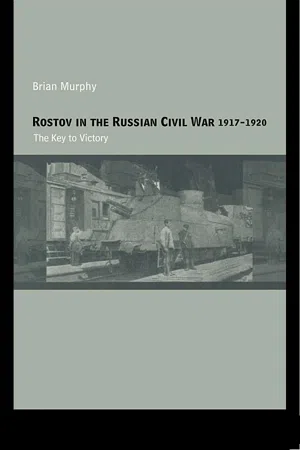
These documents were collected from the archives in Rostov-on-Don, and this book makes them available for the first time in print. Since becoming freely accessible Soviet archives have provided a rich source for understanding the hopes, fears and strivings of the Russians during the greatest crisis in their history. Both Reds and Whites realized Rostov's vital strategic importance, and the city changed hands six times between 1917 and 1920. These newly published personal stories fill out the social background to its complex mix of classes and nationalities. They convey the daily experience of life in the streets, and the perils faced by either side when changing fortunes forced them to escape across the River Don.
Over the last century the slogans of the Revolution have become stale for us. But if we seek to understand the spirit of those years we must remember that these beliefs gave fresh hope to many individuals, presenting a cause for which they were prepared to endure great suffering, and even to sacrifice their lives. Perhaps the passionate enthusiasm of these revolutionaries may give us some insight into the psychology of young men and women who are called 'terrorists' today?
1
1917: THE TSAR OVERTHROWN
The Provisional Government struggles against Germany
In 1914, Russia had a fast developing economy, but the country was still a weakling when compared to the industrial and military might of Germany. The old Russian Empire was primitive, corrupt and incompetent. The Tsar was completely incapable of dealing with the problems which the war brought to his country, and he had made a disastrous decision to take personal command of the Russian army. The immediate cause of his downfall was the lack of bread supplies in the capital, but by February 1917, the mass of the people were impatient to see an end to the Tsarist regime.
Russia’s Social Democrat Party believed in overthrowing the capitalist system by violent revolution. In 1903, the Social Democrats split into two factions, whose differences proved to be irreconcilable. The majority at the London Congress took their name ‘Bolshevik’ from the lucky chance that they were in the majority on that particular occasion, pushing for revolution at the first possible opportunity. More Social Democrats may well have thought like the Ménsheviks that Russia’s economy should first be allowed to grow under capitalism until it was sufficiently advanced to provide an industrial base for the Socialist state they wanted to introduce. But it was a fatal mishap for them that they had not enough supporters in London in 1903, and hence found themselves saddled with the uninspiring name of ‘Minority Party’. As the dominant voice among the Bolsheviks, Lénin was quite determined that there should be no attempt to unite the Social Democrats by compromising with Ménsheviks.
In 1917, active and educated Bolsheviks were a tiny number counted against the whole Russian population. But they played their hand very skilfully, by ensuring that they took over in the two main centres Petrográd and Moscow (to avoid its German connotations St Petersburg was renamed Petrográd from 1914, and held this name for 10 years until it became Leningrád in 1924). The Bolsheviks could see they had little chance of consolidating their power through elections to the Dúma, and coined the slogan ‘All power to the Soviets’. Soviets (literally meaning ‘Councils’) were set up in the large industrial centres, and therefore contained a larger proportion of Social Democrat supporters. Over the next two years the Bolsheviks marginalized the other parties in the Soviets, then vilified and expelled them as traitors to the working class. Lénin knew that the Constituent Assembly would have a majority from the Socialist Revolutionary Party, and would thus promote the interests of the peasants rather than the industrial workers in the cities. To prevent this, the Bolsheviks used armed strength to close the Constituent Assembly after its first day’s meeting in January 1918.
In Petrográd, February 1917 brought a popular revolution, when masses of people came out on the streets to free Russia from the autocracy of Nicholas II. The Tsarist regime was replaced by the Provisional Government, which struggled to continue the war against Germany. During their seven months of troubled existence the more moderate democrats were constantly under threat of a coup from left or right—the Soviets wishing to establish a workers’ state, whereas right wing nationalists were trying to bring back a more autocratic regime. In October 1917, Lénin’s Bolsheviks seized power in Petrográd. The whole history of the twentieth century was determined by Russia’s Civil War 1917-21. The victory of the Bolsheviks presented the world with its first Communist state.
The Russians were still using Old Style dates that had been superseded in the rest of Europe by the Gregorian calendar. In the twentieth century, the old calendar was 13 days behind the normal Western dates. In Russia even the Bolsheviks continued to use the old calendar till February 1918, so that Soviet historians generally referred to the Bolshevik Revolution as ‘Red October’, (albeit New Style dating brought the official celebrations to 7 November). It was symptomatic of the Whites’ rejection of any reform that they clung to the Old Style dates throughout the Civil War.
Importance of Rostóv-on-Don
Both Reds and Whites recognized the crucial strategic importance of the city. Bitterly contested, Rostóv changed hands no less than six times, falling to the Red Army in January 1920, before the Whites broke back in February to bring brief chaos and panic to Soviet administration in the city.
The River Don was a major feature in the landscape where Russia’s future was determined in the decisive battles of 1919. All strategy had to include moving large bodies of men across its wide stream, which made a great arc to the east before swinging towards the Sea of Azóv.
Rostóv is on the north bank of the river at the lowest crossing point before the Don opens into its delta, some 46 km above the open water. In winter, the Don is frozen hard with severe low temperatures down to -20°C, and thick ice also forms on the Sea of Azóv, since it contains a large proportion of fresh water brought down by the rivers.
Rostóv is on the north bank of the river at the lowest crossing point before the Don opens into its delta, some 46 km above the open water. In winter, the Don is frozen hard with severe low temperatures down to -20°C, and thick ice also forms on the Sea of Azóv, since it contains a large proportion of fresh water brought down by the rivers.
The River Témernik flows into the estuary from the north. Peter the Great made a dock there to build the ships, which he was sending against the Turkish fortress of Azóv, captured by the Russians in 1696. Rostóv was founded in 1761, and a shipyard was built in 1782 on the Témernik.
Towards the end of the eighteenth century, Catherine the Great brought Armenians to make a settlement to the east along the north bank of the Don. This centre was named Nakhicheván’ after the Armenian town near the frontier with Iran. As Rostóv grew it became part of the Rostóv-Nakhicheván’ conurbation, with the 1912 census showing a population of 199,200.
Towards the end of the eighteenth century, Catherine the Great brought Armenians to make a settlement to the east along the north bank of the Don. This centre was named Nakhicheván’ after the Armenian town near the frontier with Iran. As Rostóv grew it became part of the Rostóv-Nakhicheván’ conurbation, with the 1912 census showing a population of 199,200.
Three railway companies had lines which intersected at Rostóv. The port expanded into a major trading centre, and in 1913 was handling over two million tons of cargo. On this scale, Rostóv ranked as the third largest port in European Russia. It was the nearest point for exporting grain from the fertile black earth steppes of the Don, so that wheat and other cereals formed the main part of its cargoes. Coal from the Donéts Basin was exported by one of the larger shipping lines, owned by a rich Cossack, Kóshkin. Financial misfortunes forced him to close the business in 1905, but in his more prosperous years his ships had ranged out into the Black Sea, and his firm opened branch offices as far afield as Sevastopol’, Odéssa and Batúmi.
A factory making nails dammed the Témernik to draw water from it, and other firms dumped their waste into the river. It became so befouled and stinking that in 1916 the local authority felt they must pour several barrels of carbolic acid into it to cut down the risk of infection. For many years, both Rostóv and Novocherkássk suffered from their inadequate water supply. This posed a grave risk to health, and brought outbreaks of cholera. Fire was always a threat in towns with so many wooden buildings. In the newspaper reports on ‘Daily life (May to July 1918)’ the Chief of Rostóv Fire Brigade warns the City Council of the danger, which was still serious, because it had been difficult to control two recent fires.
The section on railway workers evokes the difficulties the Red Guards faced in May 1918 when they were driven out of Rostóv. In January 1920, as the Red Army recaptured the city the rail bridge across the Don became the lifeline along which the defeated garrison must escape. To close the book I have used the memoirs of Aten and Sergéy Mámontov, who write vividly of the disasters suffered by the Whites as they retreated south.
Before quoting from documents produced in the heat of the Civil War I have thought it useful to open with an appraisal of Rostóv, written by a young Englishwoman. Early in 1917, Rhoda Power travelled there to teach English to a 16-year-old girl in one of the rich families in the city (for Rhoda Power, see the section ‘Persons mentioned’). First, I would like to give some explanation of two groups that Rhoda Power singles out for special mention. She writes:
Jews
When I had been there for some weeks I realized that there were more Greeks, Armenians and Jews than Russians and Cossacks, and that society was divided into numberless cliques. The Jews, many of whom were said to have become rich since the outbreak of the European War, were admitted into society, but were considered ‘outsiders’, and invited to few of the big social functions. For an Englishwoman, accustomed to freedom of opinion and toleration regarding religious sects, the attitude of the Russian bourgeoisie and peasantry towards the Jews was amazing. The peasants quite frankly hated them and made no bones about it. If one mentioned a Jew by name they used to spit on the ground (Power, 1919:14).
What Rhoda Power has noted was a major feature through the whole of southern Russia, and I have given it some prominence in the two pieces on anti-Semitism, which follow the sections on ‘Daily life’. From 1881 Jews had been forbidden to reside in the main centres of European Russia. The Tsarist regime did little to protect them from massacres and the destruction of their shops, even at times encouraging anti-Jewish pogroms (see stories such as Isaak Babel’s The Story of my Dovecote and Shólokhov’s Quiet Flows the Don, part 8, chapter 16).
The British committed few armed forces to Russia, but they sent large quantities of equipment, uniforms and other stores, most of which were pilfered by unscrupulous officials in the rear, so that little reached the White units at the front for whom they were intended. Along with military equipment, Britain also sent a few officers to advise the Russians on how to use their guns and tanks. One of these artillery officers was Brigadier H.N.H.Williamson, who became quite disillusioned by the slackness of Deníkin’s Volunteer Army. In contrast he singles out the Jews as an honourable exception.
The only bright spot in all the apathy and inefficiency threw a very strong light on one of the most vexed questions regarding social conditions in Russia. That was the keenness, efficiency and persistence in demanding help and advice, displayed by the Jewish doctors, of which there were always one or two in each medical unit. This was the only capacity in which Jews were allowed to serve. It would be simpler to let the Jews run Russia. They seem to be the only people competent to run anything (Williamson, 1970:196-7).
Cossacks
Rhoda Power’s memoirs are entitled Under Cossack and Bolshevik, and we should explain something of the history of the Cossacks. For references throughout this book, see the ‘Select bibliography’. Brief personal details on Rhoda Power are included in the section ‘Persons mentioned’.
From the sixteenth century many courageous serfs had escaped from their masters and fiercely defended their independent Cossack societies. They were living round the frontiers of the Russian Empire, and were settled in 12 so-called ‘Hosts’ (voyská). The Don Vóysko was the largest, counting 1,427,000 Cossacks in 1912. When the Whites were in power, Rostóv came under the rule of the Don Cossacks with their capital in Novocherkássk. In the early centuries of their history the Cossacks formed a circle for meetings, where any man who wanted to express his views could step into the centre of the circle and speak his mind. As numbers grew they went over to a crude form of representative government, but the Cossack ‘parliament’ always retained the name of ‘Great Circle’ (Bol’shóy Krug).
The Don Vóysko was divided into a number of local administrative centres (stanítsy). The smaller villages elected their own Atamán, and a more powerful Atamán was elected over the whole stanítsa. In general, Cossacks had only an outsider’s view of life in the big urban centres and they had difficulty understanding the rudiments of politics. Even after two years of Civil War many Cossacks thought that they should fight for ‘the Bolsheviks’ against ‘the Communists’ (fearing that Communists might collectivize their land). They had failed to grasp that, by 1919, the Bolsheviks held a monopoly of power in the Social Democrat Party, having suppressed the Ménsheviks, the Socialist Revolutionaries, the Constitutional Democrats and any other party. [Holquist (2002:130-202) gives a good account of political cross-currents in the Don Cossack territory.
On the other hand, people living in Central Russia had no idea of how Cossack society functioned. Any Russian with liberal tendencies saw them as a military caste, who might almost be regarded as a sub-human species. Mutual misunderstanding was turned to fierce hostility when the Tsarist government used the Cossacks as a force to disperse popular demonstrations and connived at their pogroms against the Jews. Russians of all classes feared and distrusted them. Many well-minded people thought of them as no better than a race of cruel savages, opposed to any attempt to reform the Tsarist regime and determined to reverse everything achieved by the revolutions of 1917.
On 30 June 1917, General Kalédin was elected as Atamán of the Don Vóysko. The Atamán was nominally elected by all adult Cossacks, but under the Tsars he had been appointed by the St Petersburg government. The point is often made that General Kalédin came to power as the first Atamán to be elected by a majority of Cossacks.
However, it must be remembered that he was voted in only by the older generation of his people, by those men who had remained at home, being past the age for active service against the Germans. Cossacks fighting in the First World War felt strongly that they did not want to return to the old patriarchal society. When these younger men came back from the front they voted for more left-wing leaders and defiantly refused to work under Kalédin. Holquist (2002:122–32) gives a good account of the Cossacks’ ambivalent attitude to the Soviets.
However, it must be remembered that he was voted in only by the older generation of his people, by those men who had remained at home, being past the age for active service against the Germans. Cossacks fighting in the First World War felt strongly that they did not want to return to the old patriarchal society. When these younger men came back from the front they voted for more left-wing leaders and defiantly refused to work under Kalédin. Holquist (2002:122–32) gives a good account of the Cossacks’ ambivalent attitude to the Soviets.
The Cossacks liked to think of themselves as strong Russian patriots, but in practice they did not want to be too much under central control. After the armistice with Germany, as a price for giving further assistance, the British insisted on a single Supreme Commander for all the anti-Bolshevik forces in South Russia. It was only with the greatest reluctance that on 26 December 1918 Atamán Krasnóv finally agreed to place himself under Deníkin’s overall strategy. Even then the Don Cossacks insisted that their Vóysko must operate as a self-contained unit.
Bolshevik policy towards the Cossacks fluctuated between trying to win them to the side of the Revolution, alternating with unsparing and brutal repression. In the White advance of 1919, most Cossacks were operating on the right flank of Deníkin’s Volunteer Army, but a minority sided with the Reds (mainly men from the poorer areas north of the Don). The Red Army’s most famous unit was the 1st Cavalry Army, commanded by Budyónny. The 1st Cavalry was created in 1919 in response to Trotsky’s call Proletarians to horse’, aiming to recruit enough mounted units to face up to White cavalry under commanders such as Shkuró and Konstantín Mámantov. In March 1920, when the Volunteer Army were forced to embark from Novorossísk most of the Cossacks left on shore joined Budyónny (cf. Grigóri Mélekhov in Shólokhov’s novel Quiet flows the Don). Before the Whites had to evacuate their men from Novorossísk, 1st Cavalry had contained only a small proportion (some 14 per cent) of Don Cossacks.
In 1920, Vrángel’ also had to contend with the 2nd Cavalry Army under Colonel Mirónov. But, hardline Party members always feared that Cossacks might demand more autonomy, and this suspicion led to Mirónov’s imprisonment and death.
Much Cossack support was given to the idea of a Southeast Federation, to be formed from the three largest voyská—on the Don, the Kubán’ and the Térek. In July 1918, Krasnóv had written to the Kaiser proposing a similar scheme, which the Germans might well have instituted if they had won the war. On the Allied side Churchill was sympathetic to some sort of Cossack state, which he saw as a counterbalance to a revitalized Russia. The Cossacks sent a mission to the Versailles Conference, but by 1919 their desire for independence was impractical in view of the Red Army’s overwhelming superiority.
Any idea of such an independent state ran directly against the aim of Deníkin’s Volunteer Army to reconstitute their country as a ‘single and indivisible Russia’. This ambition cost the Whites dear, for it deprived them of support from many potential allies, who might have aspired to some degree of local autonomy. Deníkin’s blind insistence on a centralized state led to bitter quarrels with many Cossacks, and ended in an open rupture with the powerful Vóysko in the Kubán’.
Rhoda Power’s memoirs
The young English governess arrived in Rostóv shortly before the February Revolution. The Sabárovs’ house was on Bol’sháya Sadóvaya, still the city’s main street, which runs 4km east-west parallel to the Don. From the end of ...
Table of contents
- COVER PAGE
- TITLE PAGE
- COPYRIGHT PAGE
- ILLUSTRATIONS
- PREFACE
- ACKNOWLEDGEMENTS
- 1. 1917: THE TSAR OVERTHROWN
- 2. 1918: AFTER THE OCTOBER REVOLUTION
- 3. 1917: PARTY POLITICS
- 4. 1918: DAILY LIFE
- 5. 1918–1919: RAILWAYS AFTER THE WHITES HAVE TAKEN ROSTÓV
- 6. TERRORISM FOR A BETTER WORLD
- 7. 1920: RED VICTORY
- SUMMARY OF EVENTS
- GLOSSARY
- PERSONS MENTIONED
- SELECT BIBLIOGRAPHY
Trusted by 375,005 students
Access to over 1.5 million titles for a fair monthly price.
Study more efficiently using our study tools.
Frequently asked questions
Yes, you can cancel anytime from the Subscription tab in your account settings on the Perlego website. Your subscription will stay active until the end of your current billing period. Learn how to cancel your subscription
No, books cannot be downloaded as external files, such as PDFs, for use outside of Perlego. However, you can download books within the Perlego app for offline reading on mobile or tablet. Learn how to download books offline
Perlego offers two plans: Essential and Complete
- Essential is ideal for learners and professionals who enjoy exploring a wide range of subjects. Access the Essential Library with 800,000+ trusted titles and best-sellers across business, personal growth, and the humanities. Includes unlimited reading time and Standard Read Aloud voice.
- Complete: Perfect for advanced learners and researchers needing full, unrestricted access. Unlock 1.5M+ books across hundreds of subjects, including academic and specialized titles. The Complete Plan also includes advanced features like Premium Read Aloud and Research Assistant.
We are an online textbook subscription service, where you can get access to an entire online library for less than the price of a single book per month. With over 1.5 million books across 990+ topics, we’ve got you covered! Learn about our mission
Look out for the read-aloud symbol on your next book to see if you can listen to it. The read-aloud tool reads text aloud for you, highlighting the text as it is being read. You can pause it, speed it up and slow it down. Learn more about Read Aloud
Yes! You can use the Perlego app on both iOS and Android devices to read anytime, anywhere — even offline. Perfect for commutes or when you’re on the go.
Please note we cannot support devices running on iOS 13 and Android 7 or earlier. Learn more about using the app
Please note we cannot support devices running on iOS 13 and Android 7 or earlier. Learn more about using the app
Yes, you can access Rostov in the Russian Civil War, 1917-1920 by Brian Murphy in PDF and/or ePUB format, as well as other popular books in History & 20th Century History. We have over 1.5 million books available in our catalogue for you to explore.