eBook - ePub
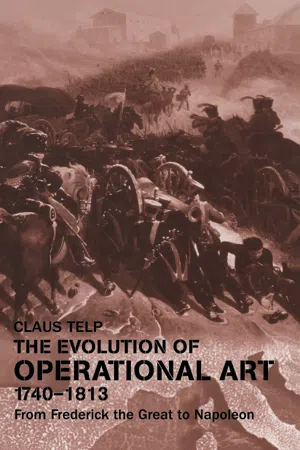
The Evolution of Operational Art, 1740-1813
From Frederick the Great to Napoleon
- 240 pages
- English
- ePUB (mobile friendly)
- Available on iOS & Android
eBook - ePub
About this book
Operational art emerged from the campaigns of Frederick the Great to the end of the Napoleonic Wars. It was the result of three dynamic interrelationships: between military and non-military factors such as social, economic and political developments; between military theory and practice; and between developments in military theory and practice in France and Prussia.
In the period 1740-1815 a major change in the complexity of warfare took place. This was reflected by an increase in the complexity of the analysis of warfare via the introduction of the operational level between the strategic and tactical levels.The evolution of operational art, driven by these three dialectical processes, evolved in stages. In the first stage, Revolutionary France had experimented with operational art though with limited success. Then, Napoleon had used it with remarkable success against an adversary clinging to outdated modes of warfare and organisation. In the final stage, Napoleon's operational art was successfully challenged by the Prussian brand.
1
MILITARY THEORY AND
PRACTICE: 1740–1791
This chapter will provide a background for the evolution of operational art. It will be shown how the interrelationship between military and non-military factors provided the Prussian army with superior military effectiveness and efficiency. It will be demonstrated how even superior military performance could not deliver the decisive victory which Frederick was pursuing.1 Also, the impact of military theory on military practice and vice versa will be demonstrated, with particular reference to French military reforms after the Seven Years’ War. Finally, it will be shown how French military reformers created operational instruments as well as operational theory guiding their use, which would help to overcome those limitations in warfare which had denied Frederick decisive victory in battle.
First, the military theories preceding the Seven Years’ War shall be discussed to provide a theoretical background of Frederician warfare. Saxe, Santa Cruz and Frederick himself were three of the most eminent military theorists of this period.
A discussion of their theories will become relevant in the light of developments discussed in the following chapters. The following section will discuss the practice of Frederician warfare. The third section presents the French conduct of war. The fourth section is concerned with military theory after the Seven Years’ War. The last two sections deal with the French and Prussian armies between the end of the Seven Years’ War and the French Revolution.
A discussion of their theories will become relevant in the light of developments discussed in the following chapters. The following section will discuss the practice of Frederician warfare. The third section presents the French conduct of war. The fourth section is concerned with military theory after the Seven Years’ War. The last two sections deal with the French and Prussian armies between the end of the Seven Years’ War and the French Revolution.
Military theory: 1740–1763
Saxe considered the art of war to be divisible into two parts, the soldier’s trade and generalship. At the lower level of the art of war, warfare was simply a trade that could be learned by everybody. At the higher level, warfare was an art which required genius to use the military instrument in the most perceptive and subtle way.2
Regarding the nature of the army, Saxe recommended universal military service without consideration of rank or birth as a means to furnish a huge reserve, to raise the prestige of soldiering and to invigorate the whole nation with a martial spirit.3 The field army itself, however, should not number more than 50,000 men since an army larger than that could not be effectively controlled.4 He considered the quality of the troops more important than the quantity because it took several years to train a fully effective soldier.5 In spite of his emphasis on drill and training, Saxe did not consider the soldier a machine. He realized that soldiers were human beings with all their weaknesses but also strengths. In order to bank on the latter, the commander should appeal to the sense of honour of his men.6
Regarding the conduct of campaigns, Saxe wished to make armies more self-sufficient in supply in order to increase speed and flexibility. He recommended a well-organized system of levying contributions in occupied areas, which would liberate the army of the shackles of rear supply. He also suggested harvesting grain on the fields in order to grind it to flour.7 Taking into account that contemporary armies still were dependent on rear supply, Saxe suggested beating the enemy by severing him from his supplies. He went so far as to say that a great commander could win a campaign without fighting a battle.8 This statement should not be taken at face value. Saxe fought battles willingly and with good success. His statement has to be seen in the light of his opposition to Folard, who was rather too fond of battle for Saxe’s taste.9 Relying on the protection provided by fortresses, he suggested beginning the campaign late in the year when the enemy would already have exhausted himself in marches and sieges.10
Regarding the conduct of battle, Saxe favoured the abandonment of linear tactics based on firepower. He preferred deep formations advancing with cold steel, supported by infantry using accurate fire at will. In order to effectively combine these two elements in the attack and defence, Saxe invented a novel tactical formation, the ‘legion’, an all-arms formation integrating cavalry, light and heavy infantry, and light support artillery. It was no coincidence that Saxe called these combined formations ‘legions’. Military theorists of this period generally dwelled much on the Roman example, embodied in the works of Vegetius, Polybius and Caesar. The weaponry envisaged for the legions also had the Roman touch: heavy infantry should carry bullet-proof shields and helmets; half of them should be armed with pikes. Cavalry should be armoured and rely on the lance. His proposals to use breechloading muskets and ultra-light artillery, the latter replacing the cumbersome field artillery, for accurate long-range fire support took more advantage of contemporary weapon technology. The legion would be self-contained and manoeuvre on its own on the battlefield as well as in the theatre of war. Once the enemy was beaten, Saxe considered pursuit with a token force sufficient for the duration of a day.11
Frederick had much in common with Saxe in terminology. He called the lower level of the art of war petite service, concerned with discipline, drill, tactical formations and recruitment. The higher level of the art of war was called connais-sances du général, dealing with campaign plans, conduct of battle and sieges. Frederick also used the term ‘tactics’, but this was hardly defined and served as a catch-all term for all military endeavours ranging from battles to campaigns.12 An awareness that warfare in this period was waged on two levels, the tactical and the strategic level, was not to be found in Frederick’s or anybody else’s works. The distinction between the two levels of the art of war only remotely reflected an understanding of the tactical and the strategic levels.
Regarding army composition and discipline, Frederick, like Saxe, valued a small, controllable army of high quality more than a large, uncontrollable army of inferior quality.13 Rather than having recourse to universal conscription, as Saxe suggested, he preferred using mercenaries. In order to turn these into reliable soldiers, he believed that they had to be subjected to strict discipline and drill. Obedience had to rule from private to general.14 Nonetheless, like Saxe, Frederick recognized that positive elements of motivation such as personal honour, esprit de corps and the commander’s charisma could bolster morale.15 In this context, Frederick regarded the role of the officer as central. A brave colonel would make a brave regiment. Since he believed only nobles to have the necessary sense of honour and martial spirit, officers had to be noblemen. Frederick further specified that the officer had to be wholly devoted to service, which included a responsibility for increasing his professional knowledge by study. Since he deemed professional knowledge particularly important for staff officers, they had to hold their positions in permanence in order to gain experience.16
In regard to the conduct of war, Frederick stressed that wars had to be short and brisk because Prussia’s modest resources would be quickly exhausted.17 This implied that the Prussian army had to act aggressively, irrespective of the relative strength of the antagonists. Frederick warned against deep penetrations of enemy territory, since these pointes would founder on supply problems. If enemy territory ought to be invaded, he recommended advancing slowly and deliberately, taking one fortress after another.18
Since Frederick regarded considerations of supply as supremely important for the conduct of the campaign, he discussed petite guerre, the war of ambushes and snatch attacks on communications.19 Like Saxe, Frederick held that the aim of the commander should be to cut off the enemy’s supply and destroy his army by hunger rather than by the sword. This statement, echoing Vegetius, contradicted Frederick’s usual preoccupation with battle and was not reflected in his practice.20 Frederick occasionally expressed ideas which were contradicted by his actions. He disapproved, for instance, of winter campaigns since they would ruin the army. Yet, he conducted winter campaigns in 1740, 1742 and 1744–1745.21
Regarding the conduct of battle, Frederick, possibly inspired by Vegetius, developed the oblique order by which he hoped to beat an enemy three times more numerous. In spite of this optimistic assumption, he stressed the importance of concentrating all available troops for battle. Like Saxe, Frederick discounted the effect of unaimed volleys and called for the advance of infantry with muskets shouldered. Though Frederick did not suggest novel formations such as the ‘legion’, Frederick, like Saxe, called for improved cooperation among the arms.22 Unlike Saxe, Frederick recognized the importance of pursuit. The pursuit was to be conducted by the bulk of the army for several days. He realized, however, that the exhaustion of the troops and supply problems would make this hard to achieve.23
With regard to the conduct of war, Santa Cruz suggested remaining on the defensive if the army was inferior, and taking the offensive when it was superior in numbers, whereas Frederick was prepared to take the offensive in any case. In offensive warfare, Santa Cruz, like Frederick, suggested a deliberate advance, leaving no enemy fortress behind. In defensive warfare, Santa Cruz suggested relying heavily on the use of fortified camps and fortresses.24
With regard to battle, Santa Cruz presented a long list of reasons for fighting a battle. Occasions of this kind were the relief of a besieged fortress, the expulsion of an invader, the control over contested territory in order to devour its resources, the preparation of a siege, the opportunity of beating enemy armies separately, and others. The list of reasons for refusing battle, however, was much longer. Santa Cruz took his caution so far that he advised the commander not to fight without the express permission of his sovereign as well as the consent of a council of war.25
Santa Cruz’s caution with reference to battle becomes understandable taking into account that he believed that battle could and often would decide the outcome of war: a strange notion which did not reflect the military experience of this period. Possibly, he was influenced in his belief by Vegetius.26 Santa Cruz was equally cautious with regard to pursuit. He advised a careful pursuit since the enemy might ambush his pursuers.27
Military practice in Prussia: 1740–1763
The strategic level
Prussian war aims and strategy changed in the course of the three Silesian Wars from territorial expansion in the first two wars to the survival of Prussia as a great power with the Hohenzollern dynasty at its head in the Seven Years’ War.28
Frederick had to wage war simultaneously against three other major powers and a number of smaller powers. Since Prussia enjoyed no protection either by a fortress belt like France or by strategic depth like Austria and Russia, the multiple onslaught could only be stopped by the Prussian army in battle. Therefore, attempting to fight decisive battles, and forcing one enemy after the other to withdraw from the war, answered best Frederick’s interests.29
The high stakes in this war, the imperative to raise and maintain an army equal to the military threat and the scarcity of Prussian manpower and resources forced Frederick to mobilize his country for war to the utmost degree. In addition, Frederick’s battle-seeking strategy made a high degree of mobilization even more urgent, since frequent combats would tear gaps into the Prussian ranks and call for numerous replacements. Furthermore, efficient administration permitted not only exhaustive but also rapid mobilization, which helped Frederick to occupy key strategic territory such as Saxony at the outset of hostilities.30
Frederick was able to mobilize the necessary quantity of men and material because Prussia’s social and economic structures were designed to sustain Prussian military power. Economic policy ensured that the army’s material needs were fulfilled and as much revenue as possible filled the war chest. In this context, Frederick made considerable strides towards industrialization. The army, in turn, helped the economy since soldiers were a source of cheap labour. Agriculture received military assistance as the army gave artillery horses to farmers in times of peace. This served both army and farmers: the army did not need to feed the horse in peacetime, and the farmer had a strong farm animal at his service. Another example of interlocking economic and military arrangements was the grain magazines: when grain prices were low, magazines would fill their stocks. When grain prices were high, thus making life difficult for recipients of fixed wages such as soldiers and labourers, magazines sold stocks and pushed prices down again.31
Social policy also played its part. Townspeople were exempt from service but they had to provide billets and forage and pay taxes for the war effort. The peasantry not only paid taxes and rendered ancillary services, many of them also had to serve in the army. This service obligation was due to the canton system, which required each regimental district to apply selective conscription in order to fill the regiments if not enough mercenaries could be recruited. In order to prevent economic damage and consequent loss of revenue, only the least productive elements of that part of the population liable for canton duty were called up and even they would serve for only two months per year. Care was taken to recruit as many mercenaries as possible to leave most Prussian subjects free to work and pay taxes. Consequently, no more than a half to two-thirds of troops consisted of cantonists. The army’s control over them was absolute. Officers granted or refused the right to marry, intervened in legacy matters in order to ensure that the strongest son, even if firstborn, would become a soldier, demanded labour service on roads and fortifications, driver services for train and artillery and excessive contributions in cash and kind. The recruitment demands on that part of the population liable for canton duty were high. In 1762, the Prussian army mustered 260,000 men, seven per cent of the population, most of them cantonists.32
In addition to the tax-paying townspeople and the serving and tax-paying peasantry, the nobility was also a major source of Prussian military strength. The relationship between king and nobility was symbiotic. The power of the king rested on the loyalty of his nobles, who were obliged to serve in his army. Supervision was close, each officer being subjected to institutionalized scrutiny of his behaviour in service as well as private life.33 The strong grip of the king on his noblemen became obvious in the winter of 1741–1742 when Frederick had driven his officers so hard that scores of them asked for dismissal, only to see their demands turned down. In return for faithful service in danger and hardship, the noble officer corps enjoyed the highest social standing, symbolized by the king himself wearing the uniform and leading his army as the first among equals.
In order to bolst...
In order to bolst...
Table of contents
- COVER PAGE
- TITLE PAGE
- COPYRIGHT PAGE
- MAPS
- ACKNOWLEDGEMENTS
- INTRODUCTION
- 1. MILITARY THEORY AND PRACTICE: 1740–1791
- 2. MILITARY THEORY AND PRACTICE: 1792–1806
- 3. THE JENA CAMPAIGN
- 4. PRUSSIAN REFORMS
- 5. CAMPAIGNS OF 1813
- CONCLUSION
- APPENDIX
- NOTES
- BIBLIOGRAPHY
Trusted by 375,005 students
Access to over 1.5 million titles for a fair monthly price.
Study more efficiently using our study tools.
Frequently asked questions
Yes, you can cancel anytime from the Subscription tab in your account settings on the Perlego website. Your subscription will stay active until the end of your current billing period. Learn how to cancel your subscription
No, books cannot be downloaded as external files, such as PDFs, for use outside of Perlego. However, you can download books within the Perlego app for offline reading on mobile or tablet. Learn how to download books offline
Perlego offers two plans: Essential and Complete
- Essential is ideal for learners and professionals who enjoy exploring a wide range of subjects. Access the Essential Library with 800,000+ trusted titles and best-sellers across business, personal growth, and the humanities. Includes unlimited reading time and Standard Read Aloud voice.
- Complete: Perfect for advanced learners and researchers needing full, unrestricted access. Unlock 1.5M+ books across hundreds of subjects, including academic and specialized titles. The Complete Plan also includes advanced features like Premium Read Aloud and Research Assistant.
We are an online textbook subscription service, where you can get access to an entire online library for less than the price of a single book per month. With over 1.5 million books across 990+ topics, we’ve got you covered! Learn about our mission
Look out for the read-aloud symbol on your next book to see if you can listen to it. The read-aloud tool reads text aloud for you, highlighting the text as it is being read. You can pause it, speed it up and slow it down. Learn more about Read Aloud
Yes! You can use the Perlego app on both iOS and Android devices to read anytime, anywhere — even offline. Perfect for commutes or when you’re on the go.
Please note we cannot support devices running on iOS 13 and Android 7 or earlier. Learn more about using the app
Please note we cannot support devices running on iOS 13 and Android 7 or earlier. Learn more about using the app
Yes, you can access The Evolution of Operational Art, 1740-1813 by Claus Telp in PDF and/or ePUB format, as well as other popular books in History & Military & Maritime History. We have over 1.5 million books available in our catalogue for you to explore.