- 288 pages
- English
- ePUB (mobile friendly)
- Available on iOS & Android
eBook - ePub
About this book
This book comprises the first complete treatment of the Irish language in social context throughout the whole of Ireland, with a particular focus on contemporary society. The possibilities and limitations of the craft of language planning for the revival of the Irish language are outlined and the book also situates the language issue in the context of current debates on the geography, history and politics of the nature of Irish identity. A comprehensive multidisciplinary approach is adopted throughout.
Information
1 Introduction
Preliminaries
According to Fischer, ‘language is the ultimate measure of human society. More than any other of life's faculties, it is language that tells us who we are, what we mean and where we are going’ (Fischer, 1999: 203); the case of the Irish language in Ireland exemplifies this in extremis. Almost from its inception as the subject of scholarly concern, the fate of the Irish language and that of Ireland, its people, the land and the state, have been locked together on a shared trajectory. Thus a statement on the Irish language was taken to be a statement upon the very nature of Irish society itself. As a result, much of the scholarly debate on the Irish language has been either dramatically overheated or pointedly disengaged. For example, the most significant works on the Irish language in the recent past have either engaged in a largely fruitless debate concerning the death, or otherwise, of the language or have failed to engage with the cutting edge of language in a sociological context; being the point at which scholarly exertions have meaningful societal impacts in terms of language policy and planning outcomes. In some cases where work does begin to engage with the real world it has tended to be strong on descriptive and narrative capacity but limited in its imaginative reach or ideological insight. However, the various contributions of the Institiúid Teangeolaíochta Éireann (ITÉ), and in particular the work of Ó Riagáin, have set in place some of the foundations for developing a better understanding of the Irish language in social context. Also, more recent activity centring upon the work of the Coimisiún na Gaeltachta has the potential to contribute further to the transformation of this state of affairs. The Irish language tells us something about Irish society – ‘who we are, what we mean and where we are going’ – but it does not tell the whole story. We should instead seek to study the language on its own terms as it does not carry with it the burden of responsibility for the fate of the Irish, whoever they might be. However, while the fate of the Irish language is its own and its alone, the particulars of its trajectory have implications for Irish society in all sociological domains. It is with these implications that this study is concerned. Moreover, the desirability of that trajectory, and the extent to which one attempts to intervene, relates directly to the reading of such implications. The means and the effectiveness of that intervention depend upon understanding the specific mechanics of that trajectory in terms of a complex nexus of society, identity, power, politics and ideology. Therein lies the craft of language policy and planning.
It is the function of this study to begin to unravel the complex relationships between the Irish language and society in Ireland. This book is divided into a number of distinct parts. In the opening section, entitled ‘Contexts’, the work is situated in relation to significant scholarly debates regarding language and society. The principal methodological and intellectual concerns of the study are presented through a critical analysis of the following:
1Linguistic relativism – that is, the view that a cultural system as a whole can be understood through its given linguistic system. The most assertive position on linguistic relativism argues that an individual's sense of reality is directly codified or systematised by language and that therefore one's experience of social reality is wholly determined by language. It is noted here that the position of language as world-view is modified by the contributions of Marxism and semiotics to the study of language in society whereby language and society are best conceived of as being set in a dialectic relationship in which the one mutually shapes the other.
2Habitus and discourse. The mechanics of understanding language in society are set in relation to the work of Bourdieu on society. The key concepts in this regard are habitus, the market and language capital. The subjectivity of agency and structural objectivity are examined through the study of habitus and its structuring dispositions that shape behavioural outcomes or practices. It is also explained that the structuring properties of habitus are modified by discourse and contestation, thereby avoiding the potential intellectual cul-de-sac of determinism. Also, these concerns are related to the condition of post-modernity.
3Ethnicity. This is noted as a common, key element to the models on language in society that are most widely used for the purposes of language policy and planning activities. The concept of ethnicity is examined in detail, and in particular with critical reference to work of A.D. Smith and the concept of ethnie. Here, the social constructivist and primordial dichotomy on ethnic identity is transcended. Also, ethnicity is situated in postmodernism as a term that is ‘under erasure’, with the work of Barth on ethnicity in ‘streams of tradition’ as an important point of reference.
4Power. Following from the discussion on language in ethnicity the socio-political organisation of the ethnie as the nation-state is examined. The relationship between nationalist political ideology and historical empowerment of language as signifier of collective identity via nation-state is described and the associated discourse on national identity and assimilation analysed.
5Globalisation and polity. It is noted that the various forces of globalisation, a key aspect of the postmodern condition, impact upon all social relations – cultural, economic and political. Globalisation is understood as comprising a number of key features – the stretching of social relations, the intensification of flows and interactions, the increasing interpenetration of global and local social processes, and the development of a transnational, global infrastructure. It is shown that a part of the impact of globalisation is the reconfiguration of the language, power and identity relations which are critical to language policy and planning practices.
6Ecology. The notion of the ecology as a metaphor and as an ideal for language-society relations is taken as the starting point for a descriptive analysis of the key models on language in society – namely, the ethnolinguistic vitality model as proposed by Giles et al. and the ecological approach that informs the work of others such as Mühlhäusler, Nettle and Romaine; the most complete ecological model is that of Haarmann on language in a network of ecological relations. The utility of such models in accounting for a wide range of variables is recognised, including, for the former model, the issues of status, demography and institutional support and, for the latter model, a wide range of variables that are categorised variously as ethnodemographic, sociological, political, cultural, psychological, interactional and linguistic. In this study it is argued that ethnicity, which is a common feature of these different models, is insufficiently problematised and that a more robust critique of language in ethnicity, power and contestation is required.
7Critical ecolinguistics. This study moves beyond the ecology as metaphor and ideal. Noting the place and function of competition and contestation in ecology, critical interrogations of an ecological approach to language in society are undertaken. Structuration theory is employed as a means of grounding the ecological metaphor in the social world. The key element to this is in the systematic ordering of societal rules and resources with action as the dynamic process whereby structure comes into being. The situating of language in this context means the adoption of a realist approach to language in ecological context, an approach that could be termed ‘critical ecolinguistics’ – an approach that is characterised by the problematisation of ethnicity and the engagement with notions of power and contestation.
Part I of the book, entitled ‘Histories’, comprises an overview of the Irish language in historical social context. In the chapter ‘The Early Historical to the Late Medieval Period’ the advent of the language and its early Celtic identity are reviewed. The status of the language in this period is of interest, in particular through its juxtaposition in relation to Christian and non-Christian traditions. The initial impact of Latin and the subsequent shift from Latin to Irish in certain domains, along with the emergence of new language domains, are traced. The geographical extent and sociological reality of the Great Irishry are explored. The idea of Gaelic continuity and the transformations wrought by the invasion of the Vikings and the interventions of the Normans are interrogated. In doing so, a radical position on continuity is adopted, conceiving it in terms of a fusion of Gaelic, Norse and Norman elements during the High Middle Ages. Also, the debate on the Gaelic resurgence is revisited with a view to demonstrating the nature of the linguistic diversity of late medieval Ireland. The second of the ‘Histories’ is ‘The Early Modern and Modern Period’. In this chapter, the traumatic experience of conquest and colonisation is examined. Beyond the immediate effect of warfare, dispossession and plantation, the importation of the Tudor revolution in government, with new language domains in administration and written law and also new institutions of government, is explored for its impact on the state and status of Irish. Also, relationships between the Irish language and social class, religion and ethnicity are examined, indicating that, in this period, the language was more significant as an indicator of socio-economic class than of ethnicity or nationality. In this chapter the processes of modernisation and industrialisation are examined for their impact upon the place of the Irish language in society during the course of the nineteenth century in particular. On a popular level, the reality of the diaspora is explored as a mechanism for the Anglicisation of Irish society based upon perceptions of the English language as a key tool for socio-economic emancipation. The various relationships between the Irish language and what may be broadly defined as Irish nationalism are studied. This includes an overview of the United Irishmen on conceptions of the Irish nation, the position of Daniel O’Connell on English as the language of politics, and Young Ireland and Romantic views on language and nationhood. The significance of the cultural revival of the late nineteenth century and the early twentieth for redefining the symbolic power of the Irish language is examined, along with the association between the language and Irish nationalist separatism at that time.
Part II of the book, ‘Contemporary Geographies’, comprises an examination of the Irish language in the two polities on the island of Ireland. This work is divided between two chapters, ‘The Republic of Ireland’ and ‘Northern Ireland’ respectively. In the former the nature of the status of the Irish language as the national and official language of the state is analysed. The idea of state building is explored with reference to the role of the language in civic and ethnic forms of nationalism. Language policy and planning successes and failures are noted with particular reference to the Gaeltacht. Critical observations are offered on the prospects for the continuity of the Irish language. In the chapter on the language in Northern Ireland (NI) the death and revival of the language during the course of the twentieth century are examined. A range of data are brought to bear in order to create an understanding of the levels of knowledge of the Irish language in NI, patterns of use of the language and the range of attitudes towards it in relation to a range of sociological factors. Part III of the book
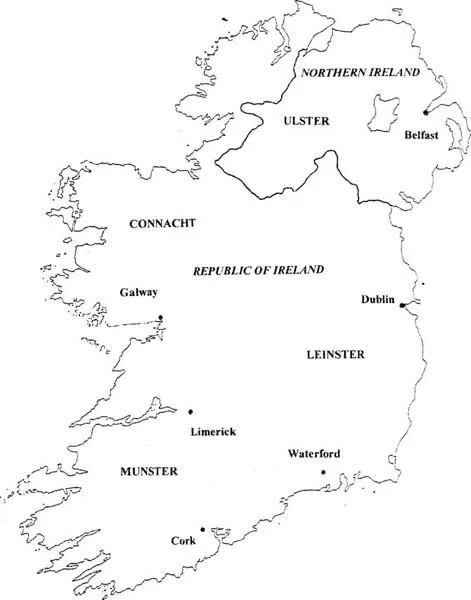
Figure 1.1 Ireland, showing international boundary, historical provinces and main cities.
is entitled ‘Discourse’. This includes two substantial chapters on ‘New Directions’ and ‘Irish in a Global Age’, and a brief concluding chapter. In ‘New Directions’ it is argued that the Irish language in Ireland, north and south, is on the cusp of dramatic change and that this change is related, in particular, to political developments in NI and socio-economic changes in the Republic of Ireland. The impact of the Celtic Tiger economy on the Gaeltacht and, in more general terms, the impact of increasing levels of materialism throughout Ireland upon ethnocentric concerns regarding the Irish language are considered. The significance to the language of the political settlement known as ‘the Agreement’ is assessed, including an analysis of the broader socio-political implications of the North–South Language Body. The prospects for greater levels of engagement between local Irish-speaking communities and the policy and planning processes are measured. Also, the nature of language planning discourse is examined with particular reference to decolonisation, cultural identity and human rights. In ‘Irish in a Global Age’ the association of the English language with the process of globalisation is considered for its impact on the Irish language. Theoretical insights are drawn from postmodernism in noting contemporary limitations on the extent to which issues on language in social context are usefully informed by Bourdieu's concepts of ‘habitus’ and ‘field’/‘linguistic market’. Finally, the Irish language is located in relation to changing conceptions of identity and place in a globalising world of stretched social relations, diverse sources of loyalty, multiple levels of governance and a compressed sense of both time and space.
2 Contexts
Linguistic relativism
‘To say language is to say society’ (Lévi-Strauss in Duranti, 1997: 337) – the origins of language as world-view are to be found in the development of the discipline of anthropology in North America during the first part of the twentieth century. Here, it was believed that any given culture could only be studied through the language of that culture. This position, according to Boas, was a not only a practical issue, requiring anthropologists to acquire the language of the cultures they study, but also theoretical. He explains it as follows:
In all of the subjects mentioned heretofore, a knowledge of Indian languages serves as an important adjunct to a full understanding of the customs and beliefs of the people we are studying. But in all these cases the service which language lends us is first of all a practical one – a means of a clearer understanding of ethnological phenomena which in themselves have nothing to do with linguistic problems … It seems, however, that a theoretical study of Indian languages is not less important than a practical knowledge of them; that the purely linguistic inquiry is part and parcel of a thorough investigation of the psychology of the peoples of the world. If ethnology is understood as the science dealing with the mental phenomena of the life of the people of the world, human language, one of the most important manifestations of mental life, would seem to belong naturally to the field of work of ethnology.(Boas in Duranti, 1997: 52–3)
The principal methodological inference drawn from this perspective on the relationship between culture and language was that a culture's language, or linguistic system, could be used to understand the cultural system itself as a whole. Kroeber puts it in the following terms:
In short, culture can probably function only on the basis of abstractions, and these in turn seem to be possible only through speech, or through a secondary substitute for spoken language such as writing, numeration, mathematical and chemical notation, and the like. Culture, then, began when speech was present; and from then on, the enrichment of either meant the further development of the other.(Kroeber, 1963: 102)
Based upon his observation that the diverse languages which he examined were employed to order and to classify the world in different ways, Boas arrived at the view that each given culture could only be understood in its own terms and, moreover, such classification was arbitrary or relative. Boas made the point in memorable fashion through reference to ‘snow’ in what he described as ‘Eskimo’ vocabulary:
It seems important … to emphasize the fact that the groups of ideas expressed by specific phonetic groups show very material differ...
Table of contents
- Cover
- Half Title
- Full Title
- Copyright
- Dedication
- Contents
- List of figures
- List of tables
- Acknowledgements
- List of abbreviations
- Chronology of events
- Glossary of Irish language terms
- 1 Introduction
- 2 Contexts
- PART I Histories
- PART II Contemporary geographies
- PART III Discourse
- Bibliography
- Index
Trusted by 375,005 students
Access to over 1.5 million titles for a fair monthly price.
Study more efficiently using our study tools.
Frequently asked questions
Yes, you can cancel anytime from the Subscription tab in your account settings on the Perlego website. Your subscription will stay active until the end of your current billing period. Learn how to cancel your subscription
No, books cannot be downloaded as external files, such as PDFs, for use outside of Perlego. However, you can download books within the Perlego app for offline reading on mobile or tablet. Learn how to download books offline
Perlego offers two plans: Essential and Complete
- Essential is ideal for learners and professionals who enjoy exploring a wide range of subjects. Access the Essential Library with 800,000+ trusted titles and best-sellers across business, personal growth, and the humanities. Includes unlimited reading time and Standard Read Aloud voice.
- Complete: Perfect for advanced learners and researchers needing full, unrestricted access. Unlock 1.5M+ books across hundreds of subjects, including academic and specialized titles. The Complete Plan also includes advanced features like Premium Read Aloud and Research Assistant.
We are an online textbook subscription service, where you can get access to an entire online library for less than the price of a single book per month. With over 1.5 million books across 990+ topics, we’ve got you covered! Learn about our mission
Look out for the read-aloud symbol on your next book to see if you can listen to it. The read-aloud tool reads text aloud for you, highlighting the text as it is being read. You can pause it, speed it up and slow it down. Learn more about Read Aloud
Yes! You can use the Perlego app on both iOS and Android devices to read anytime, anywhere — even offline. Perfect for commutes or when you’re on the go.
Please note we cannot support devices running on iOS 13 and Android 7 or earlier. Learn more about using the app
Please note we cannot support devices running on iOS 13 and Android 7 or earlier. Learn more about using the app
Yes, you can access The Irish Language in Ireland by Diarmait Mac Giolla Chríost in PDF and/or ePUB format, as well as other popular books in Languages & Linguistics & Linguistics. We have over 1.5 million books available in our catalogue for you to explore.