- 224 pages
- English
- ePUB (mobile friendly)
- Available on iOS & Android
eBook - ePub
About this book
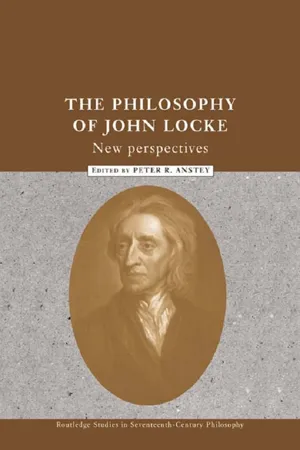
This collection of new essays on John Locke's philosophy provides the most up-to-date entrée into the exciting developments taking place in the study of one of the most important contributors to modern thought. Covering Locke's natural philosophy, his political and moral thought and his philosophy of religion, this book brings together the pioneering work of some of the world's leading Locke scholars.
Information
Part I
Locke's Essay and natural philosophy
1 The Epitome (Abrégé) of Locke's Essay
In the spring of 1688 readers of Jean Le Clerc's Bibliothèque universelle et historique were presented with an account of a new philosophical work that had been produced by one of the friends of the editor: ‘Extrait d'un Livre Anglois qui n'est pas encore publié, intitulé ESSAI PHILOSOPHIQUE concernant L'ENTENDEMENT, où l'on montre quelle est l'étenduë de nos connoissances certaines, & la maniere dont nous y parvenons. Communiqué par Monsieur LOCKE’.1 It was Locke's first publication of any real importance, and it did not fall dead-born from the press. A copy of the journal reached Dublin, where it was read by William Molyneux, who posed his famous question in a letter sent to Locke care of the Bibliothèque universelle.2 The work also came to the attention of those watchful surveyors of the Republic of Letters, Bayle and Leibniz.3 Locke himself did his best to make sure it was noticed. While the journal was being printed he took the unusual step of arranging for extra copies of his own contribution – in effect off-prints – to be run off and sent to his friends in England and elsewhere.4 The printing of these was finished by mid-February and copies had reached England by the end of the month.5
Until the publication in 1700 of Pierre Coste's French translation of the Essay, the Abrégé6 was one of the very few sources from which continental scholars with no knowledge of English could obtain a direct insight into Locke's system.7 Since then it has largely been neglected, and despite the massive expansion of Locke studies in recent years it has received barely a mention in the modern secondary literature. One might suppose that writers on Locke would turn to it to see if it could clarify any difficult passages in the Essay, just as Hume scholars regularly consult the Abstract of the Treatise. In fact this seldom happens. One likely reason – though a difficult one to document – is a loosely held (and erroneous) belief that the Epitome contains nothing not set out more fully in the Essay itself. Another is the difficulty of obtaining a satisfactory text. No modern edition in English exists,8 and the one older edition that is fairly accessible – in King's Life of John Locke9 – is both inaccurate and seriously incomplete. A critical edition of both the French and the English texts will in due course appear in the Clarendon Edition of Locke's works.10 This article contains a description and comparison of the manuscript and printed sources, and argues for a rather earlier date for the composition of the work than has hitherto been presumed.
The Bodleian manuscript
The only known manuscript of the Epitome was preserved among Locke's own papers, and is now held at the Bodleian Library as fols 52–82 in MS Locke c. 28, a guardbook of miscellaneous philosophical manuscripts. The work has no title, and is in English throughout. The main text is in the hand of Locke's manservant Sylvester Brounower, but there are a fair number of alterations and additions in Locke's hand, including the marginal chapter numbers, with a few more apparently by Brounower. The fidelity of Brounower's spelling to Locke's normal usage makes it extremely unlikely that the text was dictated orally, and small details in the manuscript confirm this.11 Other manuscripts in Brounower's hand among Locke's papers suggest that Locke seldom if ever dictated the material that Brounower copied,12 and it can be concluded with confidence approaching certainty that Brounower's copy was made from an earlier manuscript – presumably in Locke's hand – that no longer survives.
The manuscript consists of four small quires each of eight leaves. Its pages were not numbered (the folio numbers are modern) but the quires were signed A to D, probably by Locke. Their contents are as follows:13
| A (fols 52–9) | A very brief description of the first book of the Essay followed by a more detailed summary of Book II up to mid-way through ch. xxiii. |
| B (fols 60–7) | A summary from II. xxiii (second part) to III. ix. |
| C (fols 68–75) | A summary of the rest of Book III, taking up only fol. 68r and about half of fol. 68v. The remaining leaves are blank. |
| D (fols 76–82) | A summary of Book IV. This quire contains only seven full leaves: what would have been fol. 83 is reduced to a stub, the recto of which has been filled with the final part of the account of the division of the sciences, written vertically.14 |
Quire D is different from the others in several respects. Its pages are slightly larger, measuring approximately 165 × 108 mm, compared with approximately 160 × 103 mm for quires A to C. The heading ‘L 4’ is in Brounower's hand, while the headings for the first three books were written by Locke.15 Quires A to C contain a continuous text with catchwords at the end of each quire, and there would have been plenty of room to continue with Book IV in the blank portion of quire C. Whether this was not done because Book IV had already been copied, or because no abridgement of it was yet available, or for some more obscure reason, cannot be determined from an examination of the manuscript.
In its present state quire D is anomalous in another respect: it has been wrongly bound. The two innermost sheets have been placed side by side, so that fol. 78 is conjugate with fol. 79, and fol. 80 with fol. 81; a thin strip of tape joining the two sheets has been added between fol. 79 and fol. 80 and the quire stitched together through this. This was presumably done by the staff of the Bodleian Library soon after the purchase of the Lovelace Collection in 1948.16 Why it should have been done is not at all obvious, but the result is that the summary of Book IV is badly disrupted. In its present state its contents are as follows:
| fols 76–7 | From the beginning of ch. i to midway through ch. iii. |
| fols 78–9 | From midway through ch. iv to the first sentence of ch. x. |
| fol. 80 | From where ch. iii left off at the end of fol. 77v to where ch. iv picks up at the start of fol. 78r. |
| fols 81–3 | From the beginning of ch. xi to the end of ch. xix. |
It is clear from this that the sheet now forming fols 80 and 81 was originally the third sheet (D3, D6) in a normal gathering, and that the correct order of the leaves is 76, 77, 80, 78, 79, 81, 82, [83]. This rearrangement of the sheets can only be detected from a careful examination of the manuscript and would not be easy to discover if all one had to use were the photocopies supplied by the Bodleian Library to readers without access to the Locke Room. A reader unaware of what had happened might easily conclude that this part of the Essay was still in a state of disorder when the manuscript was written.
The original text of the manuscript was written by Brounower in a small, neat hand, using a fine pen. The ink is dark in quire A, while in the others it is more faded, though never so badly as to prevent the text from being legible. In a few places Brounower made deletions and corrections while he was writing but most of the alterations are later. The great majority of these are in Locke's hand, but a few in Book II were apparently made by Brounower; these can be distinguished from his earlier corrections by his use of paler ink and a rather broader pen. Locke's additions and alterations in quires A to C are also nearly all in paler ink.17 Those in quire D, on the other hand, are for the most part in darker ink than Brounower's text; this suggests that they were not added at the same time as those in quires A to C. The text of Book IV is more heavily revised than the others: in Books I–III the longest addition is a mere ten words, while the longest addition in Book IV – the account of the division of the sciences – is nearly ten times that length.
Differences of ink also suggest that while all the marginal chapter numbers in the manuscript are later insertions, those in quire D were not added at the same time as the others.
King's ‘Abstract of the Essay’
The first publication of an English version of the Epitome was in 1692, when it was included in a volume of the Young-Students-Library, published by the grandly named Athenian Society.18 The text of this diverges so markedly from the Bodleian manuscript that it must be an independent translation from the French. There is no evidence that Locke had any involvement with this edition, and its readings are therefore of no value for understanding his intentions. The needs felt by young students – then as now – for a shorter version of the Essay, were subsequently met by John Wynne's authorised abridgement, which first appeared in 1696 and which (unlike the Epitome) was frequently reprinted in the century that followed.19
The first appearance of a text taken from the Bodleian manuscript was not until 1829, when it was included by Peter King in his Life of John Locke under the title ‘View of the Essay’.20 A revised text incorporating minor changes and renamed ‘Abstract of the Essay’ was included in the second edition of the Life, which came out a year later; this is the version used here.
In one respect King's ‘Abstract’ is a more reliable gui...
Table of contents
- Cover Page
- Half Title Page
- Series Title
- Title Page
- Copyright Page
- Contents
- List of contributors
- Acknowledgements
- List of abbreviations
- Introduction
- Part I Locke's Essay and natural philosophy
- Part II Moral and political Philosophy
- Part III Reason and religion
- Bibliography
- Index
Trusted by 375,005 students
Access to over 1.5 million titles for a fair monthly price.
Study more efficiently using our study tools.
Frequently asked questions
Yes, you can cancel anytime from the Subscription tab in your account settings on the Perlego website. Your subscription will stay active until the end of your current billing period. Learn how to cancel your subscription
No, books cannot be downloaded as external files, such as PDFs, for use outside of Perlego. However, you can download books within the Perlego app for offline reading on mobile or tablet. Learn how to download books offline
Perlego offers two plans: Essential and Complete
- Essential is ideal for learners and professionals who enjoy exploring a wide range of subjects. Access the Essential Library with 800,000+ trusted titles and best-sellers across business, personal growth, and the humanities. Includes unlimited reading time and Standard Read Aloud voice.
- Complete: Perfect for advanced learners and researchers needing full, unrestricted access. Unlock 1.5M+ books across hundreds of subjects, including academic and specialized titles. The Complete Plan also includes advanced features like Premium Read Aloud and Research Assistant.
We are an online textbook subscription service, where you can get access to an entire online library for less than the price of a single book per month. With over 1.5 million books across 990+ topics, we’ve got you covered! Learn about our mission
Look out for the read-aloud symbol on your next book to see if you can listen to it. The read-aloud tool reads text aloud for you, highlighting the text as it is being read. You can pause it, speed it up and slow it down. Learn more about Read Aloud
Yes! You can use the Perlego app on both iOS and Android devices to read anytime, anywhere — even offline. Perfect for commutes or when you’re on the go.
Please note we cannot support devices running on iOS 13 and Android 7 or earlier. Learn more about using the app
Please note we cannot support devices running on iOS 13 and Android 7 or earlier. Learn more about using the app
Yes, you can access The Philosophy of John Locke by Peter R. Anstey in PDF and/or ePUB format, as well as other popular books in Philosophy & Philosophy History & Theory. We have over 1.5 million books available in our catalogue for you to explore.