- 176 pages
- English
- ePUB (mobile friendly)
- Available on iOS & Android
eBook - ePub
About this book
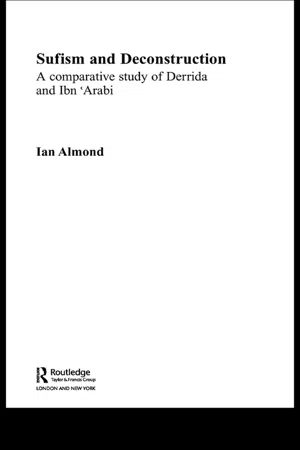
Examinung a series of common features in the works of Derrida and the Sufism of Ibn 'Arabi, considered to be one of the most influential figures in Islamic thought, the author addresses the significant absence of attention on the relationship between Islam and Derrida. Presenting a deconstructive perspective on Ibn 'Arabi, the book's features include:
* the opposition to systematizing representations of God/reality/the text
* a re-emphasis on the radical unthinkability of God and the text
* a common conception of rational thought as restrictive, commodifying and ultimately illusory - and a subsequent appraisal of confusion as leading to a higher state of knowledge
* a positive belief in the infinate interpretability of the text
* a suspicion of represention - and an awareness of its semantic futility, along with a common, 'welcoming' affirmation of openness and errancy towards God and the text.
This book will be essential reading for advanced students and academics of Religious studies, Arabic and Islamic studies and those interested in the work of Derrida and Ibn 'Arabi.
Information
1
The shackles of reason
Sufi/deconstructive opposition to rational thought
He who claims to know that God is his Creator While not being perplexed, this is the evidence of his ignorance.
Ibn ‘Arabi, from the Futuhat al-Makkiyya1
If one were ambitious enough to compile a chronology of oppositions to Western rational thought—a chronology broad enough to include such figures as Al-Ghazali, Meister Eckhart, Rousseau, Blake, Nietzsche and Levinas—it would be interesting to see what kind of common denominators, if any, such a study would produce. Metaphors of wind, breath, spirit and freedom would probably abound; a common emphasis on ‘openness’ ( futuh/ouvert—an important word for both our thinkers), an aversion towards rigidity and systems, an exaltation of wandering and a defamation of reason as somehow unnatural and restrictive … in other words, a rejection of reason which would be almost aesthetically motivated.
In this chapter, two such oppositions to rational and metaphysical thought are going to be examined alongside one another: Ibn ‘Arabi’s critique of nazar or reflective thought, and Derrida’s much wider re-examination of the entire theo-philosophical tradition of the West—the ‘fundamental conceptual system produced by the Greco-European adventure’, as Derrida puts it.2
The first thing the attentive reader notices about both Derrida and Ibn ‘Arabi is the absolute singularity of their positions. Neither of the two seems willing to attach their writings to a particular school of thought (madhahib) or tradition; a curious solitude seems to pervade their work as they critique—sometimes subtly, sometimes openly—practically every thinker they encounter, be they Mu’tazilites or phenomenologists, Ash’arites or structural linguists, esotericists (al-batiniyya) or existentialists. Probably the best example of this in Ibn ‘Arabi occurs towards the end of his treatise Shajarat al-Kawn, where the Shaykh envisages an omnitemporal Allah foretelling to Muhammad the numerous ways in which subsequent thinkers are going to misunderstand His Essence:
O Muhammad, I created my creatures and summoned them to Myself, but they differed among themselves with regard to Me. One group among them claimed that Ezra was My Son (IX: 30), and that My hand is fettered (V: 64–69). These are the Jews. Another group claimed that the Messiah is My Son (IX: 30), that I had a wife and child. These are the Christians. Another group gave Me partners. They are the idolaters. Another group gave Me a form. They are the corporealists [the Mujassima]. Another group made Me limited. They are the Mushabbiha. Another group made Me non-existent. They are the Mu’attila. And there is another group who claim that I shall not be seen in the hereafter. They are the Mu’tazilites.3
Not surprisingly, passages such as these have earned Ibn ‘Arabi the description ‘arrogant’ on more than one occasion. Not only does the Shaykh distance himself from his contemporaries, he puts his criticisms in the mouth of the Divine. Clearly, the author wants to avoid the two dangers present to any Islamic thinker—the possibility of ta’til or complete denudation of God’s attributes on one hand, and tashbih or overdetermining God with positive attributes on the other. This difficult course which Ibn ‘Arabi charters between the apophatic and the cataphatic will have to be followed carefully if we are to understand exactly why the Shaykh remains aloof from every form of reflective thought. The author’s objections to the groups of thinkers mentioned in the previous passage—the Mu’tazilites, the Mujassima, the Mu’attila, the Mushabbiha, not to mention the Christians and Jews—are not merely partisan quibbles. Some common error lies at the heart of Ibn ‘Arabi’s criticisms, some perceived, fundamental mistake motivates Ibn ‘Arabi’s slightly generic dismissal of five centuries of Islamic thought.
Derrida, likewise, cultivates a certain distance between his own textual strategies and the thinkers he writes about, isolating moments of self-presence in their work which re-consign them to an uninterrupted tradition of logocentric metaphysics. Unlike Ibn ‘Arabi, praise and critique in Derrida’s writings are often subtly blended together, particularly in dealing with figures whose own aims seem to closely resemble those of Derrida’s. Derrida’s 1964 essay on Levinas, whilst never renouncing a tone of respect for the thoughts ‘assembled and enriched in that great book Totality and Infinity’,4 nevertheless portrays a Levinas ‘resigned to betraying his own intentions in his philosophical discourse’.5 In ‘Structure, Sign and Play’, Derrida’s ‘fascination’ with Levi-Strauss’ ‘remarkable endeavour’ doesn’t stop him from finding the anthropologist guilty of ‘an ethic of nostalgia for origins’ (d’éthique… de nostalgie de l’origine).6 Various figures in Christian negative theology (St Augustine, Pseudo-Dionysius, Eckhart), held by many to be a medieval precedent for deconstruction, have received similar treatment from Derrida. On the one hand, Derrida has taken great pains to point out his admiration for negative theology—a ‘corpus at once open and closed’, and written in a language ‘that does not cease testing the very limits of language’.7 On the other hand negative theology, for all its radical questioning of metaphysics, still ‘belongs…to the onto-theological promise it seems to break’.8 It still remains ultimately logocentric in its purpose—to preserve the secret name of God.
In other words: just as Ibn ‘Arabi believes that no thinker can provide ‘a definition of the Real [al-haqq]’,9 Derrida insists that no thinker can escape the history of metaphysics. Even the trinity of Nietzsche, Freud and Heidegger, credited with no less an achievement than ‘the critique of the concepts of Being and truth…, of self-presence…, and the destruction of metaphysics’, even these initiators of the dissolution of Western metaphysics remain ‘trapped in a kind of circle’ (sont pris dans une sorte de cercle).10 Something remains, some kind of special knowledge or realization, which distinguishes Ibn ‘Arabi and Derrida from their respective traditions; ‘something’ both thinkers feel they have understood, some kind of gnosis or situation, an awareness of a hidden complexity which enables them to re-contextualize their predecessors and contemporaries so confidently.
It is to the examination of this special ‘something’ that the rest of this chapter is dedicated: what exactly motivates Ibn ‘Arabi and Derrida’s comprehensive rejection of metaphysical thought? Tempted by brevity, one could sum up both thinkers’ reasons in two easy responses: for Ibn ‘Arabi, the philosophers and the theologians have yet to understand the simultaneous transcendence (tanzih) and immanence (tashbih) of God.11 For Derrida, Western metaphysics has never really problematized the word ‘meaning’, nor come to terms with the fact that signs do not lead us to ‘meanings’, but simply to other signs. Such responses, however, would be inadequate. Both Derrida and Ibn ‘Arabi’s distrust of metaphysics is far more complex, and will involve an analysis of terms such as al-haqq and écriture if we are to understand their objections at all.
The emancipatory project in Derrida and Ibn
‘Arabi: freeing al-ḥaqq and l’écriture from the shackles of reason
Both Ibn ‘Arabi and Derrida, in their own contexts, speak of fetters and freedom. It is no exaggeration to say that a certain emancipatory spirit underlies both their projects—‘emancipatory’ not in any social sense, but rather the emancipation of the unknowability of the Real/the uncontrollability of writing from the shackles of rational/metaphysical thought. Indeed, one could say the entire aim of Of Grammatology is the liberation of écriture from ‘the rank of an instrument enslaved to full and originarily spoken language’.12 Of course, these are not identical gestures: Derrida’s liberation is a purely semantic one, whereas Ibn ‘Arabi has a more spiritual aim in mind. Nevertheless, the re-affirmation of something vital, inconstant and elusive which defeats all our attempts to talk about it will play a common role in both thinkers’ vocabularies, and evolve according to a common structure. A look at the contexts of both Ibn ‘Arabi and Derrida’s writings may help us to understand this better.
The people of reflection (ahl al-naẓar) and the idolatry of the sign
In the Futuhat, Ibn ‘Arabi points out that the root meaning of the word for reason (‘aql) comes from the same root as the word for ‘fetter’ (‘iqal).13 It is a convenient etymology for the Shaykh, whose main objection to the philosophers and theologians is that they narrow and limit a ‘Divine Vastness’ (al-tawassù al-ilahi) that is without attribute or limit. ‘Every group have believed something different about God,’14 he writes, always exuding a very definite impatience with those who mistake their specific beliefs for knowledge of the Absolute. Ibn ‘Arabi’s impatience here would be with both affirmative and negative schools of theology, both with those who insist God can be predicated through His effects (the Ash’arites), and those who said nothing could ultimately be predicated of God, only what He is not (the Mu’tazilites). Not that the Mu’tazilites and Ash’arites were polar opposites—al-Ashari’s master, after all, had been the head of the Basra Mu’tazilites (al-Juba’i).15 A common willingness to use reason as a tool in their arguments also characterized both groups—even if for the Ash’arites reason was an instrument used to justify revelation, and not vice versa. Such debates concerning the unknowability of God would have formed a common background to Ibn ‘Arabi’s thought, producing such a proliferation of schools, quarrels and doctrines that one can well sympathize with the Shaykh’s words: ‘I hear the grinding, but I don’t see any flour’.16 Thus, a believer in the eternal attributes of God such as al-Ash’ari (873–935) can declare:
We confess that God is firmly seated on His Throne…We confess that God has two hands, without asking how …We confess that God has two eyes, without asking how …We confess that God has a face … We affirm hearing and sight, and do not deny that, as do the Mu’tazila, the Jahmiyya, and the Khawarij…17
Whereas other, more apophatically inclined groups such as the Mu’tazilites are capable of producing statements which, for Western readers, are reminiscent of Dionysius the Areopagite:
He is no body, nor object, nor volume, nor form … Neither is he provided with parts, divisions, limbs, members … He cannot be described by any description which can be applied to creatures … He is a being, but not as other beings …18
In a sense these two extreme positions of tashbih (anthropomorphism) and tanzih (incomparability) provided the parameters of a very wide debate. How much can we know about God? What is the relationship between the Divine Names (the Merciful, the Generous, the Knower, etc.) to the Divinity—are they simply analogies? Or do they reflect some positive eternal attributes? How much of our beliefs concerning God are actually valid? How can we ascertain this? If there really is, as the Quran says, ‘nothing like Him’ (42: 11), then how can we know anything about God at all?
Such questions, amongst others, had been debated over the centuries by the philosophers of the Kalam. As Abdel Haleem has shown, the term ‘Kalam’ is difficult to define with any accuracy.19 Literally, it means ‘speech’, and denotes the general discussion of religious issues pertaining to the Quran—not just the extent of God’s knowability, but also such questions as the problem of freewill and divine pre-determinism, the status of the Quran and the implementation of the Shariah. ‘Kalam’ was not simply a discussion of religious topics, however—it usually required the presence of an adversary, an opposite position against whom the various arguments could be raised. It is not difficult to see why Ibn ‘Arabi wanted to distance himself from the thinkers of the Kalam and dismiss their efforts with words such as ‘meddlesome’ ( fudul) and ‘obfuscation’. For a thinker whose entire approach to divine epistemology can be summed up in the (to many) cryptic exclamation ‘He/not He’ (huwa la huwa), a thinker who insists that God is both immanent and transcendent, such polarizing debates would have reinforced the very kind of binary thinking about God which Ibn ‘Arabi was trying to escape.
Another aspect of Kalam which Ibn ‘Arabi would have resented is its claim to a knowledge of God through reflection and reason (nazar, ‘aql), the kind of knowledge which for Sufis could only by obtained through ‘tasting’ and ‘unveiling’ (dhawq, kashf ). Some past definitions of Kalam are quite telling in this respect—Al-Farabi saw Kalam as ‘a science which enables a person to support specific beliefs and actions laid down by the Legislators’; al-Iji goes slightly farther, insisting Kalam does not support but rather ‘establish(es) religious beliefs, by adducing arguments and banishing doubts.’ For Ibn Khaldun, Kalam is ‘the science that involves arguing with rational proofs in defence of the articles of faith and refuting innovators who deviate from orthodoxy’, whilst the modern Muhammad ‘abduh proposes as a definition ‘a science that studies the Being and Attributes of God, the essential and possible affirmations about Him.’20 In all of these definitions, a certain theme is constant: the acquisition of divine knowledge in order to justify social and legal practices, facilitate hermeneutics, systematize theology and ascertain exactly what is orthodox and what is heresy (ilhād).
Ibn ‘Arabi’s context: placing the Shaykh
Trying to place Ibn ‘Arabi’s writings in their proper context is not as straightforward as it sounds. The diversity of opinions and interpretations of Ibn ‘Arabi is reflected, in part, by the variety of different contexts—Sufi gnostic, Neoplatonist, hadith scholar, philosopher, mystic—critics are willing to place him in. If Burckhardt originally saw Ibn ‘Arabi as a ‘fundamentally Platonic’ thinker, early biographers of the Shaykh such as Ibn al-Abbar (d.1260) saw him rather as a muhaddith or scholar of the sayings of the prophet.21 Whereas scholars such as Netton and Corbin mention Ibn ‘Arabi in the same breath as the Persian mystic Suhrawardi—even, in Corbin’s case, to the point of suggesting the Futuhat may be more comfortably read in a Shiite tradition rather than a Sunni one22— Majid Fakhry pairs Ibn ‘Arabi with al-Ghazali in his History of Islamic Philosophy as two examples of ‘synthesis and systemization’.23 Even the Encyclopedia Britannica has a slightly different genealogy to offer, suggesting Ibn Masarrah—and ultimately Empedocles—as one of the primary sources of Ibn ‘Arabi’s thoug...
Table of contents
- Cover Page
- Sufism and Deconstruction
- Routledge Studies In Religion
- Title Page
- Copyright Page
- List of Transliterations
- Acknowledgements
- Introduction
- 1: The Shackles of Reason: Sufi/Deconstructive Opposition to Rational Thought
- 2: The Honesty of the Perplexed: Derrida and Ibn ‘Arabi On ‘Confusion’
- 3: Sages of the Book: The Meaning of Infinity In Sufi and Deconstructive Hermeneutics
- Conclusion—the Post-structuralist Dissolution of the Subject: Three Neoplatonic Moments In the Derridean Canon
- Notes
- Bibliography
Trusted by 375,005 students
Access to over 1.5 million titles for a fair monthly price.
Study more efficiently using our study tools.
Frequently asked questions
Yes, you can cancel anytime from the Subscription tab in your account settings on the Perlego website. Your subscription will stay active until the end of your current billing period. Learn how to cancel your subscription
No, books cannot be downloaded as external files, such as PDFs, for use outside of Perlego. However, you can download books within the Perlego app for offline reading on mobile or tablet. Learn how to download books offline
Perlego offers two plans: Essential and Complete
- Essential is ideal for learners and professionals who enjoy exploring a wide range of subjects. Access the Essential Library with 800,000+ trusted titles and best-sellers across business, personal growth, and the humanities. Includes unlimited reading time and Standard Read Aloud voice.
- Complete: Perfect for advanced learners and researchers needing full, unrestricted access. Unlock 1.5M+ books across hundreds of subjects, including academic and specialized titles. The Complete Plan also includes advanced features like Premium Read Aloud and Research Assistant.
We are an online textbook subscription service, where you can get access to an entire online library for less than the price of a single book per month. With over 1.5 million books across 990+ topics, we’ve got you covered! Learn about our mission
Look out for the read-aloud symbol on your next book to see if you can listen to it. The read-aloud tool reads text aloud for you, highlighting the text as it is being read. You can pause it, speed it up and slow it down. Learn more about Read Aloud
Yes! You can use the Perlego app on both iOS and Android devices to read anytime, anywhere — even offline. Perfect for commutes or when you’re on the go.
Please note we cannot support devices running on iOS 13 and Android 7 or earlier. Learn more about using the app
Please note we cannot support devices running on iOS 13 and Android 7 or earlier. Learn more about using the app
Yes, you can access Sufism and Deconstruction by Ian Almond in PDF and/or ePUB format, as well as other popular books in Theology & Religion & Religion. We have over 1.5 million books available in our catalogue for you to explore.