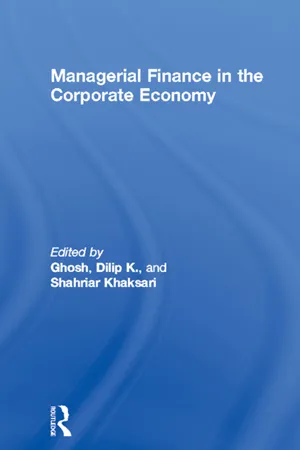
In most countries the economic structure and financial landscape are dominated by corporations. A critical examination of the various facets of the corporate economy is thus vitally important. In Managerial Finance in the Corporate Economy the authors use new theoretical apparatus and empirical evaluations to present such a study.
The book includes new findings on mutual and pension funds, portfolio diversification, market volatility, financial institutions and corporate behaviour in the context of the international economy.
- 412 pages
- English
- ePUB (mobile friendly)
- Available on iOS & Android
eBook - ePub
Managerial Finance in the Corporate Economy
About this book
Part I
Introduction
Managerial finance in the corporate economy
Dilip K.Ghosh and Shahriar Khaksari
An economy is an infrastructure with interactions of economic agents out of the constellation of consumers and producers and the intermediaries in a defined society. In such an economic society in modern days, producers appear in the structure of proprietorships, partnerships or corporations. Overwhelming, however, is the operational importance of corporate entities catering to the consumers’ side of the exchange setup. Proprietorships and partnerships, although they are legally quite distinguishable on the supply side of the equation, behave with the same norms of corporate conduct in business deals and financial matters. So, loosely speaking, in modern times corporate economy means the supply side of the economy. Corporations in that general sense provide goods and services, make investments for themselves and create investment opportunities for others with excess savings, develop various financing designs, and in the process induce the growth of financial engineering.
The management of the corporate economy rests squarely with many facets of the profitable existence and competition of corporations coexisting side by side in the market economy under various constraints and regulations. The constraints are often both financial and legal. Corporations, when they are public, raise capital either in the way of floating bonds and other debt instruments (under written indentures specifying terms and conditions for loan repayments) or by issuing equity shares in the marketplace. The individual investors decide where to put their money—in fixed income securities or in variable income securities— depending on their assessments of risk and returns. It is often considered to be relatively safe to diversify their assets in such a fashion that diversification yields a reduction in risk and an acceptable rate of return. From the issuers of debt and equity capital, the question is: what should be the optimal mix—that is, what is the optimal capital structure? The answer obviously is intimately connected to the cost of capital and the consequent valuation of the firm. Beyond this question or issue, several other factors become important in managerial finance in the corporate economy. What drives the market, how an economic agent reacts to volatility in the prices of securities, how sensitive prices are to interest rates, how the tax structure affects the behavior of corporate management and investors in corporate securities appear to factor in to decide the parameters of managerial finance.
All these issues and questions are intimately connected with the institutional structure and modus operandi of those institutions—financial and otherwise. Money moves through financial institutions and intermediaries because of the integrity and trust created for these conduits via monitoring mechanisms, regulatory constraints and safety valves through insurance and the like. Institutional structures, in many cases, provide loss-cover conditions through hedging mechanisms, and allow scope for arbitrage, and beyond hedging speculation also drives the system. It is the corporations and/or investors who should decide what positions to take at what points, and with how much integrity the process admits of changes, sometimes expected and sometimes not.
The corporate economy is not necessarily local anymore. It is very much a global framework. Many multinational corporations exist nowadays, and hence their operations—production, sales, financing and investment—are truly transnational. Coca-Cola does everything in almost every country of the world, and thus exposes itself to foreign exchange markets and diverse tax laws. This is the picture of the modern corporate structure.
Against the backdrop of such economic structures and financial systems, economic agents are moving forward with their regular activities. Many issues and problems arise in a theoretical as well as in a practical context in real life. To deal with some of these issues or questions we have divided this book in five parts. This introduction, which forms the first part, develops the unifying structure and presents the theme of each article presented in the book. Part II brings out some recent studies in the area of mutual funds, pension funds and portfolio management. The section begins with the article “The long-run gains from international equity diversification: Australian evidence from cointegration tests”, by Allen and MacDonald. The chapter analyzes the benefits for Australian investors from international diversification in the equity market for the period from 1970 through 1992 by using monthly data. The authors utilize the cointegration technique and compare their results with those obtainable from the standard two-step ordinary least squares procedure and the maximum likelihood procedure. Their results, among others, suggest that for most pairwise portfolios there exist potential long-run gains to Australian investors in the sense that there is no evidence of cointegrating relationships. In the second chapter, “Shareholder portfolio decisions in spinoffs”, Russell Gregory-Allen and Wallace Davidson examine the changes in the long-run risk structure of the common stock of firms involved in spinoffs. They compare the market model parameters of the pre-spinoff parent firm to a homemade portfolio of post-spinoff firm and post-spinoff parent firm. The study shows that very little evidence exists to demonstrate that market model parameters shift to benefit shareholders. However, it is concluded that the spinoff transaction allows shareholders to adjust their portfolio, and the authors demonstrate that this possibility can yield rewards to shareholders in some instances. Next, Paul van Aalst and Guus Boender in their chapter “A one-period model for asset-liability matching problem for pension funds” investigate the financial position and risk of pension funds with further examination of underlying interest rate risk, inflation and real wage growth risk, actuarial risk and pension system risk. In the fourth chapter, “An empirical study of the correlation between mutual funds’ selectivity and timing performance”, Zakri Bello evaluates the performance of domestic and US-based international funds quoted in the over-the-counter market by using two return-generating models and three benchmark portfolios. He asserts that the negative correlation between market timing and stock selection performance, reported earlier in several studies on mutual fund performance, is associated with the particular model used in those studies and not with the leverage characteristics of the mutual fund asset holdings. It is contended that for each of the six investment objective groups, average market timing performance and stock selection performance are either zero or negative.
Part III is an analysis of credit, security volatility and cyclicality. This part begins with the chapter “Finding the factors associated with stock price volatility” by Ariff, Kuhan, Nassir and Shamsher. In this eclectic piece, the authors attempt to find factors that may account for the stock price volatility in both developed markets such as Tokyo and developing markets such as Kuala Lumpur and Singapore. It appears that the factors that drive the volatility are dividend-related variables such as dividend yield or payout ratio, earnings-related variables, debt usage, asset growth rates of the firm, and firm size. These authors finally conclude that their results are consistent with market efficiency and leverage effects on firm value. In the second chapter in this section, “The short-term return structure of rationally (?) priced cyclical securities”, John Woods throws into clear relief the recent studies that argue against the possibility of irrational bubbles in security prices and thus call into question the conventional assumption that risk-adjusted required returns are time invariant. He contends that if returns are conditional upon the economic environment, short-term return structures are induced in security prices, which casts doubt upon the rationality of the hypothesized long-term price structures for cyclical securities. Reexamining the concept of constancy of discount rate over time (discussed earlier by Fama, Fama and French, and Chen) as inconsistent with the intertemporal asset pricing model as well as uniform rational risk aversion, Woods considers that valuation analysis yields unforeseen results. He suggests that in an economic downswing funds for current consumption become scarce and time value analysis will then place a higher than normal discount rate on future cash flows; thus in the opposite situation a lower discount rate will appear appropriate. In the next chapter, “Black Monday: what burst the bubble?”, Ali Parhizgari, Krishnan Dandapani and Arun Prakash look into the determinants of variability of stock market prices in the wake of the infamous October crash of 1987. In addition to examining the standard economic factors that affect the prices of securities they investigate the effects of market mechanisms and behavioral factors. It is claimed that the build-up of all these factors in tandem and their combined effects can be held responsible for the plummeting conditions in securities in the markets. Keith Chan, Damien McCulough and Michael Skully, in their piece “Australian imputation tax system and dividend reinvestment plans”, use a clinical study to ascertain the effects of dividend reinvestment plans on shareholders returns in the pre- and post-imputation environment. They establish that the daily share return behavior indicates that the announcement to introduce a dividend reinvestment plan is received indifferently by the market before imputation, but is valued positively afterwards. It is also shown that the simple market-adjusted returns model performs as potently as the market model in detecting abnormal returns in the Australian context. Finally, in this part, in “The credit availability theory: a non-monetarist test”, Paul Kutaslovic and Conway Lackman test the non-monetarist aspects of credit availability as it relates to the US commercial loan market. The representations of commercial loan rates and volumes thereof are developed from the data for the period from 1967 through 1988. Credit availability effects are postulated to be stronger during monetary ease than during tight money conditions. It is pointed out that loan rates respond rapidly to changes in the yields of government securities, and hence banks rarely restrict government securities at the expense of private securities.
The fourth part is a highly warranted examination of financial institutions in the wake of several developments in the recent past. Edward Kane starts off with a serious examination of the issue of establishing an efficient private-public partnership for deposit insurance. His chapter, “Establishing an efficient private-federal partnership in deposit insurance”, points to the incentive conflicts inherent in the political and bureaucratic environment, information asymmetry and taxpayer losses, and then highlights deposit insurance as consisting of six components. Through an exhaustive analysis of the deposit insurance mess, a discussion of the benefits from partial privatization, and by exploring a four-parameter partnership plan, he analyzes incentives affected by contract design. Finally, he calls for the unmangling of regulator and ex-regulator assertions. The next chapter is written by Hua Yu, and the title of the chapter is “Bank risk-taking, risk-hedging and the effects of the risk-based bank capital regulation”. In his research, the author develops a model to analyze the impact of bank capital regulation on bank portfolio decision in the presence of interest rate risk and tax. It is demonstrated that both tax liabilities and deposit insurance subsidies are contingent, and they may induce value-maximizing banks to hedge interest rate risk exposure and take positions in their investment portfolios simultaneously. It is argued that the recent risk-based bank capital regulation concentrates on default risk while ignoring interest rate risk. Rama Koundinya, in his chapter “Financial Institutions Reform, Recovery, and Enforcement Act (FIRREA) 1989 and the management of thrifts in the 1990s”, reviews, as the title suggests, the reform, recovery and managerial structures of savings institutions (essentially savings and loan associations). Starting off with a sketch of the events leading to the thrift institutions’ debacles, the author examines the viability of such financial institutions based on the terra firma of the FIRREA and the performance strategies in the last decade of the century. The next chapter, “Bank failure and capital adequacy regulation in commercial banks”, by Jiachu Song and William Rayburn, uses bank failure prediction models through multiple discriminant analysis, logit analysis and classification trees to test the effectiveness of risk-based capital standards and uniform capital norms in forecasting future bank failures. The authors have chosen a sample of 500 banks closed by the Federal Deposit Insurance Corporation (FDIC) during 1984–9, and examining the data on those banks one and two years prior to their bankruptcies collected from the Call Report they predict bank failures. Their empirical findings also suggest that the risk-based capital ratio is a better indicator of financial distress in commercial banks than the uniform capital ratio. In the last chapter in this section, “Capital regulation and bank portfolio adjustment”, Tseng-Chuan, Soushan Wu and Mei-Ying Liu study the impact of capital regulation on bank equity portfolio risk. The analysis is conducted by first examining the effects of both the uniform capital ratio requirement and the new risk-based capital plan in bank portfolio adjustment and its probability of default. Utilizing the mean-variance approach, the analysis shows that traditional uniform capital regulation is an ineffective method for controlling the probability of bank insolvency. The reason is that it ignores the different risk preferences of individual banks and the banks may choose asset portfolios with high risk to retard the efforts of the regulators, whereas the risk-based capital plan can redress this bias toward risk and thus be potentially more effective. This work theoretically corroborates the empirical results of the previous chapter by Song and Rayburn.
The fifth part is the final section of this book. It deals with international investment and corporate finance. Seven articles in this segment cover various facets of issues involving open economies and international finance. Tribhuvan Puri and George Philippatos, in their work “A general equilibrium model of international asset pricing”, construct a continuous-time general equilibrium model for multi-good production-exchange open economies with floating exchange rates for pricing international assets by integrating production decisions with portfolio choices. It is shown that the endogenously derived interest rates may exceed or fall short of the average return on world technologies by the amount of a premium determined by productivity, technology, exchange rate, systematic risks and foreign investment. Excess returns on contingent claims in some currency are a linear combination of wealth and some state variable elasticities of the price of a contingent claim, domestic or foreign, in that currency weighted by factor risk premia which are common to all claims. The authors derive a valuation equation for contingent claims. The second chapter in this final part is “The relative valuation of Japanese and US stock markets”. Jay Choi investigates the determinants of the relative valuation of Japanese and US stocks within a simple comparative valuation model. The work estimates the impact of fundamental economic variables on a broad range of relative valuation measures including relative stock prices, price-earnings ratios, price-cash flow ratios and price-book value ratios. Among the notable findings is the role of exchange rate and regulatory changes as a determinant of relative stock valuation between the two countries. Mitchell Ratner and Belmont Haydel then present their research under the title of “Cointegration and the relationship between inflation and stock prices in the emerging markets of Latin America: Argentina, Brazil, Chile, Mexico”. The chapter uses regression analysis and a cointegration procedure to test for the international Fisher effect in the emerging markets of Latin America. The tests examine the stochastic relationship between inflation and common stock in the countries cited from January 1988 through October 1991. Their results indicate that the Fisher effect is unobservable in those countries, and, in addition, they find a negative relationship between inflation and common stock returns. The next chapter, “From banca to bolsa: corporate governance and equity financing in Latin America”, is by Klaus Fischer, Edgar Ortiz and A.P.Palasvirta. These authors present three basic propositions on the relationship between government intervention, corporate governance, corporate financing and capital market development in Latin America. The propositions are as follows: (i) a necessary but not sufficient condition for the development of an efficient equities market is the existence of an adequate supply of risk-bearing securities with a suitable information set on returns and risk; (ii) the supply of risk-bearing securities and the information set on their values will be sufficient to allow the development of an efficient equities market if the public corporation is the preferred mode of corporate governance for a significant number of firms; (iiia) in the presence of competitive real and financial markets, separation of ownership and control is the preferred form of corporate governance, and (iiib) under market conditions characterized by the presence of government-induced rent opportunities and lack of competition in financial markets, corporate technological innovation is limited, and closed ownership is the preferred form of corporate governance. In the next piece, “Patterns of corporate leverage in selected industrialized countries”, Rama Seth reviews the pattern of leveraging by firms across different sectors in selected industrial countries. The author here examines the extent of and the change in leverage of firms sensitive to economic fluctuations. Although this study confirms the earlier finding in the case of the United States that highly indebted firms are concentrated in non-cyclical sectors, it further establishes that the US firms that have been increasing their leverage most rapidly have been concentrated in cyclical sectors. In this study, the relationship between firms’ leverage and the earnings sensitivity to output in the United States, Germany, Canada, Australia, Japan and the United Kingdom is spelled out. The sixth chapter in this section is by Lonie, Sinclair, Power and Michaelson, and the title is “External financial pressures on UK companies, 1978–91: an examination of the impact of interest rates in two recessions”. The chapter examines the discriminatory effects of high interest rates on UK industries and companies. At the heart of this analysis is a distinction between “interest-sensitive” and “non-interest-sensitive” companies based upon differences in the impact of interest rates on the profits and cash flows of each category of company and further reflected in differences in dividend policies, capital structure, working capital strategies and patterns of capital expenditure over the same time period. In the last chapter, “Financial accounting statements and foreign exchange risk management”, Krishna Kasibhatla, John Malindretos and Luis Ri...
Table of contents
- Cover
- Half Title
- Full Title
- Copyright
- Contents
- List of figures
- List of tables
- List of contributors
- Preface
- Part I Introduction
- Part II Mutual funds, pension funds and portfolio management
- Part III Credit, security volatility and cyclicality
- Part IV Financial institutions
- Part V International investments and corporate finance
- Index
Trusted by 375,005 students
Access to over 1.5 million titles for a fair monthly price.
Study more efficiently using our study tools.
Frequently asked questions
Yes, you can cancel anytime from the Subscription tab in your account settings on the Perlego website. Your subscription will stay active until the end of your current billing period. Learn how to cancel your subscription
No, books cannot be downloaded as external files, such as PDFs, for use outside of Perlego. However, you can download books within the Perlego app for offline reading on mobile or tablet. Learn how to download books offline
Perlego offers two plans: Essential and Complete
- Essential is ideal for learners and professionals who enjoy exploring a wide range of subjects. Access the Essential Library with 800,000+ trusted titles and best-sellers across business, personal growth, and the humanities. Includes unlimited reading time and Standard Read Aloud voice.
- Complete: Perfect for advanced learners and researchers needing full, unrestricted access. Unlock 1.5M+ books across hundreds of subjects, including academic and specialized titles. The Complete Plan also includes advanced features like Premium Read Aloud and Research Assistant.
We are an online textbook subscription service, where you can get access to an entire online library for less than the price of a single book per month. With over 1.5 million books across 990+ topics, we’ve got you covered! Learn about our mission
Look out for the read-aloud symbol on your next book to see if you can listen to it. The read-aloud tool reads text aloud for you, highlighting the text as it is being read. You can pause it, speed it up and slow it down. Learn more about Read Aloud
Yes! You can use the Perlego app on both iOS and Android devices to read anytime, anywhere — even offline. Perfect for commutes or when you’re on the go.
Please note we cannot support devices running on iOS 13 and Android 7 or earlier. Learn more about using the app
Please note we cannot support devices running on iOS 13 and Android 7 or earlier. Learn more about using the app
Yes, you can access Managerial Finance in the Corporate Economy by Dilip K. Ghosh,Shahriar Khaksari in PDF and/or ePUB format, as well as other popular books in Business & Business General. We have over 1.5 million books available in our catalogue for you to explore.