eBook - ePub
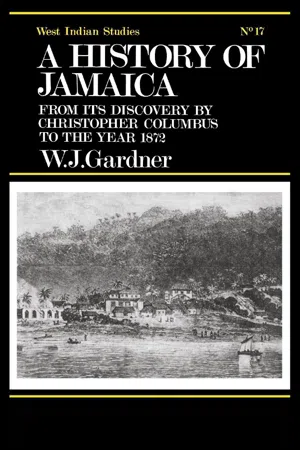
The History of Jamaica
From its Discovery by Christopher Columbus to the Year 1872
- English
- ePUB (mobile friendly)
- Available on iOS & Android
eBook - ePub
The History of Jamaica
From its Discovery by Christopher Columbus to the Year 1872
About this book
This systematic history of Jamaica was written after the abolition of slavery by a man imbued with a sense of 18th-century liberalism. It is based on public records and archives, and the mass of pamphlet literature which had been published over the years.
Information
PERIOD IV
FROM THE COMMENCEMENT
OF THE ANTISLAVERY
STRUGGLE TO EMANCIPATION
CHAPTER I
HISTORICAL EVENTS
THE exultation of the colonists at the victory of Lord Rodney was somewhat abated when the heavy taxation, rendered necessary by martial law, was announced: some consolation was, however, found in the high prices obtained for sugar and rum. Considerable accessions were also made to the material strength of the colony by the intro duction of emigrants from Honduras and the United States of America. In January, 1783, a large convoy arrived from Charleston with sixteen hundred troops, four hundred white families, and four thousand five hundred slaves.1
A considerable number of these persons settled in Kingston, and succeeded so well in business as to call forth loud complaints at their exemption from taxation for a term of years. Others, however, were poor, and some thousands of pounds were contributed, by private subscription and parochial funds, for their support. Others again became planters, and were exposed to the same misfortunes as attended large bodies of white emigrants in former days. A list is still in existence of 183 heads of families to whom grants of land were made in St. Elizabeths. This land was little better than morass, and a claim for the payment of £4696, by the gentleman who surveyed the spot and apportioned it, led to an inquiry on the part of the house of assembly, when it was stated in evidence that none but amphibious creatures, such as fishes, frogs, and “Dutchmen,” could live there. One poor gentleman, named Frogge, said he had tried the experiment, and buried most of his family, and that his case was only one of many.1
Next year General Campbell relinquished the government. He appears to have gained the esteem of all classes of the community, for while diligent in preparing for the defence of the colony at a most dangerous crisis, hehad not neglected the other duties of a governor. A service of plate, valued at £1000 sterling, was voted to him by the assembly. During his administration the long disputed right of cutting logwood and mahogany at Belize was conceded by Spain.
Brigadier-General Clark succeeded to the government. The first years of his residence were marked by a succession of hurricanes, the last by bountiful crops. The storms were on the 30th of July, 1784, 27th of August, 1785, and 20th of October, 1786. The first was the most destructive. Every vessel in Kingston harbour was either sunk, driven ashore, or dismasted. The barracks at Up Park Camp and the workhouse were blown down. Many lives were lost, and two shocks of earthquake added to the general alarm.
In these days of free trade, when the necessities of one country can be readily supplied from the abundance of another, it seems almost incredible that thousands of slaves should at this time have perished, and many of all classes have suffered considerable privations, in consequence of the commercial regulations of the parent state. The famine which followed the hurricanes of 1780 and 1781 was partly owing to the war of independence. But now, though peace had been proclaimed, the trade with the States was restricted by the imperial government. On the 2nd of July, 1783, an order in council was promulgated, and for some time annually renewed, limiting the importation of American lumber, grain, live stock, &c., into the West Indies, to British ships; while salt beef, pork, and fish were entirely prohibited.
In 1784 nearly every island sent remonstrances and petitions to the British parliament, showing how dependent they were on America for supplies. The legislature of Jamaica declared that free trade with America was abso lutely necessary to “afford a chance of carrying on our estates, or of supplying our families with bread. We claim it (said they) as the birthright of every member of the empire; we demand it as one of the gifts of nature, to enable us to avert impending ruin.” These gentlemen were not free traders in respect to sugar, coffee, and rum; and they were told that their request could not be granted without material injury to the commercial interests of Great Britain. The inhabitants of Canada and Nova Scotia were very jubilant, declaring that they could supply all the sugar the islands needed; and if prices were high, the planters, who were “wallowing in wealth,” could afford to pay them.
August, 1784, however, saw Jamaica on the brink of famine, On the 7th of that month, the lieutenant-governor, who was vested with some discretionary powers for such an emergency, issued a proclamation, with the advice of the council, permitting the importation of pro visions, in foreign bottoms, for four months. This period was, soon after, extended for two months longer. The planters paid increased attention to the cultivation of corn and other ground provisions, which were, providentially, harvested before the storm of 1785 again spread desolation over the land. After this new calamity, General Clark prohibited the exportation of provisions to other suffering colonies, but, under pressure from home, refused again to open the ports to American ships. All through the remainder of the year there was much scarcity, but the climax of misery seemed to be reached when the storm of 1786 burst upon the land.
Good resulted from these visitations. Far more attention was paid to the cultivation of yams, cocoas, and such provisions as, unlike the plantain, are not readily destroyed by storms; but the West Indies must ever be, to some extent, as dependent on temperate climes for many of the necessaries of life as such countries are on tropic climes for many luxuries. 1787 was a year of anxiety, but the average sugar crops of the three next years exceeded ninety thousand hogsheads. The coffee crops were far in excess of all former years, though inferior to what they subsequently reached. From this time the wonderful increase in the production of that staple article may be dated.
In December, 1784, the assembly prayed that General Clark might be confirmed in the government of the island. He accordingly remained six years longer, and had cause to rejoice in an immunity from those legislative contests by which others had and have since been tried. Only two events of this character occurred. In 1786 a Mr. Kenreys brought serious charges reflecting on the governor’s conduct as chancellor: he included the judges, the provostmarshal, and the clerk of court in his complaints; but the assembly, after a patient investigation, declared all the charges entirely groundless. Three years later the council and assembly again quarrelled on the old question of privileges. The former body sought to amend the poll-tax bill. This, being a money bill, the assembly denied their right to do. The governor interposed by an adjournment of the house; but both parties being obstinate, a dissolution was the only course open for the adoption of the governor, who courteously informed the legislature that he was unwilling to embarrass his successor, who had then been appointed.1
In 1790 the Earl of Effingham arrived in the colony as governor. He had been a soldier, but as a civil administrator soon obtained a very enviable degree of respect and confidence. Reserved in manner, he was calm and prudent in council, and determined in action. His stay was, however, short. The countess was first seized by a severe illness. A voyage in one of the cruisers failed to restore her health, for she died on the 13th of October, and her remains were brought back to the island for interment. On the 19th of November the earl also died. In each case the legislature decreed a public funeral, no expense was spared, nor was any mark of respect wanting. £1000 was also voted for a monument in Spanish Town cathedral. A bill had subsequently to be passed to indemnify the rector for allowing the bodies to be interred within the walls of the sacred edifice.
Two events were now seriously engaging the attention of the colonists: the revolution in Hayti and the agitation in England respecting the slave trade. The year 1789 saw the comrnencement of the French revolution. There were many republicans in Hayti, and forgetting the volcano on which they lived, they freely expressed their sympathy with the cry for human freedom. Men of African race heard of this declaration of human rights, and no sooner had they realised its significance than they also declared that freedom was their birthright. Except so far as the revolt in Hayti affected Jamaica, it is unnecessary to record its progress. The sad baptism of blood, the cruelty and self-sacrifice, the patriotism and savagery so strangely blended in Hayti, belongs not to the history of this colony.
It is more important to record the leading events of that social revolution by which freedom was ultimately secured for the bondsmen here; for though it gave birth to no such characters as Touissant la Overture, Christophé, Petion, Geffrard, and others, it has at least preserved us from the domination of such odious characters as Soulouque.
In styling the period under review that of the anti-slavery struggle, it is admitted that the term is only approximately correct. That struggle really commenced a generation before. Thoughts that afterwards possessed the minds of millions, had at even an earlier period found utterance. Baxter, the nonconforming divine, in his “Christian Directory,” printed eighteen years after the capture of Jamaica, had written: “They who go out as pirates and take away poor Africans, and make them slaves and sell them, are the worst of robbers, and ought to be considered the common enemies of mankind; and they who buy them and make use of them as beasts of burden, are fitter to be called demons than Christians.” Still earlier, Pope Leo X. and Queen Elizabeth had protested against slavery. The former said that “not only the Christian religion, but nature itself, cried out against slavery;” while the British queen stigmatised the kidnapping of negroes “as a detestable act, which would call down the vengeance of heaven upon the undertakers.”
The legal question of man’s right to property in his fellow-man was first judicially raised in England in the days of William and Mary. Chief Justice Holt then decided that a negro coming to England was free: for “one may be a villeyn in England, but not a slave.”1 Unhappily this decision was suffered to fall into abeyance. Men did not then think sufficiently of rights other than their own, still less could they see the logical deduction that might be drawn from such a decision. It was nearly a century be fore men said: “We have no slaves at home; then why abroad?” The decision of Holt was called into question about forty years after he uttered it.
In 1729, the opinion of Attorney-General York and Solicitor General Talbot was obtained by some interested parties. They said it was a mistake “that slaves became free by their being in England,or by being baptized.” This opinion was not considered final, and three years, and again ten years later, verdicts contrary to it were given. No public interest was displayed, and soon after there were as many negro slaves in London and the larger seaport towns as in many of the less important West Indian islands. Advertisements respecting them appeared in English papers, of a character similar to those so familiar in slave colonies. For example. On the 16th of May, 1768, the well-known Jamaica name of Beckford appears in an advertisement in the London “Daily Advertiser:” his negro boy had absconded. Next year, April 18th, the “Gazetteer” announced a sale at an inn in Holborn, of “A chestnut gelding, and a well made, good-tempered black boy.”
In 1754 the Quakers in America issued their first protest against the iniquity of the system, and shortly after, with their accustomed consistency, liberated their slaves; Mr. Anthony Benezet, of Philadelphia, becoming an earnest champion in the cause of freedom. In 1765 Mr. Granville Sharpe’s efforts in the same direction commenced. He providentially became acquainted with a negro named Jonathan Strong, who had been beaten on the head with a pistol by his master. As a serious illness resulted, he was turned out of doors, and was met by Mr. Sharpe. When the poor fellow had regained his health a situation was obtained for him, in which he remained two years. At the expiration of this period he was seen by his old master, who at once claimed him. Mr. Sharpe heard of it, and instantly brought him before the lord mayor, by means of a writ of habeas corpus. By this time his master had sold him for £30 to a Mr. James Kerr, of Jamaica, and the bill of sale was produced in court. The lord mayor refused to recognise the claim, and an attempt to carry Strong on board a ship bound for Jamaica having been frustrated, legal proceedings were commenced against Mr. Sharpe for robbing Lisle (the original owner) of a negro slave. This suit, for prudential reasons, was soon dropped.
Two other bondsmen, Hylas and Lewis, next benefited by Mr. Sharp’s philanthropy. The latter had actually been bound, gagged, and conveyed on board a vessel which lay in the Downs, ready to sail for Jamaica, when the officer boarded her, armed with the writ of habeas corpus procured by Mr. Sharpe. On the 22nd of June, 1772, the question as to whether slavery could exist in England was set at rest. The case was that of Somerset. The first volume of the life of Granville Sharpe records the details of the memorable trial. This man, like Lewis, had also been taken from a vessel about to bear him back to slavery in Jamaica. Lord Mansfield, assisted by other learned judges, presided at the trial, and after a protracted hearing the chief justice pronounced the decision which set the man at liberty, and clearly established the axiom proposed by one of the counsel, Serjeant Davy, that “As soon as any slave sets his foot on English ground he becomes free.” The first grand point was settled, the next was to abolish the traffic in slaves.
Four years later, Mr. Hartly, member of parliament for Hull, and a son of the celebrated metaphysician, made a motion that “The slave trade was contrary to the laws of God and to the rights of men.” Sir George Saville seconded the motion, but it was not supported. Different states in America sent petitions and remonstrances on the subject, and in England thoughtful men sought to awaken the national conscience. It will be remarked how prominently Jamaica was brought forward in the trials already noted, and in 1781 a fearful tragedy occurred off its coasts which could not fail to leave lasting impressions of the iniquity connected with the slave trade. A vessel called the Zong left Africa on the 6th of September with four hundred and forty slaves on board, bound for Jamaica. By the 29th of November she had lost sixty slaves by death, and a very large number of the survivors were sick, and not likely to live. On this day the captain spoke to the mate, and pointed out that, if the sick slaves died a natural death, the loss would fall on the owners, but if they were thrown overboard the loss would be that of the underwriters. Want of water, and the comparative humanity of putting an end to the misery of the “poor sick wretches,” were reasons assigned for this step.
The mate, who afterwards gave his consent to the mur derous deed, at first pleaded that no one had then been placed upon a short allowance of water, and in point of fact Jamaica had been sighted two days before; but the captain, asserting that he believed it to be Hayti, went to leeward. That evening fifty-four negroes were cast into the ocean. On the 1st of December forty-two more shared the same fate, though there was still some of the old supply of water on board, and heavy rain had that day fallen, affording eleven days of full allowance for all on board. On the 9th of December, Jamaica being only two to three leagues distant, twenty six more were thrown overboard, while ten others, driven to desperation by what they saw, leaped over and were drowned. One hundred and thirty-two were thus disposed of.1
The owners claimed £30 for each slave from ...
Table of contents
- COVER PAGE
- TITLE PAGE
- COPYRIGHT PAGE
- NOTE TO NEW EDITION
- PREFACE TO THE ORIGINAL EDITION
- PERIOD I: DISCOVERY BY COLUMBUS, AND SPANISH OCCUPATION
- PERIOD II: FROM CONQUEST BY THE ENGLISH, 1655, TO THE GREAT EARTHQUAKE, 1692
- PERIOD III: FROM THE EARTHQUAKE TO THE COMMENCEMENT OF THE ANTI-SLAVERY STRUGGLE, 1782
- PERIOD IV: FROM THE COMMENCEMENT OF THE ANTISLAVERY STRUGGLE TO EMANCIPATION
- PERIOD V: FROM EMANCIPATION TO 1872
- APPENDIX
Trusted by 375,005 students
Access to over 1.5 million titles for a fair monthly price.
Study more efficiently using our study tools.
Frequently asked questions
Yes, you can cancel anytime from the Subscription tab in your account settings on the Perlego website. Your subscription will stay active until the end of your current billing period. Learn how to cancel your subscription
No, books cannot be downloaded as external files, such as PDFs, for use outside of Perlego. However, you can download books within the Perlego app for offline reading on mobile or tablet. Learn how to download books offline
Perlego offers two plans: Essential and Complete
- Essential is ideal for learners and professionals who enjoy exploring a wide range of subjects. Access the Essential Library with 800,000+ trusted titles and best-sellers across business, personal growth, and the humanities. Includes unlimited reading time and Standard Read Aloud voice.
- Complete: Perfect for advanced learners and researchers needing full, unrestricted access. Unlock 1.5M+ books across hundreds of subjects, including academic and specialized titles. The Complete Plan also includes advanced features like Premium Read Aloud and Research Assistant.
We are an online textbook subscription service, where you can get access to an entire online library for less than the price of a single book per month. With over 1.5 million books across 990+ topics, we’ve got you covered! Learn about our mission
Look out for the read-aloud symbol on your next book to see if you can listen to it. The read-aloud tool reads text aloud for you, highlighting the text as it is being read. You can pause it, speed it up and slow it down. Learn more about Read Aloud
Yes! You can use the Perlego app on both iOS and Android devices to read anytime, anywhere — even offline. Perfect for commutes or when you’re on the go.
Please note we cannot support devices running on iOS 13 and Android 7 or earlier. Learn more about using the app
Please note we cannot support devices running on iOS 13 and Android 7 or earlier. Learn more about using the app
Yes, you can access The History of Jamaica by William James Gardner in PDF and/or ePUB format, as well as other popular books in Historia & Historia del mundo. We have over 1.5 million books available in our catalogue for you to explore.