- 252 pages
- English
- ePUB (mobile friendly)
- Available on iOS & Android
eBook - ePub
About this book
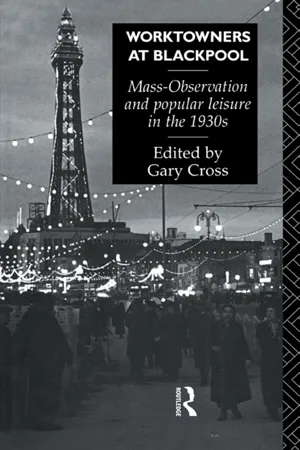
Gary Cross publishes the findings of this largely forgotten study by the Mass-Observers who followed the annual pilgrimage of labourers to Blackpool, hoping to discover what attracted workers to this centre of Victorian culture.
Information
Part 1
1
WORK
Blackpool is visited annually by 7,000,000 visitors who breathe the sea air and throng the 5,000 sideshows and joy-machines. They are greeted by the pierrots, the Sharma Yogis and the Five-Legged Cow, the Headless Woman, the Museum of Anatomy with the female Jesus and the pregnant male, Colonel Barker and his or her bride, the relics of Stiffkey, Professor Aubrey Winston Grey with his pool-winning Buddha, and the Revivalist Pastor, Four-Square Jefferies, under the Big Tent. Chinamen sell May's Vests and Sally's Whatnots in sugar sweet while the Sheikh machines tell fortunes against a background of T. E. Lawrence and the Sphinx.
This is the rich outcrop of industrialism, the bright mirror of how the workers spend their week of freedom from factory and mine. Powerful, often dominant in Blackpool culture is the Negroid, the Indian, the Oriental, and the Buddhist. These counteract the regular emphases of the rest of the year, spent in inland towns where the air is not so fresh, where many of the Blackpool shows would be unshowable.
One such town is Worktown, the town where we have been working on an intensive Mass-Observation survey for nearly two years. Blackpool and Worktown are essentially integrated. 95 per cent of Worktown's population have been there, 38 miles away — many more than have been to Manchester, which is nearer. So we have studied both Blackpool and Worktown, side by side, simultaneously, with headquarters and permanent personnel in each place. In this book we are going to give a picture of English civilisation which may at times seem un-English. In order to understand how Lancashire industrialism produced ‘Europe's greatest seaside resort’, we must understand how industrialism works in terms of all the ordinary people involved in it.
THE THREAD OF COTTON
Worktown's 170,000 people live on cotton; on cotton today it still manages to keep rates down, unemployment fairly well up, chimneys smoking many tons a year on to the slate roofs of 50,000 houses, mostly in continuous gardenless rows, 75 per cent with four rooms (14 per cent less), mainly without baths and with exterior lavatories. The trees in the parks have black stems and the town offers only 1 acre of open space per 500 people. Of 65,000 people employed, over half work in branches of the cotton industry.1
Axis to the cotton industry is the spinning section of the cotton industry. Employing relatively few people, it is nevertheless the vital link in the thread of cotton. Most basic is the ‘wheel-gate’, the space between two spinning-mules, generally about 42 yards long, 6 yards wide. With their rows and rows of bobbins of white cotton, the lower platform of the mules continually moves out and draws the thread towards the centre of the alley-way, then moves back, with the whistle of thread and the bump of the wheels on the rails. That happens about 235 times an hour. In this alley-way, three men work: the ‘spinner’, the ‘side-piecer’, and the ‘little-piecer’. All day long they walk up and down the alley-way, barefoot on the oily surface, stepping with precision without looking over the numerous rails, covering up to 20 miles a day with eyes trained on the whirling lines of cotton. The moment one breaks, you must ‘piece it up’, leaning over as the platform goes in towards the fixed part, and twisting quickly with thumb and first finger to rejoin the delicate broken ends of thread, with a cheap crude oil, spraying scrotal cancer down on your overalls. During these hours, life does seem to hang on a thread.
The spinner gets piece rates on a system of payment so complicated that only a few experts can really calculate it. He is the aristocrat of the mill workers, and his union has built a great hall, where most other unions and the Labour Party meet. It is bigger and more ornate than Conservative or Liberal headquarters. The piecers do, in effect, the same job as the spinner, though without the responsibility. Before the decline after 1920, the piecer was sure to get promoted to spinning. Now the alley between the mules is a dead-end: only about one in eight piecers have a chance of ‘getting their wheels’. In consequence many piecers are now becoming middle-aged.
In 1937, the side-piecer and little-piecer, who are paid directly by the spinner, were receiving respectively 30 and 18 shillings per week. A married side-piecer would thus benefit economically by getting the sack. Recently these wages have been upped to just above the unemployed level. Yet most piecers have to pay dues to the spinners' unions, in which they have no vote and no delegated representation. These earnings seem absurdly low; but in Lancashire, the family is still the economic unit. The wife continues at work until her husband is promoted or until the care of the children becomes too burdensome. After a period of straightened means, the family budget improves: children go to work in the mill and family income increases as they grow older, since they remain at home until marriage and pay in their earnings to their mother, only receiving back a few shillings as pocket money.
Others work in weaving sheds which typically contain about 1,250 looms. The duty of the weaver is to watch for any breakages in the weft and to stop the loom and repair them when they occur. Under the old system, still widely in force, each weaver tended four looms, but would take on two more when assisted by a ‘tenter’ or juvenile learning the trade. The majority of the weavers are women; but the overlookers, who usually supervise about eighty looms each, are all male. The card-room, where girls work, prepares and cleans cotton for spinning; the noise is too great to enable speech, and card-room workers become skilful at lip reading.
The work [48 hours per week, including Saturday mornings] is exceedingly arduous. Eye strain especially affects ring-spinners [a more modern form of spinning which is gradually replacing the mules]. They are compelled to stand all day long in a narrow and confined space, with their eyes glued to the thread. [In the card-room, combers, if not careful, can get their hands trapped. Card tenters, brushing between machines, sometimes get caught by a moving belt or pulley.] The change from a humid atmosphere and the heat to the cold, bleak streets outside makes cotton operatives peculiarly subject to rheumatism and bronchial complaints, which are not improved by the smoke-laden air of the typical Lancashire town. Many mills are over a century old, so that the general amenities do not compare well with those of the most up-to-date factories. A diet of ‘hot-pot’, potato pie, meat pies, and fish and chips, bolted at breakfast or eaten in the heat and dust of the spinning room, is not conducive to good digestion.
Working for the first time in the cotton mills, three things impressed us most: 1) the way in which workers, some of them on the job twenty years, noticed the job and still felt the effects of heat, dust, and high humidity [of the mill]; 2) the constant focus on the clock or redlight in the trajectory of the day's work; and 3) the constant focus of interest on Friday in the trajectory of the week's work. [So let's take a look at that workday and week.] Most mill workers rush their breakfasts, or take a sandwich in paper and arrive some minutes early, while older men often arrive regularly twenty to thirty minutes ahead of time. Most walk to work but others get there by any of the tram lines which radiate on a complex loop from the town centre. The majority must be at work by 7:45.
Piecers made reports and kept diaries of their jobs. This one is representative of talk before and after work:
As we turned into our spinning-room, one spinner said, ‘Oh, it's not so bad’ (meaning the temperature of the room). Another spinner said: ‘Aye, but wait till we've been running five minutes.’ [The first spinner responded:] ‘Yes they'll have to carry us out tonight!’ [He] reached his pair of mules, shouted after looking at the thermometer, ‘It is ninety degrees now.’Dinner time, 12:15, as the engine stopped and everyone rushed out, a worker said, ‘Is it warm enough?’5:30 Coming out. A side-piecer says, ‘It's like breathing fire in here.’
During the day the under-manager during his prowl round saw that the windows in our room were open about 1 inch. He complained to the spinners and made them close them.
[Another observer wrote]:
In the mill the job is such that it demands constant attention. The machines need watching continually lest there is a hitch somewhere. Even when there is a pause when nothing needs doing and the tenters are resting on the machine, they are constantly glancing up and down the line. This is firstly, to see that all is well with them and, secondly to be on the look-out for the overlooker. … Most of the windows are of frosted glass. One or two are of plain glass, and give a view of the two factories opposite. … I often look out, but I have never yet seen anyone else looking out, even in the dinner-hour.
Frosted glass, in the weaving and doubling rooms, keeps the sun from affecting the cotton. Lest the threads should dry and snap, an atmosphere of tropical heat and humidity is maintained.
In all departments of the mill, the climax to the day is when the red bulb flashes for a second at one corner of the great room. Everyone waits, watches for that, clothed and ready to rush the swing doors and go out into the air. With a rush and scramble, workers stream out of the mill the moment the red light goes at 5:30. Flecked all over with pieces of cotton waste, they seem to have come from some internal snowstorm.2 The route to and from work is so familiar that the only things in which people take an interest are the people ahea...
Table of contents
- Cover
- Half Title
- Full Title
- Copyright
- CONTENTS
- Introduction: Mass-Observation and Worktowners at play
- Editor's note
- Part 1
- Part 2
- Part 3
- Part 4
- Part 5
- Afterword: Mass-Observation's Blackpool and some alternatives
- Index
Trusted by 375,005 students
Access to over 1.5 million titles for a fair monthly price.
Study more efficiently using our study tools.
Frequently asked questions
Yes, you can cancel anytime from the Subscription tab in your account settings on the Perlego website. Your subscription will stay active until the end of your current billing period. Learn how to cancel your subscription
No, books cannot be downloaded as external files, such as PDFs, for use outside of Perlego. However, you can download books within the Perlego app for offline reading on mobile or tablet. Learn how to download books offline
Perlego offers two plans: Essential and Complete
- Essential is ideal for learners and professionals who enjoy exploring a wide range of subjects. Access the Essential Library with 800,000+ trusted titles and best-sellers across business, personal growth, and the humanities. Includes unlimited reading time and Standard Read Aloud voice.
- Complete: Perfect for advanced learners and researchers needing full, unrestricted access. Unlock 1.5M+ books across hundreds of subjects, including academic and specialized titles. The Complete Plan also includes advanced features like Premium Read Aloud and Research Assistant.
We are an online textbook subscription service, where you can get access to an entire online library for less than the price of a single book per month. With over 1.5 million books across 990+ topics, we’ve got you covered! Learn about our mission
Look out for the read-aloud symbol on your next book to see if you can listen to it. The read-aloud tool reads text aloud for you, highlighting the text as it is being read. You can pause it, speed it up and slow it down. Learn more about Read Aloud
Yes! You can use the Perlego app on both iOS and Android devices to read anytime, anywhere — even offline. Perfect for commutes or when you’re on the go.
Please note we cannot support devices running on iOS 13 and Android 7 or earlier. Learn more about using the app
Please note we cannot support devices running on iOS 13 and Android 7 or earlier. Learn more about using the app
Yes, you can access Worktowners at Blackpool by Gary Cross in PDF and/or ePUB format, as well as other popular books in Historia & Historia del mundo. We have over 1.5 million books available in our catalogue for you to explore.