- 368 pages
- English
- ePUB (mobile friendly)
- Available on iOS & Android
eBook - ePub
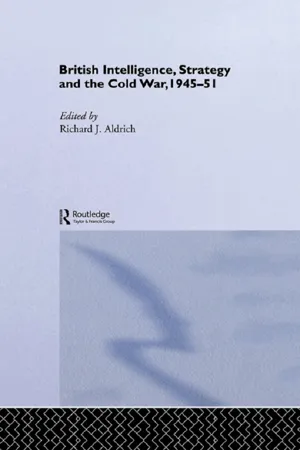
British Intelligence, Strategy and the Cold War, 1945-51
About this book
The Cold War is often considered to be the quintessential intelligence conflict. Yet secret intelligence remains the `missing dimension' of Britain's Cold War history. This volume offers an authoritative picture of Britain's clandestine role in the development of the Cold War focusing upon the key issues of intelligence and strategy.
Part I
INTELLIGENCE
THE ‘COLD WAR’
The Directors of Intelligence …set about it in no uncertain way. Their paper reviewed Communist policy, emphasized that the keystone of this policy was the inevitability of a struggle in order to establish Communism throughout the earth, and summed up the Communist policy by saying that the only method of preventing the Russian threat from ever materializing is by utterly defeating Russian Communism.For the first time in our history a totalitarian organization of states is attempting to impose its will upon us by undiplomatic means other than armed conflict — conveniently described as ‘cold war’. We could not win the ‘cold war’ unless we carried our offensive inside Russia and the satellite states. In fact what was required was a world-wide offensive, using every available agency. To date we had failed to unify our forces ten oppose Soviet ‘cold war’ aggression.It was agreed … that the whole question of intelligence about Russia should be reviewed. … Perhaps at this late hour there will be a proper set-up to control and direct this very important aspect of our national defence. It must also be hoped that the clock is not on the point of striking.(Montgomery, September 1948)
1
Secret intelligence for a post-war world:
reshaping the British intelligence
community, 1944–51
Richard J. Aldrich
It has been argued that a coherent and relatively well-ordered British intelligence ‘community’ emerged only during the Second World War, in no small part due to the efforts of Winston Churchill.1In this chapter it will be suggested that attempts to perpetuate this overall coherence beyond 1945 lost their way in the bureaucratic and political upheavals at the end of the war. These upheavals found their focus not only within Whitehall and Westminster but also in remarkable public exchanges during the election campaign of June 1945. The process of reshaping Britain's intelligence community remained ad hoc and incremental until the emergence of controversial centralized ‘Cold War planning’ mechanisms in late 1948.
Because of the absence of any comprehensive restructuring, the late 1940s were a period of continuity rather than radical change for the intelligence community. Confronted with the unfamiliar problems of an East-West conflict conducted ‘by all means short of war’, Whitehall gradually returned to the doctrines of the wartime subversive organizations, the Special Operations Executive (SOE) and the Political Warfare Executive (PWE), for a response. Elements of SOE and PWE were revived on an ad hoc basis even before they had reached a state of complete dissolution. Important continuities of personnel and doctrine were thus facilitated. Similar observations could be made regarding inter-allied co-operation: the Cold War spurred the elaboration of a network of pre-existing wartime agreements between the English-speaking powers. Meanwhile, the nature of the changes that did occur in 1945 and 1946 can also be seen as a legacy of the war, leaving a variety of bureaucratic scores to settle within Whitehall. These often found their expression in the individual post-war reviews conducted within each separate intelligence service.
In 1945 the recognition of the increased danger of surprise attack due to the advent of weapons of mass destruction and also ballistic rockets ensured that there was no possibility of the rapid contraction of intelligence services, as had occurred in 1919. The Chiefs of Staff (COS) now gave a high priority to ‘national’ or ‘strategic’ intelligence with Soviet strategic weapons development as the highest priority intelligence target. Thus intelligence appears to have suffered less under post-war austerity than other aspects of defence. As early as 1945, Victor Cavendish-Bentinck, the retiring chairman of the Joint Intelligence Committee, persuaded the COS of the principle that the intelligence structure should remain intact.2In May 1947, as austerity began to bite hard, the COS reaffirmed this in their definitive statement of ‘Future Defence Policy’, DO (47) 44. They insisted that within the Soviet Union
the high standard of security achieved renders our collection of intelligence difficult and makes it all the more likely that Russia will have the advantage of surprise at the outset….It is of the greatest importance that our Intelligence organisation should be able to provide us with adequate and timely warning. The smaller the armed forces the greater the need for developing our Intelligence Services in peace to enable them to fulfil this responsibility.3
But, tor a variety of complex reasons that will now be explored, this sense of high importance was never translated into a comprehensive attempt to review and recast Whitehall's intelligence system to meet new conditions.
INTELLIGENCE AT THE TOP
One of the most important legacies of the Second World War was a relatively integrated intelligence community, rather than a coterie of separate agencies. Until the late 1930s, Britain lacked not only an organization that oversaw the systematic collation, evaluation and interpretation of intelligence, but also any central body responsible for the co-ordination of the various services. The mechanism which increasingly addressed these functions after its reorganization in July 1939 was the Joint Intelligence Committee QIC), a COS subcommittee, albeit chaired by a senior Foreign Office official. During the war the JIC undertook not only interpretation but also a managerial role, being instructed to ‘improve the efficient working of the intelligence organisation of the country as a whole’. This extended to resolving arguments between different intelligence services.4 Changes in the role of the JIC in the post-war period offer important insights into the problems of reshaping intelligence for peacetime duties.
After 1945, the JIC remained the focus of strategic intelligence and an important link between the military, the diplomats and the intelligence community. Chaired by the head of the Foreign Office Service Liaison Department, the membership of the JIC included the heads of Service intelligence departments and of SIS and MI5 (the Security Service), with others in regular attendance.5Although the JIC received a new charter on 17 February 1948 emphasizing its established military role, ‘giving higher direction to operations of defence intelligence and security’, in practice its remit remained wider.6Significantly, in 1948 and at the suggestion of the Foreign Secretary, Ernest Bevin, the JIC membership was expanded to incorporate a Colonial Office member, reflecting the growing insurgency problems in areas like Malaya.7The extent to which the JIC continued to be the primary form of work-a-day intelligence co-ordination was underlined by the decision to retain the subordinate regional JICs that had developed within wartime commands in Europe, the Middle East and Asia.8
The co-ordinating work of the JIC was supplemented by a plethora of additional mechanisms. Wartime dissatisfaction with liaison between SIS and its political master, the Foreign Office, had led to the appointment of a Foreign Office official, Patrick Reilly, as Personal Assistant to Sir Stuart Menzies, the Chief of SIS, in 1942. In 1943 Reilly was succeeded by Robert Cecil, who remained until 1946. In addition the London Signals Intelligence Board and Committee co-ordinated signals intelligence matters while the London Controlling Section dealt with deception: all three survived into the post-war period. Meanwhile much business was conducted at the informal level in the clubland of Pall Mall (especially Whites).9As such, the JIC, until 1949, remained the hub of a complex wheel.
Economic austerity was an important motive behind the creation of a new topographic intelligence centre serving the JIC, the Joint Intelligence Bureau (JIB) headed by Eisenhower's wartime intelligence chief, General Strong.10Its inter-Service nature was intended to ‘prevent overlapping and achieve economy’, while obtaining its information ‘from all overt sources and SIS’.11The JIB defined its role in grandiose terms, but in reality the JIB merely collated topographic and economic intelligence along with political background of the sort required for operational planning at the inter-Service level.12Their initial tasks included surveys of Empire ports and of the Persian Gulf. At their first meeting in 1946 they declared their intention of establishing regional JIBs along the lines of the JIC.13The result was a JIB Middle East and a JIB Australia covering the Far East with a small outstation at Singapore.14
Despite this elaboration of the JIC system, problems remained. The JIC had, above all, been established as part of the machinery for the higher strategic direction of the war, assisting in the incorporation of ‘ultra’ signals intelligence material into command decisions. But it was less effective in co-ordinating and adjudicating between the myriad intelligence services and organizations tasked with subversive activities such as propaganda (PWE) and guerrilla warfare (SOE), a role the JIC shared with a number of Foreign Office committees.15Co-ordination was complicated by the fact that SOE came under its own separate ministry. Consequently, in wartime Whitehall, as the diaries of senior figures such as Cadogan, Dalton or Lockhart testify, these subversive organizations had quickly become a byword for back-biting and administrative confusion.16
Arguably, until 1945 this co-ordination problem had been ignored because subversion, while not insignificant, was nevertheless peripheral compared to the grand strategic direction of the war. But subsequently, in the context of an East-West conflict conducted by all means short of war, subversion and other forms of covert action would increasingly constitute central instruments in this struggle. Particularly with the advent of the Soviet Cominform in the autumn of 1947, the Foreign Office moved towards a containment policy that included elements of ‘offence’ as well as defence, requiring it to resolve the familiar wartime problem of the co-ordination of a wide range of clandestine agencies and their activities, particularly unacknowledged or ‘black’ propaganda. In 1948 pressure from the COS and from permanent officials in the Foreign Office prompted discussions on the need for a ‘permanent Cold War planning staff to manage this clandestine effort. Subsequent moves t...
Table of contents
- Cover Page
- Half Title page
- Title Page
- Copyright Page
- Contents
- List of Contributors
- Foreword
- Acknowledgements
- Abbreviations
- Documentary References
- Introduction Intelligence, strategy and the Cold War
- Part I Intelligence
- 1 Secret intelligence for a post-war world: reshaping the British intelligence community, 1944–51
- 2 Anglo-Soviet intelligence co-operation and roads to the Cold War
- 3 Covert action within British and American concepts of containment, 1948–5l1
- 4 A very British crusade: the Information Research Department and the beginning of the Cold War
- 5 British Cold War defectors: the versatile, durable toys of propagandists
- Part II Strategy
- 6 ‘We must cut our coat according to our cloth': the making of British defence policy, 1945–8
- 7 The ‘Western Union' concept and British defence policy, 1947–8
- 8 Britain's strategy for Europe: must West Germany be rearmed? 1949–51
- 9 In the back room: Anglo-American defence co-operation, 1945–51
- 10 The rise and decline of a strategic concept: the Middle East, 1945–51
- 11 British strategy and the end of Empire: South Asia, 1945–51
- 12 South East Asia and British strategy, 1944–51
- Select bibliography
- Index
Trusted by 375,005 students
Access to over 1.5 million titles for a fair monthly price.
Study more efficiently using our study tools.
Frequently asked questions
Yes, you can cancel anytime from the Subscription tab in your account settings on the Perlego website. Your subscription will stay active until the end of your current billing period. Learn how to cancel your subscription
No, books cannot be downloaded as external files, such as PDFs, for use outside of Perlego. However, you can download books within the Perlego app for offline reading on mobile or tablet. Learn how to download books offline
Perlego offers two plans: Essential and Complete
- Essential is ideal for learners and professionals who enjoy exploring a wide range of subjects. Access the Essential Library with 800,000+ trusted titles and best-sellers across business, personal growth, and the humanities. Includes unlimited reading time and Standard Read Aloud voice.
- Complete: Perfect for advanced learners and researchers needing full, unrestricted access. Unlock 1.5M+ books across hundreds of subjects, including academic and specialized titles. The Complete Plan also includes advanced features like Premium Read Aloud and Research Assistant.
We are an online textbook subscription service, where you can get access to an entire online library for less than the price of a single book per month. With over 1.5 million books across 990+ topics, we’ve got you covered! Learn about our mission
Look out for the read-aloud symbol on your next book to see if you can listen to it. The read-aloud tool reads text aloud for you, highlighting the text as it is being read. You can pause it, speed it up and slow it down. Learn more about Read Aloud
Yes! You can use the Perlego app on both iOS and Android devices to read anytime, anywhere — even offline. Perfect for commutes or when you’re on the go.
Please note we cannot support devices running on iOS 13 and Android 7 or earlier. Learn more about using the app
Please note we cannot support devices running on iOS 13 and Android 7 or earlier. Learn more about using the app
Yes, you can access British Intelligence, Strategy and the Cold War, 1945-51 by Richard J. Aldrich in PDF and/or ePUB format, as well as other popular books in History & World History. We have over 1.5 million books available in our catalogue for you to explore.