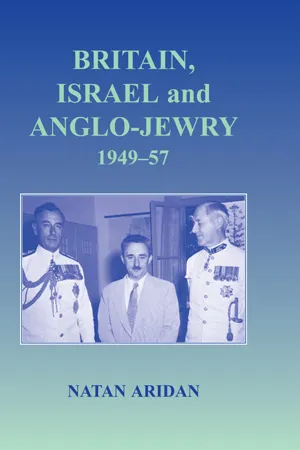
- 336 pages
- English
- ePUB (mobile friendly)
- Available on iOS & Android
eBook - ePub
Britain, Israel and Anglo-Jewry 1949-57
About this book
This book focuses on the bilateral and multilateral relations between Britain, the 'former proprietor' and Israel, the 'successor state', during the period following their armed clash in January 1949, to Israel's withdrawal from the Gaza and the Sinai in March 1957. It highlights the formulation of foreign policy decisions in Britain and Israel; Britain's special responsibility and influence, which affected Israel's relations with neighbouring Arab states; Israel's complex policy towards Britain; Anglo-Jewry's attitude towards Israel and the distinctive relationship between Israel's embassy in London and the Jewish community.
1
Playing the trump card: the protracted recognition of Israel, January 1949–April 1950
BRITAIN’S POLICY OF NON-RECOGNITION OF ISRAEL: MAY 1948–JANUARY 1949
Britain failed to dictate the outcome of the 1948 war and reluctantly accepted the permanent existence of Israel, whom it regarded throughout the period as an ‘irritant’ and an impediment to improved ties with the Arab States.1 Britain was resolved to use its trump card, recognition of Israel, as a quid pro quo for US recognition of Jordan’s union with the West Bank.2 Despite Israel’s deep suspicion of British policy, which included arming and maintaining military alliances with neighbouring Arab states, it acknowledged Britain’s considerable influence in the region and the fact that Britain remained an important source in ensuring the flow of vital supplies essential to its survival.
Although the US accorded Israel de facto recognition on 14 May 1948, Britain withheld recognition because it did not consider Israel a legitimate power.3 Res nuillius was a tenuous argument that reflected aspirations for an Arab victory:
If the Arab armies invade the territory of Palestine but without coming into conflict with the Jews they would not necessarily be doing anything illegal, or contrary to the UN Charter. If they cross the frontiers recommended by the UN Resolution of November 29th for the Jewish state, they would for the reasons given above, not ipso facto be doing anything illegal.4
In the absence of formal diplomatic relations, Cyril Marriott, British Consul in Haifa, was instructed to represent British interests ‘in the area’. He had little experience in Palestine issues and admitted that he was unsuitable for the task. His comments about Jews were tinted with anti-Semitism. His ‘experience of Jews was gained in Roumania, where one knew if there was a dirty house in the village, it was the Jews’. In New York he, ‘rarely met the Jews in a decent society’.5 On 1 June, he warned the Mayor of Haifa: ‘Should you bomb the aerodrome at Amman or hit any British craft we shall blast every Jewish aeroplane in the air and on the land all over Palestine.’ When told that the Provisional Government was the appropriate authority, Marriott retorted that ‘the State of Israel did not exist’.6
Israel did little to ease Marriott’s anomalous position in Haifa. He understood that his insistence on being accorded diplomatic status was out of the question because Britain refused diplomatic privileges to his Israeli counterpart in London.7 A thaw in policy came in November when an informal British delegation visited Israel. Marriott attended events as a guest of the ‘Provisional State of Israel’, unthinkable a month before.8
Britain erroneously claimed that its policy of non-recognition was in line with the French. Walter Eytan, Director General of the Ministry for Foreign Affairs (MFA) regularly met with French representatives who communicated with the ‘Foreign Secretary of Israel’. He granted an interview whenever one was requested.
The MFA was pessimistic about British recognition of Israel in the immediate future. Anxious to establish ties, an interim solution was found whereby Joseph Linton, a member of the Jewish Agency and a British citizen was appointed Consul-General in London.9 Britain made no reciprocal plans for Tel-Aviv.10 Ernest Bevin, Foreign Secretary, considered establishing a consulate in Tel-Aviv, which would provide useful unofficial contacts with the ‘Jewish authorities’. However, this normal means for establishing contacts, short of recognition, was considered ill advised by the Foreign Office, which feared offending the Arabs.11
A fundamental factor in Bevin’s policy towards Israel was the fear of Soviet penetration. He claimed that Palestine was vulnerable to communist influence because there was no stable electorate and that Russian-trained communists served in the Haganah. Even the leader of the right-wing Etzel, Begin, was reported to have been an active communist in Poland before reaching Palestine. Bevin stated that 40 per cent of the members of the Histadrut veered to the ‘East’ and that 20 per cent would follow an extreme left-wing party. This was used as a further pretext for withholding recognition.12
Bevin was obdurate in refusing to recognize Israel: ‘There are certain lines over Palestine from which I cannot deviate. I do not…intend in the near future to recognise the Jewish State and still less to support any proposal that it should become a member of the United Nations.’13
The question of recognition was first raised in Cabinet on 27 May when it was suggested that it ‘might be embarrassing to withhold recognition, if other Commonwealth Governments accorded it’. Bevin responded that member nations. conducted their own policy, but he omitted that British pressure was being brought to bear on the Dominions to withhold recognition. It is pertinent to note that Bevin’s references to the State of Israel were interchanged with ‘the Jewish state’, ‘the Jewish authorities’ and, ‘the Jewish provisional government’.14 Bevin later conceded that the Arabs had done little to deserve British friendship. However, ‘any sign of a more forthcoming attitude towards the Jews would convince the Arabs that they have no more hope from the Western powers, and induce in them a dangerous mood of desperation in which other counsels might prevail’.15
A further justification for Britain withholding recognition was its insistence that the whole of Israel was ‘occupied territory’ and that Israel’s borders remained unsettled.16 In the case of the ‘Jewish authorities’ in Palestine, it was ‘by no means clear what are the exact boundaries of the area which they at present administer. In any event, this area is not identical with that which they claim for permanent inclusion within their state’ Britain opposed Israel’s claim to the whole Negev in accordance with the UN partition.17
Harold Lever, Labour MP, dismissed the argument that a state could be recognized only when its borders have been defined as groundless and has no basis in history at all’. Winston Churchill, Leader of the Conservative opposition, derided government policy: ‘De facto recognition has never depended upon an exact definition of territorial frontiers. There are half-a-dozen countries in Europe, which are recognised today whose territorial frontiers are not finally settled. Surely, Poland is one.’18
Bevin maintained that Britain’s refusal to recognize Israel was realistic given that no Arab leader was willing to sit with the ‘Foreign Minister of the State of Israel’.
It appears fairly clear that a Jewish state of some kind will form part of the eventual Palestine settlement, but the state, which the Jews now claim to have set up still falls far short of the normal criteria demanded for recognition, and the aggressive declarations of the Jewish leaders are not consistent with their desire to be accepted as a member of the United Nations.19
He told Parliament that Jordan would be ‘allowed’ to annex the Arab areas of Palestine and that something should ‘be done’ about the ‘unfortunate’ occupation of the Galilee by the Jews.20 Bernadotte’s assassination was a further setback to Britain’s designs to limit Israel’s military successes.21
Britain maintained and commanded the Arab Legion fighting in Jerusalem. When asked in Parliament whether British officers were participating in the Arab Legion’s invasion of Israel, Bevin replied that they were not. Technically, he was correct since at that moment, the officers were ‘relieved’ of their duties, only to have them reinstated the following day.
The US disparaged Britain’s military involvement in Palestine and of its refusal to recognize Israel. Bernard Burrows, Director of the Eastern Department, urged that: ‘We can repeat to the Americans that our attitude on recognition will depend on the success of the plan on which we are working, and we could perhaps add that we have always considered our recognition as a valuable card, which must be played to its best advantage.’22
The Government’s policy of non-recognition became increasingly untenable. The Cabinet proposed that although it ‘might be unable as yet to recognise the Israeli Government, it would be convenient to find some practical arrangement that could be made for establishing direct communication with that government’.23 Bevin was instructed to explore a practical means of establishing direct channels with Israel without formal recognition and to report on the progress of the discussions on Palestine at the UN. The British consuls in Jerusalem and Haifa were instructed not to deal directly with the ‘Jewish authorities in Tel-Aviv’.
A major impediment to Anglo-Israeli relations was the future of the 11,000 Jewish detainees still incarcerated by Britain in Cyprus who desired to emigrate to Israel. The Chiefs of Imperial General Staff (CIGS) were adamant that men and women of military age should not be released because they would eventually strengthen the Israel Defence Forces (IDF).24 Bevin made their release contingent on support for Jordan’s application to the UN.25 In December, detainees under military age continued to la...
Table of contents
- Cover
- Halftitle
- Title
- Copyright
- Dedication
- Contents
- List of illustrations
- Acknowledgements
- List of abbreviations
- Introduction
- 1 Playing the trump card: the protracted recognition of Israel, January 1949–April 1950
- 2 Cutting and retying the umbilical cord: the sterling balances and the nurturing of bilateral ties, 1949–1954
- 3 Israel’s place in British strategic planning, 1949–1951
- 4 Israel’s place in British defence policy in the shadow of the Anglo-Egyptian negotiations, 1951–1954
- 5 ‘Nibbling at the edges’: border tensions and the search for an interim Arab-Israeli settlement
- 6 Adversaries and reluctant partners: the Sinai-Suez Crisis 1956–1957, a retrospective
- 7 Defining the relationship: Anglo-Jewry and Israel
- Conclusion
- Bibliography
- Index
Trusted by 375,005 students
Access to over 1.5 million titles for a fair monthly price.
Study more efficiently using our study tools.
Frequently asked questions
Yes, you can cancel anytime from the Subscription tab in your account settings on the Perlego website. Your subscription will stay active until the end of your current billing period. Learn how to cancel your subscription
No, books cannot be downloaded as external files, such as PDFs, for use outside of Perlego. However, you can download books within the Perlego app for offline reading on mobile or tablet. Learn how to download books offline
Perlego offers two plans: Essential and Complete
- Essential is ideal for learners and professionals who enjoy exploring a wide range of subjects. Access the Essential Library with 800,000+ trusted titles and best-sellers across business, personal growth, and the humanities. Includes unlimited reading time and Standard Read Aloud voice.
- Complete: Perfect for advanced learners and researchers needing full, unrestricted access. Unlock 1.5M+ books across hundreds of subjects, including academic and specialized titles. The Complete Plan also includes advanced features like Premium Read Aloud and Research Assistant.
We are an online textbook subscription service, where you can get access to an entire online library for less than the price of a single book per month. With over 1.5 million books across 990+ topics, we’ve got you covered! Learn about our mission
Look out for the read-aloud symbol on your next book to see if you can listen to it. The read-aloud tool reads text aloud for you, highlighting the text as it is being read. You can pause it, speed it up and slow it down. Learn more about Read Aloud
Yes! You can use the Perlego app on both iOS and Android devices to read anytime, anywhere — even offline. Perfect for commutes or when you’re on the go.
Please note we cannot support devices running on iOS 13 and Android 7 or earlier. Learn more about using the app
Please note we cannot support devices running on iOS 13 and Android 7 or earlier. Learn more about using the app
Yes, you can access Britain, Israel and Anglo-Jewry 1949-57 by Natan Aridan in PDF and/or ePUB format, as well as other popular books in History & Middle Eastern History. We have over 1.5 million books available in our catalogue for you to explore.