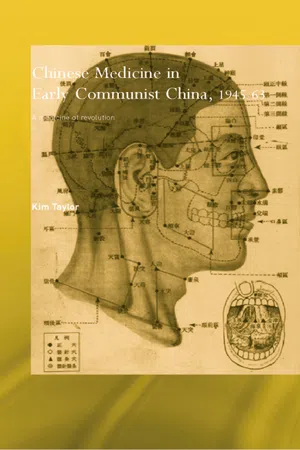
Using original sources, this significant text looks at the transformation of Chinese medicine from a marginal, side-lined medical practice of the early twentieth century, to an essential and high-profile part of the national health-care system under the Chinese Communist Party. The political, economic and social motives which drove this promotion are analyzed and the extraordinary role that Chinese medicine was meant to play in Mao Zedong's revolution is fully explored for the first time, making a major contribution to the history of Chinese medicine.
Civil war in China and the new acupuncture, 1945–9
This chapter describes the initial contact of the CCP with Chinese medicine during the desperate times of guerrilla warfare in the Civil War. It was the period when Chinese medicine came to be embraced into the Communist Revolution and this chapter describes the ensuing promotion of Chinese medicine, not so much at the hands of traditional doctors, but at the hands of Western medical doctors. Mao called for the ‘co-operation of Chinese and Western medical doctors’
in Yan’an in 1944, but was not explicit as to how such a co-operation might be achieved. His slogan was interpreted as a general ‘scientification of Chinese medicine and popularization of Western medicine’
In order to remove the feudalist and superstitious elements of Chinese medicine, some physicians attempted a rigorous transformation of the medicine according to the foremost precepts of the Communist Revolution, i.e. those of ‘new’, ‘scientific’ and ‘unified’. Acupuncture came to represent this ‘new’ medicine largely because of its practical value during wartime. This chapter is based on the work of dedicated Party member Zhu Lian, who at the time was deputy director to the Yan’an China Medical University. She published in 1951 a major work called The New Acupuncture
which embodied the political, social and economic circumstances of revolutionary China. The ‘new acupuncture’ was an unusual amalgam of Chinese medical techniques and politically correct scientific theories. A study of it demonstrates how the scope for intellectual freedom was significantly narrowed by Communist Party political guidelines, to the extent that medical efficiency was subordinated to Party criteria. This chapter will situate the ‘new acupuncture’ in the environment which created it and examine its unique medical theory.
The Civil War (1945–9) in China was the culmination of a twenty-year-long conflict between the Nationalist and Communist Parties in mainland China. It resulted in the unexpected triumph of the militarily inferior CCP, largely a result of a well-organized campaign and also a structured ideological framework that appealed to the peripheral but numerous elements of society, ostracized by the urban-based Nationalist Party. Much of this ideology was the product of Party leader Mao Zedong
(1893–1976)’s unique concept of China’s rightful place in global society and of its particular stage in the evolution of Communism. Much of his theorizing was carried out in the isolated reaches of Yan’an, the desert backwater where a much depleted but ever resilient core force of the CCP had arrived after relentless persecution from the Nationalist Party had forced them to embark on the many trials and tribulations of the Long March (1934–5). Here Mao was able to rethink the strategies of the CCP, if they were to succeed in leading China independently from the Nationalist Party. The CCP needed to convince the people in the base areas that they had a policy programme capable of guiding China to victory through the present state of war, and capable also of providing a strong and consolidated government in the future. Such a plan for the future was presented by Mao in his key text ‘On New Democracy’ (xin minzhu zhuyi
), published on 19 January 1940 in the debut edition of the CCP journal Chinese Culture (zhongguo wenhua
).1
In ‘On New Democracy’ Mao reaffirmed socialism as the Party’s ultimate goal, and appealed to the wider public to join the Communists in their efforts to rebuild China. He defined China’s revolutionary path and the role to be played by the Communist Party in this revolution. Mao stated that ‘we want not only to change a politically oppressed and economically exploited China into a politically free and economically prosperous China, but also to change a China which has been ignorant and backward under the rule of the old culture into a China that will be enlightened and progressive under the rule of a new culture. In a sentence, we want to build up a new China’.2 Mao was thus suggesting not merely political and economic reform, but an entire upheaval of cultural roots to produce a free-thinking and independent ‘new democratic culture’ which would transform Chinese society and give rise to an enlightened and prosperous new China.
In Mao’s definition of this ‘new democratic culture’, he was to use three words which were to describe its development. These were ‘new’ (xin
), ‘science’ (kexue
) and ‘unity’ (tuanjie
). The term ‘new’ implied free from superstition and the heavy links to a feudal past. Instead the components of the new culture would have to be forward-moving and enterprising. Mao advocated that such a change would be possible through the use of ‘science’. By ‘science’ Mao was not so much referring to the science linked with the Western investigation of nature, but more to the Marxist ideal of science as the criteria for true knowledge. For Mao stated that ‘this type of new democratic culture is scientific. It is opposed to all fe...
Table of contents
Cover
Title
Copyright
Contents
List of figures and tables
Acknowledgements
Introduction
1 A new, scientific and unified medicine: civil war in China and the new acupuncture, 1945–9
2 Pathway for the new medicine: the unification of Chinese and Western medicines, 1949–53
3 Modernizing the old: the creation of a ‘Traditional’ Chinese Medicine, 1953–6
4 Establishing a national treasure trove of TCM: the standardization of Chinese medicine, 1957–63
Conclusion
Appendix I: Names of first Chinese medical practitioners brought to Beijing from around China to staff the newly set up Research Academy of TCM in 1955
Appendix II: National TCM course curricula for years 1981 and 1997
Notes
Bibliography A: Western-language sources
Bibliography B: Chinese-language sources
Bibliography C: Articles from CCP government organs on Chinese medical policy
Bibliography D: List of interviewees
Index
Trusted by 375,005 students
Access to over 1.5 million titles for a fair monthly price.
Study more efficiently using our study tools.
Frequently asked questions
Yes, you can cancel anytime from the Subscription tab in your account settings on the Perlego website. Your subscription will stay active until the end of your current billing period. Learn how to cancel your subscription
No, books cannot be downloaded as external files, such as PDFs, for use outside of Perlego. However, you can download books within the Perlego app for offline reading on mobile or tablet. Learn how to download books offline
Perlego offers two plans: Essential and Complete
Essential is ideal for learners and professionals who enjoy exploring a wide range of subjects. Access the Essential Library with 800,000+ trusted titles and best-sellers across business, personal growth, and the humanities. Includes unlimited reading time and Standard Read Aloud voice.
Complete: Perfect for advanced learners and researchers needing full, unrestricted access. Unlock 1.5M+ books across hundreds of subjects, including academic and specialized titles. The Complete Plan also includes advanced features like Premium Read Aloud and Research Assistant.
Both plans are available with monthly, semester, or annual billing cycles.
We are an online textbook subscription service, where you can get access to an entire online library for less than the price of a single book per month. With over 1.5 million books across 990+ topics, we’ve got you covered! Learn about our mission
Look out for the read-aloud symbol on your next book to see if you can listen to it. The read-aloud tool reads text aloud for you, highlighting the text as it is being read. You can pause it, speed it up and slow it down. Learn more about Read Aloud
Yes! You can use the Perlego app on both iOS and Android devices to read anytime, anywhere — even offline. Perfect for commutes or when you’re on the go. Please note we cannot support devices running on iOS 13 and Android 7 or earlier. Learn more about using the app
Yes, you can access Chinese Medicine in Early Communist China, 1945-1963 by Kim Taylor in PDF and/or ePUB format, as well as other popular books in History & Chinese History. We have over 1.5 million books available in our catalogue for you to explore.