- 480 pages
- English
- ePUB (mobile friendly)
- Available on iOS & Android
eBook - ePub
Perception And Cognition Of Music
About this book
This text comprises of reviews of work relating to music and mind. It presents a range of approaches from the psychological through the computational, to the musicological. The reviews were selected from papers submitted at the Third International Conference on Music Perception and Cognition Liege 1994 to illustrate the wide range of perspectives now being adopted in studying how humans make and respond to music. The book is divided ino five sections. The first part illustrates the role of analysis and ethnomusicology in understanding cultural determinants of musical behaviour. The second part charts what is known about aquisition of musical competence, from pre-birth through to the expert performer. The evidence accumulated about specific areas of the brain which control musical thinking and behaviour is examined in Part Three. The fourth part examines how neurological, behavioural and artificial intelligence approaches are converging to shed light on processes in auditory perception. Finally, Part Five highlights the important developments in how we conceptualize the way in which musical structures are represented in the mind.
Information
Publisher
Psychology PressYear
2004Print ISBN
9781138877092
9780863774522
Edition
1eBook ISBN
9781135472238
V
Structural Approaches
14 Tonal relations
Lola L Cuddy
Department of Psychology, Queen’s University, Kingston, Canada
Department of Psychology, Queen’s University, Kingston, Canada
An important development for music perception and cognition in the last few decades is the flourishing interaction between experimental and music-theoretic approaches to systematic issues. According to Krumhansl (1995), the current psychological literature contains many and varied instances of the exchange urged in the 1950s in the writings of Meyer (1956) and Francès (1958/1988). Empirical studies of tonal relations, for example, have led to quantitative descriptions of listeners’ implicit knowledge of music-theoretic constructs; these descriptions portray the consistency and reliability of the internal representation of traditional tonal-harmonic structures. Moreover, and more recently, proposed theoretical structures for contemporary music have been subjected to experimental test, and the results have informed both analysis of psychological processes and critical evaluation of the theory. A particularly strong test of psychological proposals for music perception and cognition is offered when proposals are evaluated in the context of contemporary music (or composed excerpts with specially controlled properties).
In this chapter, I will provide an overview of the research issues engaged in our study of tonal relations (Cuddy, 1991, 1994), and will illustrate some connections between empirical results and music-theoretic constructs. I will first comment on the role of quantification and will illustrate research methods directed toward the quantification of the tonal hierarchy, taking the approach of Krumhansl and colleagues (Krumhansl, 1990). Next I will note convergence of the description of the tonal hierarchy that emerges from research findings with the description of stability conditions in Lerdahl’s (1988a, 1988b, 1989) extension of his tonal theory with Jackendoff (Lerdahl & Jackendoff, 1983). These considerations lead to questions about the constraints that are implied by the study of tonal relations within the Western tonal-harmonic system. I will then pursue the notion that principles of tonal relations, from both empirical and music-theoretic perspectives, may be applied to the study of listeners’ sensitivity to nontonal music structures.
QUANTIFICATION OF THE TONAL HIERARCHY
The study of tonality requires the analysis of complexity at many different levels, and is a challenge far beyond the scope of this chapter. I will deal primarily with elementary levels of description—the levels where the greatest control of experimental contexts can be obtained. This focus does not, however, mean that the findings are musically and psychologically trivial. On the contrary, the study of elementary levels conveys rich information about the delicate interface and interplay between the psychological processes of music perception and cognition. When musical elements as simple as scales and chord progressions engage a sense of tonality, we have evidence for many processes—the detection of raw acoustic attributes, detection of intervallic relationships, classification and categorisation, abstraction of a hierarchy of functions, and the application of knowledge. To illustrate: given the simple element C E G, a sense of the key of C depends on the input of sensory pitch information from the three sounded tones, the processing of relative information among the intervals formed by these tones, the detection of a tonal centre, C, from the pattern formed by the intervals, the assignment of function to the other tones sounded, and, finally, the assignment of function to tones not sounded. For example, once the key of C is established, our knowledge of tonal relations establishes the function of F even if F has not been sounded.
The above description is straight-forward, but detailed understanding of the nature, timing, and availability of the psychological processes engaged is not. To conduct research on these issues, a means of quantifying listeners’ sense of tonality is needed. With a quantitative approach, we can evaluate listeners’ sensitivity under different conditions, and examine how sensitivity changes with relationship to factors such as musical context, attention, learning, age, experience, and culture. Quantification provides a tool for testing the predictions of various theoretical formulations.
An important methodological contribution to the issue of quantification, called the probe-tone technique, was initiated in the late 1970’s by C. L Krumhansl and R.N.Shepard (see Krumhansl & Shepard, 1979); subsequent developments are summarised in Krumhansl (1990). Two versions have been constructed, the single-probe and the double-probe technique. In the singleprobe technique, a listener is presented with a musical context followed by a probe tone, one of the 12 tones of the chromatic scale. In a typical paradigm, the listener is asked to rate how well the probe tone fits the context in a musical sense. The set of 12 probe-tone ratings for a context is called the probe-tone profile for that context. In the double-probe technique, the listener is presented with a musical context followed by two probe tones, a pair of tones selected from the 12 tones of the chromatic scale. The listener is asked to judge the musical relationship, or similarity of function, of the first tone to the second tone, given the context.
Figure 14.1 displays standardised probe-tone profiles, collected by the single-probe technique, for the keys of C major and C minor (Krumhansl & Kessler, 1982). Profiles were obtained for contexts consisting of tonic triads, and chord cadences, and then averaged to form the standardised profiles shown in Fig. 14.1. The averaging of profiles is an important point to note; the standardised profiles are not intended to reflect local variation dependent on specific context, but, rather, reflect the overall regularity contained in profiles obtained from key-defining contexts. Thus, they provide a standard against which specific profiles, obtained in specific cases, can be compared.
Inspection of Fig. 14.1 reveals that the standardised profiles capture the hierarchy of function described by traditional music theory: the tonic receives the highest rating, followed by the other tones of the tonic triad, followed by the other scale tones, followed, finally, by the tones outside the scale.
The reliability and validity of tonal hierarchy measures collected by the probe-tone technique have been repeatedly demonstrated in our laboratory and elsewhere. One example is research conducted in collaboration with Willi Steinke (Steinke, Cuddy, & Holden, 1993; Steinke, Cuddy, & Peretz, 1994). Probe-tone ratings for musical contexts consisting of cadences in both the major and minor keys and a tonal melody in the major key were collected from a large sample of participants (n=100) over a wide range of age, formal education, and music training. Reliability was demonstrated in the finding that the ratings for all contexts reflected the levels of the tonal hierarchy recovered in the standardised profiles.
Moreover, validity was demonstrated in the finding that participants’ abilities to produce the levels of the tonal hierarchy in the probe-tone profiles were intercorrelated with other tests of sensitivity to tonal relations. These other tests included judgement of melodic endings, discrimination of tonal from atonal melodies, and discrimination of tonally conventional from nonconventional chord progressions. All tests involved ranking the most to least tonal stimulus along a continuum of tonality. Further analyses revealed that the intercorrelations could not be completely explained in terms of amount of musical training or in terms of performance on intelligence measures or other nonmusic tests of cognitive ability (e.g. standardised tests of abstraction, vocabulary, and memory). At Liège, we reported the results of factor analyses and model testing of these data (Steinke, Cuddy, & Peretz, 1994). A principle-components analysis revealed a dissociation between the music tests and the nonmusic tests; music tests loaded on one factor and the nonmusic tests on a second factor. Model testing ruled out alternative solutions, including dissociation between abstraction vs nonabstraction tests, auditory vs nonauditory tests and linguistic vs nonlinguistic tests.
In addition, we reported the data from a neurologically impaired individual, CN, who had a history of bilateral temporal-lobe surgery. CN had been classified as amusic but not aphasic (Peretz & Kolinsky, 1993). Compared to controls matched for age, gender, formal education and musical background, CN scored much lower on the music tests, but scored much the same on the nonmusic tests. Her data were consistent with the notion that there is functional specificity for certain music abilities; in the present instance there was a specific loss of tonal encoding of musical pitch.
Another validation of the tonal hierarchy measure recovered by the probetone technique has been obtained from studies of sensitivity to key shifts or modulations in a musical passage. Krumhansl and Kessler (1982) constructed chord sequences in which the type of modulation contained in each sequence was derived from Piston’s (1987) table of harmonic progressions. Probe-tone profiles were collected for each successive chord in each sequence. The findings outline how a sense of the first key of the sequence becomes established and then changes, over time, to a sense of the second key. Comparison of the findings for the different modulation types (e.g. near vs distant) were interpretable in terms of music-theoretic expectations, and also informed psychological descriptions of the unfolding processes tracking key movement in time.
Bill Thompson and I have pursued the application of probe-tone techniques to track the shifting sense of key in excerpts from Bach chorales (Cuddy & Thompson, 1992). More recently, we have been studying listeners’ sensitivity to modulations in harmonised sequences based on melodies composed by Hindemith (1968). In the course of this work, we have been analysing the performance expression for the sequences provided by an expert pianist (Thompson & Cuddy, 1994, in press), and we presented some of these data at Liège. Judgements of key movement were obtained for harmonised sequences presented without performance expression in one experiment, and with performance expression provided by the pianist in a second experiment. Sequences contained modulations of either 0, 2, 4 or 6 steps around the cycle of fifths. When performance expression was provided, judgements of key movement conformed more closely to predictions based on models of keyrelatedness (Krumhansl & Kessler, 1982) than when performance expression was absent.
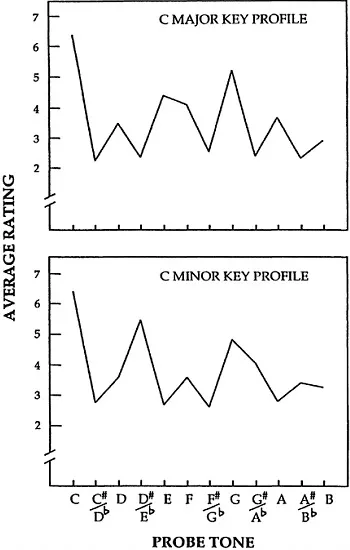
FIG. 14.1. Standardised probe-tone profiles for the keys of C major and C minor. From Tracing the dynamic changes in perceived tonal organization in a spatial representation of musical keys by C.L.Krumhansl and E.J.Kessler, 1982, Psychological Review, 89, p.
343. Copyright 1982 by the American Psychological Association.
343. Copyright 1982 by the American Psychological Association.
Redrawn with permission.
Next we examined the expressive variations introduced by the pianist (coded as MIDI data) and compared the variations with the values of the standardised profiles for the keys of the sequences. This comparison revealed that the pianists’s variations in loudness and timing were correlated with the tonal hierarchies of the keys of the sequences. Notes that were tonally stable within a key tended to be played for longer duration in the soprano and bass voices, and softer in the bass voice. The performance thus contained cues about tonal hierarchies that may have influenced listeners’ judgements of key and key movement.
...
Table of contents
- COVER PAGE
- TITLE PAGE
- COPYRIGHT PAGE
- FOREWORD AND ACKNOWLEDGEMENTS
- CONTRIBUTORS
- PREFACE
- I. MUSICOLOGICAL APPROACHES
- II. DEVELOPMENTAL APPROACHES
- III. BIOLOGICAL APPROACHES
- IV. ACOUSTICAL AND COMPUTATIONAL APPROACHES
- V. STRUCTURAL APPROACHES
Trusted by 375,005 students
Access to over 1.5 million titles for a fair monthly price.
Study more efficiently using our study tools.
Frequently asked questions
Yes, you can cancel anytime from the Subscription tab in your account settings on the Perlego website. Your subscription will stay active until the end of your current billing period. Learn how to cancel your subscription
No, books cannot be downloaded as external files, such as PDFs, for use outside of Perlego. However, you can download books within the Perlego app for offline reading on mobile or tablet. Learn how to download books offline
Perlego offers two plans: Essential and Complete
- Essential is ideal for learners and professionals who enjoy exploring a wide range of subjects. Access the Essential Library with 800,000+ trusted titles and best-sellers across business, personal growth, and the humanities. Includes unlimited reading time and Standard Read Aloud voice.
- Complete: Perfect for advanced learners and researchers needing full, unrestricted access. Unlock 1.5M+ books across hundreds of subjects, including academic and specialized titles. The Complete Plan also includes advanced features like Premium Read Aloud and Research Assistant.
We are an online textbook subscription service, where you can get access to an entire online library for less than the price of a single book per month. With over 1.5 million books across 990+ topics, we’ve got you covered! Learn about our mission
Look out for the read-aloud symbol on your next book to see if you can listen to it. The read-aloud tool reads text aloud for you, highlighting the text as it is being read. You can pause it, speed it up and slow it down. Learn more about Read Aloud
Yes! You can use the Perlego app on both iOS and Android devices to read anytime, anywhere — even offline. Perfect for commutes or when you’re on the go.
Please note we cannot support devices running on iOS 13 and Android 7 or earlier. Learn more about using the app
Please note we cannot support devices running on iOS 13 and Android 7 or earlier. Learn more about using the app
Yes, you can access Perception And Cognition Of Music by Irene Deliege,John A. Sloboda in PDF and/or ePUB format, as well as other popular books in Psychology & Cognitive Psychology & Cognition. We have over 1.5 million books available in our catalogue for you to explore.