- 328 pages
- English
- ePUB (mobile friendly)
- Available on iOS & Android
eBook - ePub
Timothy Asch and Ethnographic Film
About this book
Timothy Asch (1932-1994) was probably the greatest ethnographic filmmaker of the latter twentieth century, and one of the best-known anthropologists of his generation. He worked with Margaret Mead, John Marshall and Napoleon Chagnon, lived and filmed on every continent except Antarctica, and won numerous international prizes. His work, which includes 'The Ax Fight' and more than 50 other films of the Yanomamö Indians of Venezuela, comprises the most widely used resource in the teaching of anthropology today. Timothy Asch and Ethnographic Film combines a biographical overview of Asch's life with theoretical and critical perspectives, giving a definitive guide to his background, aims and ideas, methodology and major projects. Beautifully illustrated with 60 photos, and featuring articles from many of Asch's friends, colleagues and collaborators as well as an important interview with Asch himself, it is an ideal introduction to his work and to a range of key issues in ethnographic film.
Information
Chapter 1
Introduction
Timothy Asch in America and Australia1
E. D. Lewis
From 1968 to his death in October 1994, Tim Asch produced more than fifty ethnographic films about the Yanomamö Indians of Venezuela, transhumant herders in Afghanistan, and the Balinese, the Rotinese, and Ata Tana Ai of eastern Indonesia. If one counts Dodoth Morning, which he shot in 1961, and footage he shot in Canada which was never made into films for release, he practised his art of ethnographic film-making on three continents and in Oceania. The films in distribution have had a profound influence on the science of anthropology and the way the discipline is taught in universities around the world.
Asch’s career as an ethnographic film-maker began in the middle 1960s, just as portable synchronous sound technology for 16 mm production became available to film-makers.2 Portable synchronous sound was a technology that would revolutionize the representation of ethnographic subjects on film, and Asch’s exploration of the new technology’s possibilities and his experiments with new techniques in ethnographic film-making helped create the field of visual anthropology and remake the discipline of cultural anthropology. In these explorations and experiments he was colleague, interlocutor and, sometimes, antagonist to a small number of film-makers, including Jean Rouch, John Marshall, Robert Gardner, whose work, it is now clear, defined visual anthropology in the second half of the twentieth century.
Asch was a university teacher and his main aim as an anthropologist was to make films for use in anthropological tuition. These films would illustrate general theoretical problems in the comparative understanding of mankind’s cultures, and thereby not only improve the quality of university tuition in anthropology, but establish anthropology as the pre-eminent medium for communication between societies with quite different cultures and foster greater understanding by people everywhere of those whose ways are different from their own.
America, 1932–76
Tim Asch was born in Southampton, Long Island, New York in 1932. He was educated at the North Country School in Lake Placid, New York, and The Putney School in Vermont, from which he graduated in 1951. His classmates at Putney included the anthropologist David Sapir and the photographer John Yang. Together, they experimented with photography. The experience must have been profound: Asch himself went into photography and film-making, Yang became a photographer, and Sapir has increasingly focused on visual anthropology and still photography in his work.
In his late teens, Asch twice journeyed to California where, during the summers of 1950 and 1951, he studied with the photographers Minor White, Ansel Adams and Edward Weston. Asch has described his relationship with White as that between apprentice and master. He lived in White’s household, going out each morning before dawn and again in the late afternoon to take photographs. Evenings were spent developing and printing the day’s work. For Asch, this episode was a powerful encounter with an art form in the person of one of its masters. From White he learned aesthetics, techniques and discipline.3 Patsy Asch has said that one of the things he learned from White and Weston was that his talent lay more in photographing people than landscapes (although his photographic subjects in his last years were largely drawn from nature). If White taught Asch his art, it was perhaps the photographic sequences of W. Eugene Smith that were the strongest influence on Asch’s later mastery of documentary cinematography.
In the early 1950s, Asch’s newly trained talent found its first expression on Cape Breton Island, Canada, where he lived for seven months in 1952. He returned to the community in 1960 to shoot his first film, and made visits in 1968 and shortly before his death in 1994. A special issue of the journal Visual Sociobgy under the editorship of Douglas Harper (1994) has been devoted to a selection of Asch’s Cape Breton photographs.
After a year at Bard College, Asch was conscripted into the US Army in 1953 and served in Japan as a photographer for Stars and Stripes and the Japanese newspapers Asahi Shinbun, Mainichi Shinbun, and the Nippon Times. He lived for a time with a family in a rural Japanese village, his subject for an extensive (and as yet unpublished) photographic study. In 1955 he resumed his undergraduate studies at Columbia University. At Columbia he decided to study anthropology and became a teaching assistant to Margaret Mead, who encouraged his interest in ethnographic film.
From 1959 to 1962 he served as a film editor for John Marshall and Robert Gardner in the Peabody Museum of Harvard University, working mainly on Marshall’s Ju/’hoansi (Bushman) films. In 1960 he met Peter Loizos, who documents Asch’s relationships with Marshall and Gardner in Chapter 4 of this volume. In 1961 he traveled to Uganda, where he worked among the Dodoth as a still photographer and cinematographer for Elizabeth Marshall Thomas. In 1963 he completed the film Dodoth Morning, a short film about one morning in the life of a Dodoth family at harvest time.
From 1963 to 1965, Asch undertook a postgraduate course in African Studies at Boston University and studied with Thomas Beidelman at Harvard. After completing his M.A., from 1965 to 1967 he worked, under the leadership of Jerome Bruner, on Man, A Course of Study (MACOS), a film-based curriculum development project designed to bring the ideas of anthropology to primary school classrooms. Asch and his wife Patsy experimented with the Ju/’hoansi footage and the Netsilik Inuit films, which Asen Balikci developed for MACOS. This early work as an editor and on the development of film sequences for teaching contributed to Asch’s growing belief in the pedagogical value of short films. In 1968 he and John Marshall founded Documentary Educational Research, a non-profit organization, to produce, distribute, and promote the use of ethnographic and documentary films, in part because no film distributor would agree to distribute all of the sequence films on which he had worked with the Marshalls. In 1971 DER incorporated as Documentary Educational Resources, Inc., which has grown into an international distributor of ethnographic films and promoter of research and development in visual anthropology.
From 1967 to 1976 Asch held teaching posts in Visual Anthropology at Brandeis University, New York University and Harvard University. Whilst juggling fractional appointments in three universities must have been difficult for a man with a young family, his professional situation was one in which there were few obligations of an administrative kind to his employers. He was thus relatively free to experiment with the development of undergraduate anthropology courses oriented toward film and to undertake fieldwork, which he did in 1968 and 1971 when he filmed the Yanomamö Indians in Venezuela in collaboration with Napoleon Chagnon. The years of the mid-1960s to the mid-1970s were thus the time in which Asch refined his thinking about, and his aims for, making films for research and teaching, and he found his first opportunity to put his thoughts about making films into practice in a collaboration with another anthropologist.4 Loizos notes (Chapter 4) that by the early 1960s, Asch had set out for himself “a coherent and single-minded commitment to ethnographic documentary” and was already well along in “thinking through a programme of filming and classroom work surrounding film”. We can see that in the 1960s Asch had clearly in mind how anthropological films should be made and what he wanted to do; as he himself wrote many years later about his work in Venezuela:
When we first collaborated, Chagnon had a latent idea about the kind of film he wanted to make, whereas I knew exactly what kind of film I wanted to make.
(Asch 1982: 16)
In 1968 Asch began his long and fruitful collaboration with Napoleon Chagnon, with whom he made field trips in 1968 and 1971 to the upper Orinoco valley of Venezuela to film the Yanomamö Indians. The collaboration resulted in at least forty-two films (see the Appendix, this volume: the number of Yanomamö films is difficult to determine exactly), including The Feast and The Ax Fight, which are ranked by many as among the best ethnographic films ever produced. The films of the Yanomamö series have received numerous awards and many have been staples in undergraduate university curricula in anthropology for over two decades. For a quarter of a century The Ax Fight has been a focus in anthropology and cinema studies of critical and theoretical thinking about the representation of culture through visual media. In this book, Nichols re-examines problems of representation addressed in The Ax Fight, Martinez reports research on the reception of the film among undergraduate university students, and Biella recounts an important experiment in transforming The Ax Fight into a “researchable film” through hypertext technology.
In 1975, with the sponsorship of the Smithsonian Institution of Washington DC, Asch collaborated with Patsy Asch and the anthropologist Asen Balikci in the production of research footage from which the film Sons of Haji Omar was produced. This project marked a major change in Asch’s working methods: Patsy Asch collaborated in the fieldwork and production phases of the Afghanistan project and on the Indonesian projects that followed and was the editor of all of the Indonesia films. Patsy’s intimate involvement with filming in the field and her editorial acuity were important factors in shaping Asch’s last films, all of which reflect post-production dialogues between the Aschs on subjects ranging from how best to make use of particular footage to the basic aims of ethnographic film.
From 1969 through 1973, Asch taught in the Department of Anthropology, Brandeis University. After meeting James J. Fox in 1970 and moving to the Department of Anthropology at Harvard University as a lecturer in 1974, Asch and Fox taught a course on ethnographic film. Their common interest in film led to plans for a collaboration on a film project. Fox left Cambridge, Massachusetts to join the Research School of Pacific Studies (now the Research School of Pacific and Asian Studies in the Australian National University in 1975, but the two continued to plan a collaborative film project and in 1978 obtained a grant from the US National Science Foundation which provided partial funding for the work they had in mind.
In early 1976 Tim Asch left Cambridge, Massachusetts to join the Department of Anthropology in the Research School of Pacific Studies as a Senior Research Fellow. He lived and worked in Australia for six years until, in 1982, he took up his last position as Professor of Anthropology at the University of Southern California, where he became the first director of the Center for Visual Anthropology.
Australia, 1976–82
The six-and-a-half years the Aschs spent in Australia were extraordinarily productive. At The Australian National University, Asch was instrumental in bringing into reality what was then called the Human Ethology and Ethnographic Film Laboratory, a unit in the Department of Anthropology. The idea for HEEFL originated with Professor Derek Freeman, the head of the department at the time, who was interested in establishing a laboratory for the ethological study of human behavior and social interaction. HEEFL began with the human ethologists Adam Kendon and Peter Reynolds. With Asch’s arrival, the mandate of the laboratory expanded to encompass ethnographic film-making.
During his six years in Canberra and after his departure for California, Asch collaborated with three Australian anthropologists in the production of research footage and ethnographic films on the eastern Indonesian islands of Roti, Bali, and Flores.
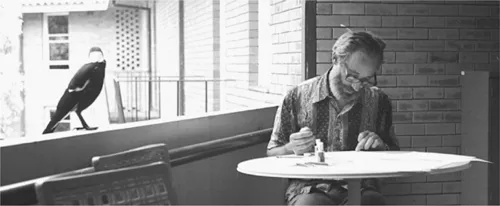
Figure 1.1 Tim Asch and magpie, Research School of Pacific and Asian Studies verandah, The Australian National University, 1980.
The Roti project
Asch’s first collaboration at The ANU was with Professor James ]. Fox (see Chapter 5). They planned to film large-scale rituals in five eastern Indonesian societies, the first filming to be of ritual contests during the ceremonial season on the island of Savu. As Fox had previously determined, Savunese ritual was spectacle in a way that contrasted with the more restrained oratorical performances which characterized ritual on the nearby island of Roti (Fox 1979). Given the combination of planned choreography and spontaneous improvisation evident in Savunese rituals and the large scale of their performance, Fox and Asch were convinced that film was the best means to document the complex Savunese performances. In the end, delays in obtaining the permits required by the Indonesian government for research and filming prevented Asch and Fox from visiting Savu during the high ceremonial season on the island. So they shifted the site of their first work to Roti. The work on Roti resulted in two films: The Water of Words (1983) and Spear and Sword (1989). As it happened, a bureaucratic snafu in Jakarta resulted in the issue of two research permits, one for filming in the province of Nusa Tenggara Timur (which includes the islands of Roti, Savu and Flores) and one for Bali. This fortuitous confusion among Jakarta bureaucrats as to the whereabouts of Savu and Roti (see Chapter 5) opened the way for Asch’s filming on Bali with Dr Linda Connor, the second of his Australian collaborators.
The Bali project
On their way to Roti in June 1977, Tim Asch and Jim Fox discovered that Margaret Mead was on the island of Bali attending a Pacific Science Association Conference. Mead planned to visit Bayung Cede, the village in which she had worked in the 1930s. She asked Asch, her former student, to record her visit to the village. On the way to Bayung Cede, Asch and Fox happened to meet Linda Connor, who was then in the middle of research for her Ph.D. in a village in central Bali. The following year, Fox, who was traveling from Europe, was to meet Asch, who was traveling from Australia, once again in Bali en route to Roti. As Asch told the story, Fox was delayed for several weeks and, worried about the state of his film stock, Asch decided to shoot a few rolls and send them back for processing and examination in Australia. But what to shoot? Asch went looking for Linda Connor, whom he had first met in Canberra before she began her fieldwork and, even though she was (again as Asch told it) in the last, frantic stages of her fieldwork, prevailed upon her to film something in which she was interested and which bore on her research topic. Asch rattled into Linda’s village on a superannuated Honda, his camera positioned precariously on the back, gave Linda a brief but intensive lesson in recording synchronous sound and the two of them began filming. The result was the footage which became A Balinese Trance Seance. The collaboration with Linda Connor on Bali, which continued with a further season of filming in 1980 and for a number of years thereafter, produced five films. In this book, Linda Connor and Patsy Asch (Chapter 9) analyze their relationships to the Balinese and how they influenced the production of the Bali films, and Lewis (Chapter 14) locates thematically the Bali films in Asch’s Indonesian corpus.
Working with Asch in Tana ‘Ai: a personal memoir
I met Tim in the spring of 1975 in Cambridge, Massachusetts, where people were still talking about the wondrous festival of ethnographic films that he had screened during the second half of 1974 in conjunction with “Film as Ethnographic Experience”, a course on ethnographic film which he and James Fox taught at Harvard. I still have the film list for the evening screenings (which regularly drew 250 to 300 students); it reads like a history of ethnographic and anthropologically oriented documentary cinema. When I arrived in Canberra in March 1977 to begin my Ph.D. research, Tim was one of the first people I met. He was then inhabiting - that is the only word - Room 7239, one of the larger rooms for research fellows in the Coombs Building, which housed the Research School of Pacific Studies.
The room was completely outfitted by Tim, which meant that no one could find a place to park oneself when visiting his lair. Cases and book shelves on wheels, equipment (mostly consisting of wires emerging from and disappearing into gadgets of uncertain provenance and less obvious function), dog-eared and spine-broken books (Tim could mangle a book in ways unimaginable by even the most fatalistic school librarian) and a fog of things (including a hammock) festooned the walls, ceiling, and every square centimeter of floor space. (This is the m...
Table of contents
- Cover Page
- Timothy Asch and Ethnographic Film
- Studies in Visual Culture
- Title Page
- Copyright Page
- Illustrations
- Contributors
- Acknowledgments
- Preface
- Chapter 1: Introduction: Timothy Asch in America and Australia
- Chapter 2: An ethnographic gaze: Scenes in the anthropological life of Timothy Asch
- Chapter 3: Man, a course of study: Situating Tim Asch’s pedagogy and ethnographic films
- Chapter 4: At the beginning: Tim Asch in the early 1960s
- Chapter 5: Efforts and events in a long collaboration: Working with Tim Asch on ethnographic films on Roti in eastern Indonesia
- Chapter 6: From event to ethnography: Film-making and ethnographic research in Tana ‘Ai, Flores, eastern Indonesia
- Chapter 7: The consequences of conation: Pedagogy and the inductive of an ethical film-maker
- Chapter 8: Producing culture: Shifting representations of social theory in the films of Tim Asch
- Chapter 9: Subjects, images, voices: Representations of gender in the films of Timothy Asch
- Chapter 10: Timothy Asch, the rise of visual anthropology, and the Human Studies Film Archives
- Chapter 11: Tim Asch, otherness, and film reception
- Chapter 12: What really happened: A reassessment of The Ax Fight
- Chapter 13: The Ax Fight on CD-ROM
- Chapter 14: Person, event, and the location of the cinematic subject in Timothy Asch’s films on Indonesia
- Appendix: Writings and films of Timothy Asch
Trusted by 375,005 students
Access to over 1.5 million titles for a fair monthly price.
Study more efficiently using our study tools.
Frequently asked questions
Yes, you can cancel anytime from the Subscription tab in your account settings on the Perlego website. Your subscription will stay active until the end of your current billing period. Learn how to cancel your subscription
No, books cannot be downloaded as external files, such as PDFs, for use outside of Perlego. However, you can download books within the Perlego app for offline reading on mobile or tablet. Learn how to download books offline
Perlego offers two plans: Essential and Complete
- Essential is ideal for learners and professionals who enjoy exploring a wide range of subjects. Access the Essential Library with 800,000+ trusted titles and best-sellers across business, personal growth, and the humanities. Includes unlimited reading time and Standard Read Aloud voice.
- Complete: Perfect for advanced learners and researchers needing full, unrestricted access. Unlock 1.5M+ books across hundreds of subjects, including academic and specialized titles. The Complete Plan also includes advanced features like Premium Read Aloud and Research Assistant.
We are an online textbook subscription service, where you can get access to an entire online library for less than the price of a single book per month. With over 1.5 million books across 990+ topics, we’ve got you covered! Learn about our mission
Look out for the read-aloud symbol on your next book to see if you can listen to it. The read-aloud tool reads text aloud for you, highlighting the text as it is being read. You can pause it, speed it up and slow it down. Learn more about Read Aloud
Yes! You can use the Perlego app on both iOS and Android devices to read anytime, anywhere — even offline. Perfect for commutes or when you’re on the go.
Please note we cannot support devices running on iOS 13 and Android 7 or earlier. Learn more about using the app
Please note we cannot support devices running on iOS 13 and Android 7 or earlier. Learn more about using the app
Yes, you can access Timothy Asch and Ethnographic Film by E.D Lewis in PDF and/or ePUB format, as well as other popular books in Social Sciences & Anthropology. We have over 1.5 million books available in our catalogue for you to explore.