eBook - ePub
Alfred Russell Wallace Contributions to the theory of Natural Selection, 1870, and Charles Darwin and Alfred Wallace , 'On the Tendency of Species to form Varieties' (Papers presented to the Linnean Society 30th June 1858)
- 448 pages
- English
- ePUB (mobile friendly)
- Available on iOS & Android
eBook - ePub
Alfred Russell Wallace Contributions to the theory of Natural Selection, 1870, and Charles Darwin and Alfred Wallace , 'On the Tendency of Species to form Varieties' (Papers presented to the Linnean Society 30th June 1858)
About this book
Wallace noticed on expeditions to the Amazon and the Malay archipelego that mammals in Southeast Asia are more advanced than their Australian cousins. His suggestion was that the two continents had split before the better adapted mammals had evolved in Asia. The isolated Australian marsupials were able to thrive, whilst those in Asia were driven to extinction by competition from more advanced mammals. This led to his theory of natural selection, which he presented to the Linnean Society in 1858 with Charles Darwin. This volume reprints those papers presented to the Linnean Society.
Information
Part I
Contributions to the Theory of Natural Selection
CONTRIBUTIONS TO
THE THEORY OF
NATURAL SELECTION.
A Series of Essays.
BY
ALFRED RUSSEL WALLACE,
AUTHOR OF
“THE MALAY ARCHIPELAGO,” ETC., ETC.
London:
MACMILLAN AND CO.,
1870.
[The right of Translation and Reproduction it reserved.]
LONDON:
PRINTED BY W.W.HEAD, ROYAL VICTORIA PRESS,
FARRINGDON STREET, E.C.
THE THEORY OF
NATURAL SELECTION.
A Series of Essays.
BY
ALFRED RUSSEL WALLACE,
AUTHOR OF
“THE MALAY ARCHIPELAGO,” ETC., ETC.
London:
MACMILLAN AND CO.,
1870.
[The right of Translation and Reproduction it reserved.]
LONDON:
PRINTED BY W.W.HEAD, ROYAL VICTORIA PRESS,
FARRINGDON STREET, E.C.
PREFACE.
THE present volume consists of essays which I have contributed to various periodicals, or read before scientific societies during the last fifteen years, with others now printed for the first time. The two first of the series are printed without alteration, because, having gained me the reputation of being an independent originator of the theory of “natural selection,” they may be considered to have some historical value. I have added to them one or two very short explanatory notes, and have given headings to subjects, to make them uniform with the rest of the book. The other essays have been carefully corrected, often considerably enlarged, and in some cases almost rewritten, so as to express more fully and more clearly the views which I hold at the present time; and as most of them originally appeared in publications which have a very limited circulation, I believe that the larger portion of this volume will be new to many of my friends and to most of my readers.
I now wish to say a few words on the reasons which have led me to publish this work. The second essay, especially when taken in connection with the first, contains an outline sketch. of the theory of the origin of species (by means of what was afterwards termed by Mr. Darwin—“natural selection,”) as conceived by me before I had the least notion of the scope and nature of Mr. Darwin’s labours. They were published in a way not likely to attract the attention of any but working naturalists, and I feel sure that many who have heard of them, have never had the opportunity of ascertaining how much or how little they really contain. It therefore happens, that, while some writers give me more credit than I deserve, others may very naturally class me with Dr. Wells and Mr. Patrick Matthew, who, as Mr. Darwin has shown in the historical sketch given in the 4th and 5th Editions of the “Origin of Species,” certainly propounded the fundamental principle of “natural selection” before himself, but who made no further use of that principle, and failed to see its wide and immensely important applications.
The present work will, I venture to think, prove, that I both saw at the time the value and scope of the law which I had discovered, and have since been able to apply it to some purpose in a few original lines of investigation. But here my claims cease. I have felt all my life, and I still feel, the most sincere satisfaction that Mr. Darwin had been at work long before me, and that it was not left for me to attempt to write “The Origin of Species.” I have long since measured my own strength, and know well that it would be quite unequal to that task. Far abler men than myself may confess, that they have not that untiring patience in accumulating, and that wonderful skill in using, large masses of facts of the most varied kind,—that wide and accurate physio-logical knowledge,—that acuteness in devising and skill in carrying out experiments,—and that admirable style of composition, at once clear, persuasive and judicial,—qualities, which in their harmonious combination mark out Mr. Darwin as the man, perhaps of all men now living, best fitted for the great work he has undertaken and accomplished. My own more limited powers have, it is true, enabled me now and then to seize on some conspicuous group of unappropriated facts, and to search out some generalization which might bring them under the reign of known law; but they are not suited to that more scientific and more laborious process of elaborate induction, which in Mr. Darwin’s hands has led to such brilliant results.
Another reason which has led me to publish this volume at the present time is, that there are some important points on which I differ from Mr. Darwin, and I wish to put my opinions on record in an easily accessible form, before the publication of his new work, (already announced,) in which I believe most of these disputed questions will be fully discussed. I will now give the date and mode of publication of each of the essays in this volume, as well as the amount of alteration they have undergone.
I.
—ON THE LAW WHICH HAS REGULATED THE INTRODUCTION OF NEW SPECIES.
—ON THE LAW WHICH HAS REGULATED THE INTRODUCTION OF NEW SPECIES.
First published in the “Annals and Magazine of Natural History,” September, 1855. Reprinted without alteration of the text.
II.
—ON THE TENDENCY OF VARIETIES TO DEPART INDEFINITELY FROM THE ORIGINAL TYPE.
—ON THE TENDENCY OF VARIETIES TO DEPART INDEFINITELY FROM THE ORIGINAL TYPE.
First published in the “Journal of the Proceedings of the Linnæan Society,” August, 1858. Reprinted without alteration of the text, except one or two grammatical emendations.
III.
—MIMICRY AND OTHER PROTECTIVE RESEMBLANCES AMONG ANIMALS.
—MIMICRY AND OTHER PROTECTIVE RESEMBLANCES AMONG ANIMALS.
First published in the “Westminster Review,” July, 1867. Reprinted with a few corrections and some important additions, among which I may especially mention Mr. Jenner Weir’s observations and experiments on the colours of the caterpillars eaten or rejected by birds.
IV.
—THE MALAYAN PAPILIONUDÆ OR SWALLOWTAILED BUTTERFLIES, AS ILLUSTRATIVE OF THE THEORY OF NATURAL SELECTION.
—THE MALAYAN PAPILIONUDÆ OR SWALLOWTAILED BUTTERFLIES, AS ILLUSTRATIVE OF THE THEORY OF NATURAL SELECTION.
First published in the “Transactions of the Linnæan Society,” Vol. XXV. (read March, 1864), under the title, “On the Phenomena of Variation and Geo-graphical Distribution, as illustrated by the Papilionidæ of the Malayan Region.”
The introductory part of this essay is now reprinted, omitting tables, references to plates, &c., with some additions, and several corrections. Owing to the publi-cation of Dr. Felder’s “Voyage of the Novara” (Lepidoptera) in the interval between the reading of my paper and its publication, several of my new species must have their names changed for those given to them by Dr. Felder, and this will explain the want of agreement in some cases between the names used in this volume and those of the original paper.
V.
—ON INSTINCT IN MAN AND ANIMALS.
—ON INSTINCT IN MAN AND ANIMALS.
Not previously published.
VI.
—THE PHILOSOPHY OF BIRDS’ NESTS.
—THE PHILOSOPHY OF BIRDS’ NESTS.
First published in the “Intellectual Observer,” July, 1867. Reprinted with considerable emendations and additions.
VII.
—A THEORY OF BIRDS’ NESTS ;SHOWING THE RELATION OF CERTAIN DIFFERENCES OF COLOUR IN BIRDS TO THEIR MODE OF NIDIFICATION.
—A THEORY OF BIRDS’ NESTS ;SHOWING THE RELATION OF CERTAIN DIFFERENCES OF COLOUR IN BIRDS TO THEIR MODE OF NIDIFICATION.
First published in the “Journal of Travel and Natural History” (No. 2), 1868. Now reprinted with considerable emendations and additions, by which I have endeavoured more clearly to express, and more fully to illustrate, my meaning in those parts which have been misunderstood by my critics.
VIII.
—CREATION BY LAW.
—CREATION BY LAW.
First published in the “Quarterly Journal of Science,” October, 1867. Now reprinted with a few alterations and additions.
IX.
—THE DEVELOPMENT OF HUMAN RACES UNDER THE LAW OF NATURAL SELECTION.
—THE DEVELOPMENT OF HUMAN RACES UNDER THE LAW OF NATURAL SELECTION.
First published in the “Anthropological Review,” May, 1864. Now reprinted with a few important alterations and additions. I had intended to have considerably extended this essay, but on attempting it I found that I should probably weaken the effect without adding much to the argument. I have therefore preferred to leave it as it was first written, with the exception of a few ill-considered passages which never fully expressed my meaning. As it now stands, I believe it contains the enunciation of an important truth.
X.
—THE LIMITS OF NATURAL SELECTION AS APPLIED TO MAN.
—THE LIMITS OF NATURAL SELECTION AS APPLIED TO MAN.
This is the further development of a few sentences at the end of an article on “Geological Time and the Origin of Species,” which appeared in the “Quarterly Review,” for April, 1869. I have here ventured to touch on a class of problems which are usually considered to be beyond the boundaries of science, but which, I believe, will one day be brought within her domain.
For the convenience of those who are acquainted with any of my essays in their original form, I subjoin references to the more important additions and alterations now made to them.
ADDITIONS AND CORRECTIONS TO THE ESSAYS AS ORIGINALLY PUBLISHED.
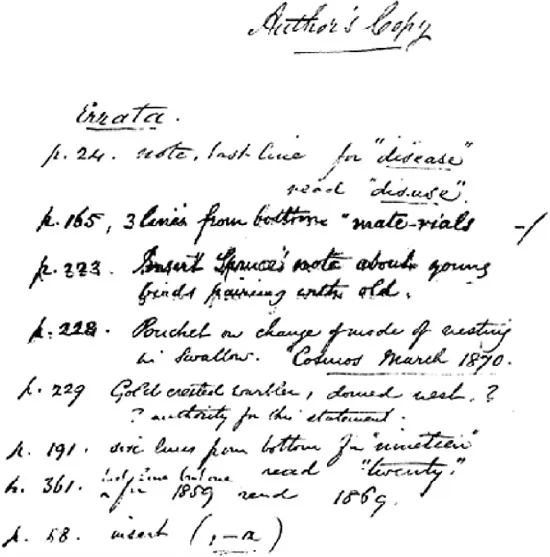
Essays I. and II. are unaltered, but short notes are added at pp. 19, 24, 29, and 40.
III.
—Mimicry, and other Protective Resemblances among Animals.
—Mimicry, and other Protective Resemblances among Animals.
PAGE
53 Additional illustration of protective colouring in the case of the wood-dove and the robin.
63 On moths resembling bird’s dung and mortar.
86 Correction of some names of African Papilios and a reference to Mr. Trimen’s observations.
89 Mr. Jenner Weir’s observation on birds which refused to eat Spilosoma menthrasti.
102 An additional case of snake mimicry in Oxyrhopus trigeminus.
107 Mr. Salvin’s case of mimicry among hawks. 113 Name, Diadema anomala, added.
117 to 122. Use of gay colours in caterpillars, with an account of Mr. Jenner Weir’s and Mr. Butler’s observations.
IV.
—The Malayan Papilionidæ or Swallow-tailed Butterflies, as illustrative of the Theory of Natural Selection.
—The Malayan Papilionidæ or Swallow-tailed Butterflies, as illustrative of the Theory of Natural Selection.
135 to 140. Additions to the discussion on the rank of the Papilionidæ, and on the principles which determine the comparative rank of groups in the animal kingdom.
PAGE
164 Illustration of variability from Mr. Baker’s revision of the British Roses.
173 Additional facts, on local variations of colour.
196 Additional genus of birds (Ceycopsis) peculiar to Celebes.
109, 200. Concluding remarks.
VI.
—The Philosophy of Birds’ Nests.
—The Philosophy of Birds’ Nests.
218 On nesting of Terns and Gulls, rewritten.
220 to 222. Daines Barrington, and others, on the song of birds.
223 On young birds learning to build, by memory and imitation.
224 Levaillant, on mode of nest-building.
229 On imperfect adaptation in birds’ nests.
VII.
—A Theory of BIRDS’ Nests.
—A Theory of BIRDS’ Nests.
231, 232. Introductory passages modified, with some omissions.
233 How modifications of organization would affect the form of the nest.
235 Illustration from the habits of children an...
Table of contents
- Front Cover
- Half Title
- The Evolution Debate 1813–1870
- Title Page
- Copyright
- INTRODUCTION TO VOLUME IX
- Part I: Contributions to the Theory of Natural Selection
- PREFACE.
- CONTENTS.
- I. —On the Law which has regulated the introduction of New Species.
- II. —On the Tendency of Varieties to depart indefinitely from the Original Type.
- III. —Mimicry, and other Protective Resemblances among Animals.
- IV. —The Malayan Papilionido, or Swallow-tailed Butterflies, as illustrative of the Theory of Natural Selection.
- V. —On Instinct in Man and Animals.
- VI. —The Philosophy of Birds’ Nests.
- VII. —A Theory of Birds’ Nests; showing the relation of certain differences of colour in female birds to their mode of nidification.
- VIII. —Creation by Law.
- IX. —The Development of Human Races under the Law of Natural Selection.
- X. —The Limits of Natural Selection as applied to Man.
- Index
- Man and Natural Selection
- Part II: On the Tendency of Species to form Varieties
Trusted by 375,005 students
Access to over 1.5 million titles for a fair monthly price.
Study more efficiently using our study tools.
Frequently asked questions
Yes, you can cancel anytime from the Subscription tab in your account settings on the Perlego website. Your subscription will stay active until the end of your current billing period. Learn how to cancel your subscription
No, books cannot be downloaded as external files, such as PDFs, for use outside of Perlego. However, you can download books within the Perlego app for offline reading on mobile or tablet. Learn how to download books offline
Perlego offers two plans: Essential and Complete
- Essential is ideal for learners and professionals who enjoy exploring a wide range of subjects. Access the Essential Library with 800,000+ trusted titles and best-sellers across business, personal growth, and the humanities. Includes unlimited reading time and Standard Read Aloud voice.
- Complete: Perfect for advanced learners and researchers needing full, unrestricted access. Unlock 1.5M+ books across hundreds of subjects, including academic and specialized titles. The Complete Plan also includes advanced features like Premium Read Aloud and Research Assistant.
We are an online textbook subscription service, where you can get access to an entire online library for less than the price of a single book per month. With over 1.5 million books across 990+ topics, we’ve got you covered! Learn about our mission
Look out for the read-aloud symbol on your next book to see if you can listen to it. The read-aloud tool reads text aloud for you, highlighting the text as it is being read. You can pause it, speed it up and slow it down. Learn more about Read Aloud
Yes! You can use the Perlego app on both iOS and Android devices to read anytime, anywhere — even offline. Perfect for commutes or when you’re on the go.
Please note we cannot support devices running on iOS 13 and Android 7 or earlier. Learn more about using the app
Please note we cannot support devices running on iOS 13 and Android 7 or earlier. Learn more about using the app
Yes, you can access Alfred Russell Wallace Contributions to the theory of Natural Selection, 1870, and Charles Darwin and Alfred Wallace , 'On the Tendency of Species to form Varieties' (Papers presented to the Linnean Society 30th June 1858) by David Knight in PDF and/or ePUB format, as well as other popular books in Biological Sciences & Evolution. We have over 1.5 million books available in our catalogue for you to explore.