- 214 pages
- English
- ePUB (mobile friendly)
- Available on iOS & Android
eBook - ePub
About this book
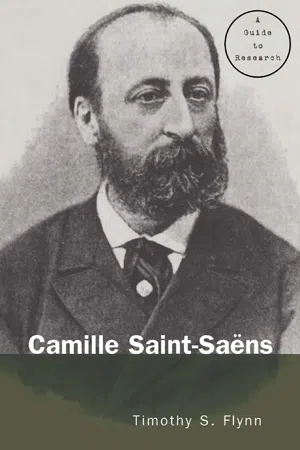
A key figure in establishing an identifiable French musical style in the nineteenth century, this annotated biliography catalogs the studies of Saint-Saens' life and works as well as examining the composer's own correspondence and essays. Included are many lesser-known writings on the composer and his music, as well as recent scholarship which re-examines his place in music history.
Information
1: Selected General Sources
1. 150 ans de musique française: 1789–1939. Lyon, 1991. (Actes Sud Biennale de la Musique Française.) 222 p. ML 270.1.A15.This is a collection of essays resulting from a conference held in Lyon to explore and analyze French contributions to music from the Revolution up to the decades following World War I. While essays are written by French, British, American, and German scholars, they appear only in French. The colloquium was originally organized into four sections: Le temps des revolutions; La renaissance de l’école française; Autour de 1900; and Aspects du XXe siècle. From these categories the following articles emerged: “Aux sources de XIXe siècle,” “Grétry et l’opéra-comique,” “A la redécouverte de l’opéra de D.F.E. Auber,” “Boëly, Onslow, Alkan et la musique instrumentale française du Premier au Second Empire,” “Berlioz retrouvé,” “Gounod, Bizet et quelques autres,” “L’oeuvre de Saint-Saëns, éclats et ombres de la célébrité,” “Franck et l’école franckiste,” “L’orgue symphonique,” “Chabrier,” “Rodrigue et Chimène, et le patrimoine musical français des années 1890 a 1920,” “La musique française au début du XXe siècle,” “Notes sur les spectacles musicaux aux arènes de Béziers, 1890–1910,” “La mélodie avec accompagnement d’orchestre en France,” “Compositeurs de l’entre-deux-guerres,” “Souvenirs et reflexions sur la mélodie française avec instruments,” “Opéra bouffe et opérette,” and “Le patrimoine discographique.”
2. Bailbé, Joseph-Marc. “Le sacré dans l’art lyrique (autour de l’opéra français du XIXe
siècle). In Littérature et opéra, ed. Philippe Berthier and Kurt Ringger, pp. 117–27. Grenoble: Presses Universitaires de Grenoble, 1987. ISBN 2706102772. ML 1700.The author identifies three main points which he uses to evaluate operas composed on a sacred subject: the choice of subject and its originality; the nature of the society and the public during that time in history; and the positive or negative conceptions of the composer and librettist. Bailbé proceeds briefly to examine various operas including Méhul’s Joseph, Rossini’s Moïse, and Meyerbeer’s Robert le diable and Les huguenots. At the conclusion of the article he turns his attentions to Berlioz’s Damnation de Faust and Saint-Saëns’s Samson et Dalila. Remarking that from Méhul to Saint-Saëns the “distance is great” and that “the reflection on opera and its problems progressed a great deal,” the author recounts Saint-Saëns’s struggle to move from oratorio to opera, and says that in Samson he actually mixes the two genres somewhat with varying degrees of success.
3. Barzun, Jacques. Berlioz and the Romantic Century. New York: Columbia University Press, 1969. 2 v. 458 p. ISBN 23103135. ML 410.B5B2.Arguably the first modern, ground-breaking study on Berlioz and his period of activity, this important contribution to nineteenth-century studies proceeds chronologically through the composer’s career but with the twist of grouping discussions of works and biography by a type of national association. For instance, the first section, labeled “France,” addresses his early biography, and the Symphonie fantastique; the second section, “Italy,” includes a discussion of Harold in Italy, and Benvenuto Cellini; the third section, “Germany,” investigates the form and philosophy of The Damnation of Faust; and a final grouping, in volume 2, entitled “England, Germany and Russia,” examines The Enfant Christ and The Trojans, among other things. Between these larger divisions, the author includes what he labels “inter chapters” which consist of valuable discussions pertaining to program music, the Romantic century, and Berlioz’s memoirs. Supplements in volume 2 include examinations of the then present state of Berlioz research, problems in Boschot’s biography of the composer, and Berlioz’s “after fame.” In addition to the standard bibliography and index of names and subjects, the author includes a listing of Berlioz’s domiciles, and addresses errors in the complete edition of his scores.
4. Brody, Elaine. Paris: The Musical Kaleidoscope 1870–1925. New York: George Braziller, 1987. 359 p. ISBN 080761176X. ML 270.8 P2 B93.This is a collection of essays ranging in topic from the death of Berlioz and the birth of the Société Nationale, through Stravinsky and the Russians in Paris. The author offers a wide variety of essays. There is one on popular culture, “Café-Concerts, Cabarets, and Music Hall,” one on “Art and Music,” featuring discussions of Fantin-Latour, Manet, and Picasso, while others address the Wagner craze in France, and the invasion of Orientalism. There is also a chapter entitled “Music and Literature” which examines Baudelaire on Wagner, and references Saint-Saëns and Fauré, Lalo, and Chabrier. The discussion ranges from Massenet to Poulenc and includes Symbolist poets, along with André Gide and Proust. The final chapter is entitled “Masterpieces of French Music 1870–1925 “and is an annotated list of composers and their representative works. Although not musically sophisticated, this is a monograph which would be of interest to the musician and amateur alike.
5. Brook, Donald. Five Great French Composers. London: Rockliff, 1946. 216 p. ML780.9 B871F.This book is a basic introduction to the music and biographies of Berlioz, César Franck, Debussy, Ravel, and Saint-Saëns. By the author’s own admission the purpose of the book is to “provide a set of compact biographies of the five greatest figures in French music.” He blames the brevity on the shortage of paper following the war. Nevertheless, the chapter on Saint-Saëns depends upon previous monographs including the Musical Memories, Harmonie et Mélodies, and earlier biographic accounts. After a discussion of the composer’s career and biography the author examines various compositions. These are Samson et Dalila, Le timbre d’argent, Étienne Marcel, Henri VII, Proserpine, Ascanio, Phryné, Les barbares, Hélène, L’ancêtre, Le rouet d’Omphale, Phaëton, Danse macabre, La jeunesse d’Hercule, the Symphony in C minor, the piano concertos 2, 4, and 5, the Violin Concerto no. 3, and the Cello Concerto in A minor. These analyses are superficial. The discussions of the operas really are nothing more than the retelling of the plot, the symphonic poems are examined no further than their stories, and the discussions of the instrumental music are confined only to general statements without any real analysis.
6. Coeuroy, A. La musique française moderne. Paris: Delagrave, 1922. 154 p. ML 390.C67.This monograph is divided into sections according to composer. They include Fauré, Ravel, Dukas, Florent Schmitt, Albert Roussel, d’Indy, Duparc, Guy Ropartz, Paul Le Flem, Paul Dupin, Henri Rabaud, Honegger, Milhaud, and Satie. In a book written a year after his death, Saint-Saëns receives no mention; however, it is strange that composers who are totally forgotten today are given prominence. It shows that by the time of his death Saint-Saëns was not viewed as “modern.”
7. Cohen, H.Robert, ed. Les gravures musicale dans “L’Illustration” 1843– 1899.Quebec: Presses de l’Université Laval, 1982.1162 p. ISBN 276376833 4. ML 270. 4.G7.The first two volumes of this three-volume set contain engravings pertaining to a wide variety of musical subjects (composers, mise en scène, instruments, costumes, theaters, etc.) found in the journal L’Illustration. The third volume is the index of the first two, arranged alphabetically, with a detailed subdivision of these general entries. For example, of the several entries for Saint-Saëns, there are two portraits, and mise en scène for many of his stage works including Étienne Marcel, Henry VIII, Samson, and Timbre d’argent. For Déjanire there is an engraving of the décors, the opera house where it played, and a mise en scène. The introductory notes which explain the organization and arrangement of the three volumes are in both French and English.
8. Cooper, Jeffrey Hawley. “A Renaissance in the Nineteenth Century: The Rise of French Instrumental Music and Parisian Concert Societies, 1828–1871.” Ph.D. dissertation, Cornell University, 1981. 566 p. ML 270.4.See #9 below for a discussion of his monograph on the same subject, a revised version of this dissertation.
9. Cooper, Jeffrey Hawley. The Rise of Instrumental Music and Concert Series in Paris,1828–1871. Ann Arbor: UMI Research Press, 1983. 387 p. ISBN 0835714039. ML 497.8 PCC6.This is a revised version of the dissertation mentioned above (#8). The most notable alterations include changes in arrangement of material, and how various chapters have been reorganized to reflect a chronological approach to the subject. The author indicates that this monograph is only a survey because of the large period of time it spans, and the amount of music-making it covers. This book addresses musical life in Paris, the concert series, the halls, the seasons, and the various performing societies. In addition, Cooper discusses the specific repertory, and includes chapters on instrumental music in general during the period. Details regarding Parisian concert series and provincial concerts comprise the two appendices. It is a very welcome addition to the study of nineteenth-century French instrumental music during a century dominated by opera.
10. Cooper, Martin. French Music from the Death of Berlioz to the Death of Fauré.Revised edition. London: Oxford University Press, 1969. 239 p. ISBN 0193162024. ML 270.4.C7.The early chapters document the interconnectedness of Gounod, Franck, and Saint-Saëns, and place them in relationship to other popular (if lesser-known) composers of the time. This monograph also attests to their importance as musical luminaries during the twilight of the Romantic period, and points to their many contributions and influence upon succeeding generations of French composers. Concentrating a great deal upon Fauré and Debussy, with excursions into the music of Ravel, Satie, Les Six, and Roussel, this book chronicles the great variety of French composers and movements, including the Schola Cantorum of Charles Bordes. A “Table of Events” is found at the conclusion of the study with important dates for births, deaths, musical events, and landmarks in the sister arts of literature and painting.
11. Dandelot, Arthur. La Société des Concerts du Conservatoire de 1828 a 1897: Les grands concerts symphoniques de Paris. Paris: G.Havard fils, 1898.221 p. ML 270. 8.P2.D18.This valuable work is divided into three main sections: concerts prior to 1828, including the foundation of the Société des Concerts, along with biography of Habeneck; a second section on the predecessors of Habeneck including Girard, Tilmant, Hainl, Deldevez, Garcin, and Taffanel; and the third section which mentions symphonic concerts from 1828 up to 1897. For the pre-1828 concerts Dandelot organizes the material chronologically, and indicates what was played in each concert up to 1828. He also offers the articles of organization for the Société des Concerts. In the second and third chapters he continues his chronological arrangement of concerts, and offers biographical information on the successors of Habeneck, as well as the committee members of the society, photographs of these men, and the various concert halls where the society performed. Important appendices include the names and roles of the committee members, and the names of the orchestra and chorus members. There is also an index of names cited throughout the work at the conclusion.
12. De Van, Gilles. “Fin de Siècle Exoticism and the Meaning of the Far Away.” Trans.William Ashbrook. Opera Quarterly 11 (1995): 77–94.This article was presented at the Second International Congress, Letteratura, musica e teatro al tempo di Ruggero Leoncavallo in 1993. The author identifies and defines what creates “exoticism” in nineteenth-century opera, and explores the “function of exoticism on the lyric stage by drawing evidence chiefly from opera librettos written between 1860 and 1920.” He discusses the public’s demand for visual verisimilitude, and how the more metaphoric texts would often lead to various clichés. Themes of sexual tensions and escapism are also addressed. The problems of exoticism are threefold: it requires a strong emphasis on spectacle, the moving of the action to a distant period or place, and the wish on the part of the composer to “move their audiences by subjects which involve the public and its sentimental views.” De Van also mentions three phenomena which raised critical questions concerning historical realism and exoticism in opera at the end of the nineteenth century; namely, Wagner’s attacks against historical subjects, the rise of the Symbolist, and the Naturalist movement. The author mentions several works of Saint-Saëns, including La princesse jaune, Samson et Dalila, Henry VIII, Déjanire, Étienne Marcel, and Les barbares. In closing, De Van indicates that “exoticism cannot be assimilated into one simple, self-contained category.”
13. Dietrich, Charles. “Les operas parfumés: Aspects of Orientalism in Nineteenth-Century French Opera.” Theatre Research International 22 (1997): 111–19.The author examines the “Oriental” elements of eight French operas: Les Troyens (Berlioz), Les pêcheurs de perles (Bizet), L’Africaine (Meyerbeer), Carmen (Bizet), Samson et Dalila (Saint-Saëns), Lakmé (Delibes), Esclarmonde and Thaïs (both by Massenet). His examination of these works is unfortunately superficial and he relies upon the writings of Edward Said and Elaine Brody. Interestingly some of his ideas may remind the reader of Ralph Locke’s writing on the Oriental “other” in opera (1991), although Dietrich does not mention this work. He discusses the Oriental associations of time and place of the opera, the libretti (briefly), and the role of woman as a symbol of the Orient and sexual freedom. His discussion of the music is very limited and misleading. He fails to notice and identify the actual Eastern rhythms and melodic fragments found in Saint-Saëns’s Samson et Dalila which have been well documented by Myriam Ladjili (#32) mentioned below.
14. Dumesnil, René. La musique en France entres les deux guerres 1919–1939. Paris:Éditions du Milieu du Monde, 1946. 304 p. ML 270.5.D83.This monograph concentrates upon the music of composers such as Ravel, Stravinsky, Les Six, and other prominent composers of the period between the world wars. Chapters are also devoted to the general musical life, and the schools of Wagner and Franck. Saint-Saëns is relegated to only four pages scattered throughout the monograph, and his death is not even mentioned in the concluding chronological table. The author dwells upon the more avantgarde styles of the early twentieth century and dismisses the final years of Saint-Saëns’s life as being relatively unimportant. The author’s account of the “new generation,” including Les Six, Georges Auric, and female composers such as Marguerite Canal and Jeanne Leleu, is quite helpful, although he basically ignores Lili and Nadia Boulanger. While this monograph is an uneven account of music during the period in question, it nevertheless remains a useful contribution.
15. Dumesnil, René. La musique contemporaine en France. 2 v. Paris: A.Colin, 1949. 205, 216 p. ML 270.5.D619. The first volume of this study is devoted entirely to the Renouveau symphonique, which includes not only symphonic music per se, but discussions of organ music and the renewal of sacred music; foreign influences on French music, especially Wagner, exoticism, and jazz; the Impressionist, Realist, and Neoclassical movements; and the contributions of the Schola Cantorum. The second volume completes the survey of the symphonic renewal, then is given over to a discussion of dramatic music from Carmen to Mélisande, and Ariane et Barbe-Bleue to Penelope. Dumesnil includes in this volume a series of brief biographies and contributions of early twentieth-century composers including Ravel, Roussel, Milhaud, Auric, Poulenc, Ibert, and others. Saint-Saëns is discussed in the first volume in regard to the Société Nationale and his symphonic works as well as his contribution to sacred music. In the second volume Dumesnil mentions Saint-Saëns’s operatic oeuvre (along with Massenet’s) as being traditional, and believes that some of his greatest strengths are also some of his greatest weaknesses.
16. Eigeldinger, Jean-Jacques, et al. La musique en France a l’époque romantique (1830–1870). Paris: Flammarion, 1991. 348 p. ISBN 208066305. ML 270.4.M87.This collection of essays examines the most important elements and trends in French music during the nineteenth century. Nicole Wilde offers a chapter on spectacle in grand opera, Malou Haine writes on instrument makers during this time, and Paul Gerbod contributes an essay on the orphéonistes. There are articles on the piano and its literature during this time along with a discussion of famous pianists (Anne Rousselin-Lacombe), an investigation of chamber music societies and their repertoire (Joël-Marie Fauquet), and an offering on violin technique, methods, and repertory (Anne Penesco). The important role of the periodic press is addressed and examined in two articles, one by H. Robert Cohen and another by Joseph-Marc Bailbé. All articles are in French, each with its own valuable bibliography. Two indices follow: one of names cited throughout the essays, and another of specific compositions mentioned.
17. Ellis, Katherine. Music Criticism in Nineteenth-Century France: “La Revue et Gazette Musicale de Paris” 1834–80. Cambridge: Cambridge University Press, 1995. 301 p. ISBN 021454433. ML 270.4.E55M8.According to the author herself, “This book is a history of musical culture in nineteenth-century Paris as revealed by some of its most prominent music critics.” She continues to say that the study has three interrelated aspects: “a study of music criticism, a reception history of more regularly performed composers, and a study of the philosophical ideas which permeated musical thought.” Pertinent topics which receive treatment are specialty periodicals; early music (along with performance practices and editions); Austro-German music and its reception; and various genres of contemporary music (opera, piano music, chamber and symphonic music, and the music of the future). Berlioz receives a chapter himself. Helpful appendices include a list of various contributors to the journal, an identification of pseudonyms, and brief biographies of various people (who throughout the text appear in bold print). Especially useful is not only the index of names cited in the text, but particularly the list of works cited and mentioned in reviews in the text. This monograph is a most welcomed and extremely valuable contribution to the study of the role and importance of the French periodic press.
18. Fauquet, Joël-Marie. Les sociétés de musique de chambre a Paris de la restauration a 1870. Paris: Aux Amateurs de Livres, 1986. 484 p. ISBN 2905053259. ML 1127.F38.This monograph is a well-documented chronicle of the chamber music traditions in France prior to the Franco-Prussian War. The author discusses the various performing organizations, individual players, repertory, and other details of the chamber music scene. During a time domi...
Table of contents
- COVER PAGE
- CAMILLE SAINT-SAËNS
- ROUTLEDGE MUSIC BIBLIOGRAPHIES
- TITLE PAGE
- COPYRIGHT PAGE
- PREFACE
- INTRODUCTION: THE ENIGMA OF CAMILLE SAINT-SAËNS
- 1: SELECTED GENERAL SOURCES
- 2: BIOGRAPHICAL STUDIES: PRIMARY SOURCES
- 3: BIOGRAPHICAL STUDIES: SECONDARY SOURCES
- 4: OTHER PRIMARY SOURCES PRIOR TO 1921
- 5: SPECIALIZED STUDIES PRIMARY AND SECONDARY SOURCES
- 6: CORRESPONDENCE
- 7: SAINT-SAËNS AS A WRITER
- APPENDIX 1: MANUSCRIPT SOURCES FOR SELECTED COMPOSITIONS
- APPENDIX 2: MANUSCRIPT SOURCES FOR SELECTED CORRESPONDENCE
- APPENDIX 3: THE SAINT-SAËNS MUSEUM AT THE CHÂTEAU-MUSÉE IN DIEPPE
- APPENDIX 4: SELECTED DISCOGRAPHY
Trusted by 375,005 students
Access to over 1.5 million titles for a fair monthly price.
Study more efficiently using our study tools.
Frequently asked questions
Yes, you can cancel anytime from the Subscription tab in your account settings on the Perlego website. Your subscription will stay active until the end of your current billing period. Learn how to cancel your subscription
No, books cannot be downloaded as external files, such as PDFs, for use outside of Perlego. However, you can download books within the Perlego app for offline reading on mobile or tablet. Learn how to download books offline
Perlego offers two plans: Essential and Complete
- Essential is ideal for learners and professionals who enjoy exploring a wide range of subjects. Access the Essential Library with 800,000+ trusted titles and best-sellers across business, personal growth, and the humanities. Includes unlimited reading time and Standard Read Aloud voice.
- Complete: Perfect for advanced learners and researchers needing full, unrestricted access. Unlock 1.5M+ books across hundreds of subjects, including academic and specialized titles. The Complete Plan also includes advanced features like Premium Read Aloud and Research Assistant.
We are an online textbook subscription service, where you can get access to an entire online library for less than the price of a single book per month. With over 1.5 million books across 990+ topics, we’ve got you covered! Learn about our mission
Look out for the read-aloud symbol on your next book to see if you can listen to it. The read-aloud tool reads text aloud for you, highlighting the text as it is being read. You can pause it, speed it up and slow it down. Learn more about Read Aloud
Yes! You can use the Perlego app on both iOS and Android devices to read anytime, anywhere — even offline. Perfect for commutes or when you’re on the go.
Please note we cannot support devices running on iOS 13 and Android 7 or earlier. Learn more about using the app
Please note we cannot support devices running on iOS 13 and Android 7 or earlier. Learn more about using the app
Yes, you can access Camille Saint-Saens by Timothy Flynn in PDF and/or ePUB format, as well as other popular books in Media & Performing Arts & Music. We have over 1.5 million books available in our catalogue for you to explore.