- 696 pages
- English
- ePUB (mobile friendly)
- Available on iOS & Android
eBook - ePub
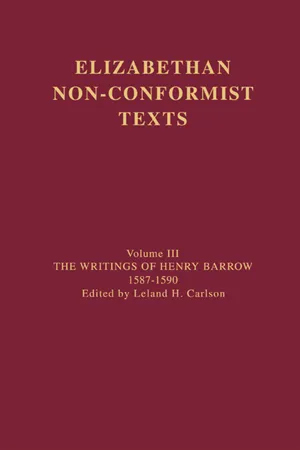
The Writings of Henry Barrow, 1587-1590
About this book
Henry Barrow and John Greenwood are the fathers of Elizabethan Separatism. Unlike Robert Browne, they refused to compromise their beliefs or conform to Anglicanism and as a consequence they died in 1593 - as martyrs for their steadfast adherence to the principles of English Congregationalism.
Volumes three and four include c. 40 items derived from manuscripts, surreptitiously printed books and very rare pamphlets and documents which allow evaluation of the teachings of the Separatists, in relation to the activities of the Elizabethan hierarchy, to the Puritans, to the Pilgrims in the Netherlands and the New World and to the Independents and Congregationalists. (16 of the pieces are by Barrow, 6 by Greenwood and 5 by both men, in addition to 13 related Barrowist items in the Appendix).
Trusted by 375,005 students
Access to over 1.5 million titles for a fair monthly price.
Study more efficiently using our study tools.
Information
Subtopic
World HistoryIndex
HistoryXIII
A True Description Out of the Worde of God, of the Visible Church
This tract of eight pages was the first Barrowist publication to be printed. Robert Stokes testified that “he caused a little thyng of one shete of paper to be prynted by their [Barrow and Greenwood’s] procurement before all thys, called the Destruc-tyon [Description] of the Vysyble Church.”1 This work carried the date 1589. It may have been printed late in that year, or if it immediately preceded the printing of A Collection of Certaine Sclaunderous Articles, the date may be the opening months of 1589/90. But prior to this time there existed a copy in manuscript, which Richard Alison had seen.2
It is possible that the idea for the title of this treatise came from Dr. Robert Some. In 1588 his book was published, A Godly Treatise Containing and Deciding Certaine Questions, Moved of Late in London and Other Places, Touching the Ministerie, Sacraments, and Church. This book discussed nine points, the last of which was: “The Church of England is the Visible Church of Christ.” Dr. Some sought to prove that the Church of England possessed the attributes or essential marks of the church of Christ. Barrow twice refuted this book in his marginal notes and his interleaved annotations, and both of his refutations were seized in prison by the authorities. It is possible that the examination of January 1, 1588/9, which is relevant to this ninth point, and the ensuing argument on whether the Church of England had one head or two heads, caused Barrow to write A True Description out of the Worde of God, of the Visible Church during the year 1589.
There is a great deal of confusion and misinformation about the authorship and editions of this work. It has been ascribed to Henry Barrow, Francis Johnson, John Penry, and others,3 but the latter two men were not Separatists in 1589, and may be eliminated. Richard Alison sought to refute one particular individual—a Barrowist, and Henoch Clapham says specifically that Barrow drew up a Description of the True Church [A True Description out of the Worde of God, of the Visible Church].4 Additional testimony comes from John Darrell.5
The problem of the editions is more complicated. Accord-ing to the Short-Title Catalogue, there are two editions, one of 1589 at the Folger Shakespeare Library, and one of [1610?] at the British Museum. On comparing these two, I find that they are the same, although the Folger copy is bound separately, and the British Museum copy is bound with [Henry Ainsworth], An Apologie or Defence of Such True Christians as Are Com-monly (but Unjustly) Called Brownists (1604). In the Henry M.Dexter Collection at the Sterling Memorial Library at Yale, there is another copy (z. d. 937), which is also identical with the above-mentioned copies. All of these copies are without title page, and have the date 1589 printed on page 8, at the conclusion of the tract.
There is a revealing dialogue which Henoch Clapham has included in his book, and which is relevant to this problem. Malcontent and Flyer are talking:
Malcontent: Mr. Henrie Barrow drawing a Description of the True Church, when he comes to deliver the canons of discipline, he in that sheete of paper, doth after the excommunication place that canon of the apostle in 2 Thessalonians 3:15—Yet count him not as an enemie, but admonish him as a brother, because he beleeved, that excommunication was a power to edification, not to destruction. Your congregation then, some yeares after his death, do reprint it, putting to it the olde date, corrupting his method, falsifying his will, by placing the sayd canon before excommunication; because after the casting out you would rid your handes of all tendernes and compassion, as delighting in nothing more, than in bitternesse against the soule distressed. The apostle can say, [Galatians 3:15]—Though it be but a man’s covenant (or will), when it is confirmed, no man doth abrogate it, or addeth any thing thereto. But you have done that which no man (that is, no honest man) would doe, in so causing his will to speake contrary to his meaning.
Flyer: Malcontent, I cannot beleeve that thou sayest.
Malcontent: But I beleeve it, and the copies will proove it. Besides that, I know him which reprooved that evill, at the comming foorth of the second edition at A[msterdam] at the charges of Arthur Billet: whereas the first was printed at D[ort], where other writings also of the same man, were then printed.6
This dialogue establishes the fact that there was a first edition printed at Dort and a second edition printed at Amsterdam. It further informs us that there was a change in the order of the paragraphs.
The earliest refutation of A True Description was made by Eichard Alison, who published his A Plaine Confutation of a Treatise of Brownisme Entitled: DESCRIPTION OF A VISIBLE CHURCH about September, 1590. In this work, the eighth paragraph from the end begins: “All this notwithstanding, the church is not to holde him as an enemie, but to admonish and pray for him as a brother.” In the Folger, British Museum, and Yale copies, this paragraph has been placed just before the preceding two paragraphs, so that it is the tenth paragraph from the end of the tract. Thus, there is confirmatory evidence for Malcontent’s charge, as set forth by Henoch Clapham.
Fortunately, there are two copies of the first edition of this tract, A True Description out of the Worde of God, of the Visible Church, available at Lambeth Palace Library, which have remained unnoticed. In S.R.Maitland’s catalogue, An Index of Such English Books, Printed before the Year M DC., as Are Now in the Archiepiscopal Library at Lambeth (London, 1845), they are listed not under Barrow’s authorship but under the heading “Church,” where they are numbered XXX. 6. 9. (4.) and XL. 2. 24. (3.), and renumbered 1590.17 and 1593.13. On the title page of one copy is a note, “Found in Penrie’s Chamber,” and on the last page is a note, “By me Rechard Malthus [or Walthus].” On the title page of the other copy is a note, “I beseche your honor yf yt maye be lawfull to lycens this booke to Mr. Thomas Purfoote, stacion[er].” Since John Penry was hanged on May 29, 1593, it is certain that this copy cannot be of a later date. Furthermore, the tract is printed with the same type as used to print five other books of Barrow and Greenwood in 1590/1 at Dort. Thus, we may feel certain that the two copies at Lambeth Palace Library are first editions, printed at Dort in 1589. Furthermore, the order of the paragraphs corresponds to the statements of Henoch Clapham and to the order found in Richard Alison’s A Plaine Confutation.
The problem of establishing the second edition is not immediately solved. From Malcontent’s statement, it is clear that the second edition was published at Amsterdam at the expense of Arthur Billet. From the Amsterdam records Henry M.Dexter was able to establish that Sarah Billet remarried in June, 1602, after having been a widow four months. Therefore the second Amsterdam edition would be earlier than 1602. Now, there is at Lambeth Palace Library (L. 2. 29 (2.), renumbered 1595.21) another edition of A True Description, unlike any other copy I have examined. It carries the date 1589, but in what appears to be a contemporary hand, the date has been changed to 1599. From this slight evidence I conclude that this is the second edition, printed at Amsterdam in 1599 at Arthur Billet’s expense. The order of the paragraphs differs from that of the first edition, as Malcontent charged.
It may be distinguished from other editions by the peculiar syllabication of the first line of the title: A TRUE DESCRIPTI=. There is also on the title page a design including a face with extending curving lines resembling a moustache.
It would follow, therefore, that Dexter is wrong in thinking that the Yale copy (and thus the Folger and British Museum copies) constitutes the second edition. They are all of the third edition, probably printed in Amsterdam, and the most likely date is 1604, (although the date 1589 is retained on page 8), if we may ascribe the same date to it as is given to [Henry Ainsworth’s] An Apologie or Defence of Such True Christians as Are Commonly (but Unjustly) Called Brownists, with which it is bound. This work is a collection of Separatist material, containing a reply to the Heads and Doctors of the University of Oxford, a reprint of “The Confession of Faith,” three petitions to King James I, and Barrow’s letter of April 4 or 5, 1593, to an Honorable Lady. It would seem fitting, therefore, in such a collection, to include a reprint of Barrow’s A True Description in this 1604 work.
In 1603 the Separatists reprinted John Greenwood’s An Answere to George Gifford’s Pretended Defence and also his A Fewe Observations; in 1604 appeared [Ainsworth’s] An Apologie or Defence; and in 1605 the reprint of Barrow’s A Plaine Refutation. Francis Johnson most likely was responsible for the reprinting of the books in 1603 and 1605, and probably collaborated with Ainsworth in 1604.
There is another edition of A True Description at the Huntington Library and at the Library of Congress. It carries no date, but on the slight evidence that the Library of Congress copy is bound up with John Robinson’s A Manumission to a Manuduction (1615) and Henry Ainsworth’s An Animadversion to Mr. Richard Clyfton’s Advertisement (Amsterdam, 1613), I conjecture that it is a later reprint about 1610–1615. It may be distinguished from other editions by a design on page 1. The initial capital letter A is flanked by two half-human or mermaid figures supporting an architrave.
At the Congregational Library, Memorial Hall, London, there is a 1641 reprint, A True Description of the Visible Congregation of the Saints under the Gospel, according to the Word of Truth, with several variants, which F.J.Powicke reproduced in Henry Barrow, Separatist, pp. 342–347. Powicke collated the 1641 edition with the “first” edition in the British Museum. Actually, the edition in the British Museum is the third edition, about 1604, which is the same edition as found at Yale and the Folger Shakespeare Library. It is interesting to note the many variants in the 1641 edition. The tract was also reprinted by Thomas Wall, in More Work for the Dean (London, 1681), pp. 20–28, as part of a polemic against Edward Stillingfleet, then Dean of St. Paul’s and later Bishop of Worcester (1689). In 1839 Benjamin Hanbury reprinted it in his Historical Memorials, I, 28–34, and in 1861 John Wadding-ton reprinted it in Historical Papers (First Series). Congregational Martyrs, pp. 131–5. It is reproduced by Williston Walker, The Creeds and Platforms of Congregationalism (1893), pp. 28–40. There is also a 1953 reprint by the Brownist Press, with an introduction by Hugo R.Pruter, of Berwyn, Illinois.
Besides these various editions and reprints, we may note that after the first edition of eight pages appeared in 1589, it was refuted in 1590 by Richard Alison in A Plaine Confutation, wherein he reprints the entire tract section by section, and utilizes 104 pages for his refutation of the eight-page tract. Alison’s reprint is the only one to retain the same correct order of paragraphs as in the 1589 edition. Again in 1613, A True Description is reprinted and refuted by Christopher Lawne, in Brownisme Turned the Inside Out-ward. The book is printed throughout in two parallel columns, the left side containing A True Description and the right side unmercifully attacking and ridiculing the Separatist manifesto.
Despite these numerous editions, reprints, and refutations, the only ones which are accurate and in the correct order of paragraphs are the first edition of 1589 and the reprint of it by Richard Alison in 1590, in his A Plaine Confutation. It is this first edition which is here reproduced, and the few minor variations of Alison are included in the notes.
* * *
[A 1 recto title page]
[A 1 verso blank]
[A 2 recto]
A True Description Out of the Worde of God, of the Visible Church
As there is but one God7 and father of all, one Lorde over all, and one spirit: so is there but one trueth,8 one faith, one salvation, one church, called in one hope, joyned in one profession, guided by one rule,9 even the worde of the most high.
This church as it is universallie understood, conteyneth in it all the elect10 of God that have bin, are, or shalbe. But being considered more particularlie, as it is seene in this present worlde, it consisteth of a companie and fellowship of faithful11 and holie12 people gathered (togither) in the name of Christ Jesus, their only king,13 priest,14 and prophet,15 worshipping16 him aright, being peaceablie17 and quietlie18 governed by his officers and
lawes, keeping19 the unitie of faith in the bonde of peace and love20 unfained.
Most joyfull,21 excellent, and glorious things are everie where in the Scriptures spoken of this church. It is called the citie,22 house,23, temple,24 and mountaine25 of the eternall God: the chosen26 generation, the holie nation, the peculiar people, the vine-yarde,27 the garden28 enclosed, the spring shut up, the sealed fountaine, the orchyard of pomgranades with sweete fruites, the heritage,29 the kingdome30 of Christ: [2] yea his sister,31 [his love, his spouse, his queene,32 and his bodie,33 the joye of the whole earth. To this societie is the covenant34 and all the promises made [A 2 verso] of peace,35 of love, and of salvation,36 of the presense37 of God, of his graces, of his power, and of his protection.38
And surelie if this church be considered in hir partes, it shall appeare most beautifull, yea most wonderfull, and even39 ravishing40 the senses to conceave, much more to beholde, what then to enjoy so blessed a communion.41 For behold[,] her king42 and Lord is the king of peace, and Lorde him selfe of all glorie. She enj...
Table of contents
- Cover
- Half Title
- Title Page
- Copyright
- Dedication
- Preface
- Contents
- Introduction
- The Writings of Henry Barrow
- 1587
- 1588
- 1589
- 1590
- Index
Frequently asked questions
Yes, you can cancel anytime from the Subscription tab in your account settings on the Perlego website. Your subscription will stay active until the end of your current billing period. Learn how to cancel your subscription
No, books cannot be downloaded as external files, such as PDFs, for use outside of Perlego. However, you can download books within the Perlego app for offline reading on mobile or tablet. Learn how to download books offline
Perlego offers two plans: Essential and Complete
- Essential is ideal for learners and professionals who enjoy exploring a wide range of subjects. Access the Essential Library with 800,000+ trusted titles and best-sellers across business, personal growth, and the humanities. Includes unlimited reading time and Standard Read Aloud voice.
- Complete: Perfect for advanced learners and researchers needing full, unrestricted access. Unlock 1.5M+ books across hundreds of subjects, including academic and specialized titles. The Complete Plan also includes advanced features like Premium Read Aloud and Research Assistant.
We are an online textbook subscription service, where you can get access to an entire online library for less than the price of a single book per month. With over 1.5 million books across 990+ topics, we’ve got you covered! Learn about our mission
Look out for the read-aloud symbol on your next book to see if you can listen to it. The read-aloud tool reads text aloud for you, highlighting the text as it is being read. You can pause it, speed it up and slow it down. Learn more about Read Aloud
Yes! You can use the Perlego app on both iOS and Android devices to read anytime, anywhere — even offline. Perfect for commutes or when you’re on the go.
Please note we cannot support devices running on iOS 13 and Android 7 or earlier. Learn more about using the app
Please note we cannot support devices running on iOS 13 and Android 7 or earlier. Learn more about using the app
Yes, you can access The Writings of Henry Barrow, 1587-1590 by Henry Barrow in PDF and/or ePUB format, as well as other popular books in History & World History. We have over 1.5 million books available in our catalogue for you to explore.