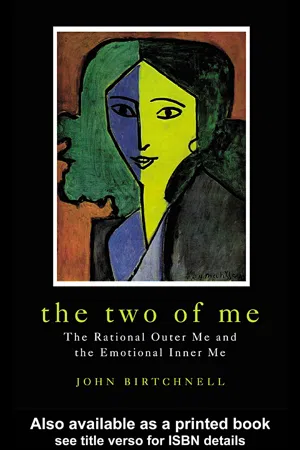
How much of what we do is directed by conscious, deliberate decisions and how much originates in unconscious, automatic directives? This is the question explored in The Two of Me via an engaging combination of phenomenological subjective investigation and objective considerations of mental processes and specific structures. John Birtchnell puts forward the thesis that many more of our actions than we might imagine are determined unconsciously. Not only are unnoticed automatic actions motivated unconsciously, but also seemingly conscious or 'thought out' behaviours are actually determined and reinforced by unconscious exigencies. Even where we produce a reasoned discourse taking responsibility for why we hold certain thoughts, there is always the possibility that these explanations serve and follow from an unconscious driving force. The conscious mind seems to act as spokesperson for both itself and the unconscious mind. Investigating this dual aspect of the person, the book addresses the issue across a range of mental processes including memory, language, problem-solving, dreams, delusions, hallucinations and more complex constructs such as the arts, humour and religion.
- 320 pages
- English
- ePUB (mobile friendly)
- Available on iOS & Android
eBook - ePub
About this book
Information
Publisher
Psychology PressYear
2004Print ISBN
9781138877474
9781841693231
Edition
1eBook ISBN
9781135425470
Part I
The outer me/inner me dichotomy
In this part I have to get across the idea with which the book is concerned. If I fail, the rest of the book will make no sense; for every one of the remaining chapters concerns the application of this idea across a range of mental functions. The idea is that there appear to be two broad categories of mental functioning, which are almost like two people in the same body. The terms outer me and inner me have been chosen to describe them because there is no existing pair of terms that fully covers the attributes that they include.
1 The birth of an idea
The germ of the idea to be developed in this book lies in a paragraph early in my 1993/96 book, How Humans Relate: A New Interpersonal Theory. Here, I was trying to make the point that much of our relating behaviour occurs quickly and spontaneously, without conscious deliberation. I drew the distinction between what I then called the cortex, which I considered to be concerned with the conscious and the deliberate, and the subcortex, which I considered to be concerned with the quick and the spontaneous. “The logic of the subcortex” I wrote, “is often so profound that it feels as though it is the prime mover and that the cortex trundles along some distance behind, long after the main action has taken place” (page 6). I now realise that the terms cortex and subcortex were inappropriate, since the greater part of cerebral cortical activity is not conscious or deliberate; but although the terms were wrong, the point I was making was probably right. By my 1999/2002 book, Relating in Psychotherapy: The Application of a New Theory, this short paragraph had grown into a complete chapter (Chapter 2) in which I had replaced the cortex and subcortex with the outer brain and the inner brain. I concluded that the distinction between what I considered to be these two major components of the brain is relevant to our understanding of a broad range of mental activities; but I also suspected that we might underestimate the extent of the inner brain’s influence. I wrote:
A point that cannot be emphasised too strongly is that the inner brain must be responsible for far more of our mental activity than we are normally prepared to admit. Since we have no conscious awareness of what goes on within it, this is a sobering thought (page 28).
I assumed that in the evolutionary sequence, the inner brain was all there was until the gradual emergence of the outer brain, which made all the difference to the way that humans function; but, as Pinker (1997) so rightly observed, “… the forces of evolution do not just heap layers on an unchanged foundation” (page 371). Just because the outer brain came into place after the inner brain does not mean that the inner brain has remained unchanged. The human inner brain, as I understood it, is a highly sophisticated set of structures, and, while it appears to remain unaware of itself, it has acquired a number of capabilities that the inner brains of other animals do not appear to have. Yet even these capabilities can only be modifications of capabilities that other animals do have. The outer brain and the inner brain of the 1999/2002 book have become the outer me and the inner me of the present one. This is because I now realise that I am primarily concerned with mental phenomena and not brain structures.
So what are the two of me?
At this stage it will be necessary to provide only the bare bones of an answer to this question, for the main object of the book is to clarify the distinction between them – for both you and me. That which I experience as I, which I formerly called the cortex, but which I now call the outer me, is the selfconscious part of me, the part that figures things out and makes rational decisions on the basis of facts and evidence. The existence of this other me can only be inferred by this self-conscious me (which I call I) from the observations it makes upon my behaviour.
The science journalist Holmes (1998), in a review article, coined the term the Zombie within to refer to that which I am now calling the inner me. He wrote, “The Zombie within, not the conscious self, is running the show.” This is exactly how it has always felt for me. The idea that an unconscious part of me “runs the show” has such implications for how we view ourselves as humans that I decided to devote an entire book to examine how far the idea can be taken. A feature of the book is to examine what the outer me can do that the inner me cannot do, and how its particular capabilities can enhance our mental functioning. I will examine how well these two parts of me are able to get on together and whether they ever get in each other’s way.
The title of the book is in keeping with my intention, as far as possible, to write in the first person singular. This is because, in many instances, I will take my experience of my own mental functioning as a starting point. In adopting this policy, I will assume that, in most fundamental respects, my own mental processes are comparable to those of other people. The title also links up with my efforts to explain what it feels like to be two of me. In explaining the title of the book to other people, I have found myself saying, “There is the me that I experience as myself, and then there is this other me that appears to make decisions on its own, and causes me to do things that I had not consciously decided to do.”
I need to emphasise that the outer me and the inner me are both, in their separate ways, me. If, at least metaphorically, the inner me is in a place, it is not a place into which I (outer me) can enter. Neither can it enter into that place that I experience as I. I (outer me) have worked out that it exists, but it cannot work out that I exist, because it does not have the capacity for working things out. It does not know it exists in the way that I know that I exist. It cannot look at itself in the way that I can look at myself (or it). I cannot communicate with it in the way that I can communicate with you, because it is not a you; it is a me, and I cannot communicate with me. I am me and it is me. We are parallel and inseparable parts of me.The inner me is the most fundamental me. The conscious, outer me is only what might be called a bolt-on extra, an added refinement, a very valuable refinement, but a refinement nonetheless. The inner me could survive without the outer me, but the outer me could not survive without the inner me. The inner me is the control centre, the part that knows where I am going. It releases emotions into consciousness that convey whether or not I am on-track in the attainment of its objectives. The primary objectives concern survival and reproduction (Chapters 6 and 7), but there are also a set of secondary objectives that have evolved out of these that concern relating (Chapter 8). The inner me would seem to have no direct means of passing the objectives on to the outer me, but one-way or another, the outer me becomes aware of them, for its main function is to bring additional capabilities into play that contribute to their attainment. It could be said that the inner me “trains” the outer me by causing it to feel good when its objectives have been attained and bad when they have not.
The confluence of ideas
It is reassuring to discover that others have thought this way. In 1923, Groddeck expressed the view that we are animated by “some wondrous force” that directs both what we do and what happens to us. He called this force the “Es” or the “It” and he believed that we are lived by the “It.” Milner (1987), who will be considered more fully in Chapter 4, wrote of the mind that “It lives you.” This is how it has always felt to me. In 1936, Agatha Christie, the crime fiction writer, quoted Mary Drower, a character from her book The ABC Murders, as saying: “Your mind gets made up for you sometimes without your knowing how it happened” (page 103).
The lines of thought of a number of writers are beginning to converge upon the same common pathway; namely, that there is the part of us that we normally recognise to be ourselves, and then there is this other part that feels as though it is buried somewhere deep inside us, which appears to exert control over us. The understanding is that the part that we normally recognise to be ourselves is, in evolutionary terms, a relatively recent development, and this other part that exerts so much control over us is what might be called the original part, which exists in continuity with the nervous systems of all other animal forms, and which carries the original “blueprints.” The more recent part appears to have concluded, on the basis of its observations and experimentations, that this other part exists, though it seems unlikely that this other part has concluded that this more recent part exists.
What is so encouraging about recent developments is that there is beginning to emerge a confluence of the introspective contributions of the more subjective theorists, and the objective contributions of experimental psychologists and neuroscientists. People who introspect are not normally good at neuroscience and experimental psychology, and neuroscientists and experimental psychologists are not normally good at introspection. Despite LeDoux’s (1998) caution that “… introspection is often a blurry window into the workings of the mind” (page 52), I believe that the book will be most successful if I can integrate the theoretical conclusions from self-observation and the observation of others with the conclusions of neuroscientists and experimental psychologists. There is some legitimacy to simply stating what something feels like; and LeDoux (1998) wrote, “According to functionalist doctrine, cognitive science stands on its own as a discipline – it does not require that we know anything about the brain” (page 27). When I speculate about how the mind appears to function, while it may not be necessary to refer to brain structures, and the findings of neuroscientists and psychologists, it provides support to my speculations if I do.
Some thoughts related to the outer me and the inner me
The distinction between the head and the heart is often used to distinguish between the sensible, practical and rational and the romantic, passionate and irrational. The heart is popularly used to refer to that which is intuitive or instinctive. People use the term I feel it in my heart (or sometimes in my bones) to mean they know it in some deep, fundamental way, which they cannot deny. Sometimes it is right to be guided by reason and sometimes it is right to go the way of the heart.
Much of what Evans (2001) wrote about intellect versus emotion comes close to the distinction between the outer me and the inner me. He wrote:
Reason and emotion can thus be seen as two complementary systems in the human brain for making decisions. When it is important to get the answer right, and we have a lot of time and information at our disposal, we can use the slow and clean method of reasoning things through. When we have little time and information or it is not so important to get the right answer, we can switch to the fast and frugal method of following our feelings (page 130).
Generally, it seems to be the case that the outer me is slow and laborious and the inner me is fast and effortless.
Maintaining a balance between the outer me and the inner me
In his 2000 BBC Reith Lecture, Prince Charles said, “We need to restore the balance between the heartfelt reason of instinctive wisdom and the rational insights of scientific analysis. Neither is much use without the other.” There are those who scorn the rational and those who scorn the irrational. There are those who are hopeless at being logical and those who shun everything that is not logical. A feature of inner me functioning is spontaneity. It does not prepare in advance. The outer me is more cautious. It thinks before it acts. While this may have advantages, it introduces a degree of contrivance, even artificiality. Some people get stuck at the outer me level, and are unable to trust the inner me sufficiently to give it free rein. Psychotherapy clients who try to maintain the dialogue at an outer me level are described as intellectualising, and this is thought to be a defence against joining up with their emotions.
The blurring of the distinction between the outer me and the inner me
Since some actions originate in the outer me and, through force of habit, become downloaded to the inner me (McCrone, 1999), there must always be some actions that fall mid-way between the consciously and unconsciously executed. When I am driving, I sometimes consciously decide to change gear and sometimes I do it without thinking. Sometimes I decide to blink and sometimes I blink reflexly. This must apply to many areas of mental activity.
Interactions between the outer me and the inner me
Pinker (1997) wrote, “And the human cerebral cortex does not ride piggyback on an ancient limbic system, or serve as the terminus of a processing stream beginning there. The systems work in tandem, integrated by many two way connections” (page 371). The book aims to explore those actions and processes that the outer me appears to be responsible for and those that the inner me appears to be responsible for. Each has its separate strengths and capabilities and, in many respects, each depends upon the other.
Can the outer me influence the inner me?
Because the inner me works quite automatically it is quite easy to deceive it. When the outer me perceives that the inner me has been deceived, it has the capacity to modify the inner me’s responses. When the outer me perceives that flowers are artificial, the inner me’s emotional response to them diminishes. The same modification of response occurs with a statue that looks like a naked woman, or when a man realises that a woman’s breast size has been augmented with silicone implants, or when a female impersonator is really a man. Such modification forms the basis of cognitive therapy, when say a therapist convinces a person with snake phobia that not all snakes are poisonous. It is interesting to speculate what neural connections might be responsible for this.
The outer me misperceiving what the inner me wants
Because the inner me does not make its intentions clear, sometimes I (outer me) think I intend to behave one-way when, from outward appearances, I clearly intend to behave another way. Hence the expression actions speak louder than words. A woman may insist that she does not love a particular man, and perhaps even believe this, but cannot stop thinking and talking about him and finding excuses to make contact with him. A man’s failure to have an erection may be because he is not turned on by a particular woman, even though he (outer me) thinks he is. A man cannot will himself to have an erection. Hence the expression, attributed to Freud, that the penis does not lie. Karen Horney (1945) introduced the expression the tyranny of the shoulds. I may try to behave in a particular way because I (outer me) believe that I should, but I may find that I have little enthusiasm to do so, and have to struggle to make myself do it. As the saying goes, my heart isn’t in it. There are also the expressions that the spirit is willing but the flesh is weak, and you can lead a horse to the water but you cannot make it drink. When I am being lazy, the outer me thinks that I should be doing something, but the inner me is not motivated to do it.
These kinds of difficulty sometimes emerge in psychotherapy. The psychoanalyst tries to understand, on the basis of what the client says and does, what the client really wants to do. When s/he believes that s/he has unearthed the reason why the client is acting the way s/he is, s/he may try cautiously to offer what is called an interpretation. Sometimes the client will refuse to accept it. This is called resistance. Here, it may be that the client (outer me) cannot believe that s/he (inner me) should wish to do such a thing, particularly if it is something which is socially unacceptable. Bateson (1973), the family therapist, introduced the term the double bind, by which a parent may confuse a child by making an explicit statement that is contradicted by an implicit action. The explicit (outer me) statement is what the parent believes s/he should be making and the implicit (inner me) contradiction is what s/he really means to convey. These terms explicit and implicit are sometimes used by psychologists to refer to what I mean by the outer me and the inner me.
Examples of the outer me not knowing why
Because so much of what I feel, say and do is inner me determined, I (outer me) am sometimes confused about what is going on. I can only observe myself and try to make sense of it after the event.
Do I know why I feel the things I feel?
LeDoux (1998) wrote, “And if there is one thing about emotions that we know well from introspection, it is that we are often in the dark about why we feel the way we do” (page 52). Westen (1998) observed that people can feel things without knowing that they feel them, and they can act upon feelings of which they are unaware. They can act in a hostile manner towards people they are not aware that they dislike. Emotions come straight out of the inner me. Only the inner me decides whether I should experience an emotion, what form it should take and with what intensity I should experience it. Only the inner me knows what it is I am feeling emotional about. Quite often, I (outer me) am not surprised by the emotion, and I can usually connect the emotion with the circumstances, but only after the event. In general terms, when I succeed in attaining what I am striving for I feel happy; when I fail to achieve it or when I lose it I feel sad; when I am in danger of losing what I have attained I feel frightened; and when I am determined to retrieve what I have lost...
Table of contents
- Cover Page
- Title Page
- Copyright Page
- Foreword by Paul Gilbert
- Preface
- Acknowledgements
- Part I: The outer me/inner me dichotomy
- Part II: Other conscious/unconscious distinctions
- Part III: The human objectives
- Part IV: The receptive and responsive me
- Part V: The active me
- Part VI: The complex me
- Part VII: The social me
- Bibliography
Trusted by 375,005 students
Access to over 1.5 million titles for a fair monthly price.
Study more efficiently using our study tools.
Frequently asked questions
Yes, you can cancel anytime from the Subscription tab in your account settings on the Perlego website. Your subscription will stay active until the end of your current billing period. Learn how to cancel your subscription
No, books cannot be downloaded as external files, such as PDFs, for use outside of Perlego. However, you can download books within the Perlego app for offline reading on mobile or tablet. Learn how to download books offline
We are an online textbook subscription service, where you can get access to an entire online library for less than the price of a single book per month. With over 1.5 million books across 990+ topics, we’ve got you covered! Learn about our mission
Look out for the read-aloud symbol on your next book to see if you can listen to it. The read-aloud tool reads text aloud for you, highlighting the text as it is being read. You can pause it, speed it up and slow it down. Learn more about Read Aloud
Yes! You can use the Perlego app on both iOS and Android devices to read anytime, anywhere — even offline. Perfect for commutes or when you’re on the go.
Please note we cannot support devices running on iOS 13 and Android 7 or earlier. Learn more about using the app
Please note we cannot support devices running on iOS 13 and Android 7 or earlier. Learn more about using the app
Yes, you can access The Two of Me by John Birtchnell in PDF and/or ePUB format, as well as other popular books in Psychology & History & Theory in Psychology. We have over 1.5 million books available in our catalogue for you to explore.