- 248 pages
- English
- ePUB (mobile friendly)
- Available on iOS & Android
eBook - ePub
Liberal Nationalism in Central Europe
About this book
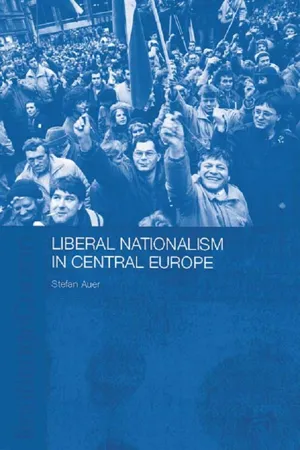
After the collapse of communism there was a widespread fear that nationalism would pose a serious threat to the development of liberal democracy in the countries of central Europe. This book examines the role of nationalism in post-communist development in central Europe, focusing in particular on Poland, the Czech Republic and Slovakia. It argues that a certain type of nationalism, that is liberal nationalism, has positively influenced the process of postcommunist transition towards the emerging liberal democratic order.
1 Nationalism in Central Europe
Some of the worst excesses of political violence in twentieth-century Europe have been attributed to the influence of nationalism. Against this background, it may appear fanciful to argue that a certain type of nationalism — liberal nationalism — can, in fact, play a positive role in the postcommunist transition of Central Europe. The concept of liberal nationalism, which seeks to reconcile the universal demands of liberalism with particularist attachments to a national culture, has gained new credibility in the West owing to recent studies by political theorists (Tamir 1993; Miller 1995; Kymlicka 2001a). However, no significant attempt has been made to show its relevance to the experience of the postcommunist countries of Central and Eastern Europe. It was assumed that owing to the lack of strong democratic traditions, people in these countries were prone to succumb to the lure of ethnocentric nationalism, which would seriously endanger the prospects for a stable liberal democratic order.
This assumption is in line with the old notion of two essentially different forms of nationalism: the enlightened Western, that is supportive of democracy, and the ‘backward’ Eastern form, that is an obstacle to any genuinely democratic society (Kohn 1944; Plamenatz 1973; Schöpflin 1995). According to this view, people in the West were liberal virtually by definition, in contrast to their eastern neighbours, who were deemed unable to overcome the illiberal legacies of the past. To label the differences between nations and their nationalism(s) with this reference to geography is, however, misleading. As this book seeks to demonstrate, different conceptions of nationalism have been competing for dominance within particular countries in both the East and the West.
What is nationalism?
Nationalism is a contentious issue. Analysts cannot agree on its definition or its role in society. Most contend, however, that nationalism is a specifically modern phenomenon, which became salient in the eighteenth (Anderson 1983; Berlin 1979; Hobsbawm 1990) or nineteenth century (Gellner 1983). Ernest Gellner convincingly demonstrated that nationalism, rather than fulfilling some ancient human need, is a specifically modern phenomenon (Gellner 1983). The Industrial Revolution in the West necessitated a radical change in the relationship between polity and culture, which in turn produced nationalism. The salient feature of the preceding agrarian societies was, according to Gellner, cultural diversity and fragmentation into small autonomous sub-communities, each of which lived in its own specific idiom. A peasant had no need to communicate with the elite of high culture who existed beyond his experience (usually limited to the breadth of his valley). The modern industrial and predominantly urban society required mass literacy and a high degree of social mobility, which could only be achieved by nearly universal access to a state-sponsored ‘national’ educational system. To be successful, such a system needed to use a vernacular accessible to the entire population of the country. Thus a need for cultural homogenization arose and gave birth to the political doctrine of nationalism, ‘which holds that the political and the national unit should be congruent’ (Gellner 1983: 1). Nations were being ‘created’ either by turning the ‘low’, spontaneous and oral cultures into the literate and cultivated ones, or by imposing the existing ‘high’ culture on the available and diverse idioms of peasants. Nationalism can then be characterized as ‘the organisation of human groups into large, centrally educated, culturally homogeneous units’ (Gellner 1983: 35). In short, Gellner concludes that modernization leads to nationalism and nationalism engenders nations, and not the other way around. And since ours is the time of a never-ending process of modernization, we live in an ‘age of nationalism’:
Nationalism — the principle of homogeneous cultural units as the foundations of political life, and of the obligatory cultural unity of rulers and ruled — is indeed inscribed neither in the nature of things, nor in the hearts of men, nor in the pre-conditions of social life in general, and the contention that it is so inscribed is a falsehood which nationalist doctrine has succeeded in presenting as self-evident. But nationalism as a phenomenon, not as a doctrine presented by nationalists, is inherent in a certain set of social conditions; and those conditions, it so happens, are the conditions of our time.(Gellner 1983: 125)
Gellner's conception has been criticized for being simplistic and historically inaccurate, and many examples seem to refute the assumption that nationalism only became important in the nineteenth century as a result of modernization. Anthony D. Smith challenged this ‘modernist fallacy’ above all on historical grounds by arguing that ‘expressions of fervent attachment to the concept of the nation as a territorial-cultural and political community’ go back as far as the fourteenth and fifteenth centuries ‘in France, England … as well as in Poland and Russia’ (Smith 1995a: 38; for the Polish case see also Walicki 1997a). Similarly, Czech nationalism can be traced back to the early fourteenth century. Robert P. Pynsent, for example, refers to Dalimil's chronicle as the first instance of the preaching of mass nationalism in the Czech context (Pynsent 1999).
Yet there can be little doubt that the scope and impact of nationalism in pre-modern times was rather limited. The full potential of nationalism as a political force could only develop in modern societies that were characterized by an unprecedented degree of social mobility and the active involvement of ever more citizens in political processes. As Ray Taras observed,
even if early forms of literary nationalism had made their appearance in the fourteenth century, magnates still went to war against each other and showed no loyalty to the nations from which they originated. In their turn, the masses were still far from experiencing any sense of larger community.(Taras 2002: 13)
Although the link between the rise of nationalism in the nineteenth century and the process of modernization is not always as straightforward as Gellner's model implies, 1 the theory offers valuable insights into the emergence of modern nationalism in Central Europe.
In fact, the example of ‘Ruritania’, which Gellner offers as a characteristic scenario of the evolution of nationalism, is based on the historic experience of the people of the Habsburg Empire, where more often than not ‘the obligatory cultural unity of rulers and ruled’ was lacking. The story proceeds as follows: the multilingual ‘Empire of Megalomania’ was politically dominated by the elite who communicated in a language very different from that of the common peasants, ‘Ruritanians’. With the rapid development of industrial centres, ‘Ruritanians’ were drawn to seek new employment opportunities in these centres, in the process of which they were forced to assimilate into the existing ‘high’ culture. Their ‘obscure and seldom written or taught language’ represented their major obstacle to upward social mobility. Even if many individuals succeeded in fully integrating themselves into the new environment, still others felt disadvantaged and discriminated against because of their ‘Ruritanian’ origin. This gave birth to a nationalism led by a new group of intellectuals, who reminded their compatriots of ‘the famous Ruritanian social bandit’ from the eighteenth century who fought against injustices afflicted on the innocent people of Ruritania. The logical alternative to assimilation is the insistence on one's own glorious traditions, which should eventually lead to the creation of an independent nation-state, Ruritania.
This account corresponds rather well with the actual history of the Habsburg Monarchy. The demands of modernization called for the introduction of one common vernacular throughout the whole empire. The Germanizing policies of Joseph II were thus not inspired by any particular national feelings of the ruler but by the practical needs of industrialization (as it happened, the elite spoke German). The attempts to introduce German as a universal language of the empire were met with fierce resistance in Hungary, where Latin remained the language of administration well until the early decades of the nineteenth century. With some delay, Hungarian (rather than German) was introduced as the official language in the Hungarian part of the Empire — a move that strengthened the Hungarian nationalist cause. In turn, the Hungarians, who managed to secure rights for their own national language, tried to impose it on the Slovaks, who reacted as had the Hungarians before. Hungarian nationalism engendered by default the evolution of the Slovak nation, which in turn strove for political autonomy and later even independence (see also Chapter 2).
Gellner's interpretation of the emergence of nationalism has been very influential, but it does not explicitly explore the issues that are arguably more pressing for the present political development of Central Europe: What is the relationship between nationalism and liberal democracy? Why did some forms of nationalism become virulent in the first half of the twentieth century (like German, Italian or even Slovak and Hungarian) and others not? Is nationalism a deadly enemy of liberalism, or its natural ally? Is the best nation no nation?
Nationalism was originally regarded as progressive and supportive of the development of liberal democracy. The two distinguished nineteenth-century liberal thinkers, Alexis de Tocqueville and John Stuart Mill, for example, considered national attachments a valuable source of social solidarity, which would strengthen the political stability of liberal democracy. Conversely, the political creed of the great eighteenth-century German nationalist thinker, Johann Gottfried Herder, was characterized by a liberal and democratic spirit, despite later abuses of his philosophy by extreme nationalists in Germany and elsewhere in Central Europe (Barnard 1965: 154). Herder had maintained that ‘a nation based on genuine culture would be peaceful, because it would respect other nations, and that concern for humanity as a whole was more important than concern for one's own nation’ (Koepke 1987: x). Echoing this sentiment, the nineteenth-century Italian liberal, Giuseppe Mazzini, believed that ‘democratic nationality was the necessary precondition for a peaceful international order’ (Urbinati 1996: 203). This has changed dramatically in the twentieth century, with Europe experiencing fanatical nationalism leading to wars, ethnic cleansing and the Holocaust. Hence, despite disagreements about the true nature of nationalism, most analysts today view it as a hindrance to the development of a liberal democracy. Some (like Habermas and Hobsbawm) say that this hindrance must be superseded altogether, while others (like Kymlicka and Tamir) see how democracy and nationalism can be reconciled.
Civic versus ethnic nationalism
Liberal defenders of nationalism are mostly indebted to the original Enlightenment ideal of a nation as an agency of democratic power that was able to challenge the oppressive order of an ancien régime. Hence French and American nationalisms have traditionally been regarded as the epitome of civic nationalism, based as they were on the political ideas of revolutionaries who fought for the sovereignty of the people. Membership in the community was thus defined primarily in political terms; civic virtues were more important for the new republic than ethnicity, common culture, or even common language. The only means of exclusion were the territorial boundaries of a country. For that reason, everybody, at least in theory, could become a French or American citizen by acquiring the necessary civic virtues (of which French or English language proficiency was but a part). This voluntaristic notion of national identity is usually contrasted with ethnic nationalism, which tends to be exclusionary, since in that case belonging to a nation is defined by birth, blood and ethnicity. While the former ideally conceives of the nation as a voluntary association, the latter sees it as a community of fate and is thus deterministic.2 Ethnic nationalism emerged in the late nineteenth century, and it is said to be pertinent to the people of Central and Eastern Europe (Smith 1991: 11; Crawford 1996: 126–8; Eatwell 1997: 238). While civic nationalism is usually associated with liberalism, exclusionary ethnic nationalism has often been conducive to authoritarian regimes.3 It is the latter that is feared by many critics of nationalism. For liberal nationalists, on the other hand, the distinction between civic and ethnic nationalism has its limitations, as both versions can lead to intolerance, undermining the aims of liberalism. Hence the arguments in this book will rely more on the differentiation between liberal and illiberal forms of nationalism.
The end of nationalism?
The distinguished Marxist historian Eric Hobsbawm argues that, ‘in spite of its evident prominence, nationalism is historically less important’ in world politics today (Hobsbawm 1990: 181). Given that ‘characteristic nationalist movements of the late twentieth century are essentially negative, or rather divisive’, Hobsbawm is hopeful that ultimately ‘nationalism will decline with the decline of the nation-state’ (Hobsbawm 1990: 164, 182). He goes as far as to suggest that ‘“nation” and “nationalism” are no longer adequate terms to describe, let alone to analyse, the political entities described as such, or even the sentiments once described by these words’ (Hobsbawm 1990: 182). From Gellner's finding that national identities are to a certain extent arbitrary results of nationalism based on myths and half-truths, Hobsbawm infers that their importance should subside with time. This seems to be plausible, considering that citizens in a truly modern (and enlightened) society are expected to act following their reason rather than feelings and attachments connected with some ‘imagined communities’ (Anderson 1983). Hobsbawm tacitly assumes that by showing that particular national traditions are usually invented and manipulated, the allegiance of the people to their nations can be undermined.4 But the simple fact that national identities are social constructs and not something inherently ‘natural’ does not mean that they can be easily abandoned, or replaced by some form of enlightened cosmopolitanism. The term ‘imagined communities’ should not be confused with imaginary ones (Tamir 1995: 423). As Anthony Smith accurately observed, ‘whenever and however national identity is forged, once established, it becomes immensely difficult, if not impossible (short of total genocide) to eradicate’ (Smith 1993: 131).
Republican alternative?
Another possible strategy to minimize the political relevance of national identity is to build on the republican tradition, which seeks to bind political communities around an ethnically neutral concept of citizenship. This idea has gained in importance owing to the ambitious project of the European Union, in which national boundaries are being transcended in order to create a new multinational state. Jürgen Habermas, for example, argues that the political unity of European nations cannot be based on the shared traditions, languages and cultures, which lie at the basis of nation-states. What is needed instead is a ‘post-national’ sense of Verfassungspatriotismus (constitutional patriotism), which is based on shared principles of justice and democracy. Only this would make the idea of a federalist European Union, comprised of European rather than national citizens, politically viable (Habermas 1995).
But it is questionable whether it is possible to develop strong attachments to a democratic constitution that is devoid of any references to the particular tradition and culture of a nation (Dahrendorf 1994). In fact, even the Germans, who, as a result of their troubled history, have been more inclined than any other nation to opt for a post-national identity based on constitutional patriotism,5 are currently re-discovering the importance of national attachments. While the question of national identity had for a long time been almost the exclusive domain of those right-wing political forces which sought to restore the lost pride of the German nation, the situation has changed. Ten years after unification, the heated debate about the German Leitkultur has seen a number of politicians and intellectuals from both sides of the political spectrum advocating the need for a ‘guiding culture’, which would encompass not only political values (including the endorsement of basic liberal principles expressed in the constitution), but also aspects of national culture. For example, Wolfgang Thierse, a Social Democrat leader of the Bundestag, argued that a political community needs a common language and a common set of references, which cannot be attained without reliance on history and culture (Thierse 2000).
Hannah Arendt, who like Habermas was deeply suspicious of nationalist forces, conceded some thirty years earlier that a liberal democratic republic could not be sustained simply by a contract:
Neither compact nor promise upon which compacts rest are sufficient to assure perpetuity, that is, to bestow upon the affairs of men that measure of stability without which they would be unable to build a world for their posterity, destined and designed to outlast their own mortal lives.(Arendt 1973: 182)
For this reason, even France and the United States (i.e. the republics which are usually regarded as the exemplary manifestations of constitutional patriotism) ‘required many of the trappings of nation-states, including founding myths, national symbols, and ideals of historical and quasi-ethnic membership’ (Kymlicka and Norman 1995: 315). One of the telling paradoxes of American history is the fact that the founding fathers of the new republic, who as thinkers of the Enlightenment and revolutionary leaders challenged the power of tradition, were soon to be revered as cult figures of the American nation, and became the focal point of a (new) tradition. As Conor Cruise O'Brien noted, ‘enlightenment ideas are far ...
Table of contents
- Cover
- Half Title
- RoutledgeCurzon contemporary Russia and Eastern Europe seriess
- Full Title
- Copyright
- Dedication
- Contents
- Preface
- 1 Nationalism in Central Europe
- 2 Reflections on minority rights in Central Europe
- 3 Nationalism in Poland
- 4 Nationalism in the Czech Republic
- 5 Nationalism in Slovakia
- 6 Conclusions
- Notes
- Bibliography
- Index
Trusted by 375,005 students
Access to over 1.5 million titles for a fair monthly price.
Study more efficiently using our study tools.
Frequently asked questions
Yes, you can cancel anytime from the Subscription tab in your account settings on the Perlego website. Your subscription will stay active until the end of your current billing period. Learn how to cancel your subscription
No, books cannot be downloaded as external files, such as PDFs, for use outside of Perlego. However, you can download books within the Perlego app for offline reading on mobile or tablet. Learn how to download books offline
Perlego offers two plans: Essential and Complete
- Essential is ideal for learners and professionals who enjoy exploring a wide range of subjects. Access the Essential Library with 800,000+ trusted titles and best-sellers across business, personal growth, and the humanities. Includes unlimited reading time and Standard Read Aloud voice.
- Complete: Perfect for advanced learners and researchers needing full, unrestricted access. Unlock 1.5M+ books across hundreds of subjects, including academic and specialized titles. The Complete Plan also includes advanced features like Premium Read Aloud and Research Assistant.
We are an online textbook subscription service, where you can get access to an entire online library for less than the price of a single book per month. With over 1.5 million books across 990+ topics, we’ve got you covered! Learn about our mission
Look out for the read-aloud symbol on your next book to see if you can listen to it. The read-aloud tool reads text aloud for you, highlighting the text as it is being read. You can pause it, speed it up and slow it down. Learn more about Read Aloud
Yes! You can use the Perlego app on both iOS and Android devices to read anytime, anywhere — even offline. Perfect for commutes or when you’re on the go.
Please note we cannot support devices running on iOS 13 and Android 7 or earlier. Learn more about using the app
Please note we cannot support devices running on iOS 13 and Android 7 or earlier. Learn more about using the app
Yes, you can access Liberal Nationalism in Central Europe by Stefan Auer in PDF and/or ePUB format, as well as other popular books in History & Eastern European History. We have over 1.5 million books available in our catalogue for you to explore.