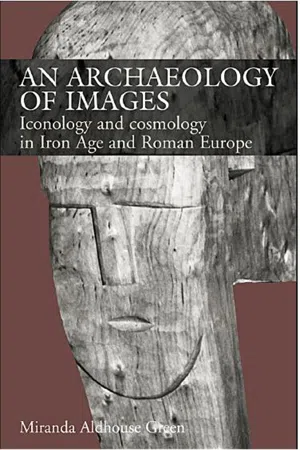
An Archaeology of Images
eBook - ePub

An Archaeology of Images

Iconology and Cosmology in Iron Age and Roman Europe

  1. 304 pages
  2. English
  3. ePUB (mobile friendly)
  4. Available on iOS & Android
eBook - ePub

An Archaeology of Images

Iconology and Cosmology in Iron Age and Roman Europe

About this book

Using archaeology and social anthropology, and more than 100 original line drawings and photographs, An Archaeology of Images takes a fresh look at how ancient images of both people and animals were used in the Iron Age and Roman societies of Europe, 600 BC to AD 400 and investigates the various meanings with which images may have been imbued.

The book challenges the usual interpretation of statues, reliefs and figurines as passive things to be looked at or worshipped, and reveals them instead as active artefacts designed to be used, handled and broken. It is made clear that the placing of images in temples or graves may not have been the only episode in their biographies, and a single image may have gone through several existences before its working life was over.

Miranda Aldhouse Green examines a wide range of other issues, from gender and identity to foreignness, enmity and captivity, as well as the significance of the materials used to make the images. The result is a comprehensive survey of the multifarious functions and experiences of images in the communities that produced and consumed them.

Challenging many previously held assumptions about the meaning and significance of Celtic and Roman art, An Archaeology of Images will be controversial yet essential reading for anyone interested in this area.

Frequently asked questions

Yes, you can cancel anytime from the Subscription tab in your account settings on the Perlego website. Your subscription will stay active until the end of your current billing period. Learn how to cancel your subscription.
No, books cannot be downloaded as external files, such as PDFs, for use outside of Perlego. However, you can download books within the Perlego app for offline reading on mobile or tablet. Learn more here.
Perlego offers two plans: Essential and Complete
  • Essential is ideal for learners and professionals who enjoy exploring a wide range of subjects. Access the Essential Library with 800,000+ trusted titles and best-sellers across business, personal growth, and the humanities. Includes unlimited reading time and Standard Read Aloud voice.
  • Complete: Perfect for advanced learners and researchers needing full, unrestricted access. Unlock 1.4M+ books across hundreds of subjects, including academic and specialized titles. The Complete Plan also includes advanced features like Premium Read Aloud and Research Assistant.
Both plans are available with monthly, semester, or annual billing cycles.
We are an online textbook subscription service, where you can get access to an entire online library for less than the price of a single book per month. With over 1 million books across 1000+ topics, we’ve got you covered! Learn more here.
Look out for the read-aloud symbol on your next book to see if you can listen to it. The read-aloud tool reads text aloud for you, highlighting the text as it is being read. You can pause it, speed it up and slow it down. Learn more here.
Yes! You can use the Perlego app on both iOS or Android devices to read anytime, anywhere — even offline. Perfect for commutes or when you’re on the go.
Please note we cannot support devices running on iOS 13 and Android 7 or earlier. Learn more about using the app.
Yes, you can access An Archaeology of Images by Miranda Aldhouse Green in PDF and/or ePUB format, as well as other popular books in Social Sciences & Archaeology. We have over one million books available in our catalogue for you to explore.

Information

Table of contents

  1. Cover Page
  2. Title Page
  3. Copyright Page
  4. Figures
  5. Preface
  6. Acknowledgements
  7. 1: Introduction
  8. 2: Image and Identity
  9. 3: Imaging Gender
  10. 4: Materiality And Meaning
  11. 5: Thinking With Beasts
  12. 6: Dreaming Monsters And Shamanic Shape-shifters
  13. 7: Paths of Perception
  14. 8: Resistant Iconographies
  15. Postscript
  16. References